
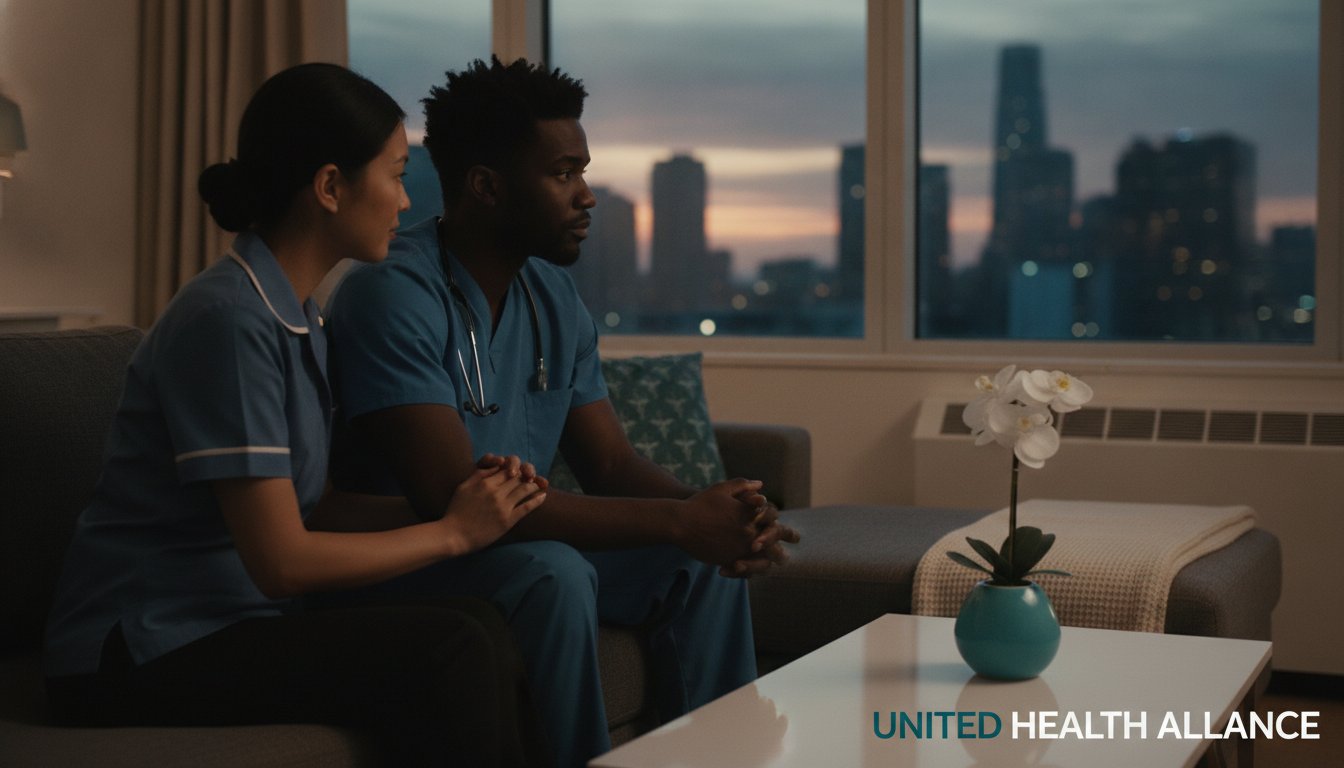
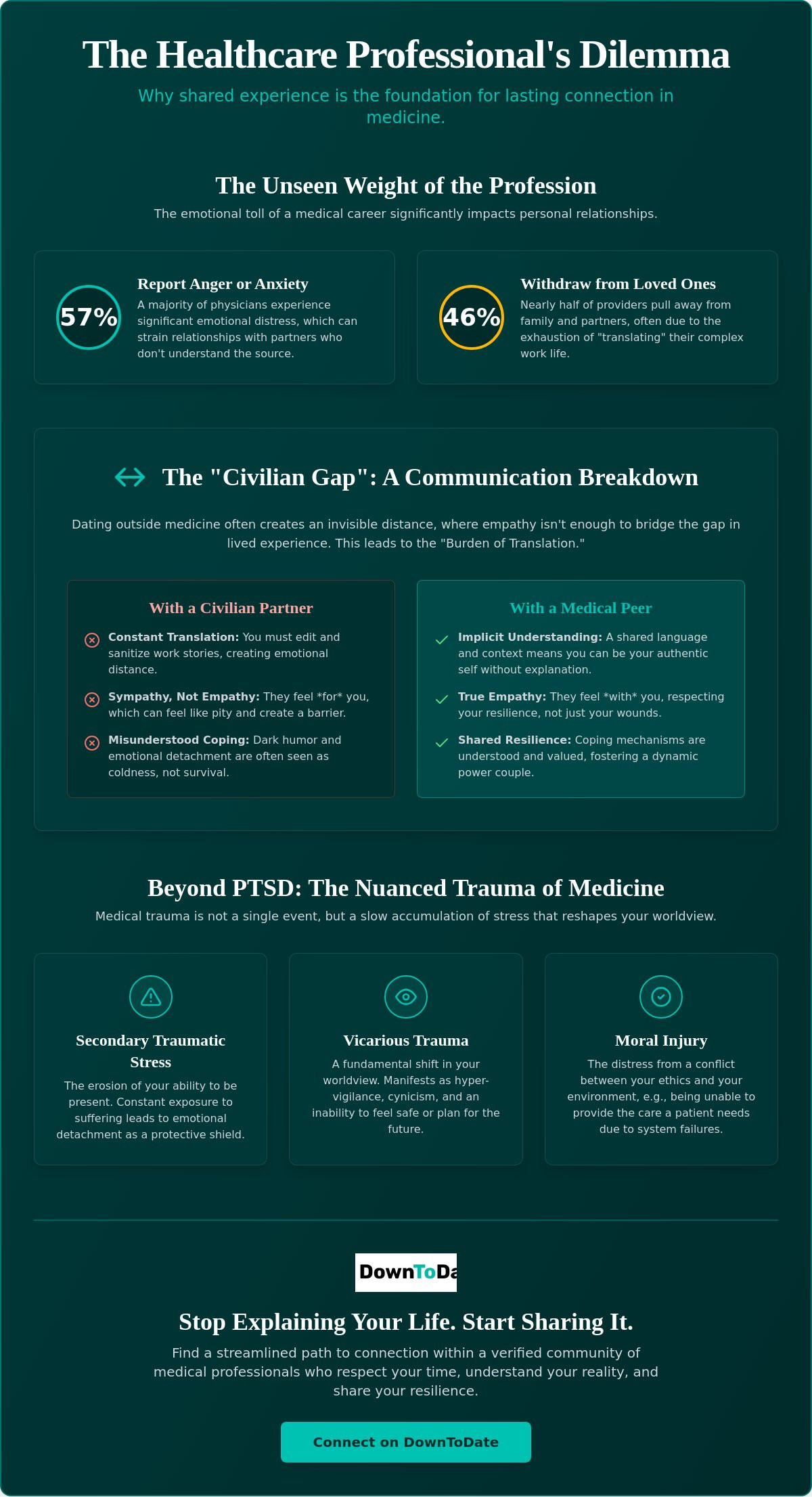
How many times have you sat across from a partner and realized they are looking at you, but they aren't seeing the weight of the code you just ran? Dating someone who understands trauma isn't just a preference for healthcare professionals; it's a survival strategy for the heart. You know the exhaustion of "translating" your day into civilian terms. You've felt the sting when your "thousand-yard stare" after a long shift is mistaken for coldness or emotional distance. In 2025, 57% of physicians reported feelings of anger or anxiety, yet 46% of providers find themselves withdrawing from those they love. You shouldn't have to feel like a burden when sharing your reality.
We agree that the most profound intimacy requires a shared language. You deserve a partnership where support is implicit rather than explained. This article will show you why shared professional experience is the ultimate foundation for emotional safety and lasting connection in medicine. We'll explore how to reduce your emotional labor, find a partner who speaks your shorthand, and build a power couple dynamic based on mutual resilience. It's time to stop explaining your life and start sharing it with someone who truly gets it.
Key Takeaways
- Eliminate the emotional labor of "translating" clinical experiences for a partner who hasn't lived them.
- Define the impact of moral injury and medical trauma on your long term relationship goals.
- Recognize why dating someone who understands trauma fosters an immediate, implicit support system.
- Identify the specific questions that gauge a peer's emotional intelligence and readiness for a partnership.
- Find a streamlined path to connection within a verified community that respects your time and professional standards.
The "Civilian Gap": Why Dating Outside the Field Can Feel Lonely
For a healthcare professional, the end of a shift marks the beginning of a second job. It's the job of translation. You walk through the door and face the "Civilian Gap." This is the invisible distance between those who witness the extremes of life and death and those who do not. When you are dating someone who understands trauma, this gap doesn't exist. Without that shared foundation, the simple question "How was your day?" becomes a loaded minefield.
You don't just answer; you edit. You sanitize the details of a failed resuscitation or a devastating diagnosis to protect your partner's sensibilities. The disconnect is most visible in your humor. Medical jokes are a survival mechanism. They are sharp, dark, and necessary. To a civilian, these jokes feel callous or inappropriate. To you, they are the only way to process the absurdity of a twelve-hour shift. When you have to explain why a joke was funny, the humor dies. A small piece of your connection goes with it. Over time, translation fatigue sets in. You stop sharing the parts of yourself that the job has shaped. Intimacy doesn't end with a fight; it fades through silence.
The Burden of Explanation
Explaining a traumatic shift is often a form of re-traumatization. To make a civilian understand, you have to recreate the scene. You have to explain the clinical stakes, the sensory overload, and the emotional fallout. It's an explicit process that requires immense energy. A peer offers implicit understanding. They know the sound of the alarm. They know the smell of the unit. They understand the nuances of Psychological trauma without a medical dictionary. When you don't have to explain, you can finally start to heal. You stop shutting down to protect them and start opening up to support each other.
When Empathy Isn’t Enough
There is a fundamental difference between a partner who is supportive and one who truly understands. A civilian partner offers sympathy; they feel for you. A medical peer offers empathy; they feel with you. You've likely experienced the moment when a partner's face shifts from concern to shock or pity. That pity becomes a barrier. It turns you into someone who needs to be handled with care rather than a high-performing professional. Dating someone who understands trauma ensures that your resilience is respected, not just your wounds. This distinction is critical for long-term stability. A peer connection breaks the wall of isolation. It allows for a dynamic where shared resilience is the standard, not the exception.
Beyond PTSD: Identifying Medical Trauma in Your Relationship
Trauma in medicine is rarely a single, explosive event. It is a slow accumulation. It is the steady drip of patient loss, systemic friction, and high-stakes decision-making. While the world focuses on Post-Traumatic Stress Disorder (PTSD), healthcare professionals often navigate a more nuanced spectrum of distress. Moral injury is the distress of being unable to provide the care a patient needs. It is not a failing of the clinician. It is a conflict between your ethics and your environment. When you are dating someone who understands trauma, these definitions aren't academic. They are lived realities.
The danger lies in minimization. You have been trained to view extreme stress as "just part of the job." You dismiss your own exhaustion as a lack of resilience. This internal narrative creates a significant impact on interpersonal relationships. If you cannot acknowledge your own trauma, you cannot expect a partner to navigate it with you. Acute traumatic events are easy to spot. Chronic secondary traumatic stress is quieter. It is the erosion of your ability to feel present at a dinner table after a shift in the ICU.
Secondary Traumatic Stress and Vicarious Trauma
Vicarious trauma represents a fundamental shift in your worldview. It is the result of constant exposure to the suffering of others. In a dating context, this manifests as a persistent sense of hyper-vigilance or an impenetrable cynicism. You might find yourself checking for exits in a restaurant or expecting the worst-case scenario in every personal interaction. Emotional detachment becomes a protective shield. If you aren't feeling, you aren't hurting. However, this detachment makes it nearly impossible to plan for a future or build deep intimacy with someone who doesn't understand the origin of your silence.
Moral Injury and the "Healthcare Hero" Myth
The "Healthcare Hero" narrative is a double-edged sword. It celebrates your dedication while demanding your silence. This myth makes seeking emotional support feel like a confession of weakness. Systemic failures, such as short staffing, administrative hurdles, and resource scarcity, fuel moral injury by forcing you to compromise your standards of care. A partner who understands these systemic pressures doesn't ask you to "just leave work at work." They recognize that the weight you carry is a reflection of your integrity, not a character flaw. Finding a community of verified peers allows you to drop the hero mask and connect with someone who sees the human beneath the white coat.
The Case for the Medical Peer Match: Shared Resilience
The medical life is built on a specific, high-pressure vocabulary. It isn't just the Latin roots or the complex acronyms. It's the emotional shorthand that exists between those who have stood in the same theater. When you are dating someone who understands trauma, you don't have to explain why a "routine" shift left you hollow. You don't have to define the impact of medical trauma on relationships to justify your need for space. They already know. This shared understanding creates a unique logistical synergy that few others can offer. A 24-hour call isn't an inconvenience; it's a known variable. A cancelled date because of an unexpected emergency isn't a personal slight; it's a professional reality. This foundation allows you to build a "Power Couple" dynamic rooted in mutual respect for high-stakes dedication.
In 2025, nearly six in ten physicians (57%) reported experiencing feelings of anger, tearfulness, or anxiety. When both partners recognize these symptoms as occupational hazards, the relationship shifts from one of explanation to one of support. You aren't just two people sharing a home. You are two people sharing a mission. This alignment of values means you both prioritize service and the discipline required to maintain it. Choosing a partner from within the field means dating someone who understands trauma as a daily operational reality, not a theoretical concept.
The Power of Implicit Support
There is a profound value in silence. A peer partner knows when you need a debrief and when you just need the lights dimmed. They offer "no-questions-asked" support because they've faced the same decisions and felt the same weight. This implicit support validates your professional competence while holding space for your emotional vulnerability. You aren't "too much" for them. You don't have to perform resilience when you're exhausted. You're exactly where they've been, and that recognition is the ultimate form of intimacy.
Navigating the "Double-Stress" Myth
Critics often argue that two medical careers create a "dumpster fire" of stress. This perspective is flawed. While the external pressures are doubled, the internal emotional labor is halved. You don't spend hours translating your pain or defending your schedule. A 2025 survey found that 46% of physicians reported withdrawing from loved ones. A peer partner recognizes this withdrawal not as a lack of affection, but as a need for clinical recovery. The total emotional load of the household decreases when the "civilian gap" is removed. To ensure "work talk" doesn't consume the relationship, successful medical couples set clear boundaries. They designate "clinical-free zones" or time limits for debriefing. They prioritize the person behind the practitioner.
Vetting for Emotional Intelligence in the Medical Community
Vetting a peer requires a specialized set of tools. You are looking for more than a shared residency or a compatible shift schedule. You are looking for emotional maturity. Dating someone who understands trauma provides a significant head start, but shared experience is not a substitute for individual healing. As of 2025, 73% of physicians agree there is a stigma surrounding mental health care. This stigma often prevents providers from doing the "inner work" necessary for a healthy relationship. You must distinguish between professional confidence and personal arrogance. A colleague may be decisive in the OR but emotionally dismissive at home. True emotional intelligence is the ability to switch roles. It is the capacity to be an expert at work and a vulnerable partner at home.
Early conversations should gauge a partner’s trauma-awareness. Ask direct questions to see how they handle the weight of the job. You might ask: "How do you transition from the hospital to your personal life?" or "What does support look like for you after a difficult case?" Listen for signs of healthy debriefing. A healthy partner shares the emotional weight without making you the sole repository for their stress. This is the difference between an intimate conversation and emotional dumping. If their only mode of connection is complaining about administration or "trauma-bonding" over grievances, the relationship will eventually feel like an extension of the shift. You deserve a partner who has processed their experiences, not just survived them.
Green Flags in a Peer Partner
Look for a partner who values their life outside the clinical setting. A high-achieving peer with active hobbies, non-medical interests, and clear boundaries is a green flag. They should respect your "on-call" time as much as their own. Respect for personal space is a prerequisite for a power couple dynamic. They don't just tolerate your demanding schedule; they protect it. A partner who can discuss emotional health openly is a partner ready for a serious commitment.
The "Burnout Check": Protecting Your Own Energy
In 2025, 41.9% of physicians reported symptoms of burnout. While you want a partner who understands the grind, you must avoid becoming their primary coping mechanism. Warning signs include a persistent lack of empathy for patients or an inability to discuss anything other than hospital politics. Research shows that 38% of physicians are afraid to seek mental health care due to licensing concerns. This fear can lead to unresolved stress that spills into a relationship. A partner deep in burnout may view your career growth as a threat or a competition. You need a teammate, not a rival. To start vetting high-caliber peers who share your values and professional standards, join our verified community of healthcare professionals.
DownToDate: A Secure Space for Medical Peers to Connect
General dating apps are a second shift. They demand explanations you don't have the energy to give. They require a "translation" of your daily life that eventually leads to fatigue. For the high-achieving medical professional, these platforms are inefficient. They don't respect the pager. They don't understand the 80-hour week. Dating someone who understands trauma is the only way to ensure your personal life offers the same depth as your professional one. DownToDate bridges the gap. It is a secure, verified community where your reality is the baseline, not a burden.
The "Civilian Gap" we explored earlier is a structural barrier to intimacy. When you connect with a peer, that barrier vanishes. You don't have to sanitize your stories. You don't have to apologize for your exhaustion. You find a partner who values your dedication because they share it. This isn't just about finding a date. It's about finding a teammate who recognizes that your resilience is your greatest asset. It's about building a partnership that doesn't require a medical dictionary to function.
Built by Doctors, for the Medical Community
Founders Dr. Shadi and Dr. Sasan Rezai built this platform with a specific mission. They understood that healthcare professionals need a sanctuary from the noise of general dating. This is a verified environment for US-based providers who value integrity and shared purpose. The platform uses medical-themed profiles, such as the "History & Physical," to facilitate introductions that matter. You can "request consults" to show interest and "page" your matches once the connection is mutual. The search filters respect the reality of a resident or attending’s schedule. The system works with your life, not against it. The latest version of the app, updated in March 2026, ensures a streamlined experience for both iOS and Android users.
From Burnout to Connection
In 2026, "intentional dating" is the standard for high-performers. You don't have time for ambiguity. With over half of physicians (55%) reporting debilitating levels of stress, your personal life must be a source of recovery, not another source of labor. Stop settling for "being tolerated" by partners who are shocked by your world. Start being truly understood. The transition from dating burnout to the excitement of a peer match begins with a shared language. You can utilize "micro-dating" to assess compatibility between shifts, ensuring every interaction respects your time. It's time to find a relationship that offers the "implicit support" you've been missing. Join the community today and take the first step toward a Premium Membership that prioritizes your emotional safety and professional standards.
Reclaiming Your Personal Life in Medicine
The "Civilian Gap" is a structural reality, but it doesn't have to be your permanent reality. You've seen how shared resilience transforms a relationship from a source of labor into a source of recovery. You understand that identifying moral injury and secondary stress is the first step toward healing. Dating someone who understands trauma isn't just a choice; it's a commitment to a partnership where your professional dedication is a strength, not a liability. You deserve a connection that requires no medical dictionary and no emotional translation.
DownToDate offers a streamlined path to this intimacy. Our platform is a verified medical community. It was founded by medical professionals who have walked your path. Every feature is tailored to high-stakes schedules to respect your time and your mission. Don't settle for being tolerated. Choose to be truly understood.
Find a partner who speaks your language. Join DownToDate today.
Your career is high-stakes. Your personal life should be your sanctuary. We're here to help you build it.
Frequently Asked Questions
Is it better to date someone in the same medical specialty?
It doesn't require a matching specialty to build a deep connection, but it offers a unique level of logistical alignment. Shared specialties mean identical call rotations. They mean identical clinical stressors. Dating across specialties offers a broader perspective while maintaining the essential medical shorthand. The most critical factor remains the shared culture of high-stakes responsibility. You need a partner who respects the weight of the work, regardless of the specific department.
How do I tell a new partner about my work-related trauma?
Lead with the emotional impact rather than the clinical specifics of your day. Describe how a difficult shift changes your energy levels. Describe how it changes your need for quiet. When you are dating someone who understands trauma, you can bypass the "sanitized" version of your reality. You don't need to explain the mechanics of a code to convey the exhaustion. Focus on communicating your current needs for support.
Can two busy doctors actually make a relationship work?
Two busy physicians can build a thriving partnership through radical prioritization and shared logistics. Success doesn't rely on being in the same building; it relies on a mutual respect for the pager. It relies on a shared understanding of the clock. Because both partners recognize the reality of emergencies, there is less resentment over cancelled plans. You trade the quantity of "civilian" hours for a higher quality of emotional intimacy.
What is the difference between trauma bonding and shared experience?
Shared experience is a healthy recognition of common professional hurdles, while trauma bonding is a cycle of distress and relief. In a healthy peer match, you support each other's resilience. You support each other's growth. In a trauma bond, you remain tethered by shared grievances. A strong relationship doesn't just focus on the unit. It focuses on the person behind the practitioner and their individual healing and personal development.
Should I avoid dating someone who is currently in residency if I am an attending?
Your decision should depend on your current lifestyle flexibility and long term goals. Residency doesn't last forever, but it is a temporary phase of extreme time scarcity. It is a season of intense pressure. If you are an attending seeking immediate stability, the resident's schedule will be a challenge. However, many successful couples navigate this transition together. The shared mission of medicine often outweighs the temporary logistical hurdles of training.
How do I know if I am ready to date after medical burnout?
Readiness is marked by the capacity for curiosity about another person. It's the ability to invest emotional energy rather than just seeking a partner to absorb your stress. If you can participate in a date without it becoming a clinical debrief, you have reached a healthy milestone. Burnout recovery takes time. You should feel capable of being a partner, not just a practitioner who needs constant care and emotional labor.
What are the signs that my work trauma is affecting my dating life?
Hyper-vigilance and emotional numbing are common signs that work stress has crossed into your personal life. You might find yourself "triage-ing" your dates. You might find yourself expecting the worst-case scenario. You shouldn't feel like a burden when sharing your reality. If you do, your work trauma is likely creating a barrier. Recognizing these patterns in yourself is the first step toward reclaiming your intimacy. You deserve a life.
How does DownToDate verify its members are actually in the medical field?
We maintain community integrity through a mandatory verification process for all members. Every applicant must provide evidence of their medical credentials. This ensures our environment remains exclusive. It ensures our environment remains professional. When you are dating someone who understands trauma, you deserve a space where your peer status is verified. You deserve a space where your standards are respected. We don't allow the noise of general dating to enter.


