

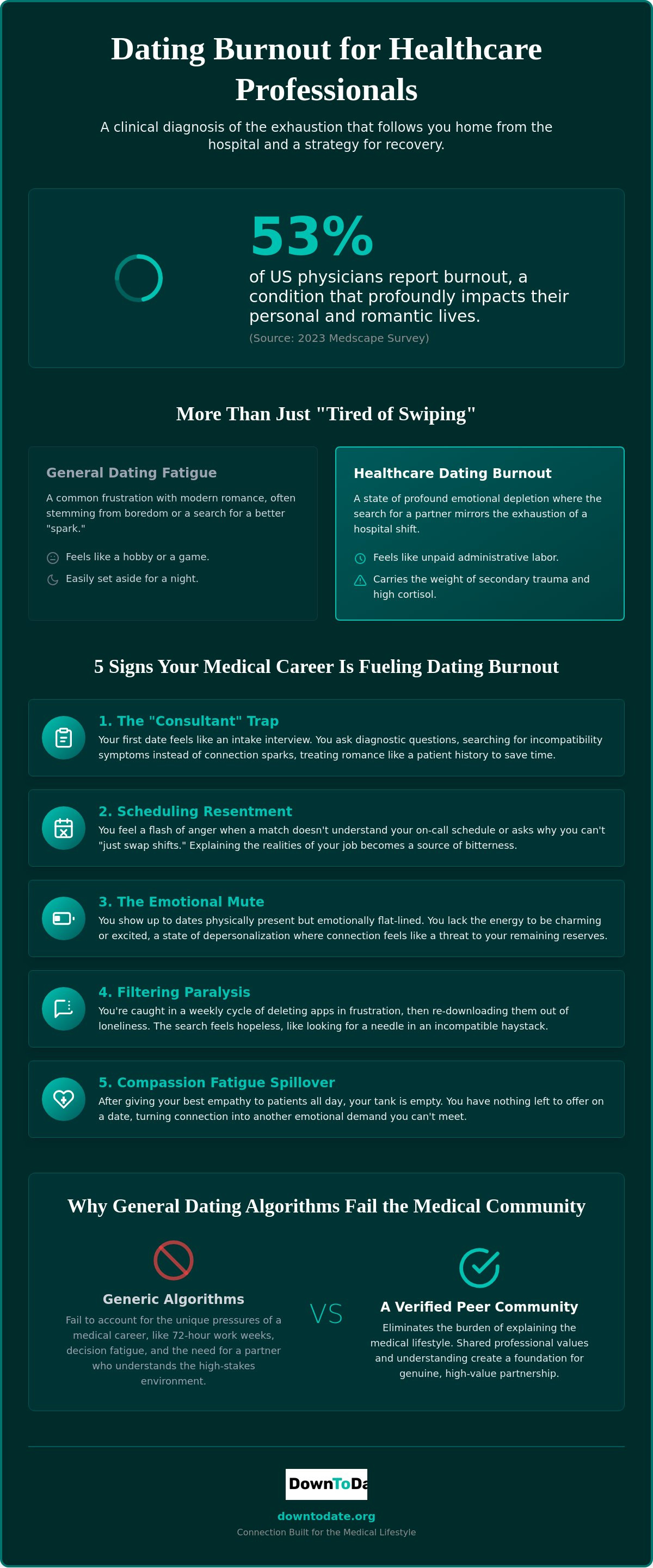
A 2023 Medscape survey found that 53% of US physicians report burnout, but the exhaustion rarely ends when you clock out. For many, the hospital's high-stakes environment bleeds directly into their personal lives. This creates a specific, heavy form of dating burnout for healthcare workers. It's the frustration of being treated as a free therapist on a Tuesday night. It's the decision fatigue of choosing a restaurant after a day of critical choices. You aren't just tired of dating. You're tired of the emotional labor required to explain your life to those who don't live it.
We know your schedule is non-negotiable and your emotional bandwidth is limited. You need a connection that functions as a sanctuary, not another shift. This recovery guide provides a professional-grade strategy to find that connection without the usual exhaustion. We'll show you how to identify the early warning signs of fatigue and streamline your search for a partner who understands the medical lifestyle. You'll learn to reduce the labor of the discovery phase and reclaim your time for genuine, high-value partnership.
Key Takeaways
- Define the specific emotional depletion that separates clinical dating fatigue from general social exhaustion.
- Identify the "Consultant Trap" and other behavioral signs that your medical career is infiltrating your personal life.
- Understand why general dating algorithms fail to account for the high-stakes, 72-hour work weeks of healthcare professionals.
- Execute a clinical 7-day reset to overcome dating burnout for healthcare workers and refine your partner filtering criteria.
- Transition to a verified peer community where shared professional values eliminate the burden of explaining the medical lifestyle.
What is Dating Burnout for Healthcare Professionals?
Dating burnout for healthcare workers is not merely a temporary frustration with modern romance. It is a profound state of emotional depletion. It occurs when the energy required to find a partner exceeds your remaining reserves. For most, swiping is a hobby. For you, it feels like a second shift. It is unpaid administrative labor performed after twelve hours of demanding clinical choices—the kind of exhaustion that can be mitigated by streamlining professional tasks with tools like TeleDIETS before you even leave the office. When the search for connection begins to mirror the exhaustion of the hospital floor, you aren't just tired. You're burned out.
General dating fatigue involves bored users looking for a spark. Healthcare burnout is different. It carries the weight of secondary trauma. You spend your day managing high-stakes crises and providing intense emotional support. When a date lacks empathy for your schedule or treats you like a medical consultant, it creates a unique sting. It is the exhaustion of being "on" when you desperately need to be "off." You deserve a partner, not another patient or a curious interviewer.
The link between professional stress and personal struggle is documented. Physician burnout often bleeds into the private sphere, turning the search for connection into a source of stress rather than a source of relief. This creates a cycle of isolation. You have less to give, so you receive less in return. The process becomes a chore. It becomes a checklist. It becomes a burden that many choose to drop entirely just to survive the week.
The Physiology of Fatigue
Your body does not reset the moment you clock out. High cortisol levels from the hospital floor linger long into your evening. These elevated stress hormones impact your romantic patience and your ability to form new bonds. They shorten your fuse. They make small talk feel like an interrogation. After a day of critical decisions, decision fatigue sets in. Choosing a person feels as taxing as choosing a treatment plan. Even ghosting feels more personal. In a high-stress environment, a sudden lack of communication feels like a failure of the system you already work too hard to maintain.
Managing the physical toll of a high-stress medical career is essential for maintaining your personal life; to explore specialized health and performance optimization, visit Testosterone.Doctor.
Dating burnout for healthcare workers is the fundamental misalignment between your high professional standards and the low efficiency of your personal search.
5 Signs Your Medical Career is Fueling Dating Burnout
Identifying the threshold where professional excellence becomes personal exhaustion is critical. You aren't just unlucky in love. You are experiencing a specific erosion of your personal bandwidth. If your career is fueling dating burnout for healthcare workers, the symptoms are usually systematic. They are predictable. They are manageable. Recognizing them is the first step toward reclaiming your time.
The first sign is the "Consultant" Trap. You find yourself triaging matches. You ask diagnostic questions rather than conversational ones. You're looking for symptoms of incompatibility rather than sparks of connection. It's a defense mechanism. You're treating a first date like an intake interview to save time. When your romantic life feels like a series of patient histories, you've crossed into burnout territory.
Next is Scheduling Resentment. You feel a flash of anger when a match asks why you can't just swap shifts. They don't understand the physical toll of being on-call. They don't respect the rigidity of a residency schedule. This disconnect creates a wall before the first drink is even poured. If you feel bitter explaining your "night shift" for the tenth time, your environment is working against you.
You might also experience the Emotional Mute. You show up, but you can't perform. You lack the energy to be charming. You lack the energy to be excited. The expected level of first-date enthusiasm feels like an impossible mountain to climb. You're physically present. You're emotionally flat-lined. This isn't a personal failing; it is a systemic outcome. To understand the root, we must look at the clinical definition. What is physician burnout? It is a state of depersonalization. It makes genuine connection feel like a threat to your remaining energy.
Finally, there is Filtering Paralysis. You delete the apps on Monday in a fit of rage. You re-download them on Thursday out of loneliness. It's a weekly cycle of hope and immediate disappointment. You're searching for a needle in a haystack that isn't even in your time zone.
The Compassion Fatigue Connection
You give your best empathy to patients. You leave the hospital with an empty tank. When you finally sit across from a date, you have nothing left to offer. You might find yourself "matching" just for a quick hit of validation. You don't want a partner; you want a distraction from the day's heavy caseload. Needing a partner is about growth. Needing a distraction is about survival. Knowing the difference protects your heart.
When Your Bio Becomes a Burden
Listing your profession often invites the "Doctor Tax." You receive medical questions instead of opening lines. You're asked for free advice before you've even exchanged last names. This fetishization of your title adds a layer of labor to every interaction. It's why many choose to hide their success. It's also why healthcare professionals need a dedicated dating app that understands these unique pressures. Finding a peer who respects your title without exploiting it is the key to a sustainable connection.
Why General Dating Apps Fail the Medical Community
General dating apps operate on a volume-first model. They prioritize the swipe over the schedule. For the medical community, this is a fundamental design flaw. These platforms are built for the 9-to-5 world. They assume you have the bandwidth to entertain a rotating door of low-quality interactions. They don't account for the 72-hour work week. They don't recognize the reality of being on-call. When you can't engage with the app’s rhythm, the algorithm buries your profile. You're penalized for your professional dedication. When the search for connection begins to mirror the exhaustion of the clinic, dating burnout for healthcare workers becomes an inevitable outcome of using the wrong tools.
The "Algorithm Gap" is a significant contributor to dating burnout for healthcare workers. General apps reward high activity and rapid responses. They push you to stay "online" when you need to be offline. This creates a lifestyle mismatch that's impossible to bridge. You aren't just looking for a partner. You're looking for someone who understands that your time is a finite, high-value resource. High volume is not an advantage. It's a burden. When everyone is an option, the labor of vetting falls entirely on your shoulders.
Many professionals fall into the trap of thinking they must be on the "big apps" because that's where the people are. This is a misconception that leads to exhaustion. Being in a massive, unverified pool means you've to act as a private investigator after a 24-hour shift. You've to screen for intentions. You've to verify reliability. You've to manage the impact of burnout on personal life while simultaneously managing a stranger’s expectations. This isn't connection. This is unpaid administrative work.
The Emotional Labor of "Explaining"
The most draining part of general dating is the constant need for translation. You've to explain why you didn't text back during a code. You've to justify your fatigue after a rough shift. To a "civilian" match, your professional dedication often looks like personal neglect. They interpret your silence as a lack of interest rather than a lack of opportunity. This creates a cycle of guilt and resentment. You shouldn't have to apologize for your career. You need a shared shorthand. You need a partner who knows that "I had a rough shift" isn't an excuse. It's a statement of fact that requires no further explanation.
How to Reclaim Your Personal Life: A 4-Step Recovery Plan
Recovery requires more than a gentle reminder to try harder. It requires a protocol. When managing dating burnout for healthcare workers, you must treat your personal bandwidth as a limited clinical resource. This is a four-step strategy designed to transition you from exhaustion to intentional connection. It is direct. It is efficient. It works.
Step 1: The Digital Detox. Commit to a clinical seven-day break. Delete every dating platform from your device. This isn't about giving up; it is about resetting your dopamine receptors. You cannot find a partner while your brain is stuck in a cycle of reflexive swiping. Silence the noise for one week to reclaim your focus and your peace.
Step 2: Audit Your Filtering. Review your criteria. Stop searching for who is attractive in a vacuum. Start searching for who understands your lifestyle. Prioritize matches who respect the demands of residency or the reality of the night shift. If they don't value the weight of your time, they don't value you. Filter for compatibility, not just chemistry.
Step 3: The Low-Stakes Entry. Move away from the high-volume swiping model. Transition to intentional, community-based matching. Focus on environments where shared professional values are the baseline, not the exception. This reduces the labor of the discovery phase. It ensures you are meeting people who already respect the stakes of your career.
Step 4: Setting the Medical Boundary. Reclaim your identity. You are a person, not a provider, when you are off-duty. Stop answering medical questions on the first date. If a match attempts to turn the evening into a consultation, redirect the conversation immediately. Protect your "off" time with the same intensity you bring to your "on" time.
Implementing Intentional Dating
Success is found in quality, not quantity. Adopt the "One Match per Week" rule. Focus your energy on a single, high-potential interaction rather than five low-effort ones. Use voice-first or video-first screenings to assess emotional intelligence quickly. This saves you from the physical toll of a wasted evening. Learning how to find time for dating as a doctor is about efficiency, not effort. It's about working smarter, not harder, in your personal life.
Communicating Your Needs Early
Transparency prevents friction. Script your availability from the start. Tell them clearly: "My schedule is demanding, but my intent is serious." Being upfront about your "off-grid" times filters out those who require constant digital validation. It sets the stage for a relationship built on mutual respect for professional obligations. If you are ready to stop the cycle of exhaustion, apply for a Premium Membership to join a community that already speaks your language and respects your time.
DownToDate: Connection Built for the Medical Lifestyle
DownToDate is the antidote to decision fatigue. It is a verified community where your credentials are the baseline, not a burden. We built this platform to eliminate the specific dating burnout for healthcare workers that stems from explaining the obvious. You shouldn't have to justify your exhaustion. You shouldn't have to translate your schedule. Here, the night shift is understood. Residency life is respected. We act as a protective gatekeeper, ensuring every match shares your high standards and your serious intent. It is direct. It is efficient. It is exclusive.
Our verification process is a tool for safety. It is a signal of authenticity. We've created an atmosphere where the "Doctor Tax" does not exist because everyone in the room has earned their place. This platform was founded by doctors who lived the same high-stakes lifestyle you navigate every day. We understand the hurdles because we cleared them ourselves. We aren't just a service provider. We are a community-builder for those who value integrity. We've solved the lifestyle mismatch by creating a space where everyone is already on the same page.
The Power of a Professional Community
Shared values lead to longer-lasting relationships. Shared schedules lead to less friction. When your partner knows the weight of a code or the toll of a 24-hour shift, the emotional labor of the relationship drops significantly. You gain a partner who offers support rather than demands explanations. It is a streamlined path to partnership. By joining a peer-to-peer network, you bypass the "civilian" learning curve that so often leads to resentment and isolation. You don't just find a match. You find a peer who speaks your language.
For those who require the highest level of efficiency, our Premium Membership provides the critical advantage. It offers advanced search filters designed for the busy professional. You can target specific criteria that align with your lifestyle. You can move with purpose. You can find quality without the high-volume noise of general platforms. This is about precision. It is about respecting your time as the finite, high-value resource it is. We provide the tools. You provide the intent.
You've dedicated your life to the care of others. You've managed the crises. You've held the line. It's time to prioritize your own connection. You deserve a sanctuary. You deserve a peer who sees the person behind the profession. Stop settling for the exhaustion of general apps. Reclaim your personal life with a strategy that respects your time, your mission, and your future.
Reclaim Your Connection and Your Time
You've identified the signs of fatigue. You've audited your filters. You've implemented a clinical protocol to protect your bandwidth. Overcoming dating burnout for healthcare workers is not about trying harder. It's about choosing a system that respects your reality. You deserve a partnership that functions as a sanctuary, not another administrative burden. You deserve a peer who understands the weight of your day without a single word of explanation. No more justifications. No more exhaustion. Just connection.
Founded by Dr. Shadi Rezai and Dr. Sasan Rezai, DownToDate is a verified medical community built for the unique demands of your life. It is tailored specifically for doctors, nurses, and residents who value integrity and shared purpose. This is not just another platform. It is a mission-driven solution for high-stakes professionals who require efficiency and authenticity. There is no more explaining the night shift. There is only genuine partnership. Join the community that understands your schedule. Start your DownToDate journey today.
Your dedication to others shouldn't come at the cost of your own happiness. The path to a meaningful relationship is now streamlined, professional, and within reach. Take the first step toward a connection that finally makes sense. You've earned it.
Frequently Asked Questions
How do I know if I have dating burnout or just a busy week?
Dating burnout is marked by a persistent sense of dread and depersonalization rather than simple physical tiredness. A busy week ends with a desire to reconnect; burnout leaves you feeling like every interaction is an unpaid administrative chore. If you find yourself triaging matches like patients or feeling cynical about the possibility of connection, you are likely experiencing dating burnout for healthcare workers. It's a state of emotional depletion that requires a strategic reset.
Can I still find love if I work the night shift?
Yes, but success requires finding a partner who respects the physiological demands of your schedule. Night shift dating fails when you attempt to force a traditional social rhythm onto a non-traditional lifestyle. You need a connection that values your "off" hours as much as your "on" hours. Finding a peer who understands the specific exhaustion of a 12-hour overnight shift eliminates the need for constant justification and guilt.
Is it better to date another healthcare worker or a civilian?
Dating another healthcare worker often reduces the "explanation tax" because they already speak your professional shorthand. They understand the stakes of a code and the reality of being on-call without needing a lecture. While civilians can provide a refreshing perspective outside the medical world, they often struggle with the lack of control over your time. Shared professional values create a foundation of mutual respect that simplifies the discovery phase.
What should I do if my match doesn’t understand my on-call schedule?
Communicate your professional boundaries clearly and early to filter out incompatible matches. If a match interprets a clinical emergency as personal neglect, it's a signal of fundamental lifestyle friction. You cannot negotiate the demands of your career. You need a partner whose serious intent includes a respect for your professional obligations. If they cannot handle the unpredictability of your schedule, they are not the right fit for your life.
How long should a "dating detox" last for a busy resident?
A clinical seven-day break is the recommended protocol to reset your dopamine receptors and reclaim your mental space. This period allows you to disconnect from the reflexive swiping cycle that fuels dating burnout for healthcare workers. Use this time to audit your priorities and rest your emotional reserves. A week of digital silence provides the clarity needed to re-enter the dating community with a more intentional and efficient strategy.
Why do I feel guilty for taking a break from dating apps?
You likely feel guilty because general dating platforms are designed to make you feel like you're missing out if you aren't "always on." This is a false narrative built to maximize app engagement, not your personal well-being. Taking a break is a strategic move to preserve your limited emotional bandwidth. It's an act of professional-grade self-care. Recognize that your time is a high-value resource that deserves protection from low-quality interactions.
How can I vet a match’s emotional intelligence before the first date?
Use voice-first or video-first screenings to assess their ability to listen and respond with genuine empathy. Pay close attention to how they react when you describe a demanding shift or a scheduling conflict. High emotional intelligence is revealed in their ability to offer support rather than a demand for your attention. This quick screening process saves you from the physical and emotional toll of a wasted evening with an incompatible match.
Does DownToDate verify that everyone is actually in the medical field?
Yes, we utilize a rigorous verification process to ensure every member is a legitimate medical professional. This gatekeeping ensures a high-value community of peers who share your standards and your lifestyle. We act as a reliable facilitator, removing the burden of professional vetting from your shoulders. This allows you to focus on finding a connection with someone who already understands the residency life and the high-stakes nature of your career.


