

Paying for a dating app can be worthwhile when its paid features address a real obstacle in your dating life. Whether it is worth paying for dating apps as a professional depends less on your job title than on whether features such as advanced filters or unlimited messaging help you use limited time more deliberately. An upgrade adds functionality, not a different pool of people.
With a demanding schedule, it makes sense to want a focused way to meet someone, and to wonder whether a subscription will improve your experience or simply add an expense. Paying alone does not create stronger conversations or better matches. Your profile and the effort you bring still matter.
Weigh the benefits against your priorities, identify when paid features solve a practical problem, and recognize when a free option may be enough. Your decision should reflect how you date, what gets in your way, and the kind of connection you want.
Key Takeaways
- Decide what currently slows down your dating process, then assess whether paid tools address that specific friction.
- Weigh convenience against the effort you can realistically bring to your profile and conversations.
- Use your dating priorities, not your professional title alone, to judge whether an upgrade fits your needs.
- If meeting someone who understands healthcare work matters to you, consider whether DownToDate Premium Membership suits that goal.
Is it worth paying for dating apps as a professional
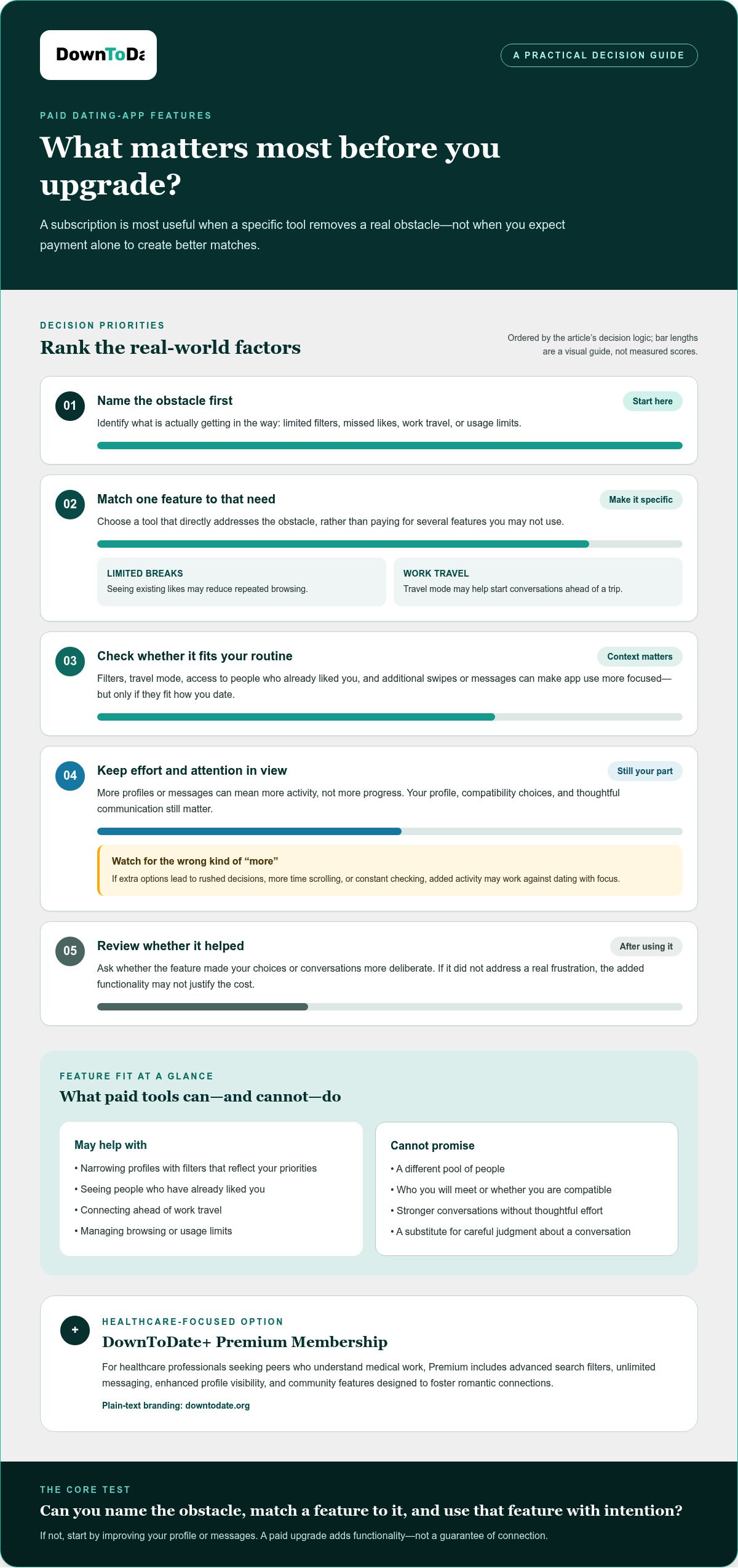
If you’re a professional weighing whether to pay for dating apps, ask whether a paid feature solves a specific problem. Upgrades on some apps may offer more filters, travel mode, access to people who have already liked you, or additional swipes and messages. These tools can make app use more focused, but they don’t create a different pool of people. Paying may change how you use the app, but it cannot guarantee who you meet.
Start with the friction you notice most. A healthcare worker with limited breaks might value seeing existing likes instead of repeatedly browsing profiles. Someone who travels for work may find travel mode useful for starting conversations ahead of a trip. If neither situation fits your routine, those features may add little practical value.
Filters can also narrow the pool to people who better fit your priorities. For example, a user might set preferences that help reduce irrelevant profiles or avoid seeing likes from people who haven’t read their profile. One commenter described paying for filters to screen out profiles they didn’t want to consider. The useful question is whether your chosen filters make browsing more intentional.
More access can mean more activity, but activity isn’t the same as progress. Additional swipes may show you more profiles, yet you still need to assess compatibility and communicate thoughtfully. If extra options lead to rushed decisions or more time scrolling, the feature may work against your goal of dating with focus.
Before upgrading, use this three-step test:
- Name the obstacle: Identify whether limited filters, missed likes, travel, or usage limits are disrupting your dating routine.
- Match a feature: Choose a paid tool that directly addresses that obstacle, rather than paying for several features you may not use.
- Set a review point: After using the feature, consider whether it has made your choices or conversations more deliberate.
This test separates convenience from hope. Seeing who has already liked you has a clear purpose. But if you expect payment to create stronger compatibility without changing how you present yourself or communicate, an upgrade may not meet that expectation.
Your profile and messages remain central. Paying may motivate you to refresh your photos or write thoughtful first messages, but a subscription can’t do that work for you. A polished profile paired with a specific opening message gives a conversation more context than a brief greeting sent to several matches.
Consider burnout, too. If repeated swiping through unsuitable profiles leaves you disengaged, filters could reduce unwanted browsing. But if the real issue is checking the app constantly, more swipes or messages may reinforce that habit. Choose features that reduce friction, not ones that simply expand activity.
Safety deserves a separate decision. The U.S. Government Publishing Office says the Romance Scam Prevention Act would allow dating services to notify users when someone they communicated with has been removed from the platform. That potential notification is distinct from paid-app tools such as filters or travel mode. Don’t treat an upgrade as a substitute for careful judgment about a conversation.
A paid plan makes the most sense when a particular feature fits your schedule, preferences, and dating habits. Weigh its practical value against the attention it requires. If you can name the problem, identify a feature that addresses it, and use the app with intention, paying may be reasonable. If you can’t, start by improving your profile or messages.
An upgraded profile provides a stronger starting point, but it cannot substitute for consistent effort. Paying for upgrades adds functionality, not access to a different group of people. One commenter says paying for filters helps them avoid seeing likes from men who have not read their profile. Another says they use filters to exclude conservatives and reduce burnout from swiping on people they do not want to see. These examples show how a feature may help someone manage their experience, but its usefulness depends on what they want to screen out.
Payment does not necessarily improve results if you continue to put in minimal effort. A filter can shape which profiles appear, but you still decide how to present yourself and communicate. Consider whether an upgrade helps you make more deliberate choices rather than assuming a subscription will build a connection for you. If the feature addresses a real frustration and you keep engaging thoughtfully, it may be worthwhile. If not, the added functionality may not justify the cost.
DownToDate: Premium Membership
DownToDate offers Premium Membership for healthcare professionals seeking connection with peers who understand the demands of medical work. For doctors, nurses, and other medical staff, shared career context can matter when building a relationship around a demanding schedule and professional responsibilities. The platform provides a secure space to pursue meaningful connections outside the work environment.
Consider DownToDate+ Premium Membership if you want a dating platform centered on the healthcare community. Its advanced search filters and unlimited messaging can help you connect with people who understand the realities of medical careers. Premium also includes enhanced profile visibility and access to community features designed to foster romantic connections.
Visit downtodate.org to explore DownToDate and its Premium Membership.
Make your next step intentional
The next move isn’t necessarily another subscription. Decide what you want dating to make room for: a more manageable routine, clearer compatibility, or connection with someone who understands your professional world. That priority can guide where you invest your attention, not just whether you pay for an app.
Asking whether paying for dating apps as a professional is worthwhile becomes more useful when you define what success means to you. It might mean conversations that feel aligned with your values or a dating process that fits around demanding work. Let that goal shape your choices and the effort you bring.
If you want to meet people in a community shaped by healthcare careers, explore DownToDate+ Premium Membership. Choose the features that fit your priorities and take your next step at your own pace.
Explore DownToDate and choose a path that feels right for you.


