

A simple video selfie is no longer enough to protect your peace of mind. With only 37% of singles feeling that profiles on open platforms are authentic, finding a dedicated dating app that vets users has shifted from a luxury to an essential boundary. When you manage a high-pressure career and demanding hours, you don't have time to gamble on unverified profiles, romance scams, or mismatched intentions.
You already know the toll of dating burnout. Sifting through unvetted accounts drains your energy and puts your professional privacy at risk around clients, patients, or colleagues. You deserve an intentional space where every profile represents an authentic peer who respects your schedule. In this guide, you will discover how rigorous background and career vetting filters out bad actors, shields your reputation, and restores serious intent to modern romance. We'll examine the critical difference between superficial selfie checks and true credential verification, showing you which platforms actually protect your time in 2026.
Key Takeaways
- Understand why choosing a dating app that vets users is crucial for preventing identity fraud and protecting career privacy.
- Learn how multi-tiered screening models separate superficial photo checks from true credential and background verification.
- Discover the non-negotiable security protocols that protect your identity documents with encrypted handling and immediate data deletion.
- Master a practical framework to evaluate member intent, vetting criteria, and community culture before joining any service.
- Explore how physician-founded platforms like DownToDate use career-level vetting to cultivate mutual respect around intense shift rotations.
Why the Demand for a Dating App That Vets Users Has Surged
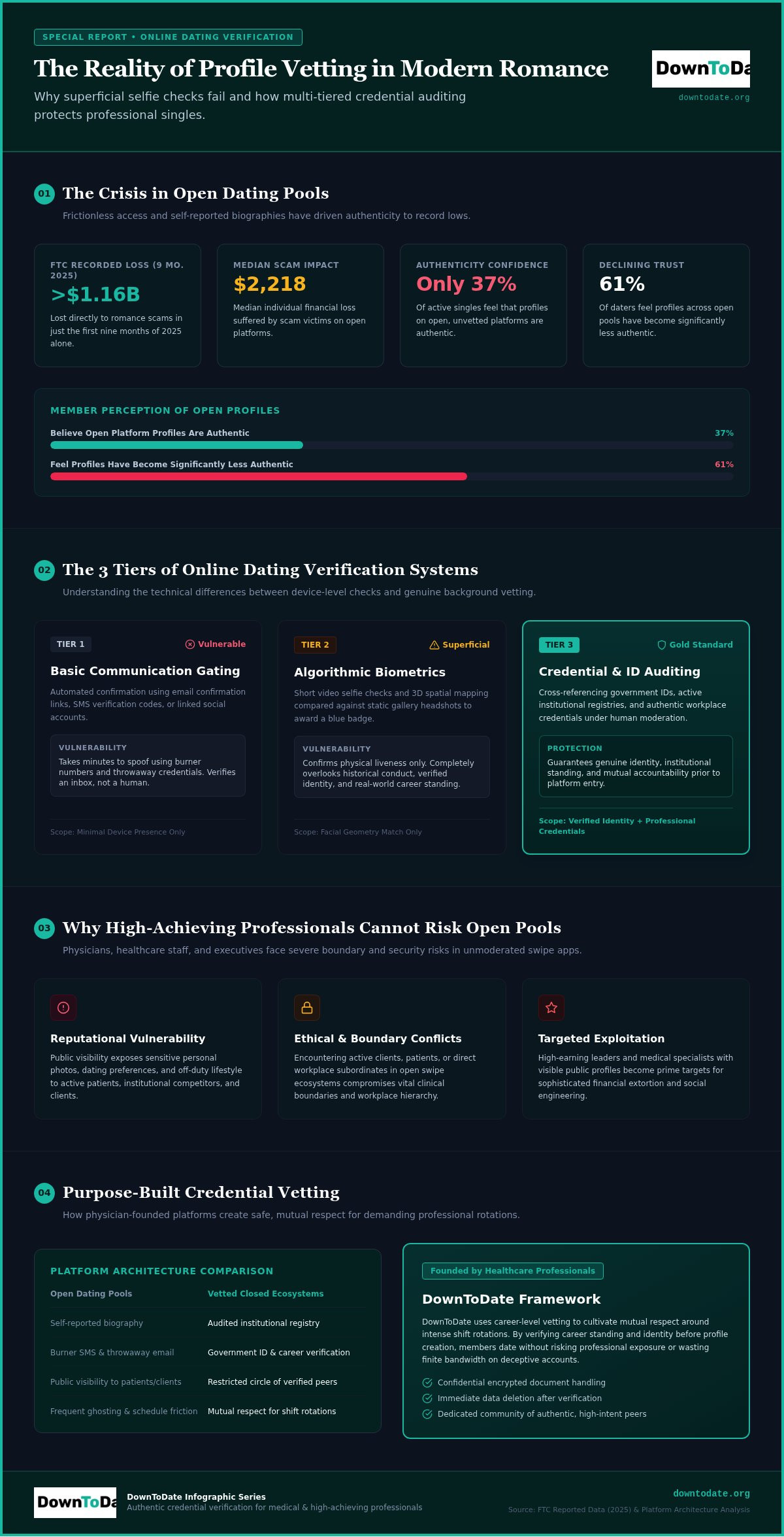
Mainstream swipe culture is broken. For years, open platforms treated identity checks as an afterthought, prioritizing rapid user acquisition over genuine member safety. Today, that frictionless access has created an environment overrun by synthetic media, commercial bots, and bad actors. The Federal Trade Commission reported over $1.16 billion in romance scam losses in just the first nine months of 2025 alone, with victims suffering a median individual loss of $2,218. Modern daters no longer view upfront screening as a niche luxury. They see a dedicated dating app that vets users as an essential defensive line.
When platforms rely on self-reported biographies, authenticity evaporates. In fact, 61% of online daters feel that profiles across open pools have become significantly less authentic. The constant chore of filtering out deceptive accounts drains your finite emotional bandwidth. High-integrity networks eliminate this friction at the gate. By requiring rigorous verification before granting entry, vetted spaces filter out low-intent opportunists and ensure that every match represents a genuine peer.
The Rise of Romance Scams and Profile Spoofing
Ever since online matchmaking became mainstream in the United States, basic email or phone confirmations have served as weak barriers against fraud. Criminal syndicates now deploy sophisticated AI engines to generate convincing photos and synthetic backstories in seconds. Superficial email checks verify an inbox, not a human being. True identity screening validates that the person behind the screen actually exists and matches their public profile. For working professionals who operate on tight schedules, serial catfishing causes genuine psychological exhaustion. It wastes valuable evenings, creates persistent cynicism, and makes intentional dating feel like an unpaid administrative chore.
Why High-Achieving Professionals Cannot Risk Open Dating Pools
Open platforms carry severe operational risks for individuals in sensitive vocations. Physicians, corporate executives, and healthcare staff cannot afford unchecked exposure. When your profile circulates in an unmoderated ecosystem, professional boundaries collapse quickly:
- Reputational vulnerability: Public visibility exposes personal details, photos, and relationship preferences to patients, clients, or institutional competitors.
- Ethical conflicts: Encountering active clients or direct subordinates in an open swipe pool compromises clinical boundaries and workplace dynamics.
- Targeted exploitation: Visible credentials make high-earning leaders prime marks for financial extortion and career-oriented social engineering.
Closed ecosystems resolve this dilemma entirely. Choosing a dating app that vets users protects your standing by keeping your personal life confined to a verified circle of professionals who share your standards, understand your schedule, and respect your privacy.
The 3 Tiers of Online Dating Verification Systems Explained
Device security is not user validation. While mainstream platforms advertise integrated biometric logins or phone confirmation prompts, these tools merely confirm that a human owns a handheld device. They do nothing to verify the integrity of the person operating it. With a surging demand for background checks and authentic user profiles across modern matchmaking, understanding the technical differences between validation tiers is vital before committing your time.
Verification architectures fall into three distinct classifications:
- Tier 1: Basic Communication Gating. Automated checks via SMS codes, email links, and linked social profiles. This level requires minutes to spoof using burner numbers and throwaway credentials.
- Tier 2: Algorithmic Biometric Matching. Short video selfies and 3D spatial mapping compared against static gallery photos. This confirms physical liveness but overlooks historical conduct and real-world standing.
- Tier 3: Professional Credential and Identity Auditing. Cross-referencing government IDs, active institutional registries, and workplace credentials under human moderation.
Tier 1 and 2: Automated Verification vs. Superficial Badges
Algorithmic selfie matching offers an illusion of security. Under Tier 2 systems, an automated scanner captures facial geometry to confirm that an applicant matches their uploaded headshots. The platform then awards a blue checkmark badge. This visual indicator often lulls singles into dropping their guard. The reality is simple: bad actors exploit this gap daily. A verified face can still fabricate their career, hide relationship status, or manipulate financial intent. Tier 2 verifies that a face is real; it cannot confirm whether the user's stated intentions or professional status are genuine.
Tier 3: Professional Credential and Identity Auditing
Real protection demands verifiable accountability. Tier 3 platforms move beyond automated facial scans by requiring documented proof of professional standing before granting entry. Human review teams inspect medical licenses, clinical registrations, and workplace credentials against official records. This multi-step gate creates genuine peer accountability. When every applicant completes manual vetting, casual catfishes and deceptive bad actors abandon the process entirely. The resulting network fosters mutual respect, shared expectations, and serious relationship intent.
For clinical professionals navigating high-stress rotations, choosing a specialized dating app that vets users eliminates the guesswork, connecting you directly with vetted peers who value your schedule and safeguard your privacy.
Data Privacy and Confidentiality: What Happens to Your Information?
Handing over personal credentials to a digital platform feels unnatural. For licensed practitioners and corporate leaders, uploading government identification or employer documentation triggers justifiable caution. You cannot afford a data leak. You cannot risk having your official licensing records connected to open marketing directories. A high-standard dating app that vets users treats data governance with the same defensive posture found in secure financial or healthcare infrastructure.
Legitimate vetting protocols separate the validation pipeline from public profiles. The objective of auditing is verification, not surveillance. When evaluated correctly, entering a vetted community actually shields your identity far better than navigating unmoderated swipe pools that leave your likeness unprotected against predatory romance scams and public harvesting.
Enterprise Encryption and Document Destruction Protocols
Secure screening architectures rely on end-to-end encrypted tunnels using AES-256 protocols during document transit. The best platforms adopt a zero-retention policy for sensitive paperwork. Once a trained human moderator confirms your active licensure or employer credentials against primary registries, the raw image file is permanently purged from active systems. Your verified badge persists; your submitted government documents do not. Furthermore, backend verification vaults remain physically isolated from consumer-facing social databases, eliminating cross-contamination risks.
Shielding Your Professional Identity in Public-Facing Profiles
Rigorous verification does not require public exposure. In a professionally vetted ecosystem, you control precisely what peers see on your match card. Leading platforms incorporate granular privacy features designed for sensitive careers:
- Incognito discovery modes: Restrict profile visibility exclusively to accounts you have actively liked, keeping your presence hidden from casual browsers.
- Institutional anonymization: Display your broader clinical or executive role without disclosing your specific hospital system, firm, or departmental address.
- Client exclusion filters: Block contact lists or prevent local indexing to eliminate accidental interactions with patients, clients, or institutional subordinates.
You shouldn't have to choose between finding companionship and maintaining professional discretion. By choosing a dating app that vets users through isolated auditing channels, you secure authentic peer matching while preserving strict personal boundaries.
How to Evaluate and Choose a Verified Dating Platform
Friction is often your greatest ally. When an app promises instant registration with three taps, it signals that anyone can enter. That means bad actors, bot operators, and low-intent scrollers sit directly across from you in the match deck. Choosing an effective dating app that vets users requires examining what happens before you ever see a profile. You want a platform that respects your time by enforcing real barriers to entry.
To identify an authentic matchmaking environment, run potential platforms through four practical checks:
- Gating rigor: Determine whether the service conducts manual reviews or relies solely on automated photo badges.
- Member intent: Assess whether the ecosystem is built around casual hookups or structured for lasting partnership.
- Moderation accountability: Confirm that human teams actively monitor community standards rather than outsourcing safety to unmonitored report queues.
- Schedule alignment: Verify that the user base shares similar professional demands, erratic hours, and lifestyle constraints.
Scrutinizing Onboarding Friction and Community Gatekeeping
Lengthy intake queues and manual approvals are positive signals. When an application asks for active credentials or places you in a brief verification waitlist, it protects the community you are about to join. High onboarding friction repels serial ghosters, dishonest opportunists, and commercial scammers. What remains is a focused group of serious individuals who invested real effort to participate. An application-based gate transforms the entire culture from mindless scrolling into intentional, respectful engagement. For singles who want to take vetting a step further, verified relationship intelligence solutions like CheriPic help evaluate compatibility before forming romantic connections.
Matching Lifestyle Demands and Mutual Schedule Empathy
Demanding vocations break relationships when partners lack schedule empathy. When you work eighty-hour weeks, manage unpredictable emergency calls, or endure rotating overnight shifts, conventional daters often misread canceled plans as personal disinterest. You shouldn't have to defend an emergency page or apologize for clinical exhaustion. Verified peer ecosystems solve this disconnection by gathering singles who share the exact same professional reality.
If you work in healthcare, consult the best professional dating app for medical professionals to see how peer vetting eliminates lifestyle misunderstandings. Ready to connect with genuine peers who respect your dedication? Apply for membership on DownToDate today to experience a community tailored to your life.
DownToDate: Purpose-Built Credential Vetting for Medical Professionals
Mainstream swipe networks simply fail healthcare workers. Between unpredictable call shifts, complex rotations, and clinical exhaustion, clinical staff operate under realities that typical dating audiences rarely comprehend. DownToDate was created to change that dynamic. By establishing an exclusive dating app that vets users through verifiable healthcare credentials, the platform bridges the gap between high-demand medical careers and intentional partnership.
Every applicant undergoes manual credential verification before gaining platform access. Whether you work as a physician, nurse, pharmacist, or clinical specialist, you enter an ecosystem insulated from catfishes, romance scams, and casual time-wasters. This rigorous screening creates peer accountability, shields your professional standing across the nation, and ensures that every match respects the unique weight of your daily responsibilities.
Built by Doctors for the Healthcare Community
Founders Dr. Shadi Rezai and Dr. Sasan Rezai created DownToDate after experiencing firsthand the isolation and scheduling hurdles of residency. They recognized that medicine demands a level of personal sacrifice standard swipe tools cannot accommodate. Connecting with someone who instinctively understands hospital culture eliminates awkward explanations after twenty-four-hour shifts. To understand how peer empathy transforms personal connections, read our guide on dating for doctors: navigating love in the modern medical world.
Elevated Connections Through Premium Membership
Time is your most finite resource. Maximizing your search efficiency requires tools calibrated to erratic shift work. Upgrading to a DownToDate Premium Membership equips you with practical advantages tailored to active clinical schedules:
- Advanced search filters: Filter profiles by clinical specialties, lifestyle habits, and alignment with non-traditional schedules.
- Unlimited messaging: Build meaningful dialogue directly without artificial daily limits or algorithmic paywalls.
- Enhanced visibility: Surface your profile to verified medical peers actively seeking serious, long-term commitment.
You don't need another generic swipe gallery. You need a vetted community that protects your privacy and shares your dedication. Visit DownToDate to connect with authenticated healthcare professionals who truly understand your world.
Protect Your Time and Connect with Genuine Medical Peers
Your free time is too rare to waste on unverified profiles, casual swiping, and persistent dating fatigue. Protecting your professional reputation shouldn't mean sacrificing your personal life. When you choose a dedicated dating app that vets users, you replace algorithmic chaos with verified integrity, strict privacy safeguards, and authentic peer accountability.
DownToDate was built specifically to solve this challenge. Founded by practicing physicians Dr. Shadi Rezai and Dr. Sasan Rezai, the platform provides an exclusive nationwide community dedicated solely to verified healthcare professionals. With options like Premium Membership offering advanced search filters, enhanced visibility, and unlimited messaging, you can focus on building meaningful connections without burning through your off-duty hours. You've earned your credentials; now date among peers who value them. Join DownToDate today to meet verified healthcare professionals who share your dedication and schedule.
Frequently Asked Questions
How does a dating app that vets users verify identity without exposing sensitive data?
Secure platforms use zero-knowledge architecture and enterprise encryption during verification. When you upload credentials, review teams inspect the documents through private, encrypted channels solely to confirm authenticity. Once verified, legitimate platforms immediately purge those raw image files from their servers. Your personal documentation never touches public servers, and other members cannot view your underlying verification records.
Can dating apps verify employment and educational background accurately?
Yes, specialized platforms verify backgrounds by cross-referencing official state licensing registries, institutional databases, and active employer credentials. Unlike open apps that rely on self-reported bios, a dedicated dating app that vets users employs human moderators to audit applications. This manual cross-check ensures every listed physician, nurse, or healthcare professional holds legitimate, active standing before gaining entry.
Are vetted dating apps safer than mainstream dating platforms?
Vetted apps provide significantly higher safety by eliminating the anonymity that enables bad actors. Mainstream apps leave registration open to anyone, inviting fake personas and commercial scams. By requiring identity validation prior to onboarding, gated networks deter romance scammers and automated bots, ensuring your matches represent authentic peers with genuine intentions.
What is the difference between a verified badge and an application-based dating app?
A verified badge on a mainstream platform simply confirms that a live face matches uploaded photos. It says nothing about a user's background, professional claims, or conduct history. Application-based services enforce strict gatekeeping. They review professional credentials and identity documentation before granting platform access, filtering the entire community rather than handing out superficial profile icons.
How do vetted dating platforms protect my profile from patients or colleagues?
Closed networks prevent public exposure by restricting visibility strictly to verified members within your target demographic. Additionally, quality platforms provide incognito browsing modes, employer-masking options, and contact-blocking capabilities. These boundaries guarantee that your clinical patients, institutional clients, or direct hospital subordinates cannot discover your profile during casual browsing.
Do vetted apps take longer to deliver matches than standard swipe apps?
Application review can take slightly longer due to manual credential checks, but finding meaningful matches is much faster. Open apps offer thousands of immediate profiles, yet most lead to dead-end chats, flakes, or mismatches. Vetted spaces deliver a curated pool of intentional peers, drastically cutting down the hours required to find a compatible partner.
Is paying for a verified dating membership worth it for busy professionals?
Paying for a dedicated service protects your most valuable asset: time. Investing in a premium membership provides tools like advanced shift-schedule filters, enhanced visibility, and unlimited messaging. For medical workers managing rigorous on-call schedules, removing dishonest profiles and low-intent scrollers makes the investment practical, efficient, and restorative.


