

What if a workable dating life didn’t require a predictable schedule? For medical professionals, shifts, call, and last-minute changes can make plans difficult to keep. Limited downtime can also make dating feel like one more obligation. Work-life balance dating solutions for medical pros start with a realistic standard: connection doesn’t require perfect availability. It takes intention, clear communication, and room for plans to change.
If you worry that your career leaves too little space for a relationship, that concern is understandable. You don’t need to overpromise your time or treat your personal life as an afterthought. You can make room for connection in ways that respect both your schedule and your energy.
This guide covers practical ways to plan around clinical demands, explain schedule constraints with confidence, and recognize partners who understand the realities of healthcare work. It also explores how a healthcare-focused dating community can support a more intentional approach. Created by physicians, DownToDate is designed for healthcare professionals, with Premium Membership features such as advanced search filters and unlimited messaging. The goal isn’t to make your schedule effortless. It’s to build a dating life that can work with it.
Key Takeaways
- Work-life balance dating solutions for medical pros start with a dating rhythm built around your actual capacity, not an idealized schedule.
- Identify flexible windows and revisit plans when shifts or call change.
- A supportive partner doesn’t need to work in healthcare, but should value flexibility, clear communication, and mutual effort.
- Use a simple communication approach to explain schedule changes and show interest without overpromising.
- DownToDate+ Premium Membership features can support a more intentional approach to dating within the healthcare community.
Why Work-Life Balance and Dating Feel Difficult in Medical Careers
Dating alongside clinical work can be challenging for practical reasons, not because healthcare professionals are unsuited to relationships. Rotating shifts, call, fatigue after demanding days, and schedules that change with little notice can make it difficult to commit to the same evening each week. Even plans made with genuine enthusiasm may need to move when work takes priority.
Dating-related work-life balance means making intentional room for connection within real clinical constraints. It doesn’t require equal time for work and personal life, or a perfectly predictable calendar. The broader idea of work-life balance frames this as an ongoing effort to make space for different parts of life. For dating, the measure is whether your approach is considerate and sustainable, not whether it follows a conventional timetable.
Sustainable dating for medical professionals means creating room for connection in ways that respect clinical responsibilities, personal capacity, and the other person’s time. That leaves space for a busy week, a rescheduled plan, and a different pace from someone with a standard Monday-to-Friday routine.
It also helps to separate scheduling constraints from assumptions. Limited availability during a stretch of shifts doesn’t automatically mean you’re not interested, and it doesn’t prove the other person is unwilling to understand. Dating successfully doesn’t require a conventional schedule or unlimited free time. It calls for honest expectations and a willingness to find workable ways to connect.
How clinical schedules affect dating plans
Rotating shifts and call can make recurring plans difficult, especially when a workweek changes after you’ve suggested a date. A first date might need to fit between shifts or move when call responsibilities change. That can be disappointing, but it isn’t a reliable measure of either person’s interest. Clear communication helps distinguish a genuine conflict from a pattern of disengagement without jumping to conclusions.
Why dating deserves space alongside patient care
Patient responsibilities matter, and dating shouldn’t require you to neglect them. But your professional role isn’t your entire identity. Companionship, affection, and the chance to know someone beyond work are valid parts of a full personal life. Making room for connection doesn’t have to add pressure to an already demanding week. It can start with recognizing that personal relationships deserve consideration when you decide how to use the time and energy you have.
That distinction is central to Work-life balance dating solutions for medical pros: respect the limits your work creates without treating those limits as a verdict on your personal life. An unpredictable schedule can still leave room for meaningful connection. The next step is to build a dating rhythm around the capacity you actually have, rather than the availability you wish you had.
Build a Dating Rhythm That Fits Shifts, Call, and Recovery Time
A sustainable dating routine should fit the life you have, not an idealized calendar. Before making plans, consider both your schedule and your energy. A free evening after a demanding stretch may be open on paper but still better spent recovering. Work-life balance dating solutions for medical pros become practical when you use a repeatable process that leaves room for connection and adjustment.
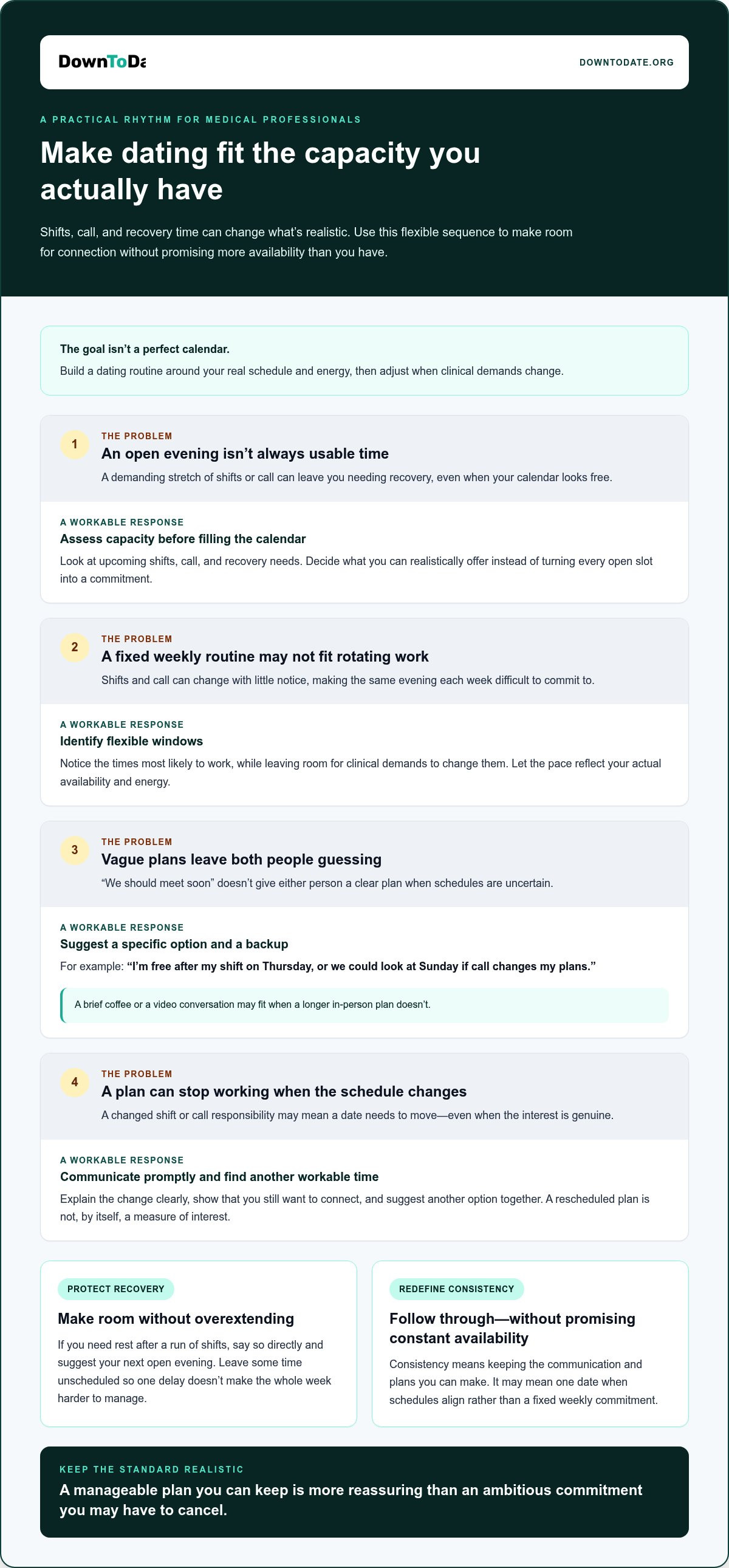
Use this sequence as a flexible starting point:
- Assess your capacity. Look at upcoming shifts, call, and recovery needs. Decide what you can realistically offer instead of filling every open slot.
- Identify flexible windows. Notice the times most likely to work, while allowing for clinical demands to change them.
- Agree on a plan. Suggest a specific option and a backup, so both people know what to expect.
- Revisit as needed. If your schedule changes, communicate promptly and find another workable time together.
Consistency matters, but it doesn’t mean being available at all times. Consistency means following through on the communication and plans you can make, not promising constant availability. A manageable cadence might mean one date when your schedules align rather than a fixed weekly commitment that creates pressure. Let the pace reflect your actual availability and energy, then adjust as work changes.
Plan around realistic windows, not a perfect weekly routine
Review your upcoming shifts before suggesting a day. Instead of a vague “we should meet soon,” offer a realistic window and an alternative: “I’m free after my shift on Thursday, or we could look at Sunday if call changes my plans.” A brief coffee can fit a limited opening; a video conversation may work when meeting in person doesn’t. A modest plan you can keep is more reassuring than an ambitious commitment you may have to cancel.
Protect recovery time while making room for connection
Decide which time is genuinely available and which time you need to recover. You might say, “I’d like to see you, but I need to rest after this run of shifts. Could we plan for my next open evening?” This communicates interest and a boundary without apology. Leave some time unscheduled, too. If every free block becomes a commitment, one delay can make the whole week harder to manage.
Connection doesn’t have to depend on frequent dates. A thoughtful message, a brief check-in, or following up about something your date shared can maintain momentum between meetings, as long as the communication feels mutual and manageable. Agreeing on a simple way to stay in touch can prevent silence from being misread without turning messages into another obligation.
If you want to meet people with a closer understanding of clinical schedules, a healthcare-focused dating community is one option. Keep the same principle: choose a pace that respects your capacity and leaves space for genuine connection.
What to Look for in a Partner Who Understands Medical Work
A partner doesn’t need a clinical background to understand the demands of healthcare work. They do need to listen, communicate directly, and respect your time and boundaries. Another healthcare professional may recognize the realities of shifts and call without much explanation, but shared work experience alone doesn’t guarantee compatible priorities or relationship skills. Look at how someone responds and collaborates, not just what they do for a living.
Shared profession versus shared relationship values
Two people in medicine may understand each other’s schedules yet have different needs for time together, communication, or commitment. A partner outside healthcare can be equally supportive when you explain what your schedule allows and ask about their needs in return. The important question isn’t whether someone already knows clinical life. It’s whether you can build understanding through honest conversation.
Use this comparison to distinguish supportive expectations from avoidable pressure:
| Supportive expectation | Pressure-creating assumption |
|---|---|
| Plans may need flexibility, and both people help find alternatives. | One person should always absorb the inconvenience of schedule changes. |
| Availability is discussed honestly, with interest shown in other ways. | Being busy automatically means disinterest, or a date must always come first. |
| Boundaries around work and recovery are respected. | A caring partner should be available whenever the other person is free. |
| Each person’s needs and time matter. | Only the healthcare professional’s schedule determines how the relationship works. |
Green flags for schedule-aware dating
Pay attention to patterns, not one disrupted plan. A considerate response to a changed shift, a clear conversation about availability, and a genuine effort to choose another time can signal flexibility and interest. Green flags also include asking what works for you while sharing what works for them. Flexibility should be mutual, not a standing expectation that one person keeps adapting.
- They respond with curiosity. If plans change, they ask what might work instead rather than treating the change as proof of rejection.
- They communicate their own limits. Directness goes both ways; a supportive partner can name their needs without guilt or pressure.
- They follow through. When you agree on a new plan, both people make a reasonable effort to keep it.
- They make room for reciprocity. Your schedule matters, and so does theirs. You look for options together instead of expecting one person to carry the planning.
Use these signals to assess whether your expectations fit, and give the other person a fair chance to understand the realities of your work. Work-life balance dating solutions for medical pros are more sustainable when compatibility means shared respect, not identical careers. For a dating space tailored to healthcare professionals, explore DownToDate+.
Practical Ways to Communicate Schedule Changes and Dating Needs
Clear communication can keep a schedule change from becoming a question about your interest. Use a simple framework: state the constraint, offer an alternative, and agree when you’ll reconnect. It respects the other person’s time while keeping the conversation constructive. Work-life balance dating solutions for medical pros depend not on having a predictable calendar, but on being clear about what you can offer and following through.
Explain an unpredictable schedule without over-apologizing
If a shift or call change disrupts a date, let the other person know as soon as you reasonably can. A concise message might be: “My shift changed, so I can’t make our plan tonight. I’m still interested in seeing you. Could we look at Thursday, or reconnect tomorrow once I know my schedule?” This gives context, affirms interest, and proposes a next step without promising a time you can’t yet confirm.
You can be considerate without giving a lengthy explanation or repeatedly apologizing for circumstances outside your control. Share only what’s relevant to making or changing the plan. Don’t disclose patient details or confidential workplace information. “I’ve been called in” or “my shift was extended” communicates the scheduling issue without crossing a privacy boundary.
Avoid leaving the plan unresolved with “I’ll let you know” if you can offer a clearer point of follow-up. If your availability is genuinely uncertain, say so directly: “I can’t confirm a new evening yet. I’ll check my schedule after my next shift and message you then.” The specific commitment is to reconnect, not to a date you may not be able to keep.
Set expectations before scheduling becomes a source of stress
Talk early about how each of you prefers to plan. Explain that shifts can change, ask how much notice the other person needs, and discuss whether tentative plans or shorter-notice invitations work for both of you. This isn’t a negotiation over whose time matters more. It’s a chance to understand each other’s needs before a missed plan carries more meaning than it should.
After a difficult change, check in rather than assuming the relationship is fine or that the other person is upset. Try: “I know changing plans affected your evening. How did that feel for you, and what would make rescheduling easier next time?” Then listen. A respectful exchange makes room for both your constraints and the impact on the other person.
- Be specific about the change. Say what you can no longer do, without unnecessary detail.
- Show intent through an option. Offer a realistic alternative or a clear time to reconnect.
- Look for reciprocity. Boundaries protect mutual respect; they don’t excuse one person from making consistent effort.
These habits turn schedule conversations into collaboration, not repeated apologies or one-sided accommodation. You can also explore DownToDate+, a dating community tailored to healthcare professionals.
How DownToDate+ Fits Dating into Medical Life
Finding someone who understands the demands of healthcare work can make early conversations easier. DownToDate+ is a dating app created by physicians and tailored to doctors, nurses, and other healthcare professionals. It brings together people with a connection to healthcare while leaving room for each person’s priorities, personality, and relationship goals.
A shared professional context can help someone understand why a schedule changes or why recovery time matters. It doesn’t replace the conversations that build trust or guarantee compatibility. The practical advantage is a dating environment designed with healthcare professionals in mind, so you can explore connection without assuming every potential partner needs the same job or schedule as you.
A dating community designed around healthcare professionals
DownToDate+ is built for a specific community, rather than treating clinical work as a detail that needs explaining from the beginning. That can matter if you value meeting people familiar with the healthcare environment. At the same time, shared work is only a starting point. Consider whether you communicate well, respect each other’s boundaries, and want compatible kinds of connection. Those qualities matter whatever either person’s profession.
Use Premium Membership tools with intention
Premium Membership includes advanced search filters, unlimited messaging, enhanced profile visibility, and access to community features. Used thoughtfully, these tools can make discovery and communication more intentional. Filters let you refine your search according to the available options, while unlimited messaging gives you room to continue conversations. Enhanced profile visibility and community features offer further ways to engage with the app.
These features can support your approach to dating, but they can’t decide who is right for you or promise a particular outcome. Use search to focus on what matters to you, then use conversation to learn about a person’s values, communication style, and expectations. Be clear about your own availability before making plans. A considered message and a realistic conversation can be more useful than trying to match with as many people as possible.
Work-life balance dating solutions for medical pros combine practical habits with tools that fit their lives. Decide what you’re looking for, use the app’s features to guide discovery, and build connections at a pace that respects your work and personal capacity. DownToDate+ brings a physician-created, healthcare-focused dating community together with Premium Membership features designed to support that process.
Explore DownToDate+ and see how its healthcare-focused community and Premium Membership tools can fit your approach to dating.
Make Space for Connection on Your Terms
Your next step doesn’t need to be a complete overhaul of your routine. Choose one standard that would make dating more sustainable, such as enough notice to plan, room to reschedule, or time to recover without guilt. Let that standard guide your choices and conversations. It gives your personal life direction without demanding that every week look the same.
Work-life balance dating solutions for medical pros aren’t about squeezing connection into every open hour. They’re about making deliberate choices that respect your energy and leave space for someone else’s needs, too. Some weeks will make dating easier than others. A changing pace doesn’t mean you’ve failed; it means your approach can adapt.
If you’re ready to explore a dating community shaped for healthcare professionals, explore DownToDate+. Take the next step at a pace that feels genuine. Your career can matter deeply, and so can the connection you choose to make room for.
Frequently Asked Questions
Can a relationship work when both partners have rotating schedules?
Yes, a relationship can work when both partners have rotating schedules. Success depends on treating planning as a shared responsibility: compare availability, choose dates that can shift if needed, and keep each other informed. For example, you might agree to confirm plans after reviewing the next roster rather than expect the same evening to work every week. Shared scheduling pressures don’t erase boundaries or the value of dependable follow-through. Revisit what works as professional demands and personal needs change.
Is it reasonable to reschedule a date because of a clinical emergency?
Yes, an urgent clinical responsibility can disrupt a date, and it’s reasonable to reschedule when that happens. Let the other person know as soon as practical, acknowledge that the change affects their time, and suggest a realistic alternative if you can. An occasional emergency is different from repeatedly cancelling without making new plans. If changes become a pattern, discuss how it feels for both of you rather than assuming your role explains everything.
How can I date without sharing confidential details about work?
You can describe how work affects your availability without explaining patient situations or sharing workplace details. Keep the focus on your own needs: “I had a demanding shift and need a quiet evening, but I’d like to find another time to meet.” That gives your date useful context while keeping the conversation personal. You can share more about your general schedule or how certain shifts affect your energy without identifying anyone involved.
What should a medical professional say when a new match asks about availability?
Be clear about the kind of schedule you have, while avoiding promises about specific future dates you can’t confirm. For example: “My shifts vary, but I can usually suggest a time once I see my schedule. What kind of notice works for you?” Work-life balance dating solutions for medical pros start with honest expectations, not apologies. Offering a flexible window and asking about the other person’s preferences makes availability a shared planning conversation.
Can dating feel like another source of stress during a demanding rotation?
Yes, dating can feel demanding when a rotation leaves you with little time or energy. You can lower the pressure by slowing the pace, choosing a brief call instead of a long evening out, or being upfront that you have limited capacity right now. A deliberate pause or lighter approach is a temporary adjustment, not proof that a relationship can’t fit into your life during a busy period.
Is it okay to prioritize rest instead of dating after a difficult shift?
Yes, rest is a legitimate need, and dating should leave room for recovery. If you’re too depleted to enjoy a plan, tell the other person respectfully rather than attending out of obligation. For example: “I’m glad we made plans, but I need to rest tonight. Could we find another day?” Suggest a new time if you’re still interested, and give the other person space to share how the change affects them.


