

A hospital title doesn’t make workplace romance automatically off-limits, but a no-fraternization policy can set firm boundaries. Dating for hospital administrators depends on the hospital’s written rules, especially when a relationship overlaps with reporting lines, decision-making authority, or colleagues’ work. Even where consensual relationships are allowed, rules on harassment, discrimination, disclosure, and workplace conduct still apply.
This distinction can feel especially important in healthcare, where professional relationships affect teams and daily operations. Administrators need clarity, not guesswork: understand the policy, consider how power dynamics may affect colleagues, and keep personal communication outside the workplace.
This guide explains how workplace romance policies may apply to hospital administrators in the United States and what to consider when a relationship could affect professional responsibilities. It also covers ways to maintain workplace boundaries while making room for meaningful connections beyond the demands of the hospital.
Key Takeaways
- Choose a dating platform based on the kind of connection and professional understanding you want, not popularity alone.
- Look beyond work for ways to meet people, keeping professional relationships and personal dating life distinct.
- Build a profile that shows your values and personality while setting realistic expectations about a demanding schedule.
- Plan dates around on-call responsibilities with clear communication and flexibility, rather than overpromising availability.
- Consider a healthcare-focused dating community when shared understanding of medical careers is a priority.
What dating apps are popular with hospital administrators in the United States?
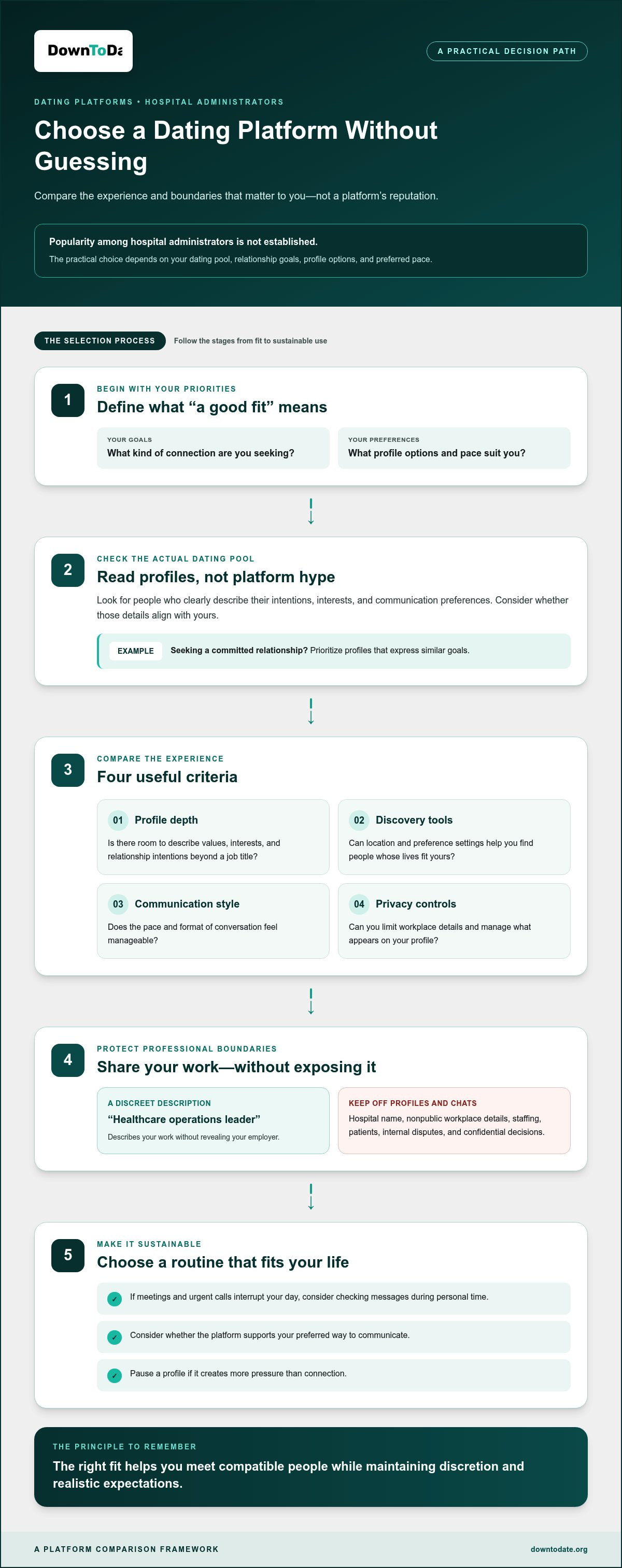
Hospital administrators in the United States can use general-audience dating apps and websites, but popularity among administrators is not established. The practical choice depends on your dating pool, relationship goals, profile options, and preferred pace. An app with broad reach may offer more potential introductions, while a service with detailed profiles may suit someone looking for more context.
A familiar platform name alone doesn’t make an app the right fit. The available dating pool can differ from one community to another. Review profiles and consider whether people clearly describe their intentions, interests, and communication preferences. If you want a committed relationship, for example, prioritize profiles that express similar goals.
Compare general-purpose platforms by the experience they provide:
- Profile depth: Look for space to describe values, interests, and relationship intentions beyond a job title.
- Discovery tools: Consider whether location and preference settings help you find people whose lives fit yours.
- Communication style: Choose an environment where the pace and format of conversations feel manageable.
- Privacy controls: Review options for limiting workplace details and managing what appears on your profile.
These are comparison criteria, not a popularity ranking or endorsement. Start by reviewing profiles on the service and deciding whether it fits your goals. Look for people whose intentions, interests, and communication styles align with yours. An administrator seeking a committed relationship can state that directly rather than relying on a platform’s reputation.
Protect professional boundaries when building a profile. Avoid naming your hospital, sharing nonpublic workplace details, or posting identifiable information about colleagues. A description such as “healthcare operations leader” explains your work without revealing your employer. Keep discussions about staffing, patients, internal disputes, and confidential decisions off dating profiles and chats.
Use your schedule as another selection criterion. If meetings and urgent calls interrupt your day, choose an app routine you can sustain, such as checking messages during personal time. Consider whether each option supports your preferred way to communicate, and pause any profile that creates more pressure than connection. The right fit helps you meet compatible people while maintaining discretion and realistic expectations.
Workplace relationships also require attention to professional boundaries. The commentary recommends allowing consensual workplace relationships while maintaining written policies against sexual harassment and discrimination, with clear complaint-reporting methods and procedures. For an administrator considering a personal connection, workplace policies are separate from the choice of dating service. Privacy, communication style, and profiles are practical considerations, but they do not establish which apps administrators prefer.
Physicians can build rapport with hospital administrators regardless of position or specialty. The author says administrators have a vested interest in physician satisfaction because unhappy physicians may leave or make mistakes, both of which can be costly to a hospital. The author advises physicians to maintain a positive attitude when working with administrators. These points concern professional interactions; personal dating choices are separate from workplace rapport.
Are there dating apps or social groups specifically for healthcare executives and hospital administrators?
Some dating communities focus on healthcare professionals, while an executive-only membership is a narrower proposition. A shared medical setting can help people understand confidentiality, demanding decisions, and unpredictable workdays, but it doesn’t mean every member has hospital leadership experience. Check the community’s stated audience and profile categories to see whether administrators, rather than clinicians alone, are included.
Professional networks serve a different purpose. Groups focused on healthcare leadership can help administrators meet peers through conferences, educational events, and regional gatherings. Those connections may become personal, but a networking group isn’t a dating service. Keep the distinction clear: attend for its stated professional purpose, respect workplace boundaries, and let any personal interest develop without pressure.
One example of a structured social format is speed-networking mixers often hosted by healthcare associations. Participants typically have brief, timed conversations before rotating to meet someone else. The format offers a structured introduction and then moves naturally to another conversation. It shows how an event can make meeting people more manageable, especially for busy executives who prefer a clear beginning and end.
These structured social mixers are designed to facilitate initial contact rather than serve as an ongoing dating group for hospital executives. Their practical lesson is the format: a purposeful gathering can create introductions without relying on workplace relationships or traditional dating apps.
For administrators considering a niche community or event, assess its fit through concrete signals:
- Audience: Does it welcome hospital administrators and healthcare executives, or focus on another professional group?
- Purpose: Is it explicitly for dating, professional networking, or a social activity?
- Format: Does it use profiles, hosted introductions, or brief rotating conversations like structured mixers?
- Boundaries: Can you participate without sharing employer details or discussing confidential work?
That distinction matters. A healthcare-focused dating community brings shared work context into personal introductions. A professional association can offer peer contact, but shouldn’t be treated as a dating channel. Choose based on your goal, communicate interest respectfully, and keep professional responsibilities separate. If a connection begins at a leadership event, for example, follow up personally only when the interest feels mutual and appropriate.
Before joining, look for clear information about who organizes a group, how introductions happen, and whether participation requires a public profile. Ask how contact details and employer information are handled, and whether you can attend without discussing your workplace. If the group is connected to a professional association or employer, confirm that its stated purpose is social or professional rather than romantic. A well-defined setting can clarify expectations, but it cannot guarantee compatibility or discretion.
National healthcare systems invest heavily in institutional marketing, communications, and community outreach. That figure concerns corporate brand management, not dating services or executive social groups like DownToDate. For a personal introduction, focus instead on the community’s own description of its audience and activities. Choose a setting where you can participate comfortably, keep professional boundaries intact, and decline further contact without pressure.
How can hospital administrators meet potential partners outside work?
Start with settings that fit your interests, rather than adding another demanding commitment. A hospital administrator who enjoys cooking could take a community cooking class; someone who prefers the outdoors could join a hiking group. Shared activities give conversation a natural starting point and keep introductions separate from workplace authority.
Choose recurring activities when your schedule allows. A book club, recreational sports league, or museum volunteer program can make it easier to see familiar people again. If a meeting conflicts with a hospital obligation, attend another session instead of treating one missed event as a failed attempt. Consistency matters more than filling every free evening.
Professional events can also expand your social circle, but their purpose remains work. A healthcare leadership conference or association meeting may introduce you to peers with shared context. Keep the initial exchange focused on the event. If mutual interest develops, suggest a separate conversation outside the professional setting, without using workplace access or influence to press for a response.
Friends can make introductions with useful context. Tell a trusted friend what kind of relationship you hope to build and what your schedule is like. For example, ask whether they know someone who enjoys independent plans and understands that urgent work can disrupt dinner. A thoughtful introduction creates a starting point, not an obligation to keep dating.
Volunteering offers another route beyond the hospital. Consider a community garden, arts organization, animal shelter, or food program that reflects your interests. Choose a role you would value even if you didn’t meet a partner. That keeps the activity meaningful and gives you a shared task to discuss, such as organizing an event or caring for a public space.
- Pick one setting: Choose a class, group, or volunteer activity that fits an existing interest.
- Protect your privacy: Share personal contact details only when you feel comfortable, and keep employer information limited.
- Make a clear invitation: Suggest coffee or a walk at a time you can genuinely protect.
- Respect the answer: If someone declines or doesn’t respond, leave the invitation there.
These approaches work best when the setting isn’t controlled by your hospital role. Don’t use reporting relationships, vendor dealings, or access to staff information to create romantic opportunities. Instead, make room for introductions where both people can participate freely. One practical plan is to set aside time for a regular personal activity, tell a friend you’re open to introductions, and accept invitations that fit your boundaries. That makes space for dating without turning the workplace into the meeting ground.
What dating profile tips work well for busy healthcare administrators
Dating for hospital administrators starts with a profile that shows a person, not a résumé. Pair your role with a personal detail, such as weekend cooking, live music, or a favorite trail, rather than leading with “hospital administrator.” That gives someone an easy opening beyond work. For example: “I lead healthcare operations and recharge by testing new recipes.” Keep employer names and identifiable workplace details private.
Use photos that reflect your life outside the hospital. Choose a clear, current portrait and images of genuine interests, such as a garden, concert, or hiking path. Avoid badges, staff, patient areas, and recognizable workplace backgrounds. A professional headshot can feel like a work profile; a relaxed photo outdoors says more about how you spend personal time.
Write with specificity. “I enjoy traveling” gives little to respond to; “I’m planning a weekend in Chicago for architecture and deep-dish pizza” offers two conversation starters. Mention the qualities you value, too. A line such as “I appreciate curiosity, direct communication, and a good museum afternoon” can attract people with compatible interests without turning your profile into a list of demands.
Dating for hospital administrators also calls for honest, calm language about availability. Avoid describing yourself as “always busy,” which can suggest you have no room for dating. Try: “Hospital operations can bring a shifting calendar, so I value thoughtful plans and clear communication.” This sets realistic expectations without sharing internal schedules or implying that a potential partner must accept last-minute changes.
- State your intention: Say whether you’re looking for a committed relationship, meaningful dates, or another clear goal.
- Offer a specific detail: Name a book, cuisine, or activity you’d enjoy sharing, such as a farmers’ market visit.
- Protect professional privacy: Describe your field broadly instead of naming your hospital, department, or colleagues.
- Make responding easy: End with a prompt, such as asking which city someone would revisit for a long weekend.
Before publishing, read your profile as a stranger would. Does it reveal your personality, offer a natural conversation starter, and set fair expectations about time? Remove details that identify your workplace or disclose confidential information. A short, specific profile is more useful than a polished biography full of job titles. Focus on the life you want to share, not only the responsibilities you manage.
For example, an administrator who enjoys jazz could write: “After a full week, I’m happiest finding a small venue and listening to live music. I’m looking for a considerate partner who enjoys good conversation.” The example names an interest, conveys a tone, and signals intent. Adapt that structure to your own interests so the profile feels credible and distinctly yours.
How can hospital administrators balance dating with on-call duties and irregular schedules
Start with the parts of your calendar you can control. If Monday evenings are usually protected, suggest dinner then instead of offering an unpredictable weekend. If call coverage often changes, plan a shorter coffee date near home. A realistic invitation gives both people clear expectations and leaves room for hospital responsibilities.
Explain schedule constraints early without making every conversation about work. For example: “My week can shift when an urgent operational issue comes up, but I’m glad to plan ahead.” This acknowledges the possibility of a change while showing interest. Avoid promising a specific evening until you know you can protect it.
Use a simple planning method: identify available personal time, choose a date that fits, and confirm once your work calendar is settled. If an urgent call disrupts the plan, contact your date promptly. A brief message acknowledging the change and offering a new option is more considerate than silence or a vague apology.
Keep the first date flexible. A walk, coffee, or early dinner can be easier to reschedule than a complex event requiring advance arrangements. For instance, suggest a café near a park, then decide together whether to extend the outing. Flexibility should make meeting easier, not leave the other person uncertain about whether the date is happening.
- Set a boundary: Choose personal time you’ll protect unless a genuine work need intervenes.
- Communicate clearly: Share that your schedule can change, without disclosing confidential hospital details.
- Reschedule thoughtfully: If called away, acknowledge the disruption and propose a concrete alternative.
- Stay present: Silence work notifications during personal time when your responsibilities allow it.
On a date, give the other person your attention instead of checking messages throughout dinner. If you must remain reachable, explain before meeting what that means in practice. For example, you might need to answer an urgent call but can otherwise keep your phone aside. Don’t discuss patient information, internal staffing matters, or sensitive operational decisions.
Balance also means recognizing patterns. If plans are repeatedly displaced, choose a lighter dating pace and make fewer, more dependable commitments. A relationship can develop through consistent communication and intentional time, not constant availability. Be direct about what you can offer, and listen to what the other person needs from a partner.
If you want to meet healthcare peers who understand demanding work calendars, explore a healthcare-focused dating community as one way to connect beyond your immediate workplace.
DownToDate: Premium Membership
DownToDate offers Premium Membership for healthcare professionals seeking connections with peers who understand medical careers. For hospital administrators, that shared context can make it easier to explain demanding responsibilities and the realities of healthcare work. The platform is designed for doctors, nurses, and other medical staff looking to build meaningful relationships beyond their busy work environments.
Consider Premium Membership when you want to meet people whose professional lives are shaped by healthcare, rather than relying only on introductions through your workplace. It offers a focused way to pursue personal connections while keeping dating separate from hospital duties and professional relationships.
Visit DownToDate to explore Premium Membership.
Make space for connection on your terms
Dating for hospital administrators can begin with a deliberate choice: decide what you want your personal life to make room for. Before pursuing a connection, define boundaries that protect your privacy, professional judgment, and time away from work. Knowing those priorities can help you recognize relationships that fit your life, rather than asking your personal life to accommodate every demand of the hospital.
Shared understanding matters, but so does the individual connection. Look for someone whose values, communication, and expectations align with yours. Choose openness and respect in personal conversations and in maintaining professional boundaries.
DownToDate’s Premium Membership offers healthcare professionals a way to seek connection with peers who understand the demands of a medical career. If you’re ready to explore that next step, contact DownToDate about your dating questions. Move forward with intention and make room for a meaningful connection.


