

Dating for medical researchers can start with a practical advantage: meeting people who understand the demands of healthcare work. Dating platforms for medical professionals bring people together around the possibility of meaningful relationships, while unpredictable shifts and long hours still call for flexibility from both people.
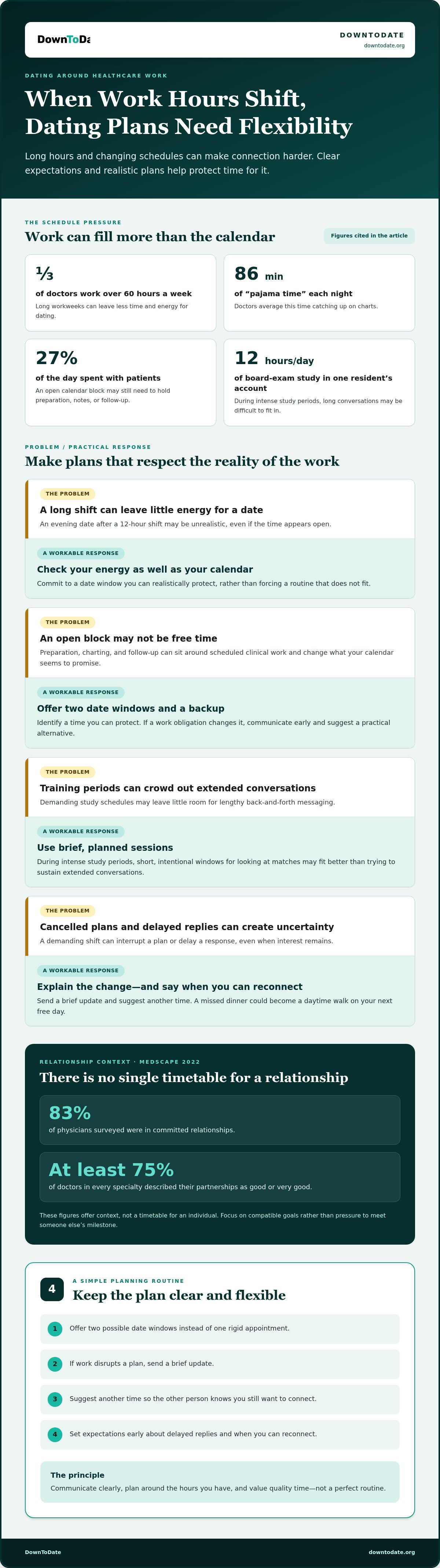
That schedule pressure is real. A third of doctors work over 60 hours a week, and doctors average 86 minutes of “pajama time” each night catching up on charts. Making space for connection isn’t about forcing a perfect routine. It’s about communicating clearly, planning around the hours you have, and valuing quality time.
This guide explains what doctor dating sites offer, what to look for in a healthcare-focused community, and how to date when your calendar can change without warning. Find practical ways to make plans, set expectations, and build a relationship without treating your personal life like another shift to manage.
Key Takeaways
- Build dating plans around realistic windows in your schedule, and communicate early when work may change them.
- Look beyond the workplace for potential partners through social activities and communities that fit your interests and availability.
- Describe your medical research career in broad, personal terms; leave confidential work details and identifying information out of your profile.
- Choose dating apps with your priorities in mind, including the kind of connection you want and how much time you can give to meeting people.
- Make flexibility and clear expectations part of early conversations so both people can find a rhythm that works.
Dating challenges from long and unpredictable work hours
Medical work can make dates difficult to plan and keep. For doctors and medical researchers, the challenge is protecting personal time when work demands shift.
Navigating Long Hours and Medical Training
An American Medical Association study on physician burnout found that a third of doctors work over 60 hours a week. Long workweeks can leave doctors with less time and energy for dating. An evening date after a 12-hour shift may be unrealistic, so consider your energy as well as your calendar before committing.
Training can reduce the time available for dating beyond scheduled clinical work. A psychiatry resident interviewed for an article described studying for a medical board exam for 12 hours a day. During demanding study periods, searching for matches may fit better into brief, planned sessions than extended conversations.
Work schedules can also interrupt seemingly open time. According to AAMC research, doctors spend 27% of their day with patients. An open calendar block may still include preparation, notes, or follow-up tasks. When arranging a date, identify a time you can protect and offer a practical alternative if a work obligation changes your plans.
Women physicians may also consider how dating expectations intersect with career priorities, family plans, and the culture of their specialty. Medscape’s 2022 physician survey found that 83% of physicians were in committed relationships. Its report also found that at least 75% of doctors in every specialty described their partnerships as good or very good. These figures offer context, not a timetable for an individual. Choose matches based on compatible goals, not pressure to meet someone else’s milestone.
Meeting Partners Outside Work
Meeting potential partners outside work can create space between professional responsibilities and personal connection. A recurring activity, such as a community class or weekend book group, offers a natural way to meet people through a shared interest. Choose events that fit your actual availability, not a schedule you hope work will allow.
Common challenges in doctor dating include cancelled plans, delayed replies, and low energy after work. Set expectations early: explain that a demanding shift can delay a response, then say when you can reconnect. Medscape’s 2022 report found that at least 75% of doctors in every specialty rated their partnerships good or very good. Communication and adaptability help partners manage changing demands.
Use a practical planning routine. Offer two possible date windows instead of one rigid appointment. If work disrupts a plan, send a brief update and suggest another time. For example, replace a missed dinner with a daytime walk on your next free day. A specific alternative shows continued interest and respects both people’s time.
How can medical researchers meet potential partners outside of work?
Build a social life beyond the hospital, laboratory, or university department. Medical researchers can meet potential partners through shared interests, alumni communities, friends, and dating platforms. Each setting creates a different kind of first conversation. Choose options that reflect your personality, not just your occupation.
Start with interests that already matter to you. A cooking class, community choir, book group, or recreational sports league gives conversation a natural focus. Choose an activity you can attend consistently, rather than one that requires weekly attendance. For example, a monthly book discussion may fit around changing research deadlines.
Friends and former classmates can also make useful introductions. Tell a trusted friend what kind of relationship you hope to build. Be specific about values, communication style, and lifestyle compatibility. “Someone who enjoys quiet weekends and meaningful conversation” gives a friend more direction than “anyone nice.”
University alumni networks and research associations offer another way to meet people, especially if you’ve relocated. Attend a public lecture or social gathering because you’re interested in its subject, not solely to find a date. That keeps the interaction genuine. If you meet someone interesting, continue the conversation outside the professional setting.
Keep professional boundaries clear at conferences and work-related events. A shared research topic can open a conversation, but it doesn’t automatically signal romantic interest. Avoid pursuing someone whose work you supervise or evaluate. If interest is mutual, suggest continuing the conversation away from the conference schedule.
Use a simple plan to make offline introductions easier:
- Pick one activity connected to an existing interest.
- Ask a friend for an introduction based on shared values.
- Attend a public alumni or research community event.
- Follow up with a brief, direct invitation when interest feels mutual.
Keep each interaction manageable. A short conversation after a lecture may feel more natural than arranging an elaborate first meeting. Ask about the other person’s interests, then share a concise detail about your work. For example, explain the question your research explores without turning the exchange into a presentation.
Protect privacy as well as professional boundaries. Don’t discuss confidential research, identifiable participants, or sensitive workplace matters in a social setting. A broad description, such as “I study how health systems support patient care,” offers context without disclosing private details.
If meeting people through existing circles feels limiting, a community centered on healthcare professionals can make shared career context part of the introduction. Explore dating with healthcare professionals as one way to connect beyond your workplace and research network.
You can mention the kinds of questions you’re exploring without describing a project or the people involved. A social introduction may still feel awkward when your schedule is demanding, so give yourself permission to keep early conversations brief. You don’t need to explain every detail of your work or decide immediately whether you’re compatible. Notice whether the exchange feels comfortable, curiosity goes both ways, and the person respects your time and boundaries. If it does, suggest continuing over coffee or a walk when your schedules allow. If it doesn’t, a courteous close is enough. Thank them for the conversation without sharing personal details or an explanation you don’t wish to give.
A longitudinal study of more than 20,000 UK physicians found that doctors were less likely than the general population to be in partnerships by age 25. That finding can offer context, but it doesn’t define any individual’s prospects or mean that a relationship must be rushed. Researchers at different career stages may have different priorities, availability, and ideas about partnership. Be candid about the amount of time you can realistically offer, and ask what the other person is looking for, too. Shared expectations are more useful than trying to match someone else’s timeline. Keep making room for social contact in a way that feels sustainable: follow up when you’re interested, accept introductions that seem promising, and let connections develop at a pace that suits both people. Meeting a potential partner outside work is not another professional task to optimize. It is an opportunity to get to know someone as a person, while allowing your own interests and life beyond research to remain visible.
How can medical researchers write a dating profile that reflects their career without oversharing?
A strong profile connects your work to your character, not private workplace details. Give potential matches enough context to understand your lifestyle, then focus on the person behind the role. For example, “I research ways to improve patient care and spend weekends testing new recipes” communicates purpose and personality without naming a lab or institution.
Begin with a plain-language description of your work. Replace specialized terminology with the question that motivates your research. Instead of listing a technical project title, write, “I study how people access preventive care.” That invites conversation without requiring readers to understand academic shorthand. Add a personal detail, such as a favorite museum or hiking trail.
Keep identifying workplace information out of your public profile. Avoid naming your hospital, university, laboratory, team, or specific research participants. Don’t describe unpublished findings or recognizable cases. A broad phrase such as “I work in medical research” gives useful context, while a named department and project can reveal more than a new match needs to know.
Use your schedule as context, not as a warning. A line like “My hours can shift, but I make time for brunch and live music” sets a realistic expectation. Avoid “I’m always working” or “My career comes first.” Those statements can sound closed to connection, even if you’re simply being candid about a demanding role.
Be specific about what you enjoy. “I like food” gives matches little to respond to. “I’m learning to make fresh pasta and welcome restaurant recommendations” offers an easy opening. Pair a work-related detail with a personal one, so your profile doesn’t read like a professional biography or research abstract.
- Work: Describe your research in one accessible sentence.
- Personality: Add a hobby, routine, or topic you enjoy discussing.
- Intent: Say what kind of connection you hope to build.
- Privacy: Remove workplace names, confidential details, and identifiable cases.
Choose photos that reflect the same balance. Use a clear, current portrait and another image that shows an interest, such as a garden, bookshop, or cycling route. Leave out badges, patient areas, computer screens, and documents that might expose workplace information. Before posting, inspect the background for names or details you didn’t intend to share.
Read every line from a match’s perspective. Could they ask a natural follow-up? Does the profile say something about your life beyond work? Would you feel comfortable discussing each detail with someone you’ve just met? Replace dense acronyms with everyday language, and remove sentences that sound like résumé achievements rather than invitations to connect.
Keep your profile honest and easy to update. If a research deadline changes your availability, adjust your wording rather than promising a fixed routine. A thoughtful profile gives matches a clear starting point: your field, a glimpse of your interests, and the kind of conversation you’d welcome.
Dating apps
Dating apps can make introductions possible without relying on a shared workplace or fixed social routine. Thousands of single doctors across the United States are looking for love. The useful question is which app approach fits your priorities: a broad pool, a healthcare-focused community, or a balance of both. Dating for medical researchers can start with choosing that priority.
Define what you want before creating a profile. Decide whether you’re seeking a long-term relationship, dating with intention, or simply meeting new people. That choice guides your profile language and filters. For example, if you want a committed partnership, say so clearly, then describe the values you hope to share.
Consider how much career context matters to you. A general app may connect you with people from many professions, while a healthcare-focused platform puts shared medical work closer to the conversation. Neither approach guarantees compatibility. Look for matches whose communication style, relationship intentions, and expectations around a demanding lifestyle align with yours.
Use apps deliberately, not continuously. Set a routine that fits your attention and energy, such as reviewing profiles during a quiet break or replying after work. Choose a stopping point before opening the app. A short, focused session helps prevent searching from becoming another open-ended task in an already full day.
Use your profile to invite an easy first exchange. Mention a research interest in plain language, a personal interest, and a realistic detail about your schedule. “I study how healthcare teams support patients, and I’m always searching for a good independent bookstore” gives a match two natural conversation starters. Keep workplace names and confidential details private. This clarity supports dating for medical researchers without making work the whole story.
Move from messaging to a clear plan when the conversation feels mutual. Suggest a brief call or a simple first date, such as coffee at a convenient public location. If your schedule changes, communicate directly and propose another time. Specificity helps both people see whether interest is translating into effort.
Use these checks before investing more time in a match:
- Intent: Do their stated relationship goals fit yours?
- Conversation: Do both people ask questions and respond thoughtfully?
- Schedule: Can you agree on a realistic way to meet?
- Privacy: Are you sharing only personal and professional details you’re comfortable disclosing?
Apps work best as an introduction, not a substitute for judgment. Read profiles closely, trust consistency between words and actions, and keep early conversations focused on shared interests. If you want a community built around healthcare professionals, explore dating for healthcare professionals as one route to meeting people who understand medical work.
DownToDate: Premium Membership
DownToDate+ offers Premium Membership for healthcare professionals seeking meaningful connections with peers. The app provides a focused dating space for doctors, researchers, nurses, and other medical staff who understand the demands of healthcare work. That shared context can make it easier to discuss career pressures and personal priorities without lengthy explanations.
Consider this option if you want your search to begin within a healthcare community rather than a general dating pool. Premium Membership is designed for healthcare professionals exploring what kind of dating experience fits their goals and schedule. The fundamentals still apply: present yourself honestly, protect workplace privacy, and make time for conversations that feel mutual.
If you’d like to explore Premium Membership, contact DownToDate.
Make Room for a Connection That Fits
Make your next step small and intentional. Before opening another profile or accepting an introduction, decide what you want a new relationship to add to your life. It might be shared curiosity, a steady emotional connection, or someone who understands the purpose behind your work. That clarity can help you recognize a promising connection without treating dating like another professional target.
Dating for medical researchers doesn’t require putting your career aside. It asks you to make space for someone who respects your priorities and wants to build mutual understanding. DownToDate offers Premium Membership for healthcare professionals seeking connection within a community shaped by medical work.
If that community feels aligned with what you’re looking for, contact DownToDate to explore your next step. The right connection can begin with one thoughtful choice, made on your terms.
Frequently Asked Questions
What Are Dating Sites for Doctors?
Dating sites for doctors are platforms designed to help medical professionals meet potential partners. Some serve broad audiences, while others focus on healthcare communities where members share professional context. DownToDate is a dating app for healthcare professionals, including doctors, nurses, and other medical staff. For researchers, the practical benefit is starting conversations with people more likely to understand healthcare work without explaining every career detail.
What dating apps are popular among medical researchers and healthcare professionals?
Healthcare professionals use both general dating apps and platforms focused on medical careers. Popularity varies by location, age group, and personal preference, so choose based on fit rather than name recognition. Consider whether you want a broad range of backgrounds or a healthcare-centered community. DownToDate+ is designed specifically for healthcare professionals, giving medical researchers a focused alternative to general-audience dating apps.
Are there dating sites specifically for doctors, scientists, or medical researchers?
Yes, specialized dating platforms serve healthcare professionals, though their communities may not be limited to researchers or scientists. DownToDate is designed for doctors, nurses, and other healthcare professionals to connect with peers. Its Premium Membership includes advanced search filters and unlimited messaging. A researcher considering a specialized platform should check whether its healthcare focus and relationship-oriented community match what they want from dating.
What dating apps are best for busy researchers with demanding schedules?
The best fit is an app that supports focused searching and communication around your availability. Look for clear profile information, useful search filters, and messaging that lets you respond between work commitments. DownToDate+ Premium Membership includes advanced search filters and unlimited messaging, helping members manage conversations on their own schedule. Set a personal routine for checking messages rather than keeping the app open during lab work.
What are the challenges of dating someone in medical research or academia?
Dating someone in research or academia can mean coordinating around experiments, grant deadlines, teaching, conferences, and changing work priorities. A planned evening may compete with a time-sensitive lab task, while conference travel can interrupt usual routines. Ask how each person prefers to handle schedule changes and communication. For example, share travel dates early and discuss how you’ll stay connected during a busy week.
How do researchers balance dating with lab work, conferences, and irregular hours?
Protect time for dating by treating personal plans as real calendar commitments. At the start of the workweek, identify a realistic opening, then suggest a specific activity, such as coffee after a seminar. Before conference travel, share the dates and agree on a manageable way to stay in touch. If an experiment changes your availability, communicate promptly and offer a clear alternative instead of leaving plans unresolved.


