

Dating for physician associates works best when a potential partner respects the demands of clinical work, whether or not they share your profession. Physician associates often work full time, and schedules may include nights, weekends, or holidays. That can make understanding and flexibility more important than having perfectly matched calendars.
If work makes dating difficult to schedule, you’re not alone. A partner in healthcare may already understand shift changes and the emotional demands of patient care; someone outside the field may bring a fresh perspective and balance. This guide covers how to make time for dating, what to consider when dating within healthcare, and how to identify the values you want in a partner. It also offers practical ways to describe your career and lifestyle so you can build a connection around the life you actually lead.
Key Takeaways
- Plan dates around the realities of shift work by communicating availability clearly and choosing flexible ways to spend time together.
- Decide which values, lifestyle expectations, and approaches to work-life balance matter most before looking for a partner.
- Compare dating apps by the kind of connection and community you want, including whether meeting other healthcare professionals is a priority.
- Describe your clinical career honestly in your profile while making room for interests and qualities beyond work.
- Look for a dating environment that understands healthcare schedules when shared professional context would make connection easier.
1. Dating challenges from demanding work schedules
Dating can be hard to schedule when patient care determines your calendar. Physician associates often work full time, and schedules may include nights, weekends, or holidays. A weekday dinner plan can fall apart when a shift runs late or your availability changes unexpectedly. The challenge isn’t simply finding a free evening. It’s making plans that can adapt without leaving either person feeling overlooked.
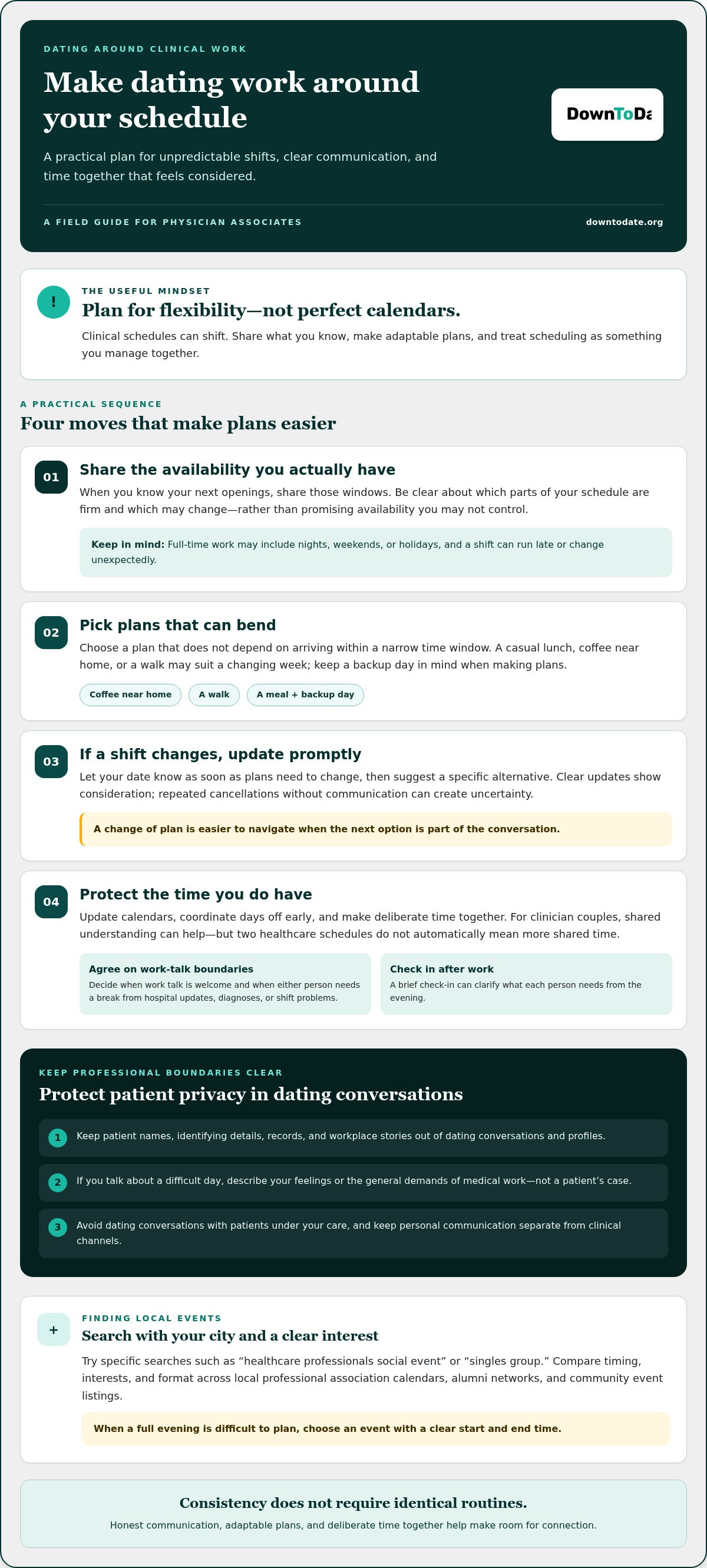
Build dating plans around the schedule you have, rather than promising availability you may not control. Share your next available windows when you know them, and suggest flexible options such as coffee near home, a walk, or a meal with a backup day in mind. If a shift changes, let your date know promptly and suggest a specific alternative. Clear updates show consideration; repeated cancellations without communication can create uncertainty.
How can physician associates protect patient privacy and maintain professional boundaries while dating? Keep patient names, identifying details, records, and workplace stories out of dating conversations and profiles. If you’re discussing a difficult day, describe your feelings or the general demands of medical work instead of sharing a patient’s case. Avoid dating conversations with patients under your care, and keep personal communication separate from clinical channels.
Work-life boundaries matter for clinician couples, too. Two healthcare schedules can make it easier to understand each other, but they don’t automatically create more shared time. Agree on a practical way to protect personal time, such as setting aside a meal together when both calendars allow. Decide when work talk is welcome and when either person needs a break from hospital updates, diagnoses, or shift problems. A brief check-in after work can help clarify what you both need from the evening.
How can physician associates find local singles events or dating groups in their city? Search with your city name and specific terms such as “healthcare professionals social event” or “singles group,” then compare event timing, interests, and format. Local professional association calendars, alumni networks, and community event listings can surface gatherings that fit a changing schedule. Choose an event with a clear start and end time if a full evening is difficult to plan.
Unpredictable hours call for clear expectations, not constant rescheduling. Tell a new partner which parts of your schedule are firm and which may shift, then choose plans that don’t depend on arriving within a narrow time window. A casual lunch may suit one week; a longer outing may work when both calendars align. For clinician couples, coordinate days off early and protect that time from routine work interruptions where possible.
Dating for physician associates becomes more manageable when both people treat scheduling as a shared task. Update calendars, make specific plans, and discuss boundaries before frustration builds. Consistency doesn’t require identical routines. It takes honest communication and deliberate time together.
Identifying the qualities you want in a partner
Start with the life you want to build, not an idealized job title. A physician associate may value a partner who understands clinical pressures, but shared work alone doesn’t establish compatibility. Write down what matters in everyday decisions: communication, reliability, family expectations, personal values, and how each person handles stress. Specific priorities make early conversations more useful.
Separate essential qualities from preferences. A shared faith may be central to one person and less important to another; neither choice has to be universal. Consider what mutual respect looks like in practice. For example, does a partner support your professional goals while maintaining interests and responsibilities of their own? Define the behavior you need instead of relying on labels such as “supportive.”
Then consider how a potential partner approaches conflict. Busy clinical work can leave little energy for unresolved tension, so look for someone who can raise concerns directly and listen without turning disagreement into blame. Discuss a realistic example: if a shift change means one of you has to cancel plans, how would you communicate, respond, and reschedule? The answer can reveal patience and accountability.
Family plans deserve honest discussion when a relationship becomes serious. Consider whether you want children, how caregiving might be shared, and how two demanding careers would shape daily responsibilities. You don’t need a complete plan on an early date, but openness can help you recognize fundamental differences before making major commitments. Ask how each person imagines balancing work, caregiving, and personal time.
Look beyond healthcare when deciding who could be a good match. A doctor, nurse, medical researcher, or another physician associate may understand the rhythms of clinical work. Someone outside medicine may offer a different perspective and help keep conversations grounded in life beyond the hospital. In either case, notice whether the person respects your responsibilities without treating your profession as your whole identity.
Reflect briefly after each date: Did I feel heard? Could we discuss values without pretending to agree? Did their actions match what they said? Note a few observations rather than assigning a score. This helps you keep attraction in perspective and notice patterns, such as dependable communication or repeated disregard for your time.
Dating with clear priorities doesn’t mean demanding perfection. It means choosing a person whose values and habits can work alongside yours. If shared healthcare experience matters to you, explore a dating community for healthcare professionals as one way to meet people familiar with clinical life. Keep your criteria focused on character, respect, and the partnership you want to create.
Be honest with yourself and potential partners about what you want in a mate. Some people seeking a professional partner may consider dating a doctor, who may better understand a medical professional’s schedule; doctors often marry partners who work in healthcare or understand the demands of the medical industry. Shared values, virtues, and expectations around child care and conflict can also guide that choice.
3. What dating apps are best for physician associates in the United States?
The best dating app depends on whom you want to meet and how you prefer to connect. A physician associate seeking healthcare peers may prefer a profession-focused community. Someone open to dating across industries may find a broader app better suited to their goals. No single platform fits every schedule, location, or relationship priority.
Start by choosing your dating pool. If shared experience matters, look for a community designed for healthcare professionals, where clinical work is part of the common context. If you value different perspectives, consider a general dating app and use your profile to explain your schedule and relationship intentions. For example, say you work in patient care and appreciate advance planning, without sharing workplace or patient details.
Next, compare how each platform supports your routine. Review its profile prompts, matching preferences, messaging options, and privacy controls. A profile with space to describe interests and values can help you show more than your job title. Preferences that let you define the kind of relationship you seek can also make early conversations more focused. Platform features vary, so compare what each one offers.
Consider your location in the United States, too. In a large city, a broad app may offer a wider range of potential matches. In a smaller community, a specialized healthcare group may have fewer nearby members, while still offering a stronger point of connection. Think about the radius you’re comfortable with and whether you’re open to meeting someone outside your immediate area.
Before committing your time, compare profiles and conversations with your priorities. Does the platform help you meet people who respect your work, communicate clearly, and share your relationship goals? Are conversations thoughtful, or do they focus mainly on your clinical role? These signals can tell you more than a platform’s popularity or branding.
A practical way to choose is to use this short checklist:
- Audience: Decide whether you want healthcare peers, people from other fields, or both.
- Profile fit: Look for room to express interests, values, and what you’re seeking.
- Schedule fit: Choose a format that lets you communicate at a pace that suits your routine.
- Privacy: Keep patient information, workplace identifiers, and clinical details out of your profile.
- Connection quality: Notice whether matches show curiosity about you beyond medicine.
For physician associates, a good choice is the platform that makes it easier to meet compatible people, not simply the one with the broadest audience. Define your priorities first, then assess each option against them. That keeps your search intentional and your professional boundaries clear.
4. Are there dating apps or communities specifically for physician associates and other healthcare professionals?
Yes. Dating communities exist for healthcare professionals, including physician associates, doctors, nurses, and other medical staff. They bring people together around a shared understanding of clinical work. That context can make it easier to explain why a shift changed or why a demanding day affects your energy. It doesn’t establish compatibility by itself, so approach each match as an individual.
A healthcare-focused dating community differs from a general professional network. Its purpose is personal connection, not recruitment, referrals, or clinical discussion. A medical association group may help colleagues meet socially, but it isn’t necessarily organized for dating. Before joining a community, identify its purpose and whether it supports the kind of relationship you’re seeking.
Shared professional context can help during early conversations. You may not need to explain why patient care sometimes takes priority or why discussing work requires discretion. Still, don’t assume every clinician has the same schedule, specialty, or boundaries. A physician associate working in one setting may have a very different routine from a nurse or researcher. Ask about daily life instead of relying on job titles.
Consider the trade-offs before focusing only on healthcare peers. Someone in medicine may understand clinical pressures, while two demanding careers can make shared time harder to coordinate. Dating outside healthcare can bring fresh interests and useful separation from work. Neither choice is automatically better. Compare each person’s communication, values, and ability to respect your professional responsibilities.
Use these steps to assess whether a healthcare-focused community fits your goals:
- Clarify the purpose: Distinguish a dating space from an alumni group, professional association, or career network.
- Review the audience: Check whether the community includes physician associates and other healthcare roles you’d consider dating.
- Protect work privacy: Keep patient details, identifiable workplace information, and clinical records out of profiles and messages.
- State your intentions: Explain whether you’re looking for a serious relationship or want to meet people first.
- Look beyond the profession: Notice shared values, interests, and communication habits, not just a healthcare job.
For example, a physician associate might connect with a nurse who understands changing shifts, then discover they differ on family priorities. Another match may work outside medicine but communicate thoughtfully and respect clinical boundaries. In both cases, profession opens a conversation; compatibility depends on the people involved.
Dating communities for healthcare professionals can make shared context easier to find. Choose one when that understanding matters to you, and keep your partner priorities at the center. A common field is a starting point, not a substitute for getting to know someone.
5. What dating profile tips help physician associates describe their career and lifestyle?
Your profile should explain what clinical work means in your life, not just name your job. “Physician associate” gives readers a starting point, but a detail about your interests or values makes the profile more personal. For example, pair your role with a weekend hike, cooking at home, or a concert you’d like to attend. Keep patient information and identifiable workplace details private.
Describe your career honestly without making it your entire identity. Physician associate work can be stressful and may involve giving people bad news. You can acknowledge the emotional demands without sharing clinical stories. Try: “I care deeply about patient care, and I reset with a quiet dinner or time outdoors.” That conveys purpose and personality while protecting professional boundaries.
Be specific about how you prefer to connect. If changing shifts make advance planning valuable, say you appreciate clear communication and thoughtful plans. Avoid promises such as “always free on weekends” if your schedule can change. A more accurate profile might say, “My availability varies, but I enjoy making time for a good conversation and planning ahead.” That gives a potential match useful context without turning your profile into a calendar.
Show what you want beyond a job title. Name a quality you value, such as kindness, curiosity, or commitment to family. Add an example that invites an easy response: “I’m learning to make fresh pasta. What meal do you enjoy cooking?” A concrete prompt gives someone more to work with than a general statement about loving food. Choose details that reflect your actual life.
Review your profile for privacy before publishing. Remove patient names, case descriptions, clinic locations, shift patterns, and details that identify colleagues. Replace a work anecdote with a broad description, such as “A demanding day reminded me how much teamwork matters.” This protects others while still communicating your perspective on medical work.
Before making your profile live, review it in three passes:
- Career: Explain your role in plain language without confidential examples.
- Lifestyle: Include an interest that gives someone a natural conversation starter.
- Intentions: State what kind of connection you hope to build.
- Expectations: Describe your approach to scheduling without promising fixed availability.
Then make one final edit for balance. If every sentence mentions medicine, replace a work detail with a hobby, value, or meaningful goal. If the profile hides your career entirely, add a concise, accurate line. Refresh it when your priorities or lifestyle change, so each conversation begins with a clear picture of the person behind the role.
DownToDate: Premium Membership
DownToDate’s Premium Membership gives healthcare professionals a dedicated way to connect with peers who understand medical careers. If shared experience matters in your search, it offers a focused alternative to meeting people without that professional context. Doctors, nurses, physician associates, and other medical staff can look for meaningful relationships while keeping their dating lives separate from work.
Consider DownToDate+ when you want potential matches to recognize the realities of healthcare, while still assessing each person by their values, communication, and relationship goals. A shared profession can help start a conversation; genuine compatibility develops through getting to know one another.
Explore Premium Membership by visiting DownToDate online.
Make Space for the Connection You Want
Dating for physician associates isn’t about filling every open hour. It’s about choosing how you want a relationship to fit alongside a meaningful career. Let your priorities guide the pace: stay open to connection, communicate clearly, and allow trust to grow through consistent actions rather than rushed expectations.
Your needs may shift as your role, schedule, or personal goals change. Give yourself permission to adjust what you’re looking for while staying grounded in the values that matter most. A healthcare-focused community can be a useful place to meet people who understand the professional context. DownToDate+ offers Premium Membership for healthcare professionals seeking meaningful connections with peers.
If you’re ready to explore that option, contact DownToDate to discuss dating. Take the next step at a pace that feels right for you. A thoughtful approach can make room for a partnership that respects both your work and the life you’re building beyond it.
Frequently Asked Questions
How can physician associates meet potential partners with busy or rotating work schedules?
Use dating channels that support brief, flexible conversations, then agree on a communication rhythm that works for both of you. For example, exchange messages during separate breaks and arrange a call on a shared day off. Mention changing shifts early, but keep your availability private rather than posting a detailed roster. Dating for physician associates can feel more manageable when both people value reliable follow-through over instant replies.
What dating challenges are common for physician associates, including long shifts and burnout?
Long shifts, changing hours, and work-related stress can leave less time and energy for dating. After a demanding day, a delayed reply may reflect fatigue rather than disinterest, so discuss communication expectations before misunderstandings grow. Try a brief check-in after difficult shifts, and agree on when to revisit plans if either person needs quiet time. Protecting recovery time matters, too: dating should complement your personal life, not become another obligation to manage.
How should physician associates discuss their job, income, and student debt while dating?
Describe your clinical career honestly, including the realities of your schedule, but keep patient and workplace details private. Discussing income or student debt is not addressed in the material.


