

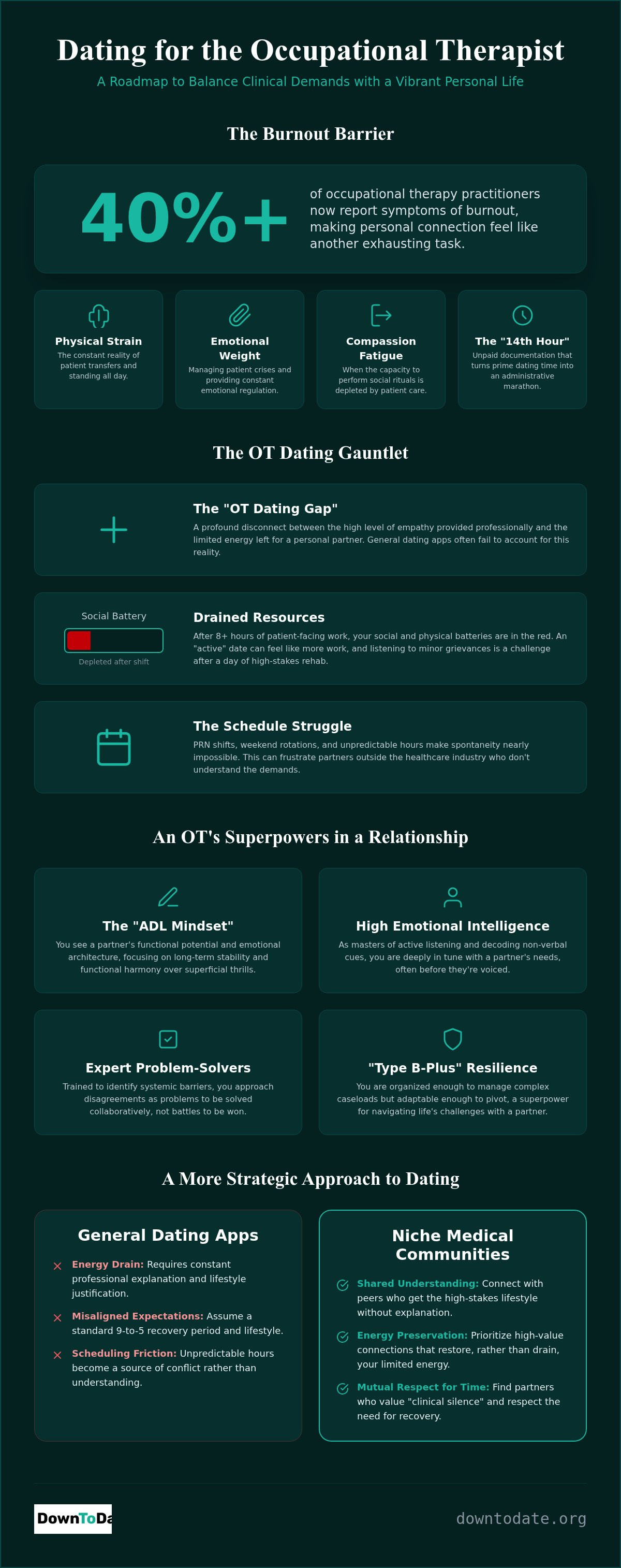
More than 40% of occupational therapy practitioners now report symptoms of burnout. This isn't just a clinical statistic. It's the physical reality of patient transfers. It's the strain of standing all day. It's the emotional weight of compassion fatigue. By the time you reach that unpaid 14th hour of documentation, the idea of dating for occupational therapists can feel like another exhausting task. You've spent your shift prioritizing others. You deserve a personal life that offers restoration. You need a partner who understands the high-stakes nature of your schedule.
We agree that your professional dedication shouldn't come at the cost of your romantic happiness. This article provides a roadmap to balance your clinical demands with a vibrant personal life through strategic, high-value connections. You'll learn how to leverage peer-to-peer communities to streamline your search for a compatible partner. We'll explore how to find a relationship that values your healthcare background without draining your limited energy. It's time to apply the same intentionality to your love life that you bring to your patient outcomes.
Key Takeaways
- Bridge the gap. Reframe personal connection as a vital component of your professional longevity.
- Leverage your strengths. Use your inherent emotional intelligence to build a resilient, supportive partnership.
- Simplify dating for occupational therapists. Prioritize verified, niche communities that eliminate the need for constant professional explanation.
- Establish a routine. Manage sensory overload and transition from the clinic to the evening with clarity.
- Connect with peers. Access a community founded by medical professionals who understand your high-stakes lifestyle.
The Unique Challenges of Dating for Occupational Therapists
The transition from a clinical setting to a social one is rarely seamless. To understand what occupational therapy is, one must recognize it as a profession of intense human connection. You spend your day facilitating independence for others. You manage high-stakes physical transfers. You provide emotional regulation for patients in crisis. By the time the shift ends, the "OT dating gap" emerges. It's the profound disconnect between the empathy you provide professionally and the energy you have left for a personal partner.
General dating apps often ignore this reality. They assume a standard 9-to-5 recovery period. They don't account for the sensory overload of a noisy gym or the mental weight of a complex neuro-rehab case. For many, dating for occupational therapists feels like another clinical intervention rather than a source of joy. High-achieving OTs need a partner who recognizes that a quiet night in isn't a lack of interest; it's a necessary recovery phase.
Physical and Emotional Labor in Rehab
Your social battery is a finite resource. After eight hours of patient-facing work, that battery is often in the red. Physical exhaustion from transfers and standing all day changes your dating preferences. An active first date like hiking or mini-golf might sound like more "standing all day" rather than a romantic opportunity.
Emotional labor in OT dating is the involuntary cognitive effort required to maintain a supportive persona when your internal reserves are depleted by patient care. It is difficult to listen to a date's minor workplace grievances when you've spent your morning helping a stroke survivor regain basic motor skills. This disparity in perspective often leads to "rehab fatigue," where you simply lack the capacity to perform the social rituals required by traditional dating platforms.
The Schedule Struggle: Beyond the 9-to-5
Clinical life rarely adheres to a predictable rhythm. You might be juggling PRN shifts at multiple facilities. You might be working weekend rotations in acute care. Even when you are physically home, the "documentation drain" persists. Paperwork often claims the 14th hour of your day, turning prime dating time into an unpaid administrative marathon.
This lack of structure makes spontaneity impossible. Many OTs find themselves dating with an unpredictable schedule, which can frustrate partners who don't understand the healthcare industry. Without a partner who shares your professional values, these scheduling conflicts become points of friction rather than points of mutual understanding. Effective dating for occupational therapists requires a strategy that respects your time and protects your energy.
Why OTs Make Exceptional Partners (and What They Need in Return)
Occupational therapists bring a unique, high-value toolkit to a relationship. It is often described as the "ADL mindset." They don't just see a partner; they see a person’s functional potential and emotional architecture. They are masters of active listening. They decode non-verbal cues with clinical precision. This training translates into a partner who is deeply in tune with your needs before you even voice them. Dating for occupational therapists should start with a clear recognition of this inherent value. You aren't just looking for a date; you're looking for someone who can match your level of intentionality.
The Occupational Therapy Personality Profile
The typical rehab professional possesses a "Type B-plus" personality. They are organized enough to manage complex caseloads but adaptable enough to pivot when a patient’s progress stalls. This flexibility is a superpower in a relationship. They excel at conflict resolution because they are trained to identify systemic barriers to success. They approach disagreements as problems to be solved, not battles to be won. Dating for occupational therapists often involves finding a partner who mirrors this resilience. When you encounter an OT on a professional dating app, you are meeting someone who values long-term stability and functional harmony over superficial thrills.
Matching with the Medical Community
There is a distinct advantage to dating within the healthcare sector. A peer match understands the demands of the OT profession without needing a lengthy explanation. They know what it means to be "on" all day. They respect the need for "clinical silence" after a grueling shift. You don't have to explain why you’re too tired to talk at 7:00 PM on a Tuesday. They’ve been there too. Shared jargon isn't just about communication efficiency; it's about emotional intimacy. It’s the ability to vent about a difficult discharge or a complex splinting case and have your partner understand the nuance immediately.
This shared understanding creates a "Power Couple" dynamic built on mutual ambition and deep empathy. You speak the same language. You share the same professional values. High-achieving OTs should look for partners who offer patience, ambition, and a similar drive for excellence. You need a partner who sees your career as an asset, not a scheduling conflict. If you are ready to find someone who respects your clinical expertise and your time, you can join a community of verified healthcare peers today and start building a connection that actually works.
General Apps vs. Niche Communities: A Strategic Comparison
Mass-market dating apps operate on a philosophy of volume. They prioritize the swipe over the substance. For the busy clinician, this "swipe-heavy" culture is more than a distraction; it is a drain on vital emotional resources. You spend hours filtering through profiles that don't align with your lifestyle. You waste energy on conversations that lead nowhere. In 2026, effective dating for occupational therapists requires a shift from quantity to quality. Niche communities offer a value-heavy alternative that respects your expertise and your time.
The Problem with 'The General Pool'
The "general pool" often creates a repetitive cycle of professional justification. You find yourself repeatedly explaining that you are not a physical therapist. You clarify the distinction between functional independence and exercise physiology. This constant education of the public is exhausting. It adds another layer of "filtering fatigue" to an already demanding day. Broad-market apps often lack the professional depth required to facilitate meaningful connections between high-achieving specialists and the general public.
Schedule alignment is the next hurdle. Non-medical professionals often struggle to understand the reality of holiday shifts or 7:00 AM clinical rounds. They view your unavailability as a lack of interest rather than a professional necessity. This disconnect creates friction early in the dating process. It forces you to choose between your career responsibilities and a potential partner’s expectations. You need a platform where these realities are already understood.
The DownToDate Advantage for Rehab Professionals
Specialized platforms solve these problems by creating a pre-filtered environment. When you explore dating for doctors and OTs on the same platform, you find instant synergy. These professionals share your high-achieving mindset. They understand the weight of patient outcomes. They respect the sanctity of your post-shift silence. This shared foundation reduces the "time-to-date" by eliminating the need for basic professional vetting.
Security is paramount in the 2026 dating landscape. DownToDate provides the safety of a peer-verified community where every member is a legitimate healthcare professional. You can use advanced filters to find someone who shares your specific clinical specialty or understands the nuances of acute care versus home health. This precision makes dating for occupational therapists a streamlined, high-value experience. You aren't just looking for anyone. You are looking for your peer.
Achieving Occupational Balance: A Guide to Sane Dating
Dating is not a secondary task. In the framework of your life, it is a vital occupation. It requires the same clinical reasoning you apply to a patient’s activities of daily living. To find success, you must treat your personal connection as a non-negotiable intervention for your own well-being. Achieving occupational balance means recognizing that your social battery needs a recharge strategy. It means shifting from the role of a caregiver to the role of a partner. Dating for occupational therapists is more than finding a match; it is about maintaining your own functional harmony.
Your date-night readiness starts with a sensory reset. Clinical environments are loud, bright, and physically demanding. Before meeting a partner, implement a low-impact transition. Wash off the clinic. Change your clothes. Dim the lights. This physical shift signals to your nervous system that the workday has ended. When choosing a location, opt for environments that respect your fatigue. Skip the high-decibel bar. Choose the quiet corner of a local bistro. Your energy is a resource. Spend it wisely.
Scheduling Love Like an Evaluation
A medical schedule is a moving target. To protect your personal life, you must treat date night like a high-priority evaluation. It belongs on the calendar. It is non-negotiable. Use "documentation blocks" throughout your week to batch your paperwork. This prevents the "documentation drain" from bleeding into your weekend. When you eliminate the unpaid 14th hour of paperwork, you reclaim your capacity for spontaneity.
Communication is your primary tool for managing expectations. Be upfront with new partners about the reality of PRN shifts or weekend rotations. A partner who understands the healthcare industry won't view a shift change as a personal slight. They will view it as a professional reality. If you are ready to connect with peers who respect your schedule, register for a verified community that understands the clinical lifestyle.
Managing Burnout and Connection
With 40% of occupational therapy practitioners reporting burnout symptoms in 2026, self-awareness is critical. You must recognize when clinical exhaustion is masquerading as a lack of romantic interest. Implement the "15-minute decompression rule." Sit in your car in silence before entering your home or meeting a date. This brief window of "clinical silence" allows you to discharge the day’s emotional labor.
Beware of the OT’s occupational hazard: the urge to "treat" your partner. Your partner is not a patient. They do not need a functional assessment or a home exercise program. They need your presence. Avoid analyzing their gait or correcting their ergonomics during dinner. Focus on the connection, not the intervention. Dating for occupational therapists thrives when you leave the therapist at the clinic and bring the person to the table.
Finding Your Peer Match: Why DownToDate is the Right Intervention
Your search for a partner shouldn't feel like another clinical shift. It shouldn't be a source of frustration. It should be a streamlined path to connection. DownToDate is the right intervention because it was built by those who have lived your schedule. Founded by Dr. Shadi Rezai and Dr. Sasan Rezai, this platform was designed by medical professionals for the medical community. It understands the nuances of the rehab lifestyle. It respects the high-stakes nature of your career. Dating for occupational therapists is more efficient when the community already speaks your language.
Trust is the foundation of any clinical relationship. It is also the foundation of a successful match. Every member on our platform carries a "verified professional" badge. This isn't just a symbol. It is a guarantee of authenticity. It means you are connecting with genuine peers who share your values. To further refine your experience, a Premium Membership provides the elite standard for medical dating in 2026. This membership grants access to advanced filters and priority visibility. It streamlines the search. It removes the noise. It puts you in front of high-achieving professionals who are ready for a serious commitment.
A Community That Understands the Grind
You need a space where your fatigue is understood, not questioned. On DownToDate, no one will ask "why are you so tired?" at 7:00 PM. They already know. They understand the weight of a heavy caseload. They appreciate the complexity of a discharge plan. This shared professional background provides a unique level of psychological safety. You can be vulnerable. You can be honest. You can be yourself. We are not just a dating app; we are a community-builder. We are helping OTs and other healthcare providers build long-term healthcare families based on mutual respect and shared ambition.
Next Steps for the Busy OT
Treat your personal life with the same care you give your patients. Start by optimizing your profile to attract other healthcare high-achievers. Be specific about your clinical interests, but don't stop there. Highlight your "off-duty" passions. Show the person behind the scrubs. Whether it's your weekend hiking habit or your passion for adaptive design, give potential matches a reason to connect. Dating for occupational therapists doesn't have to be a struggle. It starts with one intentional step. Join the community today. Find the partner who values your work and your time. Your best match is waiting for the right intervention.
Prioritizing Your Personal Wellness in 2026
Your clinical career is a marathon of empathy and physical endurance. It requires a personal life that offers true restoration. We've explored how to achieve occupational balance by treating your search for partnership with the same clinical reasoning you bring to the rehab gym. Success in dating for occupational therapists depends on choosing a community that respects your time, values your expertise, and shares your high-stakes lifestyle. You deserve a connection that doesn't require constant professional explanation.
DownToDate offers a streamlined solution for the busy clinician. It is an exclusive, verified medical community founded by practicing physicians. It is a platform tailored specifically for high-stakes professional lifestyles where your schedule is understood and your ambition is valued. Stop settling for the exhaustion of general apps. Start connecting with medical peers who understand your life on DownToDate today. You prioritize the functional independence of others every day. Now, it's time to prioritize your own happiness.
Frequently Asked Questions
Is there a specific dating app for occupational therapists?
DownToDate serves as the premier platform for the entire medical community, specifically including rehab professionals. While no app exists solely for OTs, our verified community provides the professional alignment you need. You won't have to explain your caseload or your credentialing. Every member is a verified healthcare peer. This focus makes dating for occupational therapists more efficient and less draining than general market alternatives.
How do OTs find time to date with a heavy documentation load?
Efficiency is the key to reclaiming your personal time. We recommend batching your paperwork into strict documentation blocks to prevent it from bleeding into your evenings. By using a niche platform like DownToDate, you also reduce the time spent on low-quality matches. You spend less time swiping and more time connecting. This strategic approach ensures your 14th hour doesn't steal your chance at a fulfilling relationship.
Why is it better for OTs to date other healthcare professionals?
Shared professional values create a foundation of mutual respect. Dating a fellow healthcare professional means you don't have to justify your exhaustion after a difficult discharge. They understand the weight of patient outcomes. They respect the sanctity of your post-shift silence. This common language fosters deep emotional intimacy. It allows you to skip the surface-level explanations and move straight to a meaningful, high-value connection.
How can I explain my OT career on a dating profile?
Avoid generic healthcare labels. Describe yourself as a specialist in functional independence or a master of adaptive strategies. Highlight your ability to solve complex problems and your high level of emotional intelligence. These traits are highly attractive to other high-achieving professionals. By framing your clinical skills as personality assets, you attract partners who value your expertise. It sets a sophisticated tone for your profile from the start.
What are some good date ideas for OTs who are physically tired?
Prioritize sensory-neutral environments that allow for genuine conversation. After a day of patient transfers and clinical noise, a quiet bistro or a walk through a botanical garden offers a necessary reset. Avoid high-decibel bars or physically demanding activities like rock climbing. Your energy is a finite clinical resource. Spend it on dates that offer restoration rather than additional physical strain. Focus on quality time over high-impact activity.
Can dating within the medical field lead to burnout?
Burnout is often caused by a lack of understanding at home, not by a shared profession. Dating within the medical field usually provides a buffer against compassion fatigue. You have a partner who understands the emotional labor of patient care. They won't take your need for decompression personally. As long as you maintain clear boundaries and avoid treating each other, a medical partnership often enhances your clinical longevity.
Is DownToDate only for doctors, or can OTs join too?
DownToDate is inclusive of the entire verified healthcare community. While founded by doctors, our mission is to connect all high-achieving medical peers. Occupational therapists are essential members of this ecosystem. You'll find a community that respects your specialized skills and your dedication to patient care. We provide the gatekeeping necessary to ensure you are matching with individuals who share your professional standards and life goals.
How do I handle dating when I have a 12-hour shift or weekend rotation?
Transparency is your most effective tool. Communicate your weekend rotations and 12-hour shifts during the initial phase of dating for occupational therapists. A compatible partner will respect your commitment to your patients. They will appreciate your honesty. Many of our members work similar non-traditional hours, which makes scheduling easier. Shared professional rhythms lead to more realistic expectations and less friction in the early stages of a relationship.


