

Dating success in medicine isn't about finding more time; it's about finding a partner who views time as a variable, not a constant. For the modern clinician, dating with an unpredictable schedule often feels like an exercise in apology management. You've felt the sting of a "code blue" interrupting a first date. You've felt the heavy guilt of canceling a long-awaited dinner because a shift ran late. It's exhausting to explain the nuances of residency or on-call rotations to someone who works a standard nine-to-five. You aren't looking for more hours in the day. You're looking for a connection that survives the reality of your career.
We understand the high-stakes environment of the hospital and the toll it takes on your personal life. This guide will show you how to master the art of building a meaningful relationship when your time is governed by emergencies. You'll learn to stop the cycle of dating burnout and start prioritizing quality connections over sheer volume. We'll explore strategic ways to filter for partners who respect your mission. This approach ensures your dating life finally feels like a source of support rather than a second job.
Key Takeaways
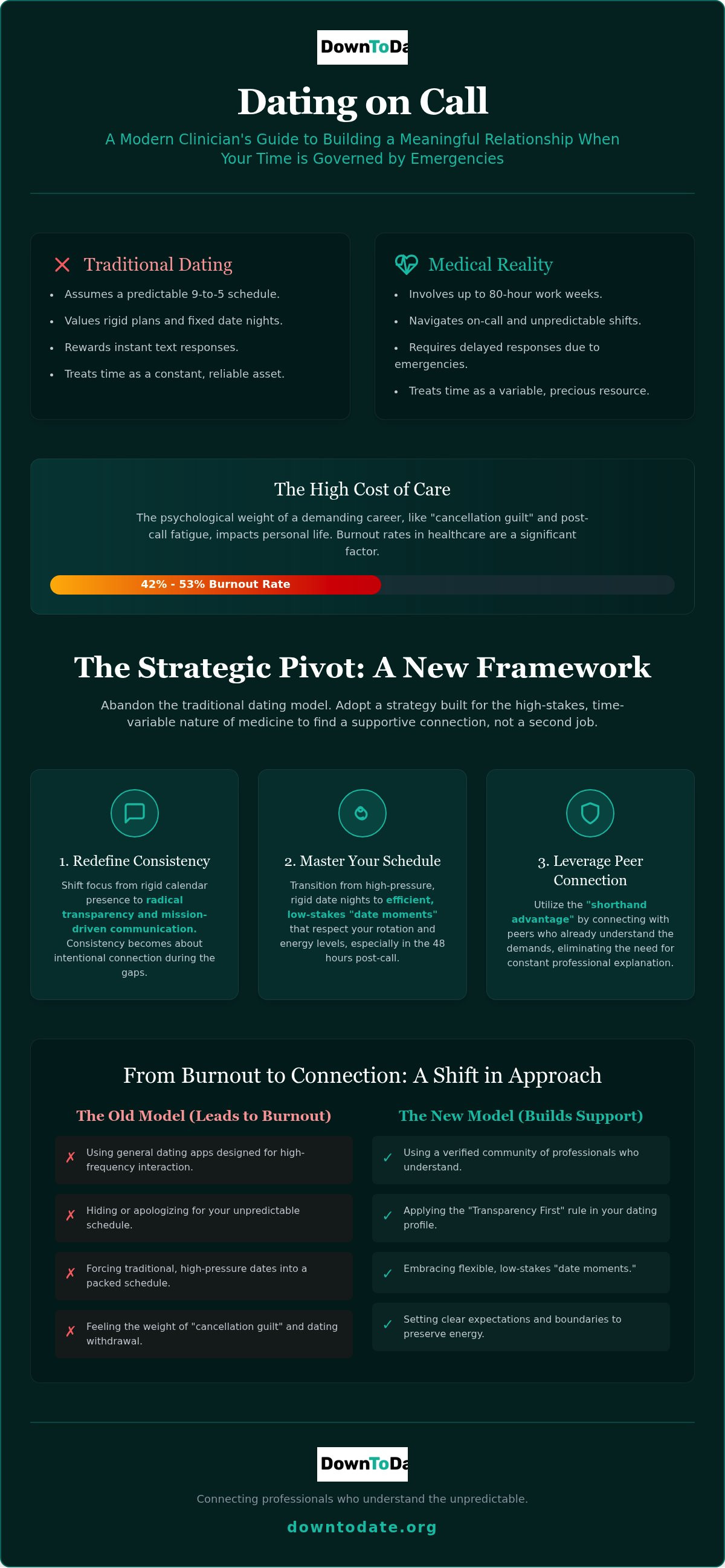
- Abandon the traditional 9-to-5 dating model. Adopt a strategy built for the high-stakes, time-variable nature of modern medicine.
- Redefine consistency. Focus on radical transparency and mission-driven communication rather than physical calendar presence.
- Master dating with an unpredictable schedule. Transition from rigid date nights to efficient, low-stakes date moments that respect your rotation.
- Utilize the shorthand advantage. Connect with peers who respect your mission and eliminate the need for constant professional explanation.
- Leverage a verified community. Ensure your limited personal time is spent with high-value individuals who share your standards and lifestyle.
The Reality of Dating with an Unpredictable Schedule in Medicine
Traditional dating advice is built for a world you don't inhabit. It assumes a Friday night is always free. It assumes a text can be answered in minutes. It assumes a plan made on Monday will happen on Saturday. For the medical professional, these assumptions aren't just wrong; they're obstructive. The Reality of Dating with an Unpredictable Schedule involves managing 80-hour work weeks and life-or-death stakes that don't wait for a dinner reservation. In the 2026 healthcare environment, where burnout rates linger between 42% and 53%, your personal time is your most precious asset. You need a strategy that treats time as a variable, not a constant. You need a partner who understands that your absence isn't a choice; it's a calling.
The psychological weight of "cancelation guilt" is a silent relationship killer. You feel the disappointment of your partner. You internalize the frustration of the host at the restaurant. You carry the burden of a career that demands your presence elsewhere. This guilt often leads to dating withdrawal. It leads to the belief that a meaningful relationship is impossible until fellowship ends or attending life begins. We reject this logic. Success requires a strategic pivot away from the standard dating model and toward one built for high-stakes reality.
Shift Work vs. Unpredictable Demands
There is a fundamental difference between working a fixed shift and being on-call. A set night shift allows for a routine, however inverted. An on-call rotation is a state of perpetual readiness. It's the difference between knowing you'll be tired and not knowing if you'll be there at all. Post-call fatigue isn't just physical exhaustion; it's a depletion of the emotional bandwidth required for romantic connection. The medical time-tax is the involuntary surrender of personal milestones to the non-negotiable demands of clinical care. When your energy is spent on patient outcomes, your remaining "social battery" must be used with extreme precision.
The Failure of General Dating Apps
General dating platforms are designed for the "instant response" culture. They reward high-frequency interaction. They penalize silence. For a surgeon in a twelve-hour procedure or a resident in a trauma bay, this model is toxic. Successful dating with an unpredictable schedule requires a partner who understands that a four-hour delay in texting isn't a lack of interest; it's a professional necessity. Explaining the weight of medical trauma to a "civilian" creates a friction that often leads to burnout. You shouldn't have to translate your life before you can share it. General apps prioritize the quantity of matches over the quality of professional compatibility, leaving you to manage a second job you didn't apply for.
Redefining Consistency: Managing Expectations During On-Call Cycles
Consistency is the bedrock of any relationship. In the corporate world, this means showing up at 7:00 PM every Tuesday. In the medical world, this definition fails. For those dating with an unpredictable schedule, consistency must be redefined as a commitment to communication rather than a commitment to a calendar. You are reliable because you keep your partner informed. You are consistent because you prioritize the connection during the gaps in your rotation. This shift in perspective removes the burden of "perfect attendance" and replaces it with the value of "intentional presence."
Success starts with your profile. Adopting a "Transparency First" rule for your dating bio eliminates confusion from the start. Clearly state your profession and the nature of your hours. This isn't about warning people away; it's about attracting those who respect high-stakes commitments. Dating with an unpredictable schedule becomes significantly easier when your partner enters the relationship with eyes wide open. You aren't "too busy" for love. You are a professional with a mission, and your profile should reflect that confidence.
The "First 48 Hours" after a grueling rotation are critical. You are physically present but emotionally depleted. Do not attempt to schedule high-pressure dates during this recovery window. Instead, set boundaries that protect your rest. Explain that your post-call phase is essential for your clinical performance and your long-term relationship health. This isn't an act of avoidance. It's an act of preservation. By being honest about your energy levels, you prevent the resentment that builds when you show up exhausted and distracted.
The Transparency Framework
Disclose your professional reality early. The "First Message" rule suggests that your schedule should be mentioned before the first date is even planned. Use industry-appropriate terminology to signal your lifestyle. Terms like "surgical block" or "residency rotation" establish your standards immediately. Radical transparency builds a foundation of trust before the first date by ensuring both parties understand the stakes involved. It filters for compatibility before you invest your limited time.
Navigating the On-Call Reality
Preparation is the antidote to frustration. Use an "On-Call Disclaimer" for every meeting that overlaps with your duty hours. A simple statement like, "I am on call, and I may be paged out," sets a realistic expectation. If you find yourself dating someone on night shift, maintain the momentum through brief, high-value digital touchpoints. These micro-interactions prove the relationship is a priority, even when the sun is down. Finding a partner who understands these nuances shouldn't feel like a second job. You can streamline this process by joining a verified medical community where your schedule is the norm, not the exception.
Peer Compatibility: Why Shared Professional Demands Simplify Dating
Eliminate the translation layer. When you date within the medical community, you stop being a "busy person" and start being a peer with a shared mission. This is the Shorthand Advantage. You don't explain the stress of a Morbidity and Mortality conference. You don't justify the exhaustion of a 24-hour call. You don't apologize for the pager. Peer-to-peer dating with an unpredictable schedule works because it replaces judgment with empathy. It replaces frustration with recognition. It replaces the "date" with the "mission."
Explanation fatigue is a real threat to medical relationships. Explaining clinical trauma to someone who hasn't seen it is a second job you don't need. A medical peer understands that silence after a shift isn't a lack of interest. It is a necessary period of decompression. This mutual understanding is one of the strongest arguments for why doctors should date other doctors. Shared professional demands don't complicate the relationship. They simplify it by aligning your expectations from day one. You aren't just looking for a partner. You're looking for an ally who understands the stakes.
The Power Couple Dynamic in Medicine
The myth that two busy people can't make it work is a relic of the past. Success in a dual-medical relationship is about finding "Golden Windows." These are the rare, overlapping hours where both rotations align. You don't need a Friday night every week. You need a Tuesday morning coffee. You need a Sunday afternoon walk. Synchronizing residency rotations requires tactical planning, but it yields a partnership built on mutual respect. You aren't competing for time. You are maximizing the time you have. Mutual understanding of burnout creates a support system that is both practical and profound.
Shared Trauma and Emotional Resilience
Medicine carries a weight that is difficult to carry alone. Dating someone who understands the impact of a patient loss provides a unique form of emotional safety. They know why you're quiet. They know why you're distant. They know when to offer support and when to offer space. Medical peers are less likely to take work-related distance personally because they have lived it themselves. They respect the post-shift transition. They value the resilience required to return to the trauma bay the next day. This shared experience creates a bond that civilian pairings often struggle to replicate. It is a connection based on reality, not just romance.
5 Strategic Tactics for Dating When Your Time is Never Your Own
Stop waiting for the perfect window. It doesn't exist. Dating with an unpredictable schedule requires tactical agility rather than rigid planning. You must move from the "Date Night" to the "Date Moment." A date moment is a deliberate choice to connect during a brief gap in clinical duties. It is focused. It is efficient. It is high-value. When your time is governed by on-call shifts and 12-hour rotations, you cannot afford to waste energy on traditional dating scripts that assume a standard work week. You need a strategy that turns the constraints of your profession into a filter for quality.
The "Low-Stakes First Meet" is the foundation of this strategy. For busy residents, the goal of a first meeting isn't a three-hour dinner. It's a quick assessment of chemistry and compatibility. By keeping the initial interaction brief, you reduce the pressure on your schedule and the guilt associated with potential cancelations. If the connection is real, it will survive a shorter format. If it isn't, you've protected your most limited resource. You can find more inspiration in our guide to date ideas for busy doctors.
The Micro-Date Concept
A thirty-minute coffee meet is often superior to a formal evening out. It fits into the "Golden Windows" of a residency rotation. It respects the reality of post-call fatigue. Hospital-adjacent dating is another powerful tool. Meeting at a park or cafe near the medical center allows you to maximize time together without the stress of a long commute. A high-value micro-date for surgical residents is a twenty-minute, hospital-adjacent interaction that prioritizes genuine emotional exchange over the duration or setting of the meet.
Digital Continuity Strategies
Intimacy is built in the gaps. Use voice memos instead of text messages to bridge the distance when your schedules don't align. A voice memo captures tone, humor, and nuance that a flat text cannot replicate. It allows for an asynchronous connection that feels personal and immediate. While the "Shared Calendar" debate is ongoing, syncing schedules can be a powerful tool for logistics, provided it's used to identify opportunities rather than track movements. You can streamline this process by using Premium Membership features to filter for partners with similar professional demands. Stop settling for matches that don't respect your mission. Start matching with verified peers today to ensure your dating strategy is as precise as your clinical practice.
DownToDate: Connecting Professionals Who Understand the Unpredictable
DownToDate wasn't built by a generic tech firm. It was built by physicians who lived the on-call lifestyle. Dr. Shadi Rezai and Dr. Sasan Rezai recognized that the traditional dating landscape was fundamentally broken for clinicians. They saw colleagues struggle with burnout and isolation. They saw relationships crumble under the weight of clinical demands. DownToDate was created to solve these specific professional pain points. It is a platform that addresses the unique hurdles of dating with an unpredictable schedule. It is a tool designed for the way you actually live. It understands that a shift isn't a suggestion. It knows that a 12-hour surgery isn't a ghosting attempt. By creating a space exclusively for medical peers, we eliminate the friction of civilian dating. You no longer have to explain why you're late. You no longer have to apologize for your calling.
The Verification Standard is our gatekeeper. Every member is a verified healthcare professional. This ensures your limited personal time is spent with true peers who share your values and standards. In a world of infinite swiping, we offer a curated environment of mutual respect. You aren't just looking for a date; you're joining a community that values your professional dedication as much as your personal fulfillment. This verification process eliminates the risk of mismatched intent. It guarantees that you're connecting with individuals who understand the weight of your white coat. We protect your time by ensuring every connection is high-quality and high-value.
Efficiency in Matching
Our platform offers advanced filters for specialty and career stage. Whether you're a resident in a high-intensity trauma program or an attending with an established practice, you can find matches that align with your specific demands. This level of granularity ensures that on-call isn't viewed as an excuse. It is recognized as a shared reality for anyone dating with an unpredictable schedule. You can stop managing expectations and start building connections. Join the verified medical community today to streamline your path to partnership.
The DownToDate Philosophy
We believe your time is a non-renewable resource. Our mission is to protect that resource by facilitating peer-level connections that don't require a translation layer. We bridge the gap between professional excellence and personal happiness. You've dedicated your life to the care of others. You deserve a partner who respects that sacrifice. The DownToDate philosophy is built on the belief that a high-stakes career and a meaningful relationship are not mutually exclusive. They are both essential parts of a full life. To the healthcare heroes navigating the 2026 landscape: your mission matters, and so does your heart. Let us help you find the person who understands both.
Prioritize Your Connection Without Compromising Your Calling
Your career demands excellence. Your personal life deserves fulfillment. You don't have to choose between the trauma bay and a meaningful partnership. Success requires a strategic pivot. Redefine consistency as intentional communication. Embrace the shorthand advantage of peer compatibility. Use micro-dates to protect your limited energy. Mastering dating with an unpredictable schedule is possible when you stop apologizing for your mission. You need a platform that speaks your language. You need a community that respects your rotation.
DownToDate was founded by Dr. Shadi Rezai and Dr. Sasan Rezai to solve the specific hurdles of the medical lifestyle. It is a secure, verified community of medical professionals designed for the unique demands of residency and attending life. Stop explaining your schedule. Start connecting with peers who already understand it.
Join DownToDate: The Dating App Where Your Schedule is Finally Understood
You've dedicated your life to medicine. Now, dedicate a moment to yourself. A partnership that respects your calling is not just possible; it's within reach.
Frequently Asked Questions
Is it possible to have a serious relationship with an unpredictable medical schedule?
Yes, success is entirely possible when you prioritize the quality of your connection over the quantity of your hours. Building a serious relationship while dating with an unpredictable schedule requires a partner who views time as a variable rather than a constant. You must replace traditional dating scripts with radical transparency and intentional presence. Focus on making the most of your clinical gaps to build a foundation of mutual respect and shared mission.
How do I tell someone I’m dating that I’m on call without sounding uninterested?
Use direct, declarative language that frames your schedule as a professional mandate rather than a personal choice. State clearly, "I am on a mandatory on-call rotation, but I am looking forward to our next window of time together." This approach signals high interest while maintaining necessary professional boundaries. It replaces vague excuses with mission-driven transparency. Authentic partners will respect the weight of your clinical obligations when you communicate them with confidence.
Why do medical professionals struggle with general dating apps?
General platforms are designed for an instant-response culture that penalizes the silence of a twelve-hour surgical block. They reward high-frequency interaction and standard work weeks, which are incompatible with residency or attending life. Clinicians often face explanation fatigue when trying to justify their hours to those outside the field. These apps prioritize high-volume swiping over the professional compatibility and shared shorthand required for a successful medical pairing.
What are the best date ideas for doctors with limited free time?
Prioritize low-stakes micro-dates that maximize connection and minimize logistics. A thirty-minute coffee meet near the medical center or a brief walk between shifts allows for genuine interaction without the pressure of a formal dinner. High-value dates are defined by focused attention rather than duration. Choose hospital-adjacent locations to protect your limited energy and ensure you can respond to clinical demands if necessary.
Should I date another doctor or someone outside the medical field?
Dating a fellow clinician offers the shorthand advantage of shared professional demands and emotional resilience. A peer understands the weight of a patient loss and the exhaustion of a 24-hour call without needing a translation. While dating outside the field can provide a healthy escape from medicine, it often requires more effort to bridge the lifestyle gap. The right choice depends on whether you value a partner who lives your reality or one who offers a different perspective.
How do I handle the guilt of canceling a date for a medical emergency?
Accept that a clinical emergency is a professional requirement and not a personal failing. Mitigate disappointment by offering a concrete plan for a make-up moment as soon as your rotation allows. A partner who respects your calling will understand that your absence is a necessity of the profession. Shift your internal narrative from guilt to professional integrity. Your commitment to your patients is a reflection of the character you bring to a relationship.
Can a relationship work if both partners have unpredictable schedules?
Dual-medical relationships thrive on mutual empathy and tactical planning. Both partners understand that the pager is non-negotiable, which eliminates the need for constant apologies. You must work together to identify Golden Windows where your rotations overlap and protect that time fiercely. This shared understanding of burnout and high-stakes pressure often creates a deeper, more resilient bond than standard pairings. It is a partnership built on reality.
How does DownToDate verify its members?
DownToDate maintains a rigorous verification standard to ensure every member is a legitimate healthcare professional. This process creates a secure, exclusive community where your time is spent only with true peers. It filters for individuals who share your high standards and understand the specific hurdles of a medical career. By verifying every user, we protect the integrity of the community and ensure that your search for connection is both efficient and authentic.


