

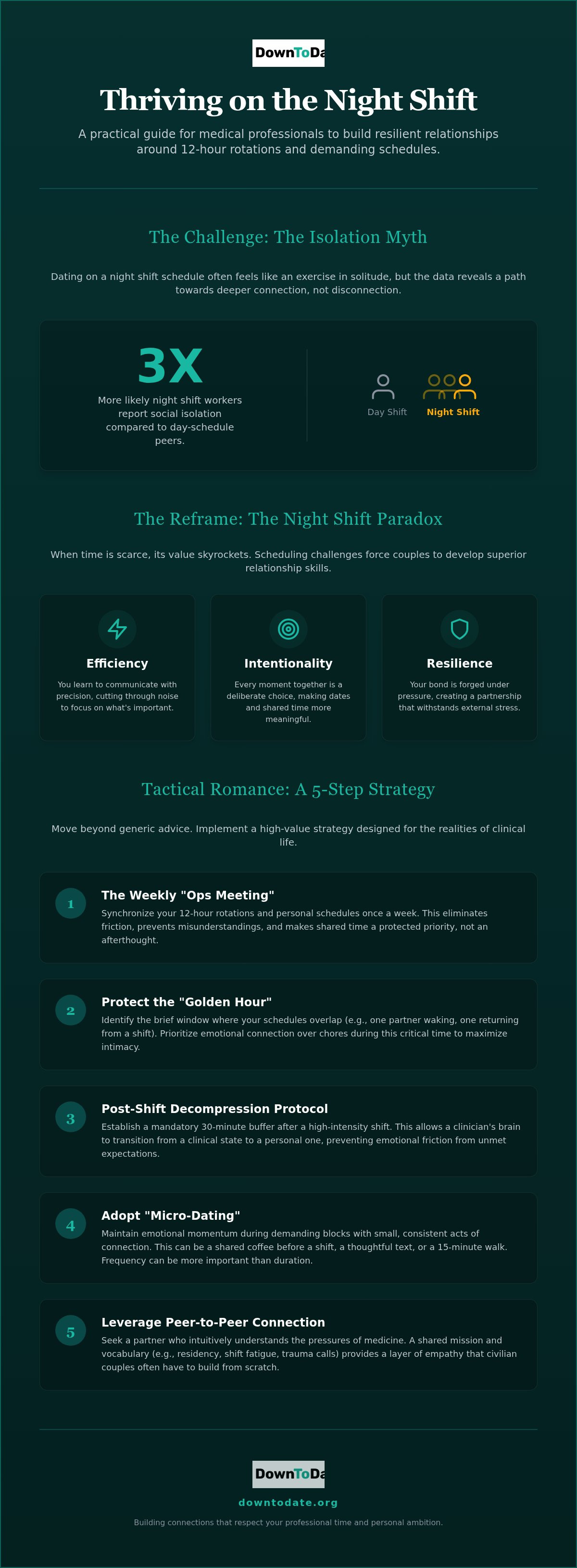
What if your 12-hour rotation isn't the relationship killer you've been told it is? For many medical professionals, dating someone on night shift feels like an exercise in perpetual solitude. A 2025 study found that night shift workers are three times more likely to report social isolation compared to those on a typical schedule. You miss the birthdays. You miss the dinners. You miss the quiet moments that define a typical Tuesday. You exist in a cycle of chronic sleep deprivation that leaves your mood frayed and your connection thin. It's easy to feel like you're just two ships passing in the night, drifting further apart with every graveyard shift.
We understand the pressure of the clinical environment because we've lived it. You don't need flowery romanticism; you need a practical, high-value strategy. This article will show you how to transform these scheduling hurdles into a foundation for a resilient, sustainable partnership. We're busting five common myths that hold healthcare workers back. From creative ways to maintain intimacy to building a communication plan that actually works, you'll discover that your career and your love life can coexist. It's time to move past the myths and start building a connection that respects your professional time and your personal ambition.
Key Takeaways
- Synchronize your 12-hour rotations with a weekly "Ops Meeting" to eliminate scheduling friction and prioritize shared time.
- Identify and protect the "Golden Hour" to maximize emotional intimacy during your limited crossover windows.
- Discover why dating someone on night shift is a manageable challenge that often leads to a more resilient, high-value partnership.
- Leverage peer-to-peer connections to find a partner who intuitively understands the demands of residency and shift fatigue.
- Adopt micro-dating strategies to maintain emotional momentum even during your most demanding clinical blocks.
The "Opposite Schedule" Myth: Why Night Shifts Don’t Have to Mean Loneliness
The myth is pervasive. The graveyard shift is a relationship killer. These are common refrains in hospital breakrooms. However, they ignore a fundamental truth. Dating someone on night shift doesn't require a miracle; it requires a strategy. We call this the Night Shift Dating Paradox. When time becomes your most scarce resource, its value skyrockets. You stop wasting hours on mindless scrolling. You start investing every available minute into genuine connection.
In 2026, healthcare accounted for 47.5% of all job growth in the U.S. The 12-hour rotation is now the industry standard. Your schedule isn't an anomaly. It is the reality of modern high-stakes medicine. This section serves as a peer-led guide. We've navigated the residency blocks and the on-call pagers. We know that a sustainable relationship isn't built on the quantity of hours spent together. It's built on the quality of the presence you bring to those hours.
The Psychology of the Nocturnal Professional
Working while the world sleeps creates a unique psychological friction. Social jetlag is the physiological and social strain caused by the misalignment between a clinician's internal circadian rhythm and the social requirements of a world that operates on a standard daytime schedule. It's more than being tired. It's feeling out of sync with the people you love. Despite the challenges of shift work, medical professionals have a distinct advantage. A shared medical mission provides a layer of empathy that civilian couples often lack. When both partners understand that a trauma call isn't a choice, the friction of the schedule begins to dissolve.
Validation: Your Career is Not the Enemy
Your career is a source of pride. It is not a barrier to love. Many dating guides suggest you should work less or find a new role to save your relationship. This is civilian advice. It fails because it treats your professional ambition as a problem to be solved. In reality, the night shift is often a strategic season of growth. It's a time for residency, specialized training, or financial building. High-value partners understand that professional excellence and personal connection are not mutually exclusive.
- Efficiency: You learn to communicate with precision.
- Intentionality: Every date is a deliberate choice.
- Resilience: You build a bond that withstands external pressure.
We are setting the stage for a tactical approach. You don't need to change your job. You need to change your methodology. By focusing on high-value connection rather than clock-watching, dating someone on night shift becomes a foundation for a stronger, more intentional bond.
The Science of Nocturnal Connection: Managing Sleep and Intimacy
Sleep is not merely a biological requirement for the clinician. It is an emotional requirement for the partner. When your circadian rhythm is fractured, your capacity for empathy is the first thing to erode. Research demonstrates that shift work creates profound pressure on health, family, and social life, often manifesting as irritability and emotional withdrawal. Dating someone on night shift requires you to view sleep hygiene as a romantic necessity. If you are chronically sleep-deprived, you are not just tired. You are emotionally unavailable. Protecting your rest is the most practical way to protect your relationship.
Success lies in the "Golden Hour." This is the narrow window of crossover energy when one partner is waking up and the other is returning from the hospital. It is a high-stakes transition. You must prioritize connection over chores during this time. You must also manage the "Post-Shift Decompression" period. After a high-intensity trauma rotation, your brain is still in a clinical state. Alienation occurs when a partner expects immediate social engagement while you are still processing the shift. Establish a clear, 30-minute buffer. It allows you to transition from the hospital to the home without the friction of unmet expectations.
Circadian Synchronicity for Couples
Aligning "awake windows" is a tactical necessity. It is not about sacrificing sleep; it is about maximizing overlap. High-value couples often utilize "Parallel Play" to maintain proximity. This involves being in the same space while performing separate tasks, such as one partner charting while the other reads. It builds a sense of togetherness without demanding constant social output. When you are in the "Zombie State" after a 12-hour block, physical presence is often more valuable than complex conversation. Acknowledge the fatigue. Be present anyway.
Protecting Intimacy in the Dark
In a 24-hour medical environment, spontaneity is a luxury. Scheduling intimacy is not "unromantic." It is a sophisticated solution for high-stakes professionals. By planning for connection, you ensure that intimacy remains a priority rather than a leftover. Focus on non-physical anchors during high-stress blocks. A five-minute connection ritual, such as a specific morning text or a shared coffee before you sleep, provides a sense of stability. Finding a partner who understands these biological constraints is essential. You may find that a medical-only community simplifies this process by connecting you with peers who already respect the nocturnal lifestyle.
- The 30-Minute Buffer: Protect your transition from clinician to partner.
- Scheduled Presence: Treat intimacy with the same professional respect as a clinical rotation.
- Connection Rituals: Use small, repetitive actions to signal commitment during busy weeks.
Myth vs. Reality: Debunking the Top 3 Misconceptions of Night Shift Dating
Social media tropes suggest that the graveyard shift inevitably leads to infidelity or isolation. This is false. High-value professionals don't drift apart because of the clock; they drift apart because of a lack of intentionality. Research shows that shared professional struggle can actually solidify a bond. It creates a "us against the world" dynamic that standard nine-to-five couples rarely experience. When you are dating someone on night shift, you aren't fighting the schedule. You are fighting the lack of a system. Constraints do not destroy intimacy. Constraints breed creativity. They force you to be more deliberate with your words and more protective of your shared time.
The second myth is that you cannot date someone with a "normal" schedule. This assumes that a relationship requires constant, synchronous presence to survive. In reality, many successful couples thrive with different operating hours. It allows for individual autonomy and professional focus. The third myth is that communication only counts if it happens in real-time. This is a trap. Waiting for a live phone call between a 2 a.m. trauma surge and an 8 a.m. wake-up call is a recipe for frustration. True connection is about the consistency of the message, not the timing of the delivery.
The "Relationship Killer" Fallacy
The idea that night shifts are a death sentence for romance is a fallacy. High-stress desk jobs and frequent corporate travel present similar hurdles. The difference is the mindset. Successful dating for doctors requires a shift from passive participation to active management. You must treat your relationship with the same professional rigor you apply to a clinical rotation. When both partners view the schedule as a manageable variable rather than an insurmountable obstacle, the bond strengthens. You aren't just partners. You are a high-functioning team navigating a complex environment together. This shared resilience is a hallmark of high-value medical partnerships.
Asynchronous Communication Strategies
Real-time conversation is a luxury. Asynchronous communication is your primary tool. Voice notes are far more effective than text messages. They carry the nuance of your tone and the warmth of your voice, bridging the gap when you are dating someone on night shift. Consider creating a shared digital space, such as a private cloud folder or a dedicated app, for non-urgent life updates. This allows your partner to feel included in your daily life without waking you up during your critical rest periods. You must also establish "Quiet Hours." This is a protocol where notifications are silenced to prevent sleep disruption. It is an act of respect. It signals that you value your partner's health as much as their company. Digital love notes left in these shared spaces provide a sense of continuity that survives even the most demanding 12-hour rotations.
- Voice Notes: Record your thoughts when you have the energy; they listen when they wake.
- Shared Digital Spaces: Centralize your planning and memories outside of active chat threads.
- Quiet Hours Protocol: Protect each other’s sleep cycles through disciplined notification management.
Tactical Romance: How to Build a Relationship Around 12-Hour Rotations
Generic relationship advice often fails medical professionals because it assumes a surplus of time. Suggestions to "take a spontaneous weekend trip" are impractical for residents or nurses with limited PTO and rigid rotations. Success requires a tactical approach. You don't need more time; you need better systems. Dating someone on night shift demands professional-grade planning. It requires you to treat your partnership with the same logistical rigor you apply to a patient handoff. When you move from passive participation to active management, the schedule stops being an obstacle and starts being a variable you can control.
The first step is the Sunday Night Ops Meeting. This is a non-negotiable weekly session to synchronize your calendars. Identify the 12-hour blocks where you are both awake and available. Map out the on-call windows. When you visualize the week ahead, you eliminate the friction of unmet expectations. Follow this with the practice of micro-dating. Dating someone on night shift often means finding value in 15-minute coffee windows before a shift begins. These small, high-intensity interactions maintain emotional momentum during busy clinical blocks. Finally, establish a No-Phone Zone. When your schedules finally align, presence is your most valuable currency. Radical transparency regarding your social battery is also essential. If a high-acuity shift has left you depleted, communicate that clearly to avoid misunderstandings.
High-Value Date Ideas for the Time-Poor
Standard dinner dates are often incompatible with a nocturnal schedule. Breakfast dates are the new high-value alternative. They fit perfectly into the window when one partner is finishing a shift and the other is starting their day. If time is exceptionally tight, integrate your chores into your quality time. A grocery store date is a practical way to handle domestic needs while maintaining connection. For more inspiration, explore these specific date ideas for busy doctors that prioritize connection over complexity. Efficiency is not the enemy of romance; it is the facilitator of it.
Handling "On-Call" Anxiety Together
On-call cycles introduce a layer of unpredictability that can strain a relationship. You must set clear expectations for interrupted dates before they happen. The non-medical partner can provide clinical support by managing meals or ensuring a quiet environment for recovery. The On-Call Buffer is a pre-negotiated emotional boundary that acknowledges the potential for professional interruption without assigning personal blame. By defining this boundary, you protect the relationship from the resentment that often follows a paged-out evening. If you are looking for a partner who already understands these unique pressures, you can join our verified medical community to find connections that respect your professional reality.
- The Sunday Ops Meeting: Synchronize logistics to eliminate scheduling friction.
- Micro-Dating: Prioritize 15-minute high-value windows over non-existent four-hour dinners.
- The On-Call Buffer: Establish emotional boundaries for professional interruptions.
Why Peer-to-Peer Dating is the Ultimate Night Shift Solution
The ultimate solution to the logistical friction of a 12-hour rotation isn't found in a better calendar app. It's found in the person you choose to date. When you are dating someone on night shift who also works in healthcare, the need for constant explanation disappears. You don't have to explain why you are too exhausted to talk after a high-acuity trauma shift. You don't have to justify why you need to sleep until late afternoon on a Tuesday. A peer understands the weight of clinical responsibility because they carry it too. This intuitive understanding is the foundation of a high-value relationship that thrives within the 24/7 medical world. You aren't fighting for attention. You are supporting a shared mission.
Shared professional standards lead to shared relationship integrity. In the medical field, we value verification, reliability, and commitment. These traits are easily translated into a partnership. When both partners operate under the same high-stakes pressure, they develop a mutual respect for each other's time and energy. You stop viewing the shift as an enemy. You start viewing it as a shared reality. This alignment eliminates the emotional toll of "social jetlag" because your partner is living in the same time zone, both biologically and professionally. It creates a streamlined path to partnership that respects your time and your ambition.
The Advantage of a Medical Peer Match
There is a distinct advantage to a medical peer match. It solves the friction of scheduling by replacing frustration with empathy. We have analyzed why doctors should date other doctors and other healthcare professionals to eliminate the "ships passing in the night" syndrome. It creates a shared language where "I had a rough shift" is a complete sentence. It requires no further breakdown of medical trauma or shift fatigue. This shared experience fosters a "Power Couple" dynamic. You aren't just navigating a schedule; you are building a life with someone who respects the same professional standards and relationship integrity that you do. You understand the pager. You understand the exhaustion. You understand the pride.
DownToDate: Built for the 2026 Medical Lifestyle
DownToDate was built specifically for the 2026 medical lifestyle. We recognize that dating someone on night shift requires a higher level of verification and intentionality. Our platform acts as a protective gatekeeper. Every profile is verified to ensure you are meeting peers who share your values and professional commitment. You aren't meeting tourists. You are meeting clinicians. With a Premium Membership, you can access advanced filtering to find partners who already respect the nuances of residency and on-call rotations. You are not looking for someone to tolerate your schedule. You are looking for someone to share it. It is time to stop compromising on your personal connection. Join the community built for your schedule and find a partner who understands the life you've chosen.
- Verified Peers: Connect with professionals who share your clinical background.
- Schedule Alignment: Use Premium filters to find partners who understand the 12-hour rotation.
- Shared Mission: Build a relationship based on mutual respect for the medical career path.
Own Your Schedule and Your Connection
The graveyard shift is not a sentence for loneliness. It's a call for professional-grade intentionality. You've learned that dating someone on night shift is a manageable variable when you prioritize quality over clock-watching. By adopting tactical romance through weekly synchronization and micro-dating, you transform scheduling hurdles into a foundation for resilience. A sustainable relationship in medicine doesn't happen by accident. It happens by design. You deserve a partner who respects the weight of your 12-hour rotation and the depth of your ambition. Stop explaining your lifestyle to people who don't understand the clinical mission.
DownToDate is a verified medical community founded by doctors for doctors. We provide the advanced search filters you need to find peers who truly get the nocturnal life. It's time to build a partnership that works with your career, not against it. Find a partner who understands your 12-hour shift on DownToDate. Your career and your love life can coexist. Let's make it happen.
Frequently Asked Questions
Is it possible to date someone on a 9-to-5 schedule if I work nights?
Yes, it is entirely sustainable if you prioritize quality over clock-watching. It requires you to treat your shared time with the same precision as a clinical handoff. You must move past the deficit mindset and focus on the intentionality of your crossover awake windows.
How do we handle missing holidays and family events due to my night shift?
You must redefine the calendar. Medical professionals often work while the world celebrates. Celebrate holidays on your first day off instead of the official date. This observed holiday strategy ensures you don't miss the connection, even if you miss the specific date on the calendar.
What are the best ways to communicate when our waking hours don’t overlap?
Asynchronous communication is your primary tool. Voice notes are superior to text because they carry the nuance of your tone. Using shared digital folders for non-urgent life updates allows your partner to feel included without waking you during critical rest periods.
Should I feel guilty for sleeping while my partner is awake and wants to spend time together?
No. You must eliminate the guilt. Sleep is a biological requirement for your health and a professional requirement for patient safety. When dating someone on night shift, both partners must view rest as a non-negotiable boundary. Protecting your sleep is an act of respect for the relationship.
How can we maintain a sex life with opposite work schedules?
You must schedule intimacy. While spontaneity feels romantic, planning ensures that physical connection does not become a leftover. Treat your intimate time with the same respect as a surgical rotation. It ensures that your bond remains a priority despite the 12-hour rotations.
Does dating another medical professional make the night shift easier or harder?
It generally makes the experience easier. A fellow clinician understands the weight of a trauma call or the exhaustion of residency without needing a detailed debrief. Dating someone on night shift who shares your medical background eliminates the friction of explaining shift fatigue or clinical trauma.
What is the "Golden Hour" in night shift relationships?
The Golden Hour is the brief crossover window where one partner is waking up and the other is returning from the hospital. It is a high-stakes transition period. Prioritize presence over chores during this time to maximize emotional connection before your schedules diverge again.
How do I explain my medical shift fatigue to a non-medical partner?
Explain fatigue as a physiological state rather than an emotional choice. Use terms like clinical depletion or social battery to describe the cognitive load of a 12-hour shift. This helps a non-medical partner understand that your need for quiet is a recovery process, not a withdrawal from them.


