

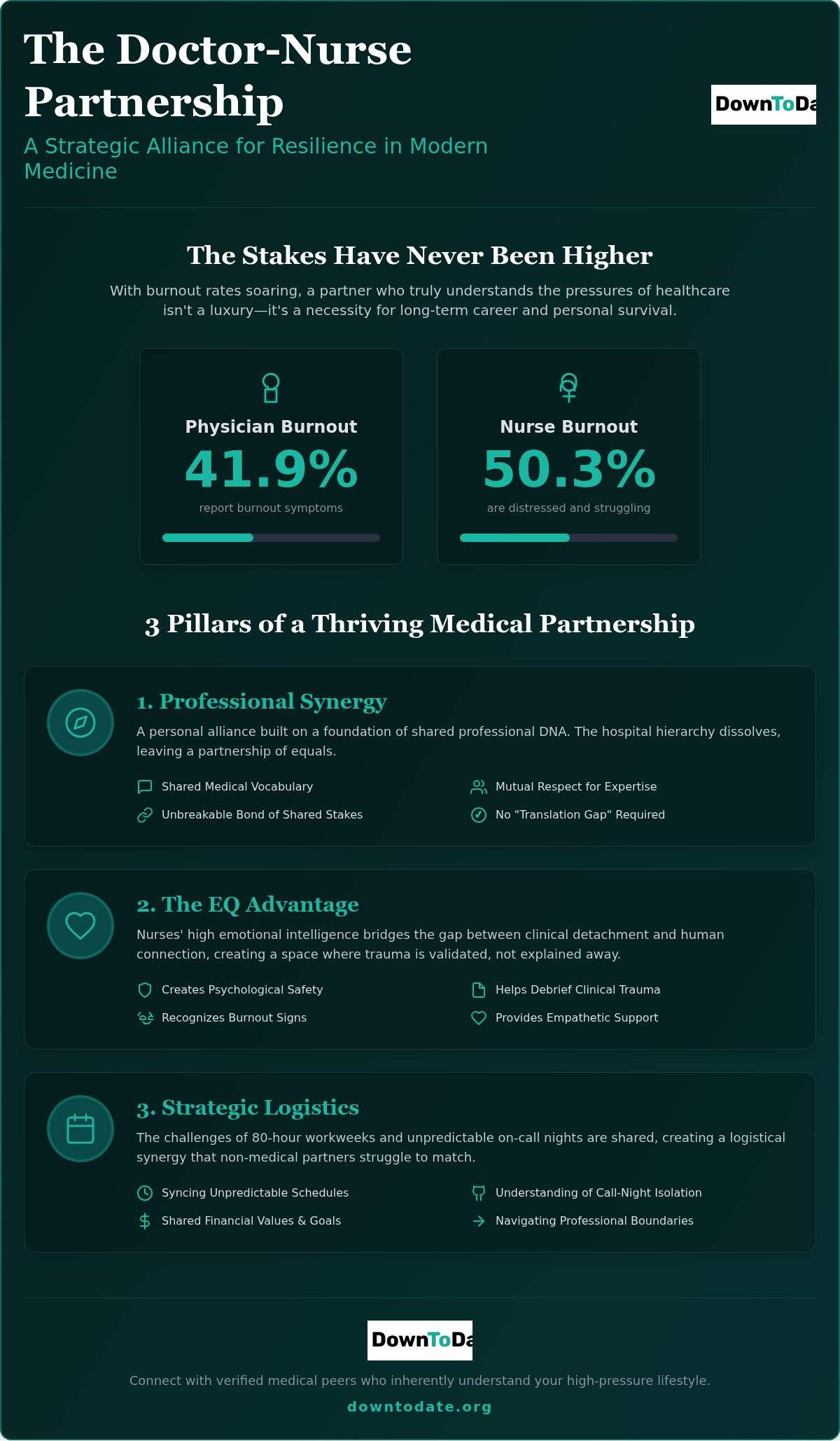
A partner who understands the difference between a routine shift and a clinical trauma isn't a luxury. It's a strategic necessity for long-term career survival. With 41.9 percent of physicians and over half of all nurses reporting burnout symptoms in 2025, the stakes for your personal life have never been higher. You need more than a companion. You need a peer who recognizes the weight of the white coat. This is exactly why doctors should date nurses to create a resilient, high-value partnership that thrives despite the pressures of the modern healthcare system.
You already know the toll of an 80-hour work week. You understand the isolation of being on-call while the rest of the world sleeps. Most partners struggle to comprehend why you can't just leave work at work. A nurse doesn't need an explanation; they have lived the same reality. Discover why the doctor-nurse dynamic creates the most resilient, empathetic, and logistically compatible partnerships in the healthcare world. We will examine the strategic advantages of shared scheduling, deep emotional synergy, and the profound relief of finding a partner who inherently understands the medical lifestyle.
Key Takeaways
- Move beyond clinical tropes to understand how shared medical context creates a foundation of genuine professional respect.
- Explore how a nurse's high emotional intelligence provides the necessary grounding for doctors managing high-stakes clinical stress.
- Identify the logistical synergy that explains why doctors should date nurses to solve the challenges of unpredictable schedules.
- Learn to navigate professional boundaries and workplace stigma with strategies designed to maintain decorum and protect your career.
- Access a streamlined path to partnership by connecting with verified medical peers who inherently understand your high-pressure lifestyle.
The Professional Synergy Between Doctors and Nurses
A medical partnership is built on more than shared workspace. It is built on shared stakes. It is built on the silent understanding that follows a difficult shift. This is the strategic reality of why doctors should date nurses. You aren't just finding a partner. You are finding a peer who speaks your language. Forget the dramatized scripts of Grey’s Anatomy. Real life in the ward is not a series of cinematic romances. It is a grueling, coordinated effort to preserve life. This fundamental alignment is a primary reason why doctors should date nurses in 2026. The partnership moves beyond the surface to something more durable. It transforms a professional collaboration into a personal alliance.
Precision matters. Accuracy saves lives. In a partnership, this shared commitment to excellence creates an unbreakable bond. This collaborative spirit is rooted in The Professional Synergy Between Doctors and Nurses, a concept that emphasizes how different roles learn to work as a cohesive unit. When this synergy moves from the hospital floor to the home, it creates a foundation of mutual professional respect that non-medical partners often struggle to replicate. You don't have to explain the weight of a high-stakes decision. Your partner already knows.
Shared Vocabulary and Immediate Understanding
The logistical hurdles of dating for doctors vanish when your partner speaks the same dialect. You don't have to explain what a Code Blue entails. You don't have to translate the exhaustion of a 24-hour call. The translation gap that plagues relationships with non-medical partners simply does not exist here. There is a profound relief in coming home to someone who understands the stakes without a glossary of terms. Clinical empathy is the bedrock of these relationships; it is the intuitive grasp of a partner’s professional trauma and triumph without the need for a preamble. It is the ability to internalize a partner's professional burden because you have carried it yourself.
Mutual Respect for Professional Expertise
Doctors value the frontline resilience of nurses. They see the observational skills required to catch a patient’s decline before the monitors even beep. This respect is not just professional. It is personal. When you recognize each other’s expertise at the bedside, it translates to a peer-to-peer emotional alliance at home. The hospital hierarchy dissolves in the private sphere. What remains is a partnership of equals who understand the weight of responsibility. They know the rhythm of the unit. They know the pressure of the pager. They know the silence of the drive home. This shared experience creates a level of support that is both practical and deeply emotional.
The Emotional Intelligence Factor in Healthcare Partnerships
Clinical excellence requires a degree of detachment. You learn to compartmentalize. You learn to prioritize the data over the distress. While this skill is necessary for survival in the OR or the ER, it can create a wall in your personal life. Nurses possess a high degree of emotional intelligence (EQ) that is essential for patient advocacy. This EQ is not just a professional tool. It is a relational asset. It bridges the gap between clinical logic and human connection. This emotional fluency is a primary reason why doctors should date nurses. They don't just see the physician. They see the person behind the practice.
Compassion fatigue is a collective burden. In 2025, with 50.3 percent of nurses classified as distressed and struggling, the need for mutual support is undeniable. You cannot manage this weight in isolation. A nurse partner understands the nuances of patient loss and systemic frustration. They recognize the signs of burnout before you do. This shared awareness creates a level of psychological safety that is impossible to find elsewhere. You can drop the professional mask. You can exist in a space where your trauma is validated rather than explained away.
Processing Clinical Trauma Together
The 'second victim' phenomenon is a reality of modern medicine. It is the psychological impact on a provider following an adverse clinical event. A nurse partner provides the ultimate decompression chamber. They know the difference between a day that requires a detailed debrief and a day that requires absolute silence. They understand that some shifts leave you hollow. This intuitive support system is vital for long-term mental health. If you are looking to connect with verified medical peers who understand these complexities, finding a partner with shared values is the first step.
Resilience as a Shared Value
Medical professionals are uniquely equipped for crisis. You are trained to maintain a 'calm in the storm' mentality. When life presents non-medical emergencies, this shared resilience becomes the household's greatest strength. You don't panic. You triage. You solve the problem together. This shared approach to adversity prevents relationship burnout. It ensures that the stresses of home never feel as overwhelming as the stresses of the unit. You are two experts in high-stakes environments. You are a team designed for durability. This is exactly why doctors should date nurses in a world that demands constant adaptability.
Strategic Logistics: Syncing Schedules and Managing Burnout
Time is the most expensive currency in medicine. You don't have enough of it. You certainly don't have enough to spend explaining your schedule to someone who works a standard nine-to-five. This is a core reason why doctors should date nurses. A nurse partner understands the tactical reality of the hospital. They know a late surgery isn't an excuse to avoid a date. It's a clinical fact. They don't resent the pager. They respect it. This shared understanding of dating with an unpredictable schedule creates a partnership built on logistical stability rather than constant friction.
Your circadian rhythms are likely out of sync with the rest of society. You eat when you can. You sleep when the schedule allows. When both partners are in the medical field, you achieve a shift-work synergy. You understand the physiological toll of a night rotation. You don't demand social energy when your partner has just finished a 12-hour stretch. Instead, you prioritize quality over quantity. You build a life that respects the biological demands of the job. You optimize the hours you have. This operational efficiency is exactly why doctors should date nurses to protect their personal well-being.
The Reality of the 12-Hour Rotation
Dating someone on the night shift often leads to guilt in traditional relationships. In a medical partnership, it leads to strategic planning. You master the art of parallel rest. You sleep together. You recharge together. You exist in the same quiet frequency. Logistical empathy is the intuitive understanding that your partner's availability is dictated by patient needs, not personal choice. It is the foundation of a low-friction household where rest is valued as much as activity.
Shared Financial and Career Goals
Medicine is a long-term investment. The training is grueling. The specialization takes years. A nurse partner is often equally career-driven and high-achieving. They understand the grind because they are in it. For those in transition, dating for travel nurses offers a unique alignment with a doctor’s residency or fellowship rotations. You are both moving toward professional excellence. You are both comfortable with the sacrifices required to get there. This alignment ensures that your personal life supports your professional trajectory rather than hindering it. You are two experts moving in the same direction.
Navigating Professional Boundaries and Workplace Stigma
Workplace gossip is the primary deterrent for many medical professionals. The fear of HR complications or unit-level drama often prevents meaningful connections from forming. However, the stigma of "dating on the unit" shouldn't overshadow the profound benefits of a shared medical lifestyle. You need a strategy that protects your career while pursuing connection. This is exactly why doctors should date nurses through channels that prioritize privacy and professional distance. By meeting peers who don't work in your immediate department, you eliminate the friction of daily oversight and the risk of perceived favoritism. Privacy is non-negotiable. Professionalism is a prerequisite.
The most effective way to bypass workplace stigma is to meet medical peers outside your immediate clinical environment. A peer-exclusive dating community acts as a necessary gatekeeper. It ensures that your personal life remains distinct from your professional obligations while still allowing you to connect with someone who understands the medical world. This approach allows you to build a foundation of trust before you ever have to navigate the complexities of hospital politics. You deserve a space where your credentials are valued and your privacy is protected.
Managing the Workplace Power Dynamic
Modern medicine is shifting toward interprofessional collaboration, but legacy hierarchies still exist in the minds of some administrators. A successful relationship requires an active effort to dismantle these dynamics at the front door. You aren't a resident and a staff nurse at dinner. You are two people with shared values and individual professional identities. Hierarchy belongs in the chart, not the home. Setting firm boundaries is essential for long-term success. One of the most effective strategies is a "no shop talk" rule during dedicated date nights. This prevents clinical stress from bleeding into your personal sanctuary and helps mitigate the risk of cumulative burnout.
Meeting Outside the Hospital Walls
General dating apps are a distraction for the high-achieving medical professional. They don't verify credentials. They don't understand the 80-hour work week. They fail to filter for the specific needs of healthcare workers. Transitioning from colleagues to partners is easier in a neutral space where the focus is on personal compatibility rather than clinical tasks. Specialized platforms that verify medical credentials provide a layer of security that general apps cannot match. If you are ready to find a partner who shares your dedication, it is time to apply for a Premium Membership within a verified community. This focused approach ensures that every connection you make is with someone who truly "gets" the lifestyle. This strategic separation of work and romance is why doctors should date nurses in a way that respects both their career and their heart.
Cultivating a Peer-to-Peer Medical Connection with DownToDate
Finding the right partner in the medical field requires a tool as specialized as your clinical training. General platforms treat your 80-hour work week as an outlier. We treat it as the standard. This is the ultimate reason why doctors should date nurses through a platform designed specifically for their unique reality. DownToDate isn't just another dating app. It is a secure, verified community. It eliminates the noise of the general dating market. It replaces it with a streamlined path to partnership. A medical partnership isn't just a romance; it is a strategic alliance built on a foundation of mutual professional respect.
You have already seen how shared logistics and emotional intelligence create a resilient bond. Now, you need the infrastructure to find that connection safely. DownToDate Premium Membership simplifies the search for high-achieving, empathetic partners. It removes the guesswork from the process. It ensures that every person you meet understands the weight of the white coat and the rhythm of the ward. This is the elite standard for connecting doctors and nurses in 2026. It is where professional commonality becomes personal compatibility.
Dating Built for the Medical Lifestyle
The medical life doesn't follow a standard clock. Your dating app shouldn't either. DownToDate features filters that account for residency cycles, specific specialties, and unpredictable schedules. This is the security of a platform founded and operated by fellow physicians, Dr. Shadi Rezai and Dr. Sasan Rezai. They lived the same hurdles you face today. They designed a solution that respects your time and your privacy. Every member is verified. Every profile represents a peer. This protective gatekeeping ensures that you start your journey toward finding a partner who truly understands your "why" without the need for constant explanation.
The Future of Medical Power Couples
Two healthcare professionals are better equipped for the future of medicine than any other pairing. They build households that value health. They value science. They value service. This shared value system creates a medical power couple capable of navigating the systemic pressures of the 2026 healthcare landscape. You aren't just sharing a home; you are sharing a mission. The long-term benefits of this alignment are clear. You achieve a level of domestic stability that supports your professional growth rather than hindering it. This is exactly why doctors should date nurses to build a life that is both logistically sound and deeply purposeful. Join DownToDate today to meet medical peers who share your world.
Building Your Medical Power Couple
The case for medical partnerships is clear. It is a strategic decision for your personal and professional longevity. You have seen how shared vocabulary eliminates the translation gap. You understand how logistical empathy solves the crisis of unpredictable schedules. You recognize that emotional intelligence is the antidote to clinical burnout. This is the ultimate reason why doctors should date nurses to build a life that is both durable and deeply understood. You are two experts. You are one team. You are a strategic alliance.
You don't have to navigate the high-pressure world of medicine alone. You deserve a partner who inherently understands the weight of your responsibilities. DownToDate provides the infrastructure for these elite connections. It is a platform founded by medical professionals who lived the same hurdles you face. It offers secure peer-to-peer verification. It is specifically tailored for healthcare schedules. It respects your time. It protects your privacy.
Start meeting verified medical peers on DownToDate today. Your ideal partnership is waiting in a community that speaks your language. Take the first step toward a resilient future today.
Frequently Asked Questions
Is it unprofessional for a doctor to date a nurse in the same hospital?
Professionalism depends on individual facility policies and the presence of a power differential. The National Institutes of Health (NIH) strongly discourages relationships where one partner has authority over the other. Most hospitals require disclosure to HR to prevent conflicts of interest or favoritism. As long as you maintain strict decorum on the unit, many facilities allow these relationships to proceed without career repercussions.
What are the biggest challenges when a doctor dates a nurse?
Cumulative burnout and the risk of "bringing the hospital home" are the primary hurdles. When both partners face high-stress clinical environments, it is easy for the relationship to become a second debriefing session. You must consciously set boundaries to prevent clinical trauma from dominating your personal time. Shared exhaustion can also make it difficult to find the energy for active dating after long shifts.
How do medical couples manage two unpredictable schedules?
Effective medical couples utilize shared digital calendars and prioritize quality over quantity in their time together. They master the art of parallel rest, sleeping and recharging during overlapping off-hours. This logistical synergy is a major reason why doctors should date nurses in 2026. Instead of resenting a last-minute call, you have a partner who recognizes it as an unavoidable part of the profession.
Do doctors and nurses actually have higher relationship success rates?
Success rates are often higher when partners share a fundamental understanding of the medical lifestyle. While specific 2026 data on these pairings is limited, the niche popularity of medical-only dating platforms suggests a strong preference for peers. The shared mission and resilience found in healthcare work create a durable foundation. This alignment reduces the friction caused by non-medical partners who don't understand on-call requirements.
What should I expect when dating a nurse for the first time?
Expect a partner with high emotional intelligence and a pragmatic approach to crisis. Nurses are trained in patient advocacy and rapid problem-solving, which translates to a very grounded relationship dynamic. You won't have to explain your exhaustion or your jargon. However, be prepared to respect their professional expertise as an equal. The hierarchy of the hospital has no place in a successful personal partnership.
How can I meet single nurses if I don't want to date my coworkers?
Using specialized networking platforms is the most secure way to meet medical peers outside your immediate clinical environment. This strategy eliminates workplace gossip and the risk of HR complications. It allows you to filter for individuals who share your professional dedication but work at different facilities. This separation of work and romance is a key reason why doctors should date nurses through verified, peer-exclusive communities.
What are the benefits of using a medical-only dating app like DownToDate?
DownToDate offers secure, peer-to-peer verification and filters specifically designed for healthcare schedules. It was founded by physicians who understand the unique hurdles of the field. You gain access to a community where everyone already "gets" the lifestyle. This streamlines the search for a partner who values your career. It ensures that your time is spent connecting with high-achieving individuals who share your values.


