

You aren't just dating a healthcare worker; you are building a life with a clinician who holds the keys to patient outcomes and diagnostic authority. With over 461,000 licensed NPs in the United States, this profession is a cornerstone of modern medicine. However, dating a nurse practitioner requires more than just patience for late shifts. It demands a peer-to-peer respect for their clinical autonomy. It requires a practical approach to high-stakes pressure. It calls for a partnership built on logic rather than just luck.
It is exhausting to plan a life around a schedule that shifts with every clinical emergency. You likely feel the weight of their burnout when they finally walk through the door. Quality time often feels like a luxury sacrificed to charting and on-call duties. We understand these hurdles because we live them. This guide provides a streamlined path to master the logistics and emotional nuances of your relationship. You will learn to navigate the medical calendar, bridge the gap between the clinic and the home, and foster a balanced power couple dynamic that thrives on mutual respect and shared professional values.
Key Takeaways
- Recognize the clinical authority of the APRN role. Understand how diagnostic and prescriptive power shapes their professional identity and daily mindset.
- Master the logistics of the 12-hour shift. Learn to navigate the "post-shift haze" and the hidden hours required for clinical documentation.
- Explore the unique advantages of dating a nurse practitioner. Build a power couple dynamic rooted in shared medical shorthand and clinical understanding.
- Implement a four-step framework to combat decision fatigue. Create a dedicated decompression zone to protect your relationship from professional burnout.
- Connect within a verified medical community. Find a partner who respects the high-stakes demands of an advanced practice lifestyle.
What is a Nurse Practitioner? Understanding Your Partner’s Role
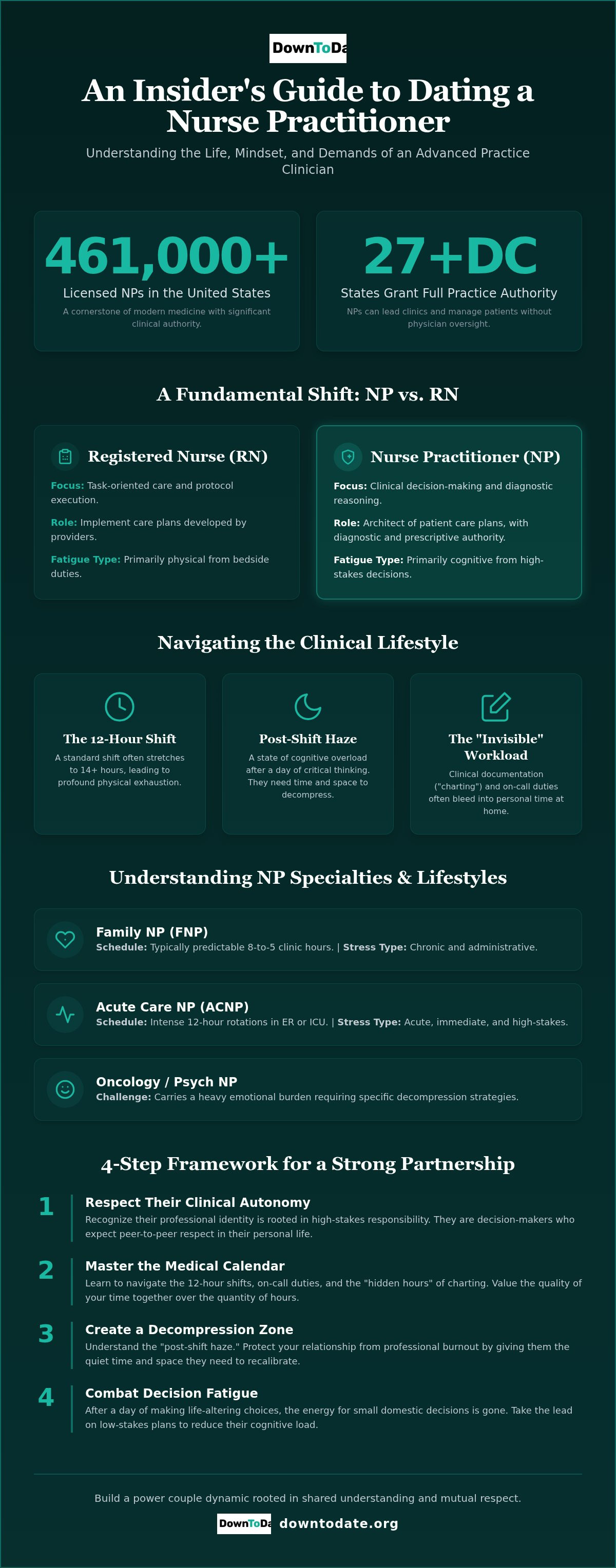
A Nurse Practitioner is a primary or specialty care provider who has completed graduate-level training to manage patient health independently. They are not merely advanced nurses; they are clinicians with the authority to diagnose, treat, and prescribe. When you are dating a nurse practitioner, you are building a relationship with a professional who has likely earned a Master of Science in Nursing (MSN) or a Doctor of Nursing Practice (DNP). Their role is defined by clinical autonomy and a deep commitment to the medical hierarchy. They are the architects of patient care plans. They are the decision-makers in the exam room. They carry the weight of every prescription they sign.
The journey to becoming an NP is rigorous. It requires thousands of clinical hours and successful completion of national board certification. This path demands a specific type of resilience. It creates a partner who is analytical, decisive, and highly focused. Understanding What is a Nurse Practitioner? means recognizing that their professional identity is rooted in high-stakes responsibility. As of July 2026, 27 states and the District of Columbia grant full practice authority to these professionals. This allows them to lead clinics and manage patient panels without physician oversight. They are peers in the medical community, and they expect that same level of respect and competence in their personal lives.
The NP vs. RN Distinction
NPs function differently than bedside Registered Nurses. The shift is fundamental. Bedside RNs focus on task-oriented care and protocol execution. NPs focus on clinical decision-making and diagnostic reasoning. This professional evolution changes how they process information at home. When an NP finishes a shift, their fatigue is often cognitive rather than just physical. They have spent the day weighing risks and benefits for every patient. This mental load does not simply disappear at the hospital exit. It follows them into the evening. It impacts how they approach domestic decisions. They may have little energy left for choosing a restaurant after a day of choosing life-saving treatments. Respect this mental drain. It is a byproduct of their clinical authority.
Specializations and Their Lifestyles
The daily reality of dating a nurse practitioner depends heavily on their chosen specialty. Schedules are not universal in advanced practice. A Family Nurse Practitioner (FNP) often works in a primary care clinic with predictable 8-to-5 hours. Their stress is chronic and administrative. Conversely, an Acute Care Nurse Practitioner (ACNP) manages crises in the ICU or ER on 12-hour rotations. Their stress is acute and immediate. Other specialties, such as Oncology or Psychiatric Mental Health, carry a heavy emotional burden that requires specific decompression strategies.
Regardless of the setting, "charting from home" is a common reality. Clinical documentation is an invisible requirement that often bleeds into personal time. An NP might be physically present on the couch while mentally finishing a patient note in the Electronic Health Record. This is not a lack of interest in the relationship. It is a requirement of the job. Their evening availability is often dictated by the complexity of their patient panel. Successful partners learn to value the quality of time over the quantity of hours available.
Navigating the Logistics: Schedules, Charting, and On-Call Life
The logistics of dating a nurse practitioner are defined by the clock. It isn't just about long hours. It is about high-intensity hours. A standard 12-hour shift in a hospital or acute care setting often stretches into 14 hours. By the time they return home, they are in a "post-shift haze." This state is a mix of physical exhaustion and cognitive overload. They aren't being distant; they are recalibrating. They have spent the day making decisions that affect lives. Now, they need silence. They need space to decompress before they can fully engage with you.
Beyond the physical shift, hidden hours exist. Clinical documentation often happens outside the hospital walls. Charting is a mandatory, high-stakes task that requires focus and accuracy. For those dating with an unpredictable schedule, these charting blocks can feel like an intrusion. However, they are part of the professional mandate. On-call rotations add another layer of complexity. The phone could ring at 2:00 AM, and the clinical mindset must be immediate. This emotional weight is easier to navigate when you prioritize Understanding Your Partner’s Role and the holistic approach they take to patient care.
The "Golden Hour" Strategy
Success requires identifying small windows of high-quality connection. A late-night dinner might be impossible after a brutal shift. Instead, focus on the "Golden Hour." This might be a 20-minute morning coffee before they head to the clinic. It might be a shared walk during a rare weekend off. Managing the transition from "Clinician Mode" to "Partner Mode" is essential. Don't expect an immediate emotional pivot. Give them space to shed the clinician skin before engaging in deep conversation. Respect the silence of the drive home. It is their bridge between two worlds.
Digital Communication for Busy Clinicians
Communication must be strategic. High-acuity shifts don't allow for constant texting. "Just seeing this" is a legitimate clinical reality, not a lack of interest. They might be in a sterile field. They might be managing a code. They might simply be overwhelmed by a high patient volume. Use asynchronous communication to maintain intimacy. Send a supportive voice note or a thoughtful text without expecting an immediate reply. This reduces the pressure on the clinician while keeping the connection alive. If you are looking for a partner who truly understands these professional rhythms, consider meeting someone within a verified medical community. Connection is easier when the baseline understanding is already there.
The Peer Dynamic: Why NPs and Doctors Make Power Couples
Healthcare is a dialect. It is a language of acronyms, triage, and rapid-fire clinical reasoning. When you are dating a nurse practitioner, you aren't just finding a partner; you are finding a peer who speaks your language. This shared "medical shorthand" eliminates the need for long explanations after a grueling shift. You don't have to explain why a HIPAA violation is a dealbreaker or why a "quiet" shift is a jinx. This efficiency creates a unique intimacy. It allows for a deeper connection rooted in the shared trauma and triumph of the clinical environment. You understand the stakes. You understand the silence. You understand the fatigue.
This relationship is a strategic alliance between two high-achieving professionals. It is a partnership where both parties recognize the weight of clinical responsibility. For a more expansive look at these professional unions, see our guide on why doctors should date nurses. In these pairings, the attraction isn't just romantic. It is intellectual. It is a mutual recognition of the resilience required to survive in modern medicine. You aren't just building a home; you are building a support system that can withstand the pressures of a high-acuity life.
Mutual Respect for Clinical Autonomy
Success in this dynamic requires shedding traditional hospital hierarchies. In a romantic partnership, the "doctor-nurse" dynamic has no place. You must value the NP's unique perspective on patient advocacy and holistic care. They bring a specific blend of diagnostic authority and patient-centered empathy to the table. Recognizing their broad scope of practice is essential for mutual respect. When you acknowledge their clinical autonomy, you strengthen the foundation of the relationship. Shared professional goals, such as achieving board certifications or advancing in a specialty, become milestones you celebrate together. This alignment creates a long-term stability that few other pairings can match.
Managing Dual-Medical Career Stress
The challenges of dating a nurse practitioner as another medical professional are real. Stress is doubled. Fatigue is mutual. To survive, you must implement a "No Hospital Talk" rule. There is a time for clinical debriefing and a time for personal connection. You have to know when to shut off the clinical brain. Support each other through the cycles of continuing education and board recertifications. These are high-pressure periods that require domestic flexibility. Planning vacations is a logistical puzzle that involves two conflicting call schedules. It requires precision. It requires compromise. However, the reward is a partner who never asks why you are late or why you are tired. They already know.
How to Support Your Nurse Practitioner Partner: A 4-Step Framework
Support is not an abstract concept. It is a series of deliberate, tactical interventions. When dating a nurse practitioner, your role is to provide the stability that the clinical environment lacks. You are the counterweight to their high-stakes professional life. This framework is designed to preserve their energy and protect the relationship from the erosion of burnout. It requires a shift from passive observation to active facilitation. It demands a commitment to understanding the specific burdens of advanced practice. It is about creating a partnership that functions as a sanctuary.
Action 1: Master the Logistics
The most effective way to support an NP is to reduce their cognitive load. Clinical decision-making is exhaustive. By taking over the mundane details of daily life, you remove choice paralysis for a partner who makes over 100 high-stakes clinical decisions a day. Handle the meal planning. Manage the grocery runs during heavy clinical weeks. These small acts of domestic stewardship allow them to fully exit "clinician mode" when they walk through the door. If you are dating a nurse with kids, this logistical support becomes even more critical for maintaining household stability.
Prioritize low-stakes dates. A partner who has spent 12 hours in scrubs and a mask often finds a formal dress code or a loud restaurant overwhelming. Opt for environments that require minimal social performance. A quiet walk or a home-cooked meal provides the restorative environment they need. Success is measured by how much "mental space" you can clear for them. Your goal is to be the one place in their life where they don't have to be the primary problem-solver.
Action 2: Emotional Containment
Create a dedicated decompression zone. For the first 30 minutes after they arrive home, provide silence. Do not lead with questions about their day or domestic stressors. This window is essential for their transition from the hospital to the home. When they are ready to talk, practice active listening. If they discuss a difficult patient outcome, resist the urge to "fix" the situation. They don't need a solution; they need a witness. Validate their clinical expertise rather than just their hard work. Tell them you respect their diagnostic reasoning. Acknowledge the weight of their prescriptive authority. This validates their professional identity as a clinician, not just a shift worker.
Recognize the signs of secondary traumatic stress. Advanced practice involves deep patient relationships that can lead to emotional exhaustion. Provide a safe space for the "weird" medical humor that often serves as a coping mechanism in the field. If the humor feels dark, remember it is a tool for resilience, not a reflection of their character. By offering this level of emotional containment, you become an indispensable partner. If you are ready to build a relationship with a high-achieving clinician who values this level of support, apply for our premium membership today and connect with verified medical peers.
Finding Your Clinician Match on DownToDate
General dating apps are built for the masses. They aren't built for the medical hierarchy. They don't account for the weight of clinical responsibility or the nuances of diagnostic authority. When you are dating a nurse practitioner, you need a partner who values your time as much as you do. You need someone who understands that a 12-hour shift is rarely just twelve hours. DownToDate is a specialized platform designed to bridge this gap. We provide a streamlined path to connection for high-achieving clinicians. We eliminate the noise of general apps. We focus on peer-level matching for professionals who live the advanced practice lifestyle.
The importance of a verified medical community cannot be overstated. General platforms are often filled with individuals who don't respect the high-stakes nature of your career. On DownToDate, every member is a verified healthcare professional. This ensures a baseline of shared values and serious intent. You aren't just swiping; you are building a foundation for a real-world medical partnership. The transition from digital connection to a lasting relationship is easier when the initial match is rooted in mutual professional respect. It is a community built on trust, verification, and authenticity.
The DownToDate Advantage
Our profiles are designed for the clinician's reality. They highlight clinical backgrounds and career goals. They allow you to filter for specific healthcare roles and schedules. This level of specificity is essential for managing the logistics of a dual-medical life. You can find someone who understands the post-shift haze without a single explanation. You gain the security of knowing your match is an actual peer. It is a space where your professional dedication is an asset, not a hurdle. We act as a protective gatekeeper to ensure quality and shared values among all members.
Getting Started with Premium
A Premium Membership offers the tools needed for a focused, efficient search. Use advanced filters to find NPs in your specific geographic region. This precision respects your busy schedule and minimizes wasted time. You can build a foundation through unlimited messaging before the first date. This ensures that when you finally meet, the connection is already established. It allows you to focus on the person rather than the logistics. You deserve a partnership that mirrors the excellence of your career. Join DownToDate today to meet verified medical professionals and start your journey toward a balanced power couple dynamic.
Building Your Advanced Practice Partnership
Success in dating a nurse practitioner is about clinical respect. It is about logistical precision. It is about emotional endurance. You now have the strategic framework to navigate the post-shift haze and the decision fatigue that defines the APRN lifestyle. You understand that a lasting partnership with a clinician requires a peer-to-peer mindset. It requires a commitment to domestic facilitation and emotional containment. By prioritizing their clinical autonomy and mastering the logistics of the medical calendar, you move beyond the surface-level frustration of general apps into a territory of true partnership.
You don't have to navigate these high-stakes pressures in isolation. DownToDate was designed by doctors, Dr. Shadi and Dr. Sasan Rezai, who understand the medical hierarchy from the inside. We provide an exclusive, verified medical community where shared values and professional integrity are the standard. Our premium features are built for busy professionals who demand efficiency and authenticity in their personal lives. It's time to find a partner who respects your schedule and shares your mission. Find your clinician match on DownToDate and build the power couple dynamic you deserve. Your future as a healthcare pair is within reach.
Frequently Asked Questions
Is a Nurse Practitioner a "good catch" for a doctor or professional?
A nurse practitioner is an exceptional partner for any high-achieving professional. They bring intellectual depth, financial stability, and a resilient mindset to a relationship. Their graduate level training and clinical authority mean they understand the demands of a high stakes career. When you are dating a nurse practitioner, you are with someone who manages complex systems and patient lives daily. This creates a partner who is decisive and capable of handling intense pressure.
How do I handle my NP partner always being on call?
Managing an on-call schedule requires a commitment to radical flexibility. You should maintain your own independent social life and hobbies to prevent resentment when clinical emergencies arise. Accept that the phone call is a professional mandate, not a personal slight. Success lies in planning for "penciled-in" dates while always having a backup plan. This practical approach ensures the relationship remains stable despite the unpredictable nature of advanced practice medicine.
What is the best way to support a nurse practitioner during burnout?
The most effective support involves reducing their cognitive load through domestic facilitation. Handle the meal planning, grocery shopping, and household chores during peak clinical weeks. Provide a decompression zone where they can transition from clinician to partner in silence. Validate their diagnostic expertise instead of just offering generic sympathy. This targeted support helps mitigate the effects of clinical burnout and protects your emotional connection from the strain of the hospital.
Do nurse practitioners have a higher divorce rate due to their schedules?
No verified data suggests that nurse practitioners face higher divorce rates than other medical professionals. Relationship success is determined by the quality of communication and the ability to manage a demanding schedule together. While the 12-hour shift and on-call duties are real stressors, many couples find that the shared resilience required for the job actually strengthens their bond. It is about how you navigate the logistics, not the profession itself.
What should I avoid talking about on a first date with an NP?
Avoid treating the first date like a free clinical consultation. Don't ask for a diagnosis or spend time discussing your minor health concerns. This is a boundary issue that can quickly derail a romantic connection. Instead, focus on their life outside the hospital. Ask about their interests, travel goals, or personal philosophy. They spend all day being a clinician; on a date, they want to be seen as an individual first.
How can I meet single nurse practitioners who want a serious relationship?
Meeting single nurse practitioners is most effective on specialized platforms designed for the medical community. General dating apps often lack the verification needed to ensure you are meeting a true peer. DownToDate provides a secure environment where every profile is a verified healthcare professional. This allows you to connect with NPs who are looking for serious relationships and who understand the unique demands of dating a nurse practitioner in a high stakes world.
Is it better to date within or outside the medical profession?
Dating within the medical profession offers the advantage of shared shorthand and mutual empathy. You don't have to explain the exhaustion of a code or the frustration of charting to another clinician. However, dating outside the field can provide a necessary escape from hospital talk. The best choice depends on your personal need for professional understanding versus a desire for a total mental break from the medical environment after your shift ends.


