

Your Saturday night plans aren't a commitment. They're a placeholder for a late call that ends in a missed dinner and a cold apology. This is the reality of dating for paramedics. It's the fatigue of explaining why a twelve hour shift turned into sixteen. It's the weight of a traumatic call that you can't quite leave at the station. You're tired of the explanation fatigue that kills a connection before it even starts. You've spent enough time defending your schedule to people who will never understand the adrenaline or the exhaustion of the job.
You deserve a partner who speaks your language. You need someone who understands that on-call isn't a suggestion and decompression is a necessity. This 2026 EMS Resource Guide provides the framework to master these complexities. We'll explore practical strategies for managing unpredictable schedules, frameworks for emotional recovery, and a more efficient way to meet high-quality peers who respect the mission. It's time to build a partnership that supports your career instead of competing with it. Let's move beyond the EMS bubble and find a connection that actually works.
Key Takeaways
- Eliminate explanation fatigue by finding partners who respect the clinical and emotional realities of your career.
- Master the art of dating for paramedics by reclaiming off-peak hours with a "Tuesday is the New Saturday" mindset.
- Implement the "Traffic Light" system to communicate your emotional state after high-stress shifts without the need for long explanations.
- Balance your life by weighing the shared empathy of a medical peer against the diverse perspective of a civilian partner.
- Increase your efficiency by moving away from general apps and toward verified communities that understand the 24-hour shift life.
The EMS Dating Dilemma: Navigating the High-Stakes Barrier
Most people view a date as a simple social interaction. For you, it's a logistical mission. Dating for paramedics requires more than just chemistry. It demands a partner who can bypass explanation fatigue. This is the mental exhaustion that comes from constantly justifying why you missed a birthday or why you're too drained to talk after a shift. You shouldn't have to defend your career to the person you love. High-stakes work creates high-stakes barriers in your personal life. It requires a specific type of resilience from both partners.
The public sees the uniform. They see the hero. They rarely see the psychological trauma experienced by first responders that follows you home. This creates the "Hero-Trauma" paradox. Your partner may admire your heroic role while simultaneously resenting your emotional withdrawal. The classic Friday night date is a civilian myth. While the rest of the world winds down, you're often starting a 24-hour rotation. Consistency is a casualty of the 24/48 and 12-hour shift cycle. Relationships often struggle under the weight of this unpredictability.
The Biological Clock of a First Responder
Sleep is a luxury in EMS. Chronic sleep deprivation and circadian rhythm disruptions directly impair your ability to regulate emotions. You might feel irritable or distant, not because of a lack of interest, but because of your biology. The "Post-Shift Slump" makes the first 24 hours after a difficult call a minefield for new relationships. Circadian desynchronization is the misalignment of the body’s internal clock with external social time, which often renders a paramedic unavailable during standard dating hours. This biological tax makes traditional courtship nearly impossible without a partner who understands the physiological toll of the job.
Overcoming the "EMS Bubble"
Many paramedics default to dating within their own station. It's convenient. Your coworkers understand the dark humor and the shared trauma. But station romance often leads to an echo chamber. You spend your work hours responding to calls and your off hours discussing them. This bubble can limit your personal growth and prevent you from finding a world outside of medicine. Dating for paramedics should involve seeking a partner who brings balance. Whether they're a medical peer or a civilian, they must understand that your time is a finite resource. You need a streamlined path to connection that doesn't require a repeat of EMS 101 every time you meet someone new. Finding that balance is the key to a sustainable partnership.
Choosing Your Match: Dating Within the Medical Field vs. Civilians
Dating for paramedics often feels like a choice between two extremes. You can date someone who understands the acronyms or someone who provides an escape from the station. Both paths have merits. Both paths have risks. The goal is to find a partner who respects the mission without being consumed by it. Success depends on how you manage the emotional spillover of the job. It requires a clear understanding of what you need when the uniform comes off.
The "Medical Peer" advantage is rooted in shared language. You don't have to explain why a "refusal" took two hours or why a "frequent flyer" caused a late off-time. They understand the dark humor required for survival. They know that a 24-hour shift is a physiological event, not just a work day. By dating within your profession, you gain a partner who views your schedule as a shared reality. The primary risk is the "echo chamber." If every dinner conversation revolves around clinical outcomes, you never truly clock out. You must deliberately protect your personal time from becoming a shift debrief.
Bridging the Gap with a Non-Medical Partner
A civilian partner offers a window into a world outside of medicine. They provide the balance you need to stay grounded. But this path requires a "Translation Guide." You must teach them that "on-call" is a lifestyle, not a choice. You have to manage the "trauma dump." Not everyone is equipped to hear the details of a pediatric arrest over dessert. Establish boundaries early. Tell them what you need after a bad shift. Maybe it's twenty minutes of silence. Maybe it's a complete distraction. Helping them understand your world prevents the resentment that builds from unmet expectations.
Shared values matter more than shared career paths. Whether they are a nurse or a teacher, they must value integrity and resilience. They must accept that your job is high-stakes and unpredictable. If you want to skip the trial-and-error of explaining your life to people who don't get it, consider joining a verified community of medical peers who already understand the cost of the uniform. Efficiency is key. You don't have time to waste on partners who view your career as a burden rather than a calling. Dating for paramedics is about finding that specific level of understanding, regardless of the person's job title.
Tactical Time Management: Making Love Work Around 24-Hour Shifts
Traditional dating advice assumes you have weekends off. It assumes your shift ends at 5:00 PM. For those in EMS, these assumptions are liabilities. Success in dating for paramedics requires a shift in perspective. You must reclaim your time by ignoring the civilian calendar. Tuesday morning is just as valuable as Saturday night. It's about tactical efficiency, not just finding more hours. You don't need a typical schedule to build a premium connection. You need a better strategy.
Mandatory overtime is a reality, not an excuse. You must plan for the inevitable hold-over call. Digital intimacy becomes your lifeline during a 48-hour stretch. A quick text between calls maintains the connection and signals intent. However, the most critical part of your schedule is the decompression buffer. You cannot transition from a high-acuity scene to a romantic dinner without a reset. Schedule thirty minutes of solitude before you engage with your partner. It protects the relationship from the residual stress of the shift. It ensures you're present when it matters most.
The 5-Step EMS Date Planning Framework
Planning requires a systematic approach. It removes the friction of last-minute cancellations. Follow these steps to maintain consistency and reduce explanation fatigue:
- Step 1: The Google Calendar Rule. Sync your shared calendars immediately. Visibility reduces resentment when the schedule shifts.
- Step 2: Identify Micro-Dates. Look for small windows during busy weeks. A thirty-minute coffee is better than a cancelled dinner.
- Step 3: Fatigue Communication. Be honest about your energy levels. If you're post-call and exhausted, say it before the date begins.
- Step 4: Establish Plan B. Always have a contingency for late calls. A partner who understands the "Plan B" mindset is a partner who lasts.
- Step 5: The Decompression Window. Hard-code time to shower and decompress. Don't rush the transition from medic to partner.
Micro-Dates: High Impact, Low Time Commitment
When time is a scarce resource, you must optimize for impact. Micro-dates keep the momentum alive without requiring an eight-hour window. They focus on quality over duration.
- The Breakfast Date: Utilize the 08:00 post-shift window. It's the perfect time for a quiet meal before you sleep.
- The Station Drive-By: If station policy permits, a five-minute connection during standby time can reset your mood.
- Virtual Watch Parties: Stay connected while on different rotations. Watching a show together through an app maintains a sense of shared experience.
Effective dating for paramedics isn't about working more. It's about working smarter with the time you actually have. By prioritizing these tactical windows, you prove that the relationship is a priority, even when the job is demanding.
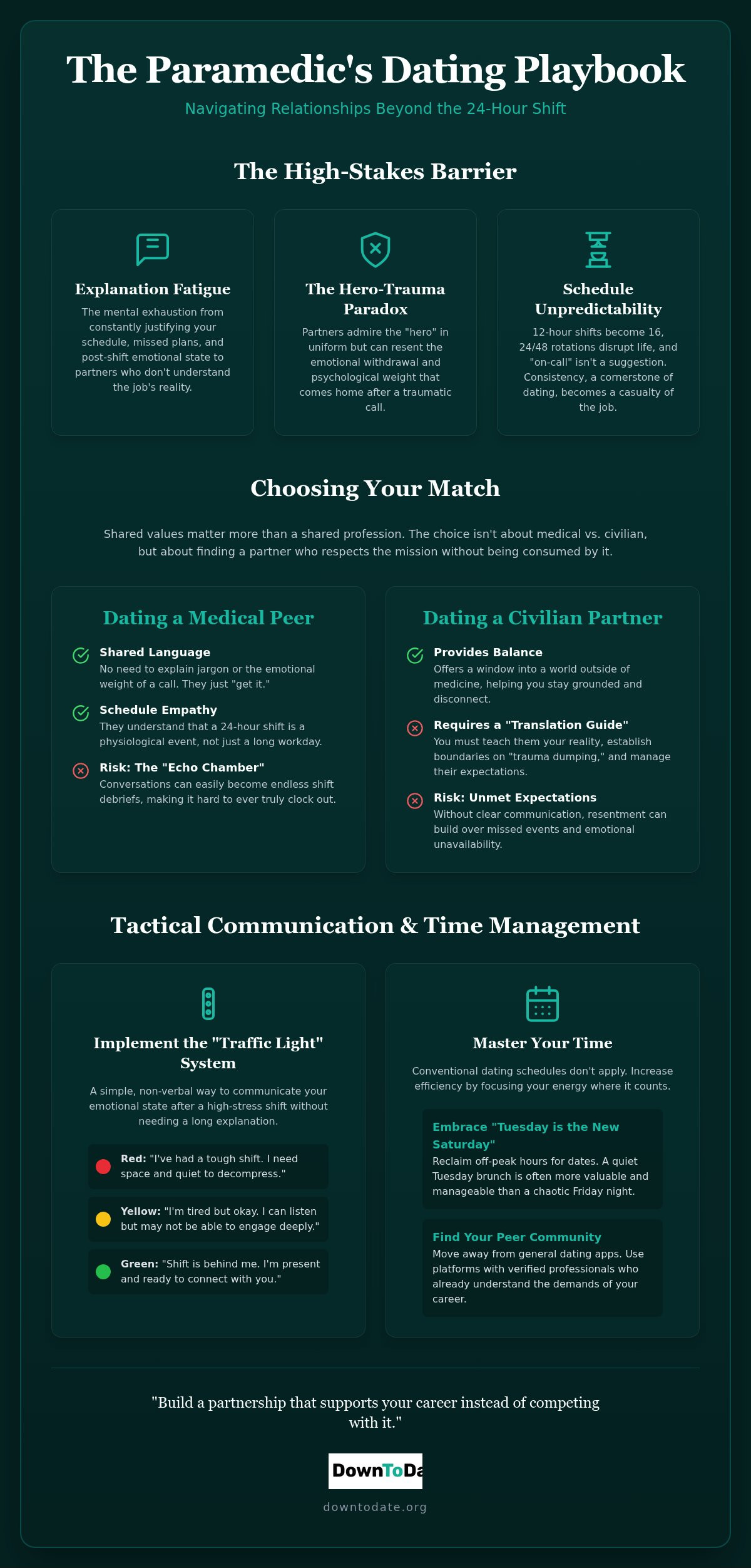
Emotional Decompression: Communication Strategies for First Responders
Emotional survival is a skill. It's not a personality trait. In the field, you are trained to be objective, decisive, and detached. These are the tools that save lives. In a relationship, these same tools can feel like emotional distance. You must learn to bridge the gap between the high-acuity environment of the ambulance and the soft environment of your home. Success in dating for paramedics depends on your ability to decompress without shutting your partner out. It requires a shared vocabulary for stress.
Empathy fatigue is a common hazard. You've spent twelve hours managing cardiac arrests and multi-system trauma. When your partner needs to vent about office politics, their problems may feel trivial. This isn't a lack of love. It's a physiological limit on your capacity to care. You must recognize when your "empathy tank" is empty and communicate that reality before it turns into resentment. Mastering dating with an unpredictable schedule means also mastering your unpredictable emotional bandwidth.
The "Traffic Light" Communication Tool
Complexity is the enemy of communication. When you're exhausted, you don't have the words for a deep conversation. The Traffic Light system provides a streamlined way to signal your emotional state without the need for a long explanation. It sets immediate expectations for the evening.
- Green: I had a good shift. I'm energized and ready for social interaction or a night out.
- Yellow: I had a long day. I need thirty minutes of quiet decompression before I can engage meaningfully.
- Red: I had a traumatic call. I am not emotionally available right now and need space to process.
This system removes the guesswork for your partner. It replaces tension with clarity. If you're looking for a partner who already understands these signals, consider a premium membership for verified medical peers who live this reality every day.
Active Listening for the Medical Mind
Paramedics are fixers. When you hear a problem, your "Triage Brain" immediately looks for a solution. But your partner usually isn't looking for a clinical intervention. They're looking for validation. You must learn to switch off the triage mode and simply listen. Validating non-medical stressors is essential for relationship health. Their spreadsheet error might not be a life-or-death crisis, but it's a real stressor in their world. By physically removing your duty boots and showering as soon as you arrive home, you create a tangible boundary that signals the end of your clinical role and the beginning of your personal life. This simple ritual helps you transition from the medic who acts to the partner who listens. For added peace of mind while you are away on duty, you can also discover The Wellbeing App to ensure your home and family are protected by round-the-clock security monitoring.
General dating apps are built for people with 9-to-5 schedules. They rely on volume, not compatibility. For a first responder, this creates a cycle of swipe fatigue. You spend hours explaining your career to civilians who cannot grasp the reality of a 48-hour stretch. Dating for paramedics requires a more efficient approach. You need a platform that acts as a protective gatekeeper. You need a community where verification is standard and professional standards are high. Efficiency is your most valuable asset.
Verification is the core of a trust-based community. It ensures you are meeting genuine peers with shared values and similar professional pressures. DownToDate was founded by doctors who understand the 24/7 medical grind. It was designed to remove the friction of modern dating. It provides tailored networking tools for unpredictable schedules. You don't have to defend your lifestyle here. You only have to find the person who fits into it. This is how you build a partnership that survives the long-term demands of the field.
The DownToDate Advantage for Paramedics
The night shift lifestyle isn't a barrier on a specialized platform. It's a shared experience. You can connect with people who already understand why you're awake at 3:00 AM. There is no need to explain clinical protocols or mandatory overtime. By exploring the shared foundation of dating for doctors and paramedics, you find matches who respect your mission. You gain access to a verified medical community that values your time. This streamlined path allows you to focus on connection rather than justification. It’s about finding a peer-level match without the noise of general apps.
Creating a Profile That Resonates
Your profile should be more than a photo in uniform. Avoid "One-Dimensional" syndrome by highlighting your life outside the station. Show your interests—whether you're into fitness, travel, or working on cars with professional diagnostic equipment from Topdon Norge AS. Share your passions. Be transparent about your schedule from the first interaction. Honesty about your rotation prevents future conflict. Use the Premium Membership features to filter for serious, high-achieving peers. This ensures you are meeting people who are looking for partnership, not just a distraction. Dating for paramedics is more successful when you lead with your authentic self. Focus on quality. Prioritize shared values. Build a life that works both on and off the clock.
Secure a Partnership That Understands the Mission
Your career is defined by high-stakes decisions and unpredictable rhythms. Your personal life shouldn't be a source of additional friction. Success in dating for paramedics is possible when you stop apologizing for your schedule and start optimizing your connections. By reclaiming non-traditional time and implementing tools like the Traffic Light system, you protect your energy and your partnership. You don't need more time. You need better alignment. You don't need a general audience. You need a specialized community.
The solution is a platform built on shared reality. DownToDate was founded by medical professionals who have lived your 24-hour shift life. It offers a verified community of high-achieving healthcare peers and advanced filters designed for unpredictable medical lifestyles. Stop wasting your off-hours on general apps that don't respect your mission. It's time to find a peer who already understands the cost of the uniform.
Join DownToDate and connect with medical peers who understand your life.
Build a relationship that supports your calling. You've done the work in the field. Now, find the partnership you deserve.
Frequently Asked Questions
Is it better for a paramedic to date another first responder or a civilian?
It depends on your need for shared empathy versus external balance. A first responder provides immediate understanding of the schedule and trauma, while a civilian offers a perspective outside the EMS bubble. Success in dating for paramedics requires identifying which dynamic supports your mental health. Neither choice is inherently superior. The goal is finding a partner who respects the high-stakes nature of your calling without being consumed by it.
How do I explain my 24-hour shift schedule to someone I just started dating?
Be direct and transparent from the first interaction. Explain that your schedule is a 24-hour lifestyle rather than a standard job. Frame it as a logistical reality, not a lack of interest. Use a shared calendar early to visualize your availability. This prevents resentment when mandatory overtime occurs. Clarity upfront builds trust and filters out partners who require traditional, consistent availability that your career cannot provide.
How can I prevent my job trauma from affecting my romantic relationships?
Implement a strict decompression ritual before engaging with your partner. Use a signaling system to communicate your emotional bandwidth. This allows you to share your state without dumping trauma on your partner. Seeking professional support for secondary traumatic stress ensures you remain emotionally available. A healthy relationship requires a firm boundary between the clinical chaos of the ambulance and the peace of your home environment.
What are the best date ideas for paramedics who work night shifts?
Focus on micro-dates and non-traditional timing. A 08:00 breakfast date after your shift ends is often more relaxing than a late dinner. Consider weekday museum visits or afternoon hikes when crowds are thin. These windows capitalize on your off-peak hours. Reclaiming these moments proves that the relationship is a priority. It moves the focus away from the Friday night myth and toward quality time that fits your rotation.
Why do paramedics have such a high divorce rate, and how can I avoid it?
High stress, sleep deprivation, and poor communication are primary drivers of relationship strain in EMS. Avoid this by prioritizing emotional intelligence and schedule transparency. Proactively manage empathy fatigue by validating your partner's stressors, even when they seem trivial compared to your shift. Consistency in small gestures compensates for the lack of consistent hours. Building a foundation of mutual respect for the mission is the best defense in dating for paramedics.
Can a relationship work if both partners are first responders with different schedules?
Yes, but it requires radical logistical coordination. You must treat your shared time as a high-value resource. Syncing digital calendars is mandatory to find overlapping windows. When schedules don't align, use digital intimacy to maintain the connection. A quick text or a virtual watch party keeps the bond strong during long stretches apart. It's about maximizing the quality of the hours you actually share together.
How do I handle on-call interruptions during a date?
Establish a contingency plan before the date begins. Ensure your partner knows that an interruption is a professional requirement, not a personal choice. Have a backup plan ready, such as rescheduling the meal or continuing the date later. This transparency reduces the friction of late calls. A partner who understands the on-call lifestyle will view these moments as part of the commitment rather than a burden on the relationship.
What should I do if my partner doesn’t understand why I need time to decompress after work?
Explain the physiological toll of a high-acuity shift. Use professional descriptors to help them understand that your brain needs to transition from triage mode to partner mode. Define a specific window, such as thirty minutes, for quiet recovery. This isn't a withdrawal from the relationship; it's a tool for being more present later. Setting this boundary early ensures your partner views your decompression as a necessary ritual for long-term health.


