

What if the most exhausting part of your 10-hour shift isn't the complex pathology on your monitors, but the prospect of explaining your career to a stranger afterward? Dating for radiologists shouldn't feel like another diagnostic puzzle to solve. You spend your days in a dark room. You make high-stakes decisions. You battle extreme cognitive fatigue. When you finally step out, the last thing you want is to explain the difference between a physician and a technician to a date who doesn't understand your world. It's frustrating to feel socially isolated when your professional life is so demanding.
We understand that your time is your most valuable asset. You need a partner who respects the 80-hour work week and the intensity of a fellowship schedule. This article will show you how to navigate these unique social challenges and build meaningful connections with peers who share your intellectual baseline. We will explore how to move beyond the dark room, overcome social isolation, and leverage verified medical communities to find a relationship that actually survives the pressures of healthcare. Discover how to streamline your search for a partner who truly sees the person behind the workstation.
Key Takeaways
- Understand how diagnostic isolation affects your social battery and why your dating needs differ from other medical specialties.
- Learn to maintain a relationship through the pressures of residency, fellowship, and high-stakes board exams.
- Discover why dating for radiologists is more successful on verified, peer-to-peer platforms that value your limited time.
- Master profile optimization techniques that highlight your physician status while showcasing your life beyond the reading room.
- Utilize the advanced filters of a Premium Membership to connect with high-value peers who understand your professional world.
The 'Dark Room' Dilemma: Why Dating as a Radiologist is Different
The reading room is a sanctuary for some and a silo for others. For the specialist, it is the center of the clinical world. For the dater, it is often the source of diagnostic isolation. This unique professional environment shapes how you interact with the world outside the hospital. Unlike colleagues in Emergency Medicine or Family Practice who spend their days in constant verbal dialogue, your work is visual, analytical, and solitary. This makes dating for radiologists a distinct challenge that general platforms often fail to address. Understanding radiology as a medical specialty means recognizing that your social battery is taxed differently than your peers. You aren't just physically exhausted from rounds; you are mentally drained from thousands of high-stakes decisions.
The Cognitive Load of the Reading Room
An 8-12 hour diagnostic shift is a marathon of pattern recognition. Each pixel matters. Each subtle shadow requires a definitive judgment. By the time you leave the dark room, your capacity for making more choices is depleted. This is decision fatigue. General dating apps demand a level of superficial engagement that feels like a second shift. Swiping through endless profiles requires the same cognitive energy you just spent on complex CT scans. It's inefficient. It's draining.
The physical environment also plays a role. Spending your day in a dim, temperature-controlled room can disrupt your circadian rhythms and alter your social availability. You need a connection that doesn't require a performance. Intensive diagnostic focus creates a fundamental need for a partner who values quiet, restorative downtime over constant social stimulation.
The Identity Gap: Physician vs. Technician
There is a recurring frustration in the radiology community. It's the moment a date asks if you "take the X-rays." Explaining your medical degree, your residency, and your fellowship becomes a chore. You shouldn't have to defend your expertise over appetizers. This identity gap is a primary reason why general apps fall short. They don't account for the prestige or the pressure of your role. You deserve a peer who already knows the weight of your signature on a report.
Shared educational backgrounds remove this friction. When you connect with a peer, the baseline of respect is already established. You don't have to explain the "Core Exam" or why a missed finding keeps you up at night. For more on this, explore Dating for Doctors: Navigating Love in the Modern Medical World. Peer-to-peer dating is more than a preference; it's a productivity hack for your personal life. It saves time. It reduces explanation. It ensures that dating for radiologists focuses on the person, not the job description.
Navigating Love During Radiology Residency and Fellowship
Residency is a trial by fire. It is a period defined by the 80-hour work week and the looming shadow of the Core Exam. For many, these years feel like a social hiatus. Fellowship applications add another layer of geographic uncertainty. Dating for radiologists during this high-pressure phase requires more than just effort. It requires a strategy. You need a partner who understands that your "on-call" status is not a choice. They must accept the pager as a permanent guest at dinner. They must value the quality of time over the quantity of hours.
The Strategic Use of Medical Conferences
Major events like the RSNA annual meeting serve a dual purpose. They are academic milestones. They are also premier social outlets. These conferences offer a rare opportunity for national-level peer networking in a setting that feels like a professional vacation. Strategic dating for radiologists often involves using these gatherings to meet individuals who share your intellectual baseline. If a connection forms during a rotation or a conference, focus on intentionality. Long-distance foundations are built on shared goals and a mutual respect for the specialty's demands.
Managing the Residency Schedule
Time is your scarcest resource. Traditional dating often fails because it demands blocks of time you simply do not have. The answer is micro-dating. These are short, high-value interactions. A quick breakfast after a night shift. A walk during a brief break in fellowship interviews. A shared coffee on a post-call day. These moments keep a relationship alive without compromising your training. It is essential to set expectations early about your rotation schedule and night shifts. For a deeper look at managing these logistics, read our Dating with an Unpredictable Schedule guide.
Dating a fellow healthcare professional simplifies the logistics. They understand the fatigue. They respect the silence after a long shift. They don't need an explanation for why you are late or why you are too tired to talk. This shared context is why many find success within a verified medical community. It removes the friction of the "civilian" world. It focuses on the connection. It allows you to find someone who already speaks your language.
Peer-to-Peer Dating vs. General Apps: A Strategic Analysis
General dating apps are built on volume. They prioritize the swipe. They reward the endless scroll. For a specialist managing high-stakes diagnostic cases, this is a flawed model. Dating for radiologists requires precision, not just participation. You need a system that filters for quality before you ever invest your time. Curated medical platforms offer a strategic alternative to the noise of "swipe-heavy" apps. They replace superficial matching with professional alignment. They prioritize your schedule over a platform's engagement metrics.
Your time is a non-renewable resource. Spending hours on dates with individuals who confuse your medical degree with a technical certificate is a poor investment. Niche apps act as a preliminary screen. They ensure that every match understands the weight of your professional life. This is about more than just convenience. It is about psychological safety. A verified medical community ensures that your peers are who they say they are. It eliminates the need to "vet" a date's professional background, allowing you to focus on the connection itself.
The Efficiency of Shared Values
There is a unique benefit to skipping the basics. When both partners are in healthcare, the baseline of trust is established on day one. You share a common ethical framework. You understand the reality of educational debt. You value the same level of intellectual parity. This shared foundation creates an immediate sense of logic and inevitability in the relationship. For a detailed look at the current market, see our guide on The Best Professional Dating App for Medical Professionals. Dating for radiologists is most successful when intellectual standards are high and professional respect is mutual.
Filtering for Lifestyle Compatibility
General filters focus on the superficial. They ask about height. They ask about hobbies. In the medical world, these metrics are secondary. You need to know if a partner understands a 24-hour call rotation. You need to know if they can handle the cognitive fatigue of a 10-hour diagnostic shift. DownToDate allows you to filter for specific medical roles to ensure lifestyle compatibility from the start. Schedule-matching is more critical than hobby-matching in high-stakes medicine. Finding someone who respects your "on-call" reality is the ultimate productivity hack for your personal life.
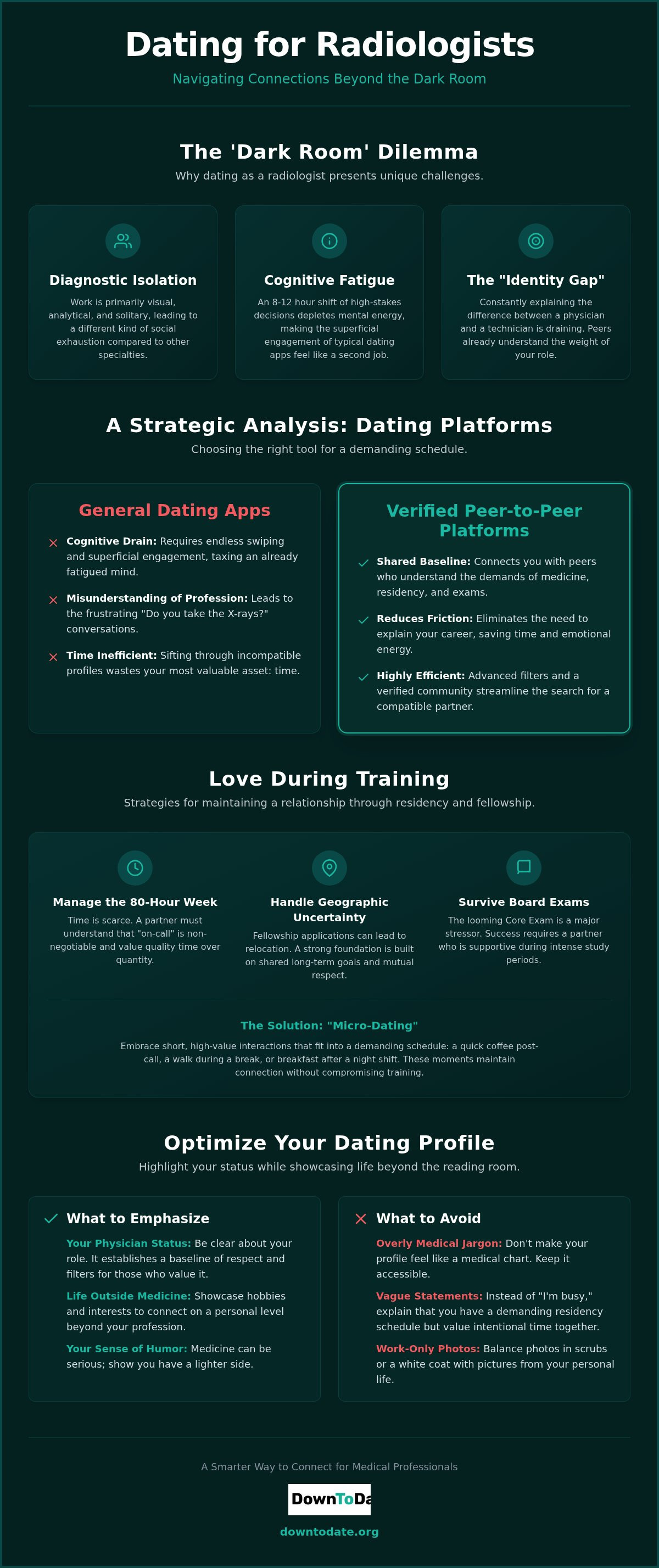
The Radiologist’s Guide to Optimizing a Dating Profile
Your digital presence is a diagnostic tool for potential partners. It should be precise. It should be authentic. It should be efficient. Dating for radiologists often stalls because of a fundamental misunderstanding of the role. If your profile reads like a CV, you attract candidates seeking a paycheck. If it's too vague, you attract those who don't understand your commitment. You must signal your physician status with confidence while remaining human. Address the "technician vs. physician" misconception early. Use your profile to define your standards. Show that you are a doctor who interprets the complex, not just a staff member who operates the machinery.
Crafting the High-Value Bio
Efficiency is key. High-achieving peers value clarity. Use declarative fragments to highlight your life beyond the hospital. Art lover. Marathoner. Diagnostic expert. These short bursts of information are easy to consume for a busy specialist. Avoid "colorful shoptalk" in your initial bio. Save the lingo for the first date. Instead, focus on mission-driven language. Mention your dedication to your field. Mention your desire for a partner with a similar intellectual baseline. This approach filters for quality. It attracts individuals who respect your drive.
Honesty about your availability is a requirement, not an option. Include a "Call Schedule" disclaimer. It doesn't have to be a list of dates. Simply state that your life involves high-stakes shifts and pager-friendly dates. This sets expectations immediately. It weeds out those who require constant, immediate attention. It invites those who understand that a missed text isn't a lack of interest, but a commitment to a patient. You are looking for a partner who values the weight of your signature.
Photo Selection for the Busy Specialist
Your photos must counter the "dark room" stereotype. A gallery of scrub selfies is a common mistake. It suggests your life is one-dimensional. It hides the person behind the profession. You need to show life outside the lead apron. Include at least one photo in a social setting or an outdoor environment. Show yourself hiking. Show yourself at a gallery. Show yourself in natural light. This signals that you have a social battery, even if it's currently taxed by a 10-hour shift.
Credibility is your most valuable asset in the medical community. On general platforms, anyone can claim a title. On specialized platforms, verification is the standard. This is why joining a verified medical community is a strategic move for your personal life. Verified badges add instant trust. They confirm your professional status without you having to explain your degree. When you optimize your profile for a peer-to-peer environment, you stop defending your identity and start building a connection. Dating for radiologists becomes about finding a match, not just an audience.
Finding Your Match with DownToDate: Dating Designed for Medical Life
The search for a partner shouldn't be a second career. You've already invested years in mastering the complexities of the human body. You shouldn't have to spend your remaining hours filtering through low-quality matches on general platforms. DownToDate is the premier community for radiologists seeking meaningful connection. It is not just an app. It is a solution. Founded by Dr. Shadi Rezai and Dr. Sasan Rezai, the platform was built on a simple philosophy: dating for doctors, by doctors. This mission-driven approach ensures that every feature respects your time, your intelligence, and your professional standards. Dating for radiologists becomes a streamlined process when you use a tool designed specifically for the medical lifestyle.
Why Verification Matters for Radiologists
In the dark room, accuracy is everything. The same should be true for your personal life. DownToDate acts as a protective gatekeeper for the medical community. Every member undergoes a verification process to ensure they are healthcare professionals. This eliminates the uncertainty of general apps. You don't have to worry about "identity" or "shared values" problems. You can move forward with the peace of mind that every match is a real peer. This level of exclusivity is the foundation of a high-value community. To access the highest level of this experience, many specialists choose the DownToDate Premium Membership: The Elite Standard. It is about quality over quantity. It is about authenticity over volume.
The Premium Membership provides the tools you need to reclaim your schedule. Advanced filters allow you to search for partners who understand the specific demands of your subspecialty. Unlimited messaging removes the barriers to communication. You can connect with intent. You can plan dates that fit your call rotation. You can find someone who doesn't just tolerate your high-stakes lifestyle but shares it. This is how dating for radiologists evolves from a challenge into a strategic advantage.
Taking the Next Step
Reclaiming your personal life starts with a single choice. It requires moving away from the noise of general platforms and toward a community that values your time. Join the community. Optimize your profile using the insights we've discussed. Focus on life outside the lead apron. Show the person behind the workstation. Our empathetic insider approach means we understand the hurdles you face because we've lived them ourselves. We are here to facilitate connections that matter.
Professional excellence shouldn't come at the cost of personal happiness. You can have both. You can be a leader in the reading room and a partner in a thriving relationship. It starts with using a high-value tool that understands your world. It ends with a connection that survives the pressure of a residency, a fellowship, and a career. Your life is more than a series of diagnostic reports. It is time to find someone who sees the whole picture.
Step Out of the Dark Room
You don't have to navigate your personal life alone. The dark room provides focus, but it shouldn't define your entire social existence. We've explored how diagnostic isolation impacts your social battery and why general apps often fail the specialist. We've analyzed the strategy of peer-to-peer connection. You now have the framework to optimize your profile and set clear expectations regarding your call schedule. Dating for radiologists is about reclaiming your time and finding a partner who understands the high-stakes nature of your career.
Efficiency is the standard in your professional life. It should be the standard in your dating life, too. DownToDate was founded by medical professionals who understand your unique hurdles. Our verified healthcare peer community ensures you connect with people who share your intellectual baseline. Use our advanced search filters to find matches that fit your busy schedule. Don't wait for a break in your rotation to find happiness. Join the exclusive medical community on DownToDate and find your peer match today. You've mastered the complex world of diagnostics. Now, it's time to master your own connection.
Frequently Asked Questions
Is dating a fellow radiologist a good idea for work-life balance?
Dating a fellow radiologist can improve work-life balance through a mutual understanding of unique professional pressures. You won't need to explain why a 10-hour diagnostic shift leaves you mentally drained. You share a similar intellectual baseline and professional vocabulary. It is important to be intentional about leaving shop talk at the hospital. Focus on building a life that exists beyond the reading room to prevent professional burnout from bleeding into your connection.
How do I explain my on-call schedule to a new date?
Be direct and transparent about your clinical obligations from the very first conversation. Explain that being on-call means your presence is contingent on patient needs, not a lack of interest in the date. Use specific terms like home call or in-house shifts to provide clarity. A partner who respects the high-stakes nature of your work will appreciate the honesty. It sets a foundation of trust and prevents future friction regarding canceled plans.
Are there specific dating apps for radiologists and doctors?
Specific platforms like DownToDate offer a tailored experience for medical professionals by prioritizing verification to ensure every match is a peer. For those interested in dating for radiologists, niche apps eliminate the need to explain your medical degree to the general public. These communities offer advanced filters for specific roles and schedules. This streamlined approach respects your limited time and focuses on connecting you with individuals who share your professional values.
How can I find time to date during my radiology residency?
Prioritize efficiency by utilizing micro-dating strategies during your residency years. Focus on short, high-quality interactions like a quick coffee post-call or a brief walk between study sessions. Remember that ACGME regulations limit your hours to 80 per week, averaged over four weeks. Use your designated 24-hour period free of clinical duties to invest in meaningful personal connections. High-value dating tools can help you avoid wasting hours on incompatible matches during your limited downtime.
What are the most common challenges when dating a radiologist?
The primary challenges include extreme cognitive fatigue and the dark room effect on social availability. After a shift of intense pattern recognition, a radiologist often has a limited social battery. Partners may struggle with the hidden nature of the role compared to patient-facing specialties. Success requires a partner who values quiet downtime and understands that diagnostic focus is mentally taxing. Communication about these specific hurdles is essential for maintaining a healthy, long-term relationship.
Is it better to date within the medical field or find a civilian partner?
Dating within the medical field offers an immediate baseline of trust and shared context. You don't have to explain the difference between a physician and a technician to a peer. A medical partner understands the weight of your signature and the reality of educational debt. Many find that dating for radiologists is more efficient when the partner already speaks the language of healthcare. However, a civilian partner can provide a refreshing escape from hospital life.
How do I handle dating burnout while working long diagnostic shifts?
Handle burnout by being highly selective with your time and emotional energy. Don't force social interaction after a grueling 12-hour shift if your battery is empty. Shift your focus from match volume to match quality. Use high-value dating tools that act as a protective gatekeeper, ensuring your matches are worth the effort. Taking intentional breaks from apps can prevent fatigue. Focus on restorative activities that prepare you for meaningful connection rather than superficial swiping.
What should I include in my dating profile as a medical professional?
Include declarative statements that highlight your interests beyond the hospital walls. Signal your physician status confidently but avoid making your bio read like a professional CV. Use photos that show you in natural light or outdoor settings to counter the dark room stereotype. Mention your dedication to your field while emphasizing your personal hobbies, such as travel or fitness. This balanced approach attracts high-achieving peers who respect your profession while wanting to know the person.


