

What if the most effective treatment for medical burnout isn't a sabbatical, but a partner who actually understands why you are late for dinner? You spend your shifts navigating high-stakes decisions, yet finding meaningful connections for healthcare workers often feels like an exhausting second job. It is difficult to explain on-call realities to those who have never stepped foot in a clinical setting. You are tired of the blank stares. You are tired of the dating fatigue that comes with civilian partners. We agree that your professional life shouldn't come at the cost of your personal fulfillment. You deserve a relationship that adds to your resilience rather than draining your remaining energy.
This article provides a roadmap to cultivate deep, resilient relationships that withstand the unique pressures of medicine. You will discover how to find a partner who respects your schedule and shares your high-value lifestyle. We will explore practical strategies for reducing isolation, building a power couple dynamic with a peer, and moving past the emotional exhaustion of the hospital. It is time to find the depth you deserve beyond the bedside. Your career demands excellence; your personal life should reflect the same standard. Let's move toward a connection that understands the weight of the white coat.
Key Takeaways
- Distinguish clinical empathy from personal intimacy to build a foundation of emotional safety at home.
- Analyze how 12-hour rotations and compassion fatigue erode social availability and learn strategies to remain present.
- Leverage the "shared language" of medicine to build meaningful connections for healthcare workers that bypass the frustrations of "civilian" dating.
- Prioritize high-value networking over generic social interactions to maximize the impact of limited personal time.
- Utilize a verified, physician-founded community to find a partner who respects the realities of on-call life.
Redefining Meaningful Connection for the Modern Clinician
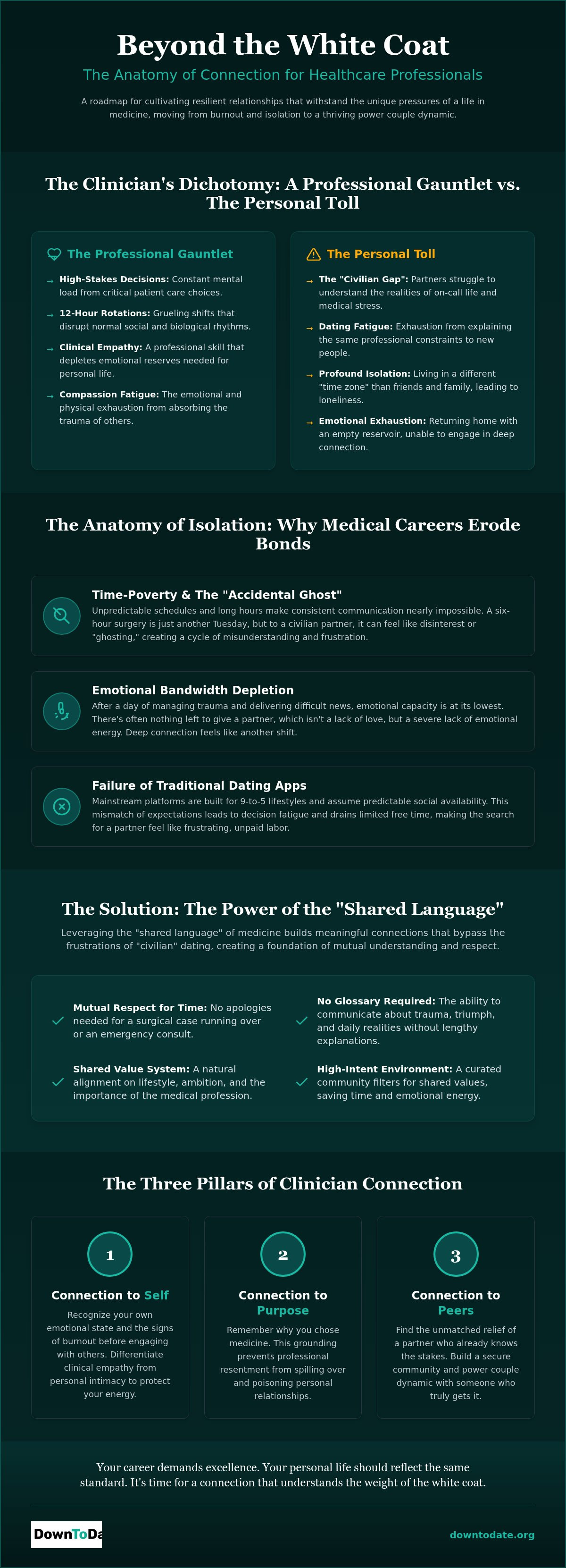
Meaningful connection is not a luxury; it is a clinical necessity. For those in medicine, a connection is a reciprocal, high-value bond that provides genuine emotional safety. It is the space where you drop the mask of the "hero" and exist as a human being. Too often, the lines between clinical empathy and personal intimacy become blurred. Clinical empathy is a professional skill used to treat patients. Personal intimacy is a private sanctuary used to sustain the self. When you spend twelve hours giving empathy to others, you often return home with an empty reservoir for your partner.
This depletion leads many to settle for surface-level interactions. You might find yourself engaging in "small talk" because deep conversation feels like another shift. You avoid the effort of explaining your day because the terminology is too heavy. This creates a cycle of isolation. Finding meaningful connections for healthcare workers requires a shared frequency. We call this the "Medical Language." It is a shorthand for trauma, triumph, and the specific rhythm of a life on call. It is the ability to communicate without a glossary.
The Three Pillars of Clinician Connection
To build a resilient bond, you must first address three foundational areas. First is the connection to self. This involves understanding a comprehensive overview of physician burnout and recognizing your own emotional state before you walk through your front door. Second is the connection to purpose. You must remember why you chose this path to avoid resentment in your relationships. Finally, there is the connection to peers. There is an unmatched relief in finding someone who doesn't need an explanation for a 24-hour shift or a cancelled dinner. They already know the stakes.
Why Traditional Dating Apps Fail Healthcare Heroes
Mainstream platforms are built for a "civilian" lifestyle. They assume a standard 9-to-5 schedule and predictable social availability. This creates the "Civilian Gap." You shouldn't have to apologize for a surgical case that ran over or an emergency consult. On generic apps, these realities are often misinterpreted as a lack of interest. This leads to dating fatigue and frustration. It's a mismatch of expectations that drains your limited free time.
Decision fatigue is another significant hurdle. After making hundreds of critical choices on the floor, swiping through thousands of generic profiles feels like unpaid labor. You don't need more options; you need better ones. Meaningful connections for healthcare workers thrive in curated, high-intent environments. You deserve a space that filters for shared values and professional understanding. You deserve a community that respects your time as much as you do.
The Anatomy of Isolation: Why Healthcare Demands Erode Personal Bonds
Isolation in medicine is rarely a choice. It is a structural byproduct of the profession. When you work 12-hour rotations or back-to-back night shifts, your social availability doesn't just shrink; it disappears. You live in a different time zone than the rest of the world. While friends gather for dinner, you are managing a code or finishing charts. This misalignment creates a profound sense of "otherness" that makes finding meaningful connections for healthcare workers feel like an uphill battle.
Compassion fatigue further complicates this dynamic. You spend your day absorbing the trauma and needs of others. By the time you clock out, your emotional bandwidth is depleted. You have nothing left to give a partner. This isn't a lack of love; it's a lack of capacity. The American Medical Association identifies systemic issues that contribute to burnout, and these same forces actively erode your ability to be present in personal relationships. A residency schedule is a structural architect of loneliness that systematically dismantles the possibility of traditional dating routines. The hospital follows you home. The weight of a difficult outcome or a high-stakes decision doesn't simply vanish when you remove your scrubs.
The Time-Poverty Trap
Time-poverty is the silent killer of medical romance. Unpredictable schedules often lead to accidental "ghosting." You don't intend to ignore a text; you are simply in the OR for six hours. To a civilian, this looks like disinterest. To you, it's just Tuesday. The psychological cost of constantly canceling plans is high. It leads to guilt, and eventually, it leads to you stopping the attempt to make plans at all. Reclaiming connection requires extreme intentionality. It means finding a community that understands the "on-call" life without requiring a 20-minute explanation. If you're ready to stop apologizing for your career, it might be time to join a verified medical community designed for your schedule.
Emotional Shielding and Vulnerability
To survive a high-pressure clinical environment, you must build emotional shields. You learn to be the authoritative clinician who remains calm in chaos. However, that same shield makes it difficult to transition into a vulnerable partner at home. You can't just flip a switch. This emotional "shut down" is a survival mechanism, but it can be a barrier to intimacy. Shared professional backgrounds lower this barrier. When your partner understands the stakes, you don't have to explain why you are quiet. You don't have to justify your need for silence. They already know the weight you're carrying.
The Shared Language of Medicine: Why Peer Connections Thrive
There is a specific relief in coming home to someone who speaks your language. You don't have to explain why a "stable" patient can still weigh heavy on your mind. You don't have to sanitize the details of a traumatic shift to protect their sensibilities. Peer connections thrive because they eliminate the burden of translation. For those seeking meaningful connections for healthcare workers, the shared vocabulary of medicine acts as a bridge rather than a barrier. It creates an immediate foundation of trust and mutual understanding.
The "Power Couple" dynamic in medicine is built on this foundation. It is a partnership where both individuals respect the high stakes and high rewards of the field. Logistically, it's often easier to align your life with someone who understands the rhythm of a call schedule. You aren't fighting for time; you are optimizing the time you have. This shared perspective turns potential conflict into a source of strength. For a deeper look at these dynamics, explore our guide on dating for doctors.
Mutual Respect for Professional Dedication
In a peer relationship, guilt is replaced by support. You don't feel guilty for staying late to finish an admission. Your partner doesn't feel neglected when you need to study for Boards or the USMLE. They've been there. They've lived the same pressure. This mutual respect for professional dedication fosters a unique security. You are both driven by a shared intellectual curiosity. You challenge each other. You grow together. It's not just about sharing a home; it's about sharing a mission. For those who prioritize spiritual development, using a dedicated app like Make Disciples can help you grow together in faith while managing the demands of clinical life. This alignment is what transforms a simple relationship into a resilient partnership.
Navigating the Night Shift Together
The night shift doesn't have to be a death knell for romance. It simply requires a more strategic approach to communication. When you are on opposite rotations, quality matters more than quantity. Leave voice notes. Send a quick text during a quiet moment on the floor. Share a "morning" coffee when one of you is just waking up and the other is winding down. For more practical tips on managing these hurdles, read our strategic guide on dating with an unpredictable schedule. Meaningful connections for healthcare workers are possible even in the most chaotic rotations when both partners prioritize intentionality over convenience.
Strategic Networking: How to Cultivate Depth in a Time-Poor Environment
In the clinical world, we triage. We prioritize the urgent and the essential. Your personal life requires the same level of precision. Stop attempting to maintain a broad-spectrum social circle that drains your energy without providing a return. Finding meaningful connections for healthcare workers depends on prioritizing quality over quantity. You don't need a hundred acquaintances; you need a few high-value bonds that offer genuine respite from the hospital floor. Efficiency is not just a workplace goal; it is a relationship requirement.
Utilize specialized platforms that filter for shared values, education, and professional intent. This isn't about being elitist. It's about being practical. When you start from a place of mutual understanding, you skip the "civilian" explanation phase. Be transparent about your schedule from the very first interaction. If a potential partner cannot respect a delayed text or a shift change now, they are not a viable candidate for a long-term medical partnership. Practice "Active Recovery" socializing. Choose activities that facilitate connection without adding stress, such as a quiet walk or a shared meal, rather than high-stimulus environments that mimic the chaos of the ER.
Vetting for Intentionality
Time-poor clinicians cannot afford the ambiguity of casual dating. You must vet for intentionality. Look for markers of serious commitment early on. Verification is a critical component of this process. In a professional community, verification ensures you are connecting with true peers who share your stakes. Ask direct questions about lifestyle compatibility. Inquire how they handle unpredictability. If you are tired of the guesswork, apply for a Premium Membership to access a community where everyone is already on the same page.
Building Emotional Resilience as a Couple
Once a connection is established, you must protect it. Establish "no-work" zones for your dates. The hospital should not have a seat at your dinner table. If every conversation revolves around patient outcomes or administrative hurdles, burnout will inevitably follow. Create small rituals of connection. A 15-minute morning check-in or a specific "welcome home" routine can be more impactful than a rare, elaborate weekend away. These small windows of focus build the emotional resilience needed to survive a medical career together. Peer support groups can also play a role, but the most important support comes from the person who understands your silence as much as your words.
DownToDate: Building a Secure Community for Medical Professionals
As your connection matures, you may begin to consider long-term goals like starting a family; for LGBTQ+ medical professionals, Storge offers a streamlined way to access fertility resources that fit into a busy clinical lifestyle.
DownToDate is more than a platform. It is a sanctuary. Founded in 2021 by Dr. Shadi and Dr. Sasan Rezai, it was created specifically for those who spend their lives caring for others. They understood the isolation of the night shift. They experienced the frustration of "civilian" dating. They saw the need for a curated space where medical professionals could find love without the burden of constant explanation. This is a platform built by clinicians, for clinicians.
General dating sites are often chaotic and unfiltered. They are noisy environments that demand too much of your limited energy. DownToDate serves as a safe harbor. Our rigorous verification process ensures that every member is a true peer. You aren't just another profile in a vast database. You are part of an exclusive community of high-profile professionals who share your education, your values, and your high-stakes lifestyle. For those who require the most efficient path to partnership, the Premium Membership provides advanced filtering tools to streamline your experience.
Dating Built for the Medical Lifestyle
The medical life is unique. It is demanding. It is rewarding. Our features are designed to reflect these realities for busy residents, nurses, and attending physicians. We recognize that your time is your most valuable asset. We facilitate meaningful connections for healthcare workers by providing a shared professional context from the first interaction. You don't have to justify your hours. You don't have to apologize for your pager. In this secure space, your career is an asset to your relationship, not a hurdle to overcome.
Join the Community of Healthcare Heroes
It is time to stop settling for misunderstood relationships. You deserve a partner who recognizes the weight of the white coat. The mission of Dr. Shadi and Dr. Sasan Rezai is simple: to foster love and understanding within the medical community. They have created a gatekeeper that ensures quality and integrity among its members. You have dedicated your life to healing others. Now, it's time to invest in your own happiness. Join a community that respects your mission and understands your life. Start building your meaningful connections for healthcare workers today.
Prioritize Your Personal Resilience Beyond the Bedside
Your career is defined by high standards and precise execution. Your personal life deserves the same level of intentionality. We have discussed how the structural demands of medicine often erode intimacy, but these hurdles are not insurmountable. By shifting from broad social circles to high-value peer relationships, you reclaim your emotional bandwidth. You move from explaining your life to living it. Meaningful connections for healthcare workers are built on a foundation of mutual respect and a shared language that bypasses the civilian gap. You don't have to apologize for a 24-hour shift when your partner has walked the same halls.
DownToDate was founded by medical professionals who understand the weight of your lifestyle. It is an exclusive community for doctors, nurses, and clinicians that prioritizes professional security. Every profile is verified to ensure you are meeting true peers who respect your schedule and your mission. Stop settling for misunderstood relationships. Find your peer match on DownToDate today and discover a partnership that adds to your resilience. You have spent your shift caring for others; it's time to care for your own connection. You are ready for a partner who speaks your language.
Frequently Asked Questions
Why is it so hard for healthcare workers to find meaningful connections?
Finding meaningful connections for healthcare workers is difficult because of the structural architecture of the medical profession. Long shifts and unpredictable on-call rotations create a time-poverty trap that separates you from the standard social world. You are often emotionally depleted after a shift. This makes it hard to invest in the vulnerability required for new relationships. Mainstream dating apps often fail to account for these specific professional pressures and schedules.
Is dating a fellow medical professional a good idea?
Dating a peer is often the most efficient path to long-term compatibility. A fellow clinician already understands why you are late or why you need silence after a difficult case. You share a common vocabulary and a mutual respect for professional dedication. This eliminates the civilian gap and the need to apologize for your career. It allows you to build a resilient power couple dynamic based on shared values.
How can I find time for dating during my medical residency?
Efficiency is the key to dating during residency. You must prioritize high-value interactions over generic social swiping. Utilize specialized platforms to filter for partners who already respect the residency schedule. Be transparent about your limited availability from the first interaction to ensure lifestyle alignment. By focusing on a verified community of peers, you reduce the time wasted on explaining your professional reality to those who don't understand the field.
What are the best date ideas for busy doctors and nurses?
The best date ideas focus on active recovery rather than high-stimulus events. Choose low-stress activities that facilitate genuine conversation. A quiet walk in a park or a shared meal at a non-traditional hour fits the medical lifestyle better than loud, crowded venues. Focus on creating rituals of connection that can exist within small windows of time. These moments provide a sanctuary from the high-pressure chaos of the hospital environment.
How do I explain my night shift schedule to someone I just met?
Lead with transparency and define your schedule as a professional rhythm rather than a hurdle. Explain that your availability is different, not non-existent. However, the most effective way to handle this is to connect with peers who already live the night shift reality. When you date within the medical community, your schedule requires no explanation. It's understood as a standard part of your commitment to the patients and the field.
What is the most effective way to avoid dating burnout in healthcare?
Avoiding dating burnout requires a shift toward curated, high-intent environments. Stop treating dating like a second shift by swiping through thousands of incompatible profiles. Vet for intentionality early and choose platforms that verify professional status. This reduces decision fatigue and ensures that your limited personal time is spent with individuals who share your educational background and professional stakes. Efficiency protects your emotional bandwidth and your limited free time.
How does DownToDate verify its members are actually medical professionals?
DownToDate utilizes a rigorous verification process to maintain the integrity of its exclusive community. This ensures that every member is a true peer within the medical field. The platform was founded in 2021 by Dr. Shadi Rezai and Dr. Sasan Rezai to provide a secure space for doctors, nurses, and clinicians. By acting as a protective gatekeeper, the app ensures your connections are built on authenticity and shared high-level professional standards.
Can meaningful connections help reduce clinician burnout?
Yes, building meaningful connections for healthcare workers is a vital strategy for reducing burnout. A supportive partner provides the emotional safety needed to decompress after high-stakes clinical shifts. Research indicates that strong peer support and a sense of community mitigate feelings of isolation. When you have a partner who understands the weight of the white coat, you build a resilient foundation that sustains both your career and your personal well-being.


