

The assumption that medical professionals need a full-time support system is a common misconception. In reality, physician relationships thrive on something far more robust. They thrive on intellectual parity. They thrive on emotional self-sufficiency. Understanding what doctors look for in a partner starts with acknowledging these specific needs. You know the weight of the pager. You know the unique exhaustion of a 24-hour shift. It's frustrating when a partner views your schedule as a personal slight rather than a professional reality.
This 2026 guide identifies the high-value traits that lead to long-term success. You'll discover how to navigate the logistical hurdles of a medical schedule. You'll learn to find a partner who provides genuine stability. We'll break down the specific qualities that turn a high-pressure lifestyle into a shared, successful journey.
Key Takeaways
- Understand the lifestyle. Recognize how clinical demands redefine social availability and require partners who can manage second-hand stress.
- Identify the core pillars. Discover exactly what doctors look for in a partner by prioritizing intellectual parity and personal autonomy.
- Navigate the logistics. Learn why schedule-autonomy is essential for maintaining a connection during the rigors of residency and fellowship.
- Protect your connection. Implement radical transparency and designated decompress zones to safeguard your relationship from professional burnout.
- Connect with peers. Leverage verified communities to find partners who inherently understand the unique pressures of the medical field.
The Physician Perspective: Why Medical Life Redefines Partnership
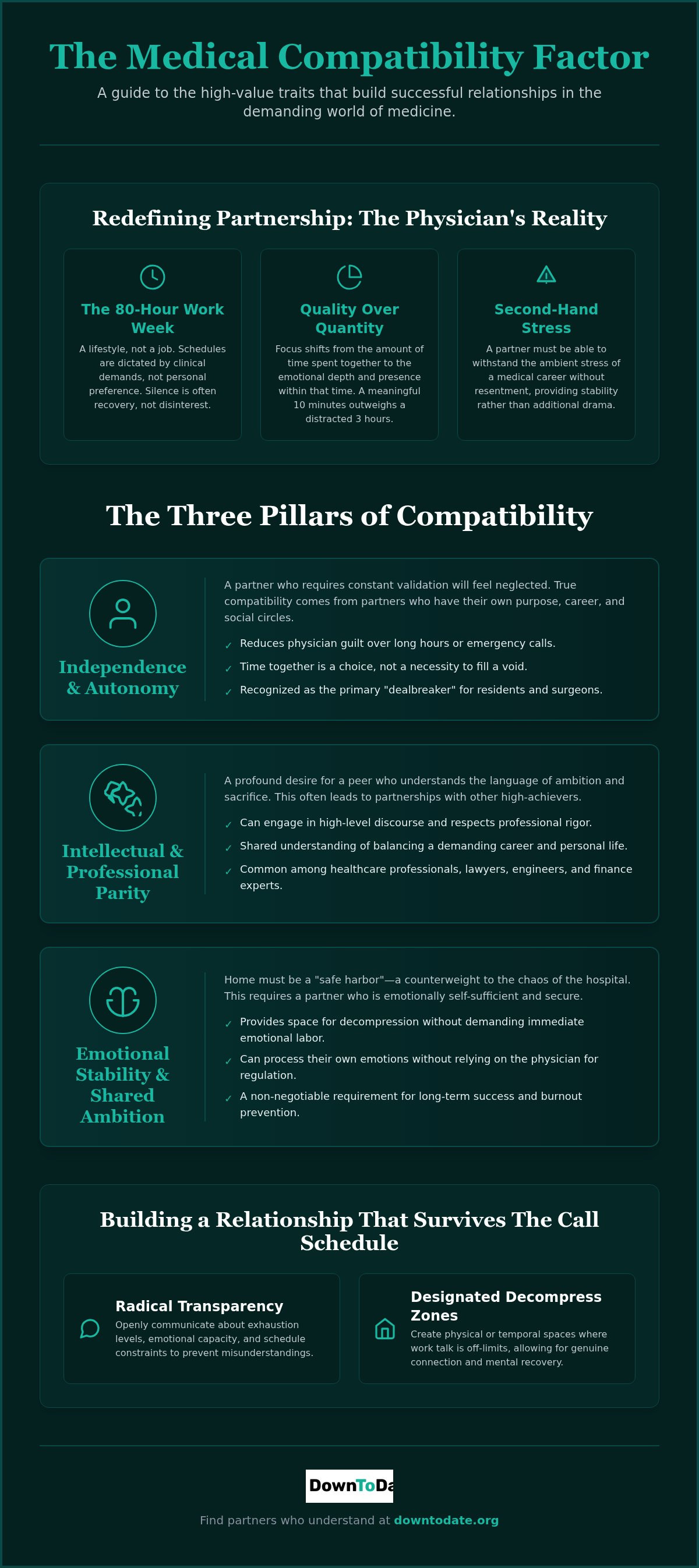
Medicine is not a profession. It is a lifestyle. It dictates your social availability. It determines your sleep cycles. It often decides your geographic location. For the physician, a career is an all-encompassing identity that traditional dating advice fails to address. Most dating guides focus on shared hobbies or romantic gestures. They don't account for the 3:00 AM emergency call or the mental fog after a 24-hour shift. This is why the "Medical Compatibility Factor" is the only metric that truly matters. It is the ability to thrive despite unpredictable demands. When considering what doctors look for in a partner, the search usually leads to one specific trait: the ability to withstand second-hand stress without resentment.
The Reality of the 80-Hour Work Week
Physical exhaustion is a constant variable. After a week of 12-hour shifts, a doctor doesn't have the bandwidth for elaborate social obligations. They need a partner who understands that silence isn't a lack of interest. It's a recovery period. In this environment, the traditional concept of work-life balance is often a luxury. Success in these relationships requires a shift from the quantity of time spent together to the emotional depth of that connection. Ten minutes of focused, meaningful conversation often outweighs three hours of distracted television. You aren't looking for someone to fill your schedule. You're looking for someone who respects its constraints. High-value partners recognize that presence is more than just being in the same room.
Emotional Resilience as a Shared Value
Clinical practice is heavy. It involves life-altering decisions and high-stakes outcomes. Doctors naturally seek a "safe harbor" at home. They need a partner who provides stability rather than additional drama. This requires a unique level of emotional independence. A compatible partner can process their own emotions without relying solely on the physician for regulation. This isn't about being cold. It's about being secure. When we analyze what doctors look for in a partner, we find a preference for those who can offer professional-grade empathy. They understand that a bad day at the hospital isn't something you can just leave at the door. They provide the space for decompression without demanding immediate emotional labor in return. This mutual resilience is the foundation of a lasting medical partnership.
The Three Pillars of Compatibility for Doctors
Compatibility in the medical world is not a matter of chance. It is a matter of structure. When we analyze what doctors look for in a partner, three specific pillars emerge as essential for longevity. These aren't just preferences. They are survival mechanisms for a high-stakes life. You need a partner who mirrors your intensity but maintains their own orbit. You need a partner who understands the weight of your decisions without being crushed by them. Without these foundational elements, the friction of the medical lifestyle will eventually erode even the strongest initial attraction.
Independence and Autonomy
Clinginess is the primary dealbreaker for residents and surgeons. It is a harsh reality. A partner who requires constant attention or external validation will inevitably feel neglected by the medical schedule. This leads to a cycle of resentment and exhaustion. High-value partners possess their own career goals. They have their own social circles. They have their own sense of purpose. This independence is a gift to the physician. It reduces the pervasive guilt felt when staying late for a patient or an unexpected surgery. When a partner is fulfilled elsewhere, the time spent together becomes a choice, not a burden. It allows the relationship to breathe even when the schedule is suffocating.
Intellectual and Professional Parity
There is a profound desire for a peer. Doctors often seek partners who understand the challenges of balancing a demanding career and personal life at a visceral level. This is why many gravitate toward other healthcare professionals or high-achievers in fields like law, engineering, or finance. You need someone who can engage in high-level discourse. You need someone who respects the rigor of your training and the complexity of your daily workload. Shared educational backgrounds facilitate a shorthand in communication that is invaluable. It is about intellectual respect. It is about finding someone who speaks the same language of ambition and sacrifice. Finding this level of alignment is often difficult on traditional platforms, which is why many are turning to exclusive medical communities that prioritize shared professional context.
Emotional Stability and Shared Ambition
The hospital is a place of chaos. The ER is loud. The OR is intense. Home must be the counterweight. Emotional stability is a non-negotiable requirement for long-term success. A grounded presence provides the necessary balance to a volatile workday. Coupled with this is shared ambition. A partner must understand the drive required to reach attending status. They must see the long-term vision of the medical path. They must believe in the mission as much as you do. Without this shared perspective, the relationship will eventually buckle under the pressure of the residency match or the fellowship hunt. You are looking for a teammate, not just a passenger.
Navigating the Logistical Maze: Schedule-Autonomy as a Non-Negotiable
The medical schedule is not a suggestion. It is a third party in the relationship. It sits at the dinner table. It joins you on vacation. It often dictates when you sleep and when you wake. When exploring what doctors look for in a partner, logistical synergy is often more important than shared hobbies. You need someone who can pivot. You need someone who does not view a 4:00 AM call-in as a personal betrayal. This is the reality of modern medicine. Traditional dating advice often asks Do doctors have a hard time dating?, and the answer usually lies in a lack of schedule-autonomy.
Doctors prioritize partners who provide "silent support." This isn't about outdated gender roles or domestic service. It is about the ability to manage a household and a social life without constant supervision. If a physician has to micromanage the home after a 14-hour shift, the relationship becomes another task on a never-ending to-do list. They look for a partner who is a co-pilot, not a passenger. They need someone who understands that the mission comes first, even when it is inconvenient.
The On-Call Lifestyle
Expectations around holidays and weekends must be fluid. A missed anniversary dinner is rarely a choice; it is a professional obligation. Successful medical couples prioritize "micro-dates." A twenty-minute coffee before a shift is more valuable than a cancelled weekend getaway. Schedule-autonomy is the ability to maintain a high level of personal happiness and functional routine regardless of a partner’s physical presence. It is the refusal to let a partner's absence stall your own life. It is the hallmark of a resilient partnership.
Long-Term Planning in a Medical Career
The path from residency to fellowship to attending status is rarely a straight line. It often requires relocation. It requires sacrifice. A partner’s flexibility directly impacts a doctor’s career trajectory. If you are looking for more strategies on this, read Dating for Doctors: Navigating Love in the Modern Medical World. Understanding the residency match process is crucial. It is a system that demands geographic flexibility. A partner who embraces this uncertainty becomes an asset to the physician's professional mission. They aren't just along for the ride. They are part of the strategy.
How to Build a Relationship That Survives the Call Schedule
Survival is the baseline. Thriving is the objective. Building a relationship that lasts through residency and beyond requires a tactical approach to connection. When we evaluate what doctors look for in a partner, the answer often centers on emotional intelligence and logistical flexibility. You cannot rely on spontaneous romance when you are working 80 hours a week. You must build a framework that protects the connection from the inevitable exhaustion of clinical life. This starts with radical transparency about your mental bandwidth. If you are at a zero, say it. If you need silence, request it.
Establish a "decompress zone" after every shift. This is a non-negotiable transition period. It allows the physician to move from the high-stakes environment of the hospital to the domestic reality of home. Engaging in heavy topics or conflict immediately upon arrival is a recipe for burnout. Respect the transition. It is the buffer that prevents professional stress from leaking into personal peace.
Communication Strategies for Busy Couples
The "Post-Call Check-in" is your most valuable tool. Before making any plans, assess the immediate needs of the exhausted partner. Do they need sleep? Do they need food? Do they need to vent? To help prepare something quickly, you can learn more about Pick My Meal Today for a wide variety of global recipe ideas. Use shared digital calendars to sync unpredictable rotations and on-call shifts. This removes the "I didn't know you were working" friction. For more specific tactics, explore this relationship advice for doctors. It provides a roadmap for navigating the complexities of 2026 medical schedules. Active listening during your limited time together ensures that every minute counts.
Burnout is not relationship dissatisfaction. It is a physiological state. Partners must learn to recognize the signs of clinical exhaustion to avoid misinterpreting silence as distance. What doctors look for in a partner is someone who understands this distinction. Small, consistent gestures often carry more weight than grand displays. A pre-packed lunch or a clean house signals appreciation when physical time is scarce. These acts of service bridge the gap created by an 80-hour work week.
Focus on a shared mission. Remind yourselves why the sacrifice matters. When both partners are aligned on the long-term goal, the daily grind becomes manageable. If you are ready to find someone who already understands these dynamics, join a community of verified medical professionals who share your values and your schedule. This shared context is the ultimate shortcut to a successful partnership.
Connecting with Peers Who Get It: The DownToDate Advantage
General dating apps are designed for the masses. They are built for people with 9-to-5 schedules. They are built for those who have never seen the inside of a trauma bay. For a physician, these platforms are a drain on limited energy. They require a heavy "explanation tax." This is the constant need to justify why you are late, why you are exhausted, or why you cannot commit to a weekend getaway three weeks in advance. When you prioritize what doctors look for in a partner, the most valuable asset is often a shared reality. You need a partner who understands the clinical mission without a formal orientation.
DownToDate was founded by Dr. Shadi and Dr. Sasan Rezai to solve this specific friction. It is a community built by physicians, for healthcare professionals. It eliminates the need to apologize for your career. In this space, your schedule is not a hurdle; it is a known variable. This shared context creates an immediate foundation of trust. It allows you to skip the surface-level explanations and move directly toward meaningful connection. Efficiency is a priority. Verification is a necessity. Integrity is the standard.
The Elite Standard for Medical Dating
Safety and serious intent are the pillars of our community. Every member is verified. This ensures you are connecting with peers who share your professional language and your level of dedication. You aren't just swiping; you are entering a protected environment designed for high-achievers. Finding a partner who respects the weight of your decisions is easier when they have faced similar stakes. If you are evaluating your options, consult our 2026 guide on The Best Professional Dating App for Medical Professionals. It outlines why specialized platforms are the only logical choice for busy residents and attendings.
Your Next Step Toward Partnership
Stop wasting your limited bandwidth on general apps that do not respect your time. Your personal life deserves the same level of precision as your clinical practice. What doctors look for in a partner is often found right here, among a community of individuals who already "get" the lifestyle. We provide the bridge between professional dedication and personal connection. Join a community that values your mission and understands your sacrifice. Your time is valuable. Your connection should be, too. Join the verified community today and find the partnership you deserve.
Securing Your Future Partnership
Finding the right connection shouldn't be another clinical burden. You've seen how the medical lifestyle redefines the nature of partnership. It requires more than just patience. It requires a shared understanding of the mission. It requires intellectual parity. It requires a high level of personal autonomy. When you define what doctors look for in a partner, you're looking for a teammate who can navigate the logistical maze of an 80-hour work week without losing their own sense of self.
You don't have to explain your exhaustion to someone who has lived it. You don't have to justify your schedule to someone who shares it. Founded by Dr. Shadi Rezai and Dr. Sasan Rezai, DownToDate is a community designed specifically for these demands. It is a secure space exclusively for verified healthcare professionals. Stop swiping on platforms that don't respect your time. Join DownToDate today to connect with peers who truly understand your life. Your career is exceptional. Your partnership should be, too.
Frequently Asked Questions
Do doctors prefer dating other doctors?
Preferences vary, but the shared context of medicine is a powerful draw. It reduces the explanation tax significantly. Many physicians favor dating peers because they inherently understand the 80-hour work week. This shared language eliminates friction over missed dinners or late calls. However, others seek a mental escape through non-medical partners. The priority isn't the degree. The priority is finding someone who respects the intensity of the medical path without resentment.
What is the biggest dealbreaker for a doctor in a relationship?
Emotional dependency is the most frequent dealbreaker. A doctor's schedule is volatile. It is unpredictable. They cannot be the sole source of a partner's social engagement. If a partner interprets a late night in the OR as a personal slight, the connection will erode. Doctors require partners who are self-sufficient. They need someone who maintains a fulfilling life of their own. Autonomy is not just a preference. It is a requirement.
How do I support a partner who is a medical resident?
Support them through logistical synergy. Residency is a period of high-risk burnout. You can help by managing the silent household tasks. Don't demand heavy emotional labor the moment they walk through the door. Establish a clear decompress zone after long shifts. Small acts of service, like preparing a meal for their next rotation or taking the initiative to learn more about AskMyDoc.ca virtual doctor appointments in Manitoba, show appreciation. Your role is to be a stable harbor while they navigate the intensity of their training.
It is challenging but possible with the right mindset. The difficulty often comes from a lack of shared context. Non-medical partners must learn the specific rhythms of the healthcare lifestyle. You must be comfortable with micro-dates and flexible planning. Understanding what doctors look for in a partner helps bridge this gap. Success depends on your ability to thrive independently. You must be happy and functional even when they are on call.
How much time do doctors actually have for dating?
Time is a scarce resource. Most U.S. physicians work between 49 and 58 hours per week. Residents often reach 65.6 hours or more. This means quality time must be redefined. You won't always have consistent dinner dates or long weekends. You must maximize the small windows that do exist. Doctors prioritize high-value interactions. They look for partners who can pivot when a schedule changes at the last minute. Efficiency is the goal.
What qualities make a "power couple" in medicine?
A medical power couple is built on mutual ambition. Both partners must respect the drive required for career advancement. They share a vision for the future. They manage the logistics of two high-stakes careers with precision. This requires radical transparency about mental bandwidth. They don't compete for attention. They support each other's professional milestones. They maintain a grounded, stable home environment that serves as a counterweight to the chaos of the hospital.
How can I meet single doctors who are looking for serious relationships?
Move away from general dating apps. They don't filter for professional intent. Specialized communities are the most efficient path forward. What doctors look for in a partner is often found in verified, exclusive spaces. These platforms reduce the time spent explaining your lifestyle. Look for communities founded by physicians. They understand the specific hurdles of your career. They prioritize safety and shared values. This ensures you meet peers who have serious intent.
What should I know before dating a surgeon?
Prepare for extreme schedule volatility. Surgeons often work the longest hours. Some residents average 75 hours per week. Their work is physically demanding and mentally intense. You must be comfortable with a partner who is decisive and focused. Home must be a place of recovery. Understand that their commitment to the patient is absolute. You are dating someone whose mission frequently dictates their physical presence. Flexibility is your most valuable asset.


