

The hardest part of dating a surgeon isn't the 80-hour work week. It's the silence that follows it. You wait for a text that doesn't arrive. You plan a dinner that gets cancelled at the last minute. You feel like a secondary character in a high-stakes hospital drama. It's exhausting to compete with a career that saves lives. You're tired of explaining your partner's absence to friends who don't understand the stakes. We know the pressure. We've lived the schedule. Dating a surgeon requires a specialized toolkit that standard relationship advice simply can't provide.
This guide changes the narrative. You'll master the unique rhythms of surgical life and discover why peer-to-peer connection is the secret to a lasting relationship. We'll provide a functional framework for maintaining intimacy during residency. We'll offer methods for managing the unpredictability of the call schedule. We'll explore why the 2026 medical landscape demands a more sophisticated approach to partnership. From navigating ACGME regulations to finding a community that shares your values, we're giving you the blueprint for success. It's time to stop surviving. It's time to start thriving together.
Key Takeaways
- Understand the surgical mindset. Recognize that the operating room is a professional duty, not a personal choice, to avoid feeling like a second priority.
- Differentiate between the career stages. Navigate the intensity of the residency years and prepare for the transition to attending life with a clear roadmap.
- Bridge the explanation gap. Discover why dating a surgeon thrives when built on the foundation of shared professional empathy and mutual sacrifice.
- Prioritize connection over the calendar. Master the "No-Guilt" Rescheduling Policy to keep your relationship functional during high-stakes rotations.
- Simplify the search for partnership. Use a verified, peer-to-peer platform to connect with medical professionals who already understand your lifestyle.
Understanding the Surgical Lifestyle: Beyond the Scrub Room
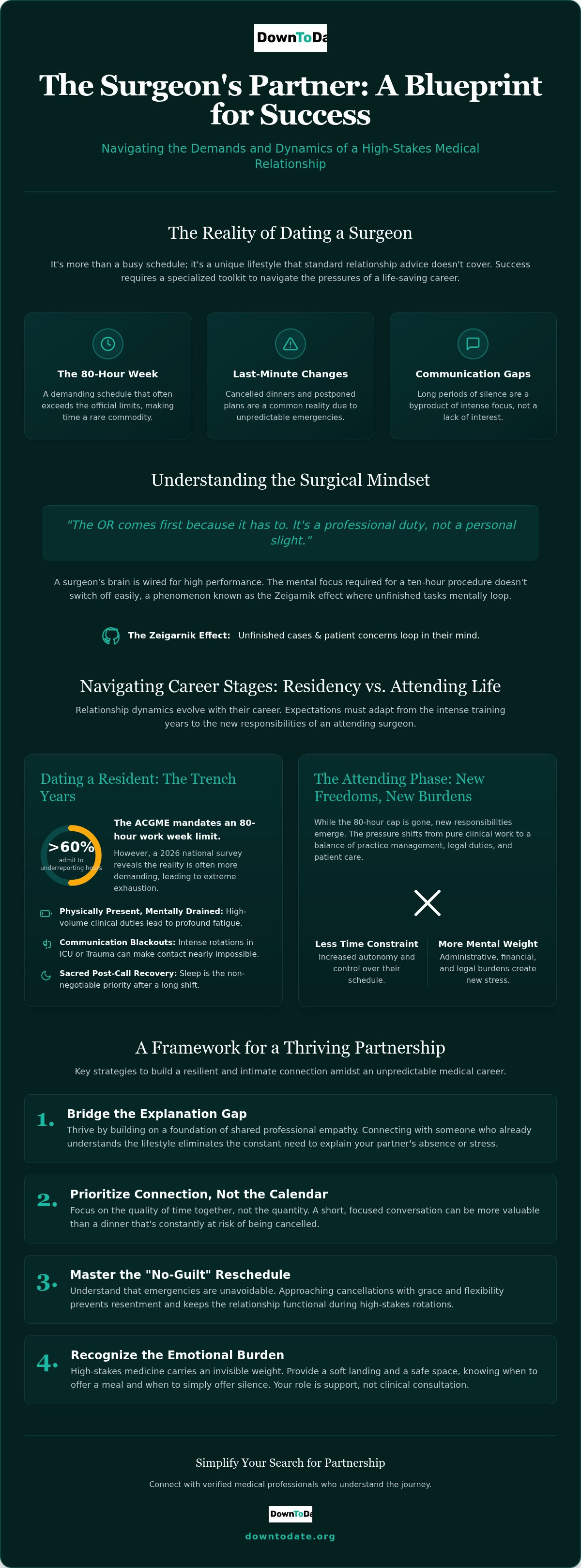
Success in the operating room requires a specific psychological architecture. Precision is non-negotiable. Stakes are absolute. Delayed gratification is a survival skill learned over decades of training. When you are dating a surgeon, you aren't just dating a person. You are dating a set of high-performance habits. Understanding what is a surgeon beyond the technical skill helps reframe their behavior. The focus required for a ten hour procedure doesn't simply vanish when the gloves come off. This is the Zeigarnik effect in action. Unfinished tasks or complex cases loop in the mind. It makes switching off at the dinner table nearly impossible. It isn't a lack of interest in you. It's a brain wired for completion and patient safety. The OR comes first because it has to. It's a professional duty, not a personal slight.
The Reality of the Call Schedule
The call schedule is the primary architect of a surgeon's life. It dictates when they sleep. It dictates when they eat. It dictates when they see you. On call isn't a suggestion. It's a legal and ethical mandate. While elective surgeons might have predictable blocks, those in trauma or emergency roles live by the pager. A shift ending at 6:00 PM rarely means a 6:30 PM arrival at home. Post-operative notes must be written. Hand-offs must be precise. New admissions can appear in the final five minutes of a shift.
- Elective roles: More control, but still subject to surgical complications.
- Trauma/Emergency: Zero predictability; plans are always tentative.
- The Stay-Late Factor: Procedures often take longer than scheduled.
Expecting punctuality is a recipe for resentment. Expecting unpredictability is the first step toward a functional partnership.
The Emotional Burden of High-Stakes Medicine
High-stakes medicine leaves an invisible footprint. A twelve hour day in the OR is physically grueling. The emotional tax is often higher. Bad outcomes happen. Even with perfect execution, biology sometimes fails. Your partner carries these moments home. They might be distant. They might be quiet. They might be uncharacteristically irritable. They don't need you to be a second medical assistant. They don't need a clinical consultant. They need a space where they don't have to be the person in charge.
Your role is to provide a soft landing. Recognize that their physical exhaustion is a physiological response to sustained cortisol levels. Dating a surgeon means witnessing the human cost of a high-pressure career. Empathy isn't about fixing the clinical problem. It's about acknowledging the weight they carry. It's about knowing when to offer a meal and when to offer silence.
Navigating Career Stages: Residency vs. Attending Life
Relationship dynamics aren't static. They evolve as the medical career matures. Understanding the pros and cons of dating a doctor requires looking at the specific stage of their training. What works during intern year won't work for a senior attending. When dating a surgeon, you must adapt your expectations to the medical hierarchy. Each phase demands a different version of support and a different level of patience.
Dating a Surgical Resident: Survival Strategies
These are the trench years. Time is the rarest commodity. While ACGME regulations mandate an 80-hour work week, a 2026 national survey found over 60% of residents admit to underreporting hours to remain compliant. When dating a surgeon in residency, expect them to be physically present but mentally drained. ICU or Trauma rotations create communication blackouts. Don't take the silence personally. It's a byproduct of high-volume clinical duty. The Post-Call Day is a sacred period for recovery where sleep is the only priority. Success here means finding a partner who values your independence. If you're looking for someone who "gets it" immediately, consider joining a verified medical community where these schedules are the norm.
The Attending Phase: New Challenges, New Freedom
Attending life brings a shift in power. Autonomy increases. The 80-hour cap disappears. New burdens take its place. Administrative requirements and legal responsibilities create a different kind of weight. It's no longer just about the clinical work. It's about managing a practice or navigating academic politics. Fellowship often adds another layer of specialized intensity before the lifestyle stabilizes. Relocation is a common reality during these transitions. You might finally have the financial resources for luxury, but the schedule remains a jealous master.
Managing the move from residency to attending life requires a new contract. You're trading time-poverty for responsibility-heavy stress. The money provides comfort, but it doesn't buy back the hours spent on-call or finishing charts. Stay focused on the long-term mission. Build a life that thrives regardless of the hospital's demands. True partnership in this phase means protecting your shared time with the same ferocity they apply to their surgical cases.
The Peer Advantage: Why Surgeons Date Other Healthcare Professionals
The "Explanation Gap" is the silent killer of many medical relationships. When you are dating a surgeon, the lack of shared context creates constant friction. Civilians often struggle to grasp why a shift doesn't end when the clock hits five. They don't understand the emotional residue of a difficult case. Peers don't need a primer. They know the pager isn't a choice. They know the exhaustion isn't a lack of interest. This shared reality eliminates the need for constant justification. It replaces frustration with professional empathy. You spend less time explaining your life and more time living it. This is the peer advantage.
Shared values form the backbone of these connections. The mutual understanding of sacrifice and professional dedication isn't something you can teach. It's something you live. When both partners recognize that the patient's needs are paramount, the "OR comes first" rule is no longer a source of conflict. It's a shared commitment. Reducing "Civilian Friction" means you don't have to sanitize your day. You can share the realities of medical trauma with someone who has the clinical and emotional framework to process it alongside you.
Mutual Respect for Professional Demands
Dual-medical relationships operate on a different frequency. There is a profound respect for the high-stakes nature of the work. You don't have to apologize for a late arrival or a cancelled dinner. Your partner has been in the same position. This creates a sanctuary of understanding. However, be wary of "competitive exhaustion." It's easy to fall into a pattern where both partners are too drained to engage. You must intentionally pivot from clinical mode to partner mode. Practical relationship advice for doctors suggests scheduling "non-medical" zones. Protect these spaces. Ensure the hospital doesn't occupy every corner of your home life.
Building a Shared Mission
A lasting partnership requires a shared mission. In the medical community, this mission is often centered on service and sacrifice. You aren't just roommates. You are a team supporting each other through the rigors of a demanding career. Speaking the same "medical lexicon" provides an emotional shorthand. You can process a bad day without translating clinical terms into layman's language. This psychological safety is why peer-matched couples often experience lower burnout rates. By focusing on dating for doctors, you are building a "Power Couple" dynamic. You leverage your shared experiences to create a relationship that is resilient, authentic, and mission-driven. You understand the cost. You value the connection. You thrive together.
5 Rules for Maintaining Intimacy with an Unpredictable Schedule
Intimacy isn't measured in hours. It's measured in intent. When dating a surgeon, you don't have the luxury of a standard 9-to-5 calendar. You have windows. You have fragments. You have to make them count. Success requires a shift from quantity to quality. A focused twenty minutes before sleep is more restorative than four hours of distracted scrolling. This is the first rule of survival. Be present when you are together. Be intentional when you are apart. Focus on the person, not the clock.
Adopting a "No-Guilt" Rescheduling Policy is the second rule. Complications happen. Cases run over. Trauma doesn't follow a schedule. When a procedure extends beyond the expected window, it isn't a choice; it's a professional mandate. Handling these cancellations with grace prevents the corrosive buildup of resentment. The third rule involves leveraging 2026 technology for digital intimacy. Use shared digital calendars to track shifts and video check-ins for 24-hour calls. Parallel play is the fourth rule. Spend time together while one person charts or sleeps. Presence is enough. Finally, the fifth rule is strategic planning. Book "protected time" weeks in advance and treat it with the same reverence as a surgical procedure.
Tactical Date Ideas for Busy Surgeons
Traditional Saturday night dinners are often impossible. Pivot to the "Post-Call Brunch" instead. It utilizes the natural window after a long shift before the sleep cycle resets. Hospital cafeteria dates can feel special with the right mindset. They provide a brief oasis of connection in a high-pressure environment. You aren't just eating; you're supporting their mission. Micro-dates are the essential building blocks of long-term stability in a medical relationship. These five-minute connections sustain the bond when the schedule is most demanding.
Communication Under Pressure
Effective communication is low-stakes and high-frequency. Send text check-ins during breaks. Don't expect an immediate reply. This keeps the connection alive without adding to their cognitive load. You want to be their peace, not another task on their list. Manage the dating with an unpredictable schedule by using shared digital tools. This ensures both partners are aligned on upcoming rotations and on-call duties. Transparency reduces the friction of the unknown. It builds trust when time is scarce. If you're ready to find a partner who values this level of strategic connection, join our exclusive medical community today. Stop explaining your life to people who don't understand it.
Meeting Your Match: How DownToDate Simplifies Medical Dating
General dating apps fail the medical community. They are built for civilians with predictable lives. They are designed for people who have never stepped foot in an OR. When you are dating a surgeon, you shouldn't have to spend the first three dates explaining why you missed dinner. Civilian frustration is inevitable on traditional platforms. It leads to wasted time and emotional burnout. You need a space where your career is an asset, not a hurdle. You need a platform that filters for serious, medical-minded professionals from the start. Efficiency is the priority. Authenticity is the requirement.
DownToDate was founded by surgeons, Dr. Shadi and Dr. Sasan Rezai, who understand this specific friction. It is a verified community designed by medical professionals for medical professionals. We act as a protective gatekeeper to ensure shared values and serious intent. Choosing a Premium Membership is more than a subscription. It's an investment in your personal life. It respects your limited time. It prioritizes high-value connections. It removes the noise of general dating so you can focus on finding a partner who truly "gets it" without a primer.
Filtering for Shared Professional Experiences
Compatibility in medicine requires more than shared hobbies. It requires compatible lifestyles. Our platform uses tailored matching tools designed for unpredictable schedules. You can find partners who understand the nuances of resident work hours. You can connect with peers who respect the weight of clinical duty. A medical-only space allows for authentic connection without the "Explanation Gap." To attract other high-achievers, optimize your profile with precision. Highlight your dedication. Be clear about your professional goals. High standards aren't a barrier here. They are the requirement for entry.
Taking the Next Step Beyond the Hospital
Medicine shouldn't be your entire identity, but it is a significant part of your world. Moving from professional networking to romantic partnership requires a bridge. DownToDate is that bridge. We help you navigate the transition from the hospital ward to the real world. Dating a surgeon becomes a functional reality when both partners share a professional shorthand. You don't have to apologize for your mission. You don't have to hide your ambition. You find a partner who supports the larger goal of your career while building a life alongside you. Join the community that understands your life today. Build a partnership that is as resilient as your career.
Building a Partnership Beyond the Pager
Success isn't about finding more time. It's about finding the right person to share it with. You've learned that the surgical mindset is a professional duty, not a personal choice. You've identified the critical differences between the residency trench years and the administrative responsibilities of attending life. Most importantly, you've discovered that dating a surgeon thrives when built on professional empathy rather than civilian explanation. Shared values are the foundation. Mutual respect is the framework. Intentionality is the fuel.
You don't have to navigate this high-stakes lifestyle alone. You don't have to settle for the frustration of general dating apps that don't respect your schedule. DownToDate was founded by Dr. Shadi and Dr. Sasan Rezai to bridge the gap between clinical excellence and personal connection. It's a verified medical community designed specifically for the unique demands of the healthcare lifestyle. It moves with your rhythm. It respects your mission. It protects your time. Join DownToDate and connect with medical peers who understand your schedule. Stop explaining your life to people who don't understand it. Start building a lasting partnership with someone who already gets it. Your career is elite. Your relationship should be too.
Frequently Asked Questions
Is dating a surgeon harder than dating other types of doctors?
Surgical dating is uniquely challenging due to procedural unpredictability. Unlike clinic-based physicians, a surgeon cannot leave a case mid-operation. Their exit time is dictated by biology and complications rather than a clock. This creates a higher level of schedule volatility compared to other specialties. Success when dating a surgeon requires a partner who accepts that the operating room is a non-negotiable priority that often overrides personal plans.
How often do surgeons actually see their partners during residency?
Visibility is often limited to the margins of the day. ACGME regulations cap resident hours at an 80-hour weekly average, but clinical duties frequently consume 12 to 14 hours daily. You might only share 30 minutes of conscious time before they need to sleep. Meaningful connection happens during post-call days and rare golden weekends. You must learn to value the quality of these brief windows over the quantity of time spent together.
What is the best way to support a surgeon after a long shift?
Provide a low-friction environment. Surgeons spend their entire day making high-stakes decisions and managing clinical crises. When they return home, they need a space where the cognitive load is zero. Handle the logistics of dinner and household tasks without asking for input. Offer physical comfort and silence before diving into complex discussions. They need to decompress from the intensity of the OR before they can fully engage as a partner.
Do surgeons only date other medical professionals?
Surgeons often gravitate toward other healthcare professionals to eliminate the "Explanation Gap." A peer understands the ethical mandate of a call schedule without requiring a justification. This shared professional shorthand reduces the friction often found with partners who don't grasp the medical lifestyle. While they don't exclusively date within the field, the mutual understanding of sacrifice makes these "Power Couple" dynamics highly resilient in the face of hospital demands.
How can I handle the frequent cancellations when dating a surgeon?
Adopt a "No-Guilt" Rescheduling Policy as your primary defense. Recognize that a late case or emergency trauma is a professional obligation, not a personal choice. Always maintain an independent "Plan B" for your own evening. Your relationship remains functional when you stop viewing a cancellation as a slight. Resilience comes from building a life that thrives even when the hospital keeps your partner in the scrub room for extra hours.
Is it possible to have a family while dating or married to a surgeon?
A family is entirely possible but requires meticulous strategic planning and a robust support system. Many surgical families utilize extended family or professional help to manage the household during heavy rotations. You must be prepared to handle daily logistics autonomously when your partner is on-call. Success is found in viewing the family as a shared mission. Both partners must align on how to protect domestic stability during the training years.
What are the red flags to look for when dating a surgeon?
Watch for a total lack of effort during their scheduled free time. Exhaustion is a reality, but a partner who never prioritizes you during a "golden weekend" is a concern. Another red flag is "God complex" behavior that bleeds into your personal life. A healthy surgeon remains empathetic and respectful regardless of their professional status. Ensure they value your time as much as they value their own, even if they have less of it.
Why do surgical relationships have a reputation for being difficult?
The difficulty stems from extreme time-poverty and the emotional residue of high-stakes work. Surgeons often struggle with the "Zeigarnik effect," finding it hard to switch off their clinical brains after a complex case. The mismatch between civilian expectations of a predictable life and the reality of surgical duty creates constant tension. When dating a surgeon, you must bridge this gap with professional empathy. The reputation exists because few people can handle the sacrifice.


