

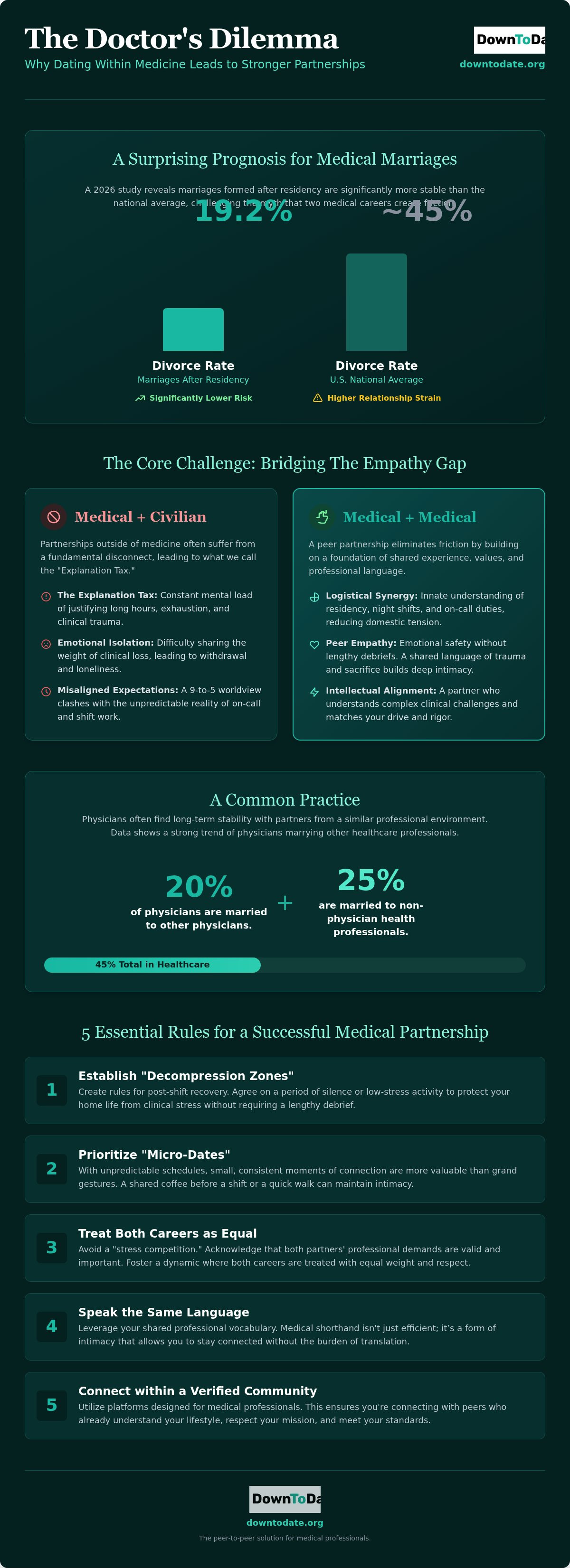
A 2026 study reveals that marriages formed after residency have a divorce rate of just 19.2 percent, significantly lower than the national average. This data challenges the common myth that two medical careers in one household lead to inevitable friction. When you consider the benefits of dating a fellow medical professional, the logic becomes clear. You're likely tired of paying the explanation tax. You're exhausted from justifying your clinical fatigue to partners who don't understand the weight of a code or the reality of a 24-hour shift. Many healthcare workers face burnout not from the hospital, but from the constant emotional labor of translating their trauma to someone outside the field.
Discover why a peer partnership is the most efficient path to a relationship that understands your schedule, your stress, and your standards. We will explore how a shared professional background provides emotional safety without lengthy explanations. We will examine why a common language builds deeper intimacy. This guide provides a clear roadmap for finding a partner who respects the demands of residency and the high-stakes lifestyle you've chosen. It's time to stop explaining your life. It's time to start sharing it with someone who already speaks the language.
Key Takeaways
- Eliminate the "explanation tax." Find a partner who intuitively understands clinical fatigue and the weight of a 24-hour shift.
- Realize the strategic benefits of dating a fellow medical professional through shared values of high achievement and intellectual rigor.
- Navigate the "Empathy Curve." Peer relationships offer a more sustainable path for long-term emotional safety and domestic management.
- Implement practical rules for success. Establish "Decompression Zones" and "Micro-Dates" to protect your romantic life from clinical stress.
- Access a verified community. Connect with peers who already speak your professional language and respect your mission.
The Empathy Gap: Why Dating Outside the Medical Field is a Challenge
Every medical professional pays a hidden cost in civilian relationships. We call it the "Explanation Tax." It is the mental load of justifying why you are late, why you are exhausted, or why you cannot attend a Saturday wedding. Non-medical partners often perceive your absence as a lack of priority. They see the job as a competitor for your affection. This friction creates a cycle of guilt and resentment that erodes the foundation of a partnership. Understanding the benefits of dating a fellow medical professional starts with acknowledging this inherent gap in perspective.
General dating apps exacerbate this problem. They are designed for a 9-to-5 world. They do not filter for the resilience or the mission-driven focus required in healthcare. When a civilian partner expects a predictable work-life balance, the reality of clinical life feels like a betrayal. This preference for similar backgrounds is a documented sociological phenomenon known as Assortative mating, which suggests that long-term stability often stems from shared professional and social environments. In medicine, this alignment is not just a preference. It is a survival strategy.
The Reality of the 80-Hour Work Week
The concept of being "on-call" is difficult for civilians to internalize over the long term. At first, it feels like a noble sacrifice. Eventually, it becomes a source of domestic tension. Traditional dating apps prioritize immediate availability, which conflicts with the erratic nature of residency and shift work. The medical lifestyle is a lifelong commitment to service that transcends the boundaries of a traditional 9-to-5 career. A peer understands that a pager is not an interruption; it is a responsibility. They do not see your dedication as a personal slight. They see it as a shared standard of excellence.
The Emotional Isolation of the Healthcare Hero
Coming home after a traumatic shift is an exercise in emotional translation. You try to explain the weight of a clinical loss to someone who has no context for the environment. Often, you simply stop sharing. This leads to profound emotional isolation within the relationship. One of the primary benefits of dating a fellow medical professional is the removal of this translation phase. Shared professional trauma acts as a bonding agent. A peer knows that your silence after a shift is not a rejection of them. It is a necessary period of decompression. They provide emotional safety because they have stood in the same trauma bay. They offer support without requiring a lengthy debrief.
The Strategic Benefits of Dating a Medical Professional
Efficiency is the hallmark of a successful medical career, and just as high-performing professionals often use the D2C Method to bring systematic precision to their outreach and education, your personal life deserves that same standard. Choosing a partner within your field isn't about doubling the stress; it's about halving the friction. One of the primary benefits of dating a fellow medical professional is the immediate removal of the explanation phase. You don't have to justify why you're tired. You don't have to apologize for a 14-hour day. Data from a recent annual report on physician lifestyle confirms this trend. It shows that 20 percent of physicians are married to other physicians, and another 25 percent are married to non-physician health professionals. These couples choose this path because it creates a logistical synergy. They navigate residency, night shifts, and rotations with a partner who is in the same trenches.
A Shared Language of Sacrifice
Peer dating eliminates the pervasive guilt often found in civilian relationships. You miss a holiday. You skip a family milestone. In a non-medical partnership, this is often a point of contention. In a peer partnership, it's a known variable. Communicating in medical shorthand during a busy day isn't just efficient; it's an act of intimacy. It allows you to stay connected without the burden of translation. Peer Empathy is the foundational block of medical-medical relationships. It fosters a power couple dynamic where both careers are treated with equal weight. You build a life with a partner who respects your mission as much as their own.
Intellectual and Professional Alignment
High-achieving professionals thrive when their drive is matched. You need a partner who acts as a sounding board for complex clinical challenges. They understand the nuance of your professional hurdles. They respect the intellectual rigor required to maintain your standards. Mastering dating for doctors requires a strategy that values your time and your talent. When both partners share a commitment to altruism and achievement, the relationship becomes a source of strength. It is no longer a drain on your limited energy. If you're ready to find this level of alignment, connecting with an exclusive community of verified peers is the most direct path forward.
Medical-Medical vs. Medical-Civilian: A Comparative Framework
The "Empathy Curve" in medical relationships follows a predictable trajectory. In civilian partnerships, empathy often peaks during the initial "hero" phase but sharpens into resentment by year three. The non-medical partner grows weary of the missed dinners and the emotional unavailability. In peer partnerships, the curve remains resilient. There is no decline because there is no misunderstanding. One of the primary benefits of dating a fellow medical professional is this long-term stability. You aren't just sharing a bed; you're sharing a lifestyle that has already been vetted and accepted by both parties. This is why, in 2026, we see a massive migration of healthcare workers toward specialized communities. They are seeking efficiency over explanation.
The Stability of Shared Expectations
Medical-medical couples report higher satisfaction during the grueling residency years because the baseline of expectation is identical. You both know the hospital is the third person in the room. It doesn't leave. It doesn't sleep. It demands your attention at 3:00 AM. When your partner is also a peer, the hospital's presence is an accepted reality rather than a source of jealousy. Success requires a blueprint, and many couples are now using strategies for dating with an unpredictable schedule to maintain intimacy. They don't fight the schedule. They optimize the time that remains.
Navigating the "Two-Body Problem" in Medicine
Success in a dual-medical partnership requires more than mutual attraction. It requires a deliberate operational strategy. To fully realize the benefits of dating a fellow medical professional, you must protect your personal space from clinical encroachment. These five rules provide a framework for professional and romantic longevity.
- Rule 1: Establish Decompression Zones. Designate physical or temporal spaces where medical talk is strictly prohibited. Your bedroom and your dinner table should remain clinical-free zones.
- Rule 2: Prioritize Micro-Dates. Don't wait for a full weekend off. A fifteen-minute coffee between shifts or a shared commute is more valuable than a canceled getaway.
- Rule 3: Use specialized platforms. Stop filtering through civilians on general apps. Connect with verified peers who share your serious intent by joining an exclusive medical community.
- Rule 4: Practice proactive communication. Flag your shift burnout before it manifests as irritability. Tell your partner you are "at capacity" before the conflict begins.
- Rule 5: Celebrate the mission. Honor your shared commitment to medicine, but ensure it is a part of your identity, not the whole.
Vetting for Shared Intent
Swiping through thousands of profiles is fundamentally inefficient for a busy clinician. In the professional dating landscape of 2026, verification is the gold standard for safety and quality. You need to know that your partner understands the nuances of the residency match or the demands of a surgical fellowship. Ask about professional trajectories during the first few conversations. Ensure your long-term goals align before you invest significant emotional capital. Efficiency in vetting leads to higher quality connections and fewer wasted nights.
Protecting the Relationship from Burnout
Protecting the bond means leaving the hospital at the door. This is a difficult skill to master when both partners are physically and mentally exhausted. Shared insider humor serves as a vital release valve that only another medical professional can provide. Use your unique perspective to find lightness in the heavy moments of clinical life. The 20-minute debrief is a structured tool for emotional health, allowing both partners to vent about their day before transitioning into their roles as partners. Once the timer ends, the clinical day is officially over. This boundary prevents the hospital from becoming a permanent resident in your home.
DownToDate: The Peer-to-Peer Solution for Medical Professionals
Dr. Shadi Rezai and Dr. Sasan Rezai founded DownToDate to solve a specific, recurring crisis. They lived the struggle of medical training. They understood that general dating apps fail healthcare workers by design. They knew the "explanation tax" was a barrier to true intimacy. DownToDate acts as a protective gatekeeper for high-value connections. It's a space where professional empathy is the baseline. It's where your career is an asset, not a liability. This is where the benefits of dating a fellow medical professional become a daily reality. You move beyond the sterile environment of the hospital. You find a meaningful connection with a peer who shares your standards and your mission.
Dating Built for Your Life, Not a 9-to-5
The platform accommodates the unique pacing of a medical career with precision. It doesn't expect a response during a surgical block. It doesn't penalize you for a late-night reply after a code. It respects the 80-hour work week. Advanced filters are designed specifically for the healthcare professional. You can filter by clinical specialty or training level. This is not just dating; it's strategic partnership. For those ready to commit to a higher standard of connection, the DownToDate Premium Membership offers the elite standard for medical dating. It provides the advanced tools necessary to remove noise and focus on high-intent matches.
Join a Community of Verified Professionals
Security and exclusivity are the pillars of this community. DownToDate is a dedicated ecosystem for the medical field. Every member is a verified peer. Every profile represents someone who understands the resilience required to thrive in medicine. In 2026, there's no reason to settle for platforms that don't recognize your worth. You deserve a partner who values your dedication. You deserve a relationship built on the benefits of dating a fellow medical professional, where shared language creates immediate trust. This is the most efficient path to a relationship that respects your schedule and your stress. It's a community built on integrity and serious intent. Stop translating your life to civilians. Start sharing it with someone who already knows the weight of the white coat. Find your medical peer match on DownToDate today.
Your Path to a Partnership Without the Explanation Tax
Choosing a partner who shares your professional background is a strategic decision. It's an investment in your emotional health and your career longevity. You've spent years mastering clinical excellence; you shouldn't have to spend your limited free time justifying your fatigue to a civilian. The benefits of dating a fellow medical professional include immediate empathy, logistical synergy, and a shared language of sacrifice. You deserve a relationship that functions with the same efficiency as a well-run surgical team. It's time to move beyond the friction of mismatched expectations.
DownToDate was founded by Dr. Shadi Rezai and Dr. Sasan Rezai to bridge the gap between demanding careers and meaningful connections. This is an exclusive community for verified healthcare professionals. It's tailored specifically for your schedule and your lifestyle. Stop settling for platforms that don't understand your value. Your mission is unique, and your partnership should be too. Join DownToDate and connect with peers who understand your medical journey. You've already found your professional calling. Now, find the person who truly gets it.
Frequently Asked Questions
Is it a good idea for two doctors to date?
Yes, it creates a foundation of mutual respect and shared standards. Two physicians understand the high-stakes nature of their daily decisions. They don't need to explain the exhaustion following a surgical block or a long call shift. This alignment reduces domestic friction and allows both partners to pursue ambitious career goals without guilt. It's about finding a peer who respects your mission as much as their own. It is a strategic partnership for life.
What are the biggest challenges when dating someone in the medical field?
The primary hurdle is logistical synchronization. Coordinating two erratic schedules requires deliberate planning and a commitment to micro-dates. You must also manage the "Two-Body Problem" during Match Day or fellowship applications. Without clear boundaries, clinical stress can bleed into your personal life. Success depends on proactive communication and establishing decompression zones where the hospital's presence is strictly prohibited. It requires an intentional effort to protect your romantic identity from your professional one.
How do you balance two medical schedules in one relationship?
Balancing two medical schedules requires prioritizing quality over quantity. You must optimize the small windows of time between rotations and night shifts. Successful couples often use shared digital calendars to track on-call duties and residency demands. One of the benefits of dating a fellow medical professional is that neither partner takes a canceled plan personally. You both understand that the patient's needs are a shared priority. It's about flexibility and mutual respect for your professional oaths.
Why do medical professionals prefer dating other healthcare workers?
Preference for other healthcare workers stems from the desire for emotional safety. You want a partner who speaks your language without a translator. Clinical life involves trauma and triumphs that civilians often struggle to internalize. Dating a peer removes the "explanation tax" and ensures your partner understands the weight of your responsibilities. It provides a streamlined path to a relationship built on high achievement and mutual altruism. You are looking for an insider who shares your world.
Can a relationship with a nurse work if I am a resident?
Yes, these partnerships are highly successful because both parties understand the hospital ecosystem. A nurse and a resident share a common environment and a mutual respect for the clinical team. While your specific duties differ, your lifestyle demands are identical. You both experience the physical toll of 12-hour shifts and the emotional weight of patient care. This shared context creates a resilient bond that transcends hierarchical roles. It is a partnership built on shared reality and empathy.
How do I meet other single medical professionals outside of work?
Meeting peers outside the hospital requires a targeted approach. Specialized platforms like DownToDate offer an efficient solution for busy clinicians. These communities verify credentials to ensure you are connecting with serious, high-value professionals. It's the most direct way to meet people who share your standards and understand your schedule. Stop swiping through civilian apps and join a community designed for your specific professional lifestyle and personal needs. Efficiency is the key to finding a meaningful peer connection.
Will dating a peer lead to too much "shop talk" at home?
Shop talk is a common risk, but it is manageable with strict boundaries. You must consciously choose when to transition from clinician to partner. Many couples use a "20-minute debrief" to vent about their shifts before closing the clinical chapter for the evening. While the benefits of dating a fellow medical professional include having a sounding board, your relationship needs its own identity separate from the hospital walls. You speak the same language, but you must choose your topics wisely.
What is the best dating app for healthcare professionals in 2026?
DownToDate is the premier choice for healthcare professionals in 2026. Founded by Dr. Shadi Rezai and Dr. Sasan Rezai, it specifically solves the medical dating crisis. The platform utilizes a verified community of peers to ensure safety and quality. A Premium Membership provides advanced filters and unlimited messaging, allowing you to streamline your search for a partner who understands the unique pacing and pressures of a high-stakes medical career. It's the most efficient way to find a relationship that respects your time.


