

What if someone understands your call schedule but still isn’t the right match? Connecting with like-minded medical singles can make shared work pressures easier to discuss, but a job title alone can’t reveal someone’s values or intentions. General dating spaces may not make medical experience easy to identify, and demanding work can leave little time to connect.
You don’t have to choose between understanding and compatibility. A shared medical background can open a conversation. What matters next is how you communicate, what kind of relationship you want, and whether your schedules and boundaries can work together.
This guide offers a practical way to meet medical singles, assess compatibility beyond a career, and move at a pace that respects work and personal time. You’ll learn how to compare broad and healthcare-focused dating spaces, what to look for in a potential partner, and how to discuss intentions and availability early. DownToDate offers a healthcare-focused setting, with Premium Membership features such as advanced search filters and unlimited messaging to support more purposeful discovery.
Key Takeaways
- Connecting with like-minded medical singles starts with defining compatibility, from relationship goals to communication and lifestyle preferences.
- Compare ways to meet people by audience relevance, discovery tools, privacy information, and how well they fit your schedule.
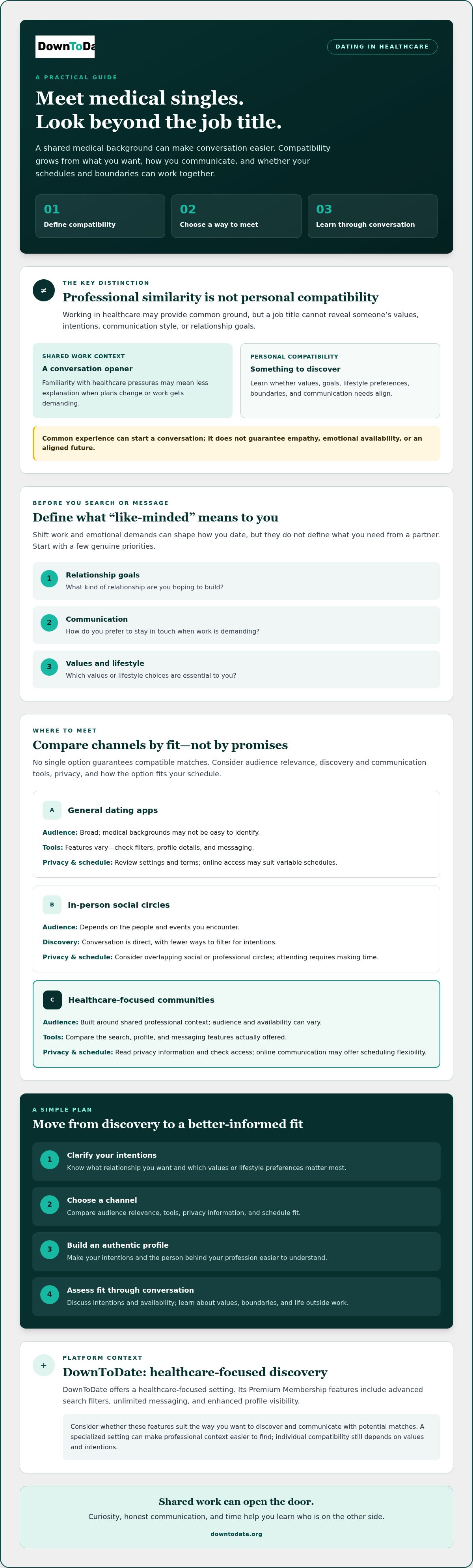
- Use a simple plan: clarify your intentions, choose a channel, build an authentic profile, and assess fit through conversation.
- A shared medical background can create common ground, but it doesn’t guarantee aligned values, boundaries, or relationship goals.
- Consider whether DownToDate’s Premium Membership features, including enhanced profile visibility, suit the way you want to discover and communicate with potential matches.
Connecting with like-minded medical singles starts with defining compatibility
Demanding work can make meeting compatible people less straightforward. Shifting schedules, emotional demands, and limited personal time may shape how you date, but they don’t define what you need from a partner. Connecting with like-minded medical singles starts with looking beyond profession to the qualities that matter in a relationship.
Professional similarity means sharing a work context; personal compatibility means aligning on values, communication, lifestyle preferences, and relationship goals. A medical career can offer common ground, but it can’t tell you whether two people want the same future or connect in the same way. Social research describes a tendency to bond with similar others, but similarity is a starting point, not proof of a lasting fit.
What does like-minded mean when dating in healthcare?
Shared work realities can help, but don’t assume every clinician has the same routine. One person may work nights while another has more predictable hours. Both may understand shift work without having identical availability. Beyond work, consider beliefs, interests, long-term goals, and how quickly you prefer a relationship to develop.
Before searching or messaging, identify a few genuine priorities. For example:
- What relationship are you hoping to build?
- How do you prefer to stay in touch when work is demanding?
- Which values or lifestyle choices are essential to you?
Why shared medical context can help, and where it stops
Someone familiar with healthcare pressures may need less explanation about a changed plan or a demanding stretch at work. That can make an early conversation easier. Still, familiarity isn’t automatic empathy. People differ in how they manage stress, protect personal time, and communicate their needs. A shared profession doesn’t guarantee understanding, emotional availability, or aligned goals.
Use the common context as an opening, then learn about the person behind the role. Ask how they like to spend time away from work, what they’re looking for, and what a sustainable relationship means to them. For more profession-specific context, explore dating for doctors. Common experience can start a conversation; compatibility takes curiosity, honest communication, and time.
Choose where to meet medical singles using clear comparison criteria
There’s no single best place to meet a partner. General dating apps may offer a broader pool, while in-person connections can develop through shared social circles. Healthcare-focused communities make professional context easier to find. Compare what each option offers with what you value rather than assuming any channel guarantees compatible matches.
| Option | Audience relevance | Discovery and communication | Privacy and flexibility |
|---|---|---|---|
| General dating apps | Broad audience; medical backgrounds may not be easy to identify. | Tools vary. Check filters, profile details, and messaging features. | Review privacy settings and terms. Online access may suit variable schedules. |
| In-person social circles | Depends on the people and events you encounter. | Conversation happens directly, but there may be fewer ways to filter for intentions. | Consider what you’re comfortable sharing in overlapping social or professional circles. Attendance requires making time. |
| Healthcare-focused communities | Designed around shared professional context; audience and availability can vary. | Compare the actual search, profile, and messaging features offered. | Read privacy information and check how community access works. Online communication may offer scheduling flexibility. |
General dating apps or a healthcare-focused community?
A broad platform may expose you to more varied profiles, but a larger pool doesn’t guarantee that you’ll find people who understand medical work or share your goals. A specialized community can make healthcare experience easier to spot, but the right fit still depends on individual values and intentions. Before choosing, check the audience, available features, and current membership information. For added context on work and personal life, the American Medical Association discusses medicine's toll on personal relationships.
How to judge whether a dating platform fits your priorities
Look for tools that support how you want to connect. Can search filters reflect relevant preferences? Do profiles help you understand relationship intentions? How are messaging, profile visibility, and community access described? Treat these as features, not promises. A filter can narrow discovery, but it can’t ensure chemistry or shared intent. Review privacy and safety information before sharing personal details, and check the platform’s current terms.
DownToDate is one healthcare-focused option. Its Premium Membership includes advanced search filters, unlimited messaging, and enhanced profile visibility. To compare selection criteria in more depth, read the medical dating app evaluation guide. If a healthcare-centered community aligns with your priorities, you can explore DownToDate. Connecting with like-minded medical singles depends on more than the platform: use its tools to start purposeful conversations, then assess each person on their own merits.
Create a practical plan for connecting with medical singles
A clear process can make dating feel more manageable without turning it into another shift on your calendar. Connecting with like-minded medical singles works best when your choices reflect what you want and your pace leaves room for real life.
Clarify your relationship goals, choose a dating channel, create an honest profile, start conversations, and assess whether your values and communication styles align. Treat this as a flexible sequence, not a deadline. A busy period at work may affect when you can reply or meet. It doesn’t require you to lower your standards or overpromise availability.
Set up your search around values and relationship goals
Separate essentials from preferences. An essential might be a shared desire for a committed relationship; a flexible preference might be a particular hobby or work schedule. In your profile, describe more than your role. Mention what you enjoy outside work, what you value in a partnership, or how you like to spend a free day. Specific details give someone a natural way to connect with you as a person.
If your schedule is unpredictable, be candid without sharing more than you’re comfortable with. For dedicated guidance, see dating with an unpredictable schedule.
Start a conversation that moves beyond work
Work can be an easy opening, but it doesn’t need to carry the whole exchange. Ask questions that invite a personal answer, such as:
- “What do you look forward to doing on a day off?”
- “What qualities make a relationship feel supportive to you?”
- “What are you hoping to find through dating?”
Share professional details only at a level that feels appropriate, and let the other person decide what they’re comfortable discussing. Avoid assumptions about their hours or requests for sensitive workplace details. Considerate communication matters more than immediate replies. You can set expectations simply: “My schedule can shift, but I’ll let you know when I’m available to talk.”
As interest grows, assess fit through both words and actions. Do they communicate respectfully? Are your intentions broadly aligned? Do you feel comfortable being yourself? If the conversation is mutual and you’re both ready, suggest a call or date without pressure: “I’ve enjoyed talking with you. Would you be comfortable moving to a call or meeting sometime that works for both of us?” A respectful invitation leaves room for either person to say yes, suggest another option, or decline.
Address the concern: shared medical work does not guarantee compatibility
A shared occupation is a conversation bridge, not a compatibility guarantee. Healthcare experience may give two people a useful point of reference, but a professional title can’t tell you how someone communicates, treats others, or approaches a relationship. Connecting with like-minded medical singles means staying curious about the person rather than relying on credentials to fill in the picture.
What a shared healthcare background can and cannot tell you
A healthcare background may create common ground around teamwork, clinical environments, and demanding responsibilities. But people can work in different specialties, follow different schedules, and have very different experiences of the same profession. Don’t assume a match understands your particular pressures or shares your expectations simply because they work in medicine. Ask open questions and listen to how they describe work and life.
Dating within a professional community can have benefits and trade-offs:
- Potential advantages: Familiarity with healthcare settings may make some work-related conversations easier, and shared context can reduce the need to explain certain pressures.
- Potential challenges: Similar work may leave less room to disconnect from professional concerns, while overlapping networks can make privacy and boundaries especially important.
Neither side determines the outcome. Consider whether the person shows mutual respect, communicates thoughtfully, and is clear about what they want. Their values and behavior matter more than their credentials.
Keep personal connection separate from professional responsibilities
Protect both people’s privacy. Keep conversations about employers, colleagues, and workplace experiences appropriately general. Don’t share confidential patient information or details that another person wouldn’t expect you to repeat. You can build closeness without disclosing sensitive details; a respectful partner won’t pressure you to cross that line.
Plans should also account for real-life boundaries. If your availability changes, communicate when you can rather than promising a schedule you can’t maintain. Offer options, ask what works for the other person, and accept a no or a request to reschedule without treating it as a judgment of your worth.
A strong match is built on mutual interest, compatible expectations, and respect for each other’s lives, not professional status. If you value meeting people who share a healthcare context, explore DownToDate’s healthcare-focused dating community, while taking time to assess each connection on its own merits.
Use a healthcare-focused platform as one route to meeting compatible singles
Once you’ve clarified what matters in a relationship and considered where you want to meet people, a healthcare-focused platform may be one useful route. It can make shared professional context easier to find, but it can’t determine whether two people’s values, communication styles, or goals align. Treat the platform as a way to begin discovery, not a promise of compatibility.
How DownToDate’s features support intentional discovery
DownToDate is a dating platform for healthcare professionals, founded and operated by medical professionals. Its Premium Membership includes advanced search filters, unlimited messaging, and enhanced profile visibility. These features can support different parts of the process: filters help narrow discovery around preferences you choose, messaging gives you a way to communicate, and profile visibility can help your profile be seen. None guarantees a response, a match, or a relationship.
Before joining, review how DownToDate currently describes its medical community, including eligibility and any verification details. Don’t assume a particular credential or process applies without checking the platform’s current information. Consider whether a healthcare-focused audience is valuable to you and whether the available features support the way you want to search and connect.
Decide whether the platform is right for your next step
Compare your priorities with the stated features and membership terms. If focused discovery matters, consider whether the search options are relevant to what you’re looking for. If you want to start conversations on your own terms, review how messaging is described. Check profile visibility details and read the platform’s privacy information before sharing personal details. Take time to understand what Premium Membership includes and whether it fits your preferences.
If you decide to join, make your profile specific and genuine. Describe the kind of connection you hope to build and include details that give someone a sense of you beyond your work. In first messages, refer to something in the other person’s profile and ask a respectful, open-ended question. Shared professional context can be a starting point; compatibility still takes conversation and mutual interest.
Connecting with like-minded medical singles doesn’t require choosing one perfect channel or rushing the process. Use tools that suit your priorities, stay clear about your intentions, and make room for a connection to develop at a pace that works for both people. Explore DownToDate and see whether it fits your search.
Make your next connection intentional
Connecting with like-minded medical singles starts with knowing what compatibility means to you. Shared healthcare experience can make it easier to understand parts of each other’s work, but lasting potential depends on values, communication, relationship goals, and respect for personal boundaries.
Choose a way to meet people that fits your priorities, then approach each conversation with curiosity. Be clear about what you’re looking for, stay considerate of changing schedules, and assess the person rather than relying on their professional title.
If a healthcare-focused dating community suits your approach, DownToDate is one option. Founded and operated by medical professionals Dr. Shadi Rezai and Dr. Sasan Rezai, the platform offers a Premium Membership with advanced search filters and unlimited messaging. Review its current information, including how it describes community eligibility and verification, before deciding whether it fits your needs.
A thoughtful first step is enough. Build connection at a pace that respects your work, your boundaries, and the partnership you hope to find.
Frequently Asked Questions
How can I meet like-minded medical singles?
Start by defining what “like-minded” means to you beyond working in healthcare. Consider your relationship goals, values, communication preferences, and lifestyle needs, then choose a channel that helps you meet people with relevant context. Connecting with like-minded medical singles may begin on a general dating app, in a social setting, or in a healthcare-focused community. Shared work can open a conversation, but compatibility develops through mutual interest and honest communication.
Is a medical dating site better than a general dating app?
Neither is automatically better; the right choice depends on your priorities. A healthcare-focused community may make shared professional context easier to find, while a general app may offer a broader audience. Compare search and messaging features, profile options, privacy information, community access, and current membership terms. For example, DownToDate’s Premium Membership includes advanced search filters and unlimited messaging. No platform can guarantee a compatible connection, so choose the option that supports your goals.
Can doctors and other healthcare professionals find partners outside work?
Yes. Dating platforms and social settings can help healthcare professionals meet people beyond their workplace and keep dating separate from professional responsibilities. You can share general information about your role or schedule while keeping employer, colleague, and patient details private. Don’t disclose confidential patient information. Build conversations around interests, values, and relationship intentions, as well as work and life realities. A respectful connection should leave both people comfortable with what they choose to share.
How do I start a conversation with a medical professional on a dating app?
Start with a detail from their profile and follow it with an open-ended question. If they mention hiking, for instance, ask what kind of trail they enjoy or how they like to spend time off. You might also ask what qualities they value in a relationship. Avoid making their job title the whole conversation. Share professional details only as you feel comfortable, and let both people set the pace.
What should I look for when choosing a dating platform for healthcare professionals?
Look for a clearly described audience, relevant search and communication features, accessible privacy and safety information, and membership terms you understand. Consider whether profiles and filters help you express relationship preferences without reducing compatibility to a job title. Review the platform’s current information directly, including how it describes community eligibility or verification. Check which features are included in any membership before deciding. Prioritize the tools and safeguards that matter to you.
Does dating another healthcare professional guarantee a better match?
No. Shared work may offer common ground around clinical environments, teamwork, or demanding responsibilities, but it doesn’t guarantee aligned values, communication styles, or relationship goals. People in the same field can have different specialties, schedules, and expectations. Treat professional similarity as useful context, not proof of compatibility. Ask rather than assume, and assess the person through honest conversation, mutual respect, and how well your intentions and personal values align.


