

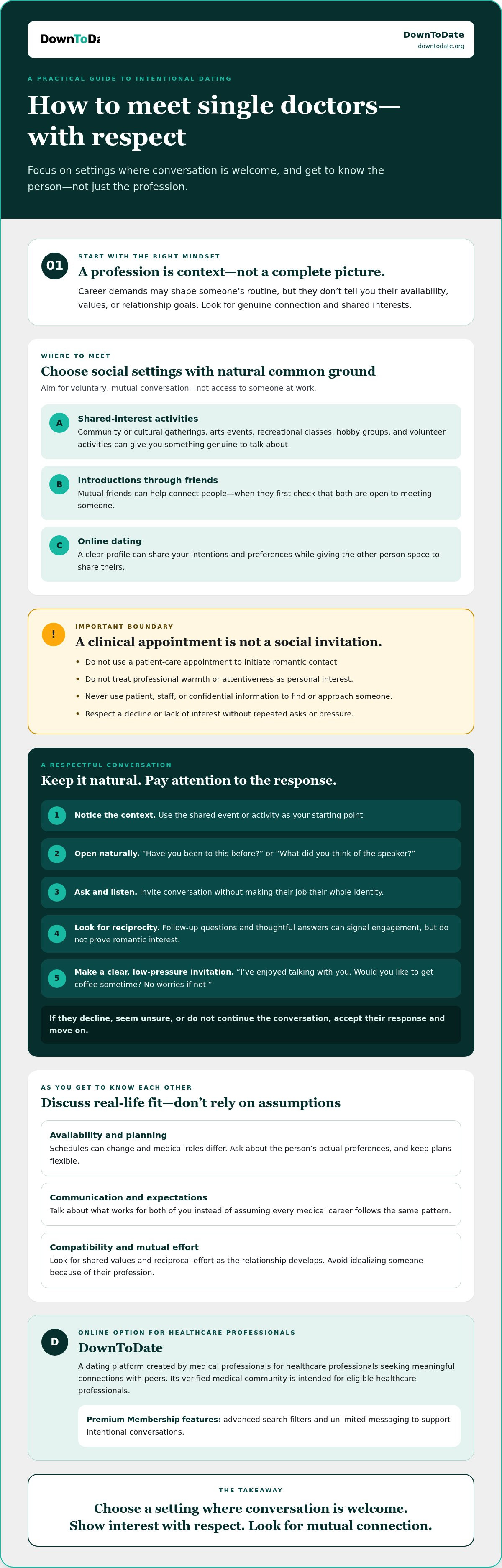
The best place to meet a doctor usually isn’t a hospital. If you’re wondering how to meet single doctors, focus on settings where conversation is welcome, not on someone’s workplace or private time. A genuine connection starts with respect, not access.
It’s understandable to feel unsure where to look or how to make plans when a doctor’s schedule can change. Career stage and work demands may shape availability, but they don’t define who someone is or what they want from a relationship. Ask thoughtful questions, avoid assumptions, and be clear about what works for you, too.
This guide covers appropriate ways to meet single doctors, from shared-interest events to online dating. It also offers practical tips for starting conversations and discussing time, expectations, and compatibility as a relationship develops. For healthcare professionals seeking peers, DownToDate is a dating platform created by medical professionals, with a verified medical community and Premium Membership features designed to support intentional connections.
Key Takeaways
- Learn how to meet single doctors by choosing social settings and channels where genuine conversation is welcome.
- Start conversations respectfully, listen closely, and accept the other person’s response.
- Discuss availability, communication preferences, and date planning instead of assuming every medical career follows the same schedule.
- Make your online profile clear about your interests, values, and relationship intentions to encourage compatible connections.
- Look for mutual effort and shared values as the relationship develops, rather than idealizing someone’s profession.
How to meet single doctors without relying on chance
Meeting someone with a demanding career can take deliberate planning. That doesn’t mean treating dating like a search for a particular job title. The aim is to meet an individual whose values, interests, and relationship goals complement your own. A doctor’s profession may shape parts of their routine, but it can’t tell you whether you’ll connect.
For a practical approach to how to meet single doctors, choose settings where social interaction is voluntary and mutual. Consider introductions through friends, gatherings that bring together different social circles, or events connected to interests you genuinely share. Look for a natural reason to talk, and make sure both people have room to continue the conversation or step away.
Where can you meet single doctors outside the workplace?
Community events, cultural gatherings, and hobby groups create common ground before anyone’s occupation comes up. An arts event, recreational class, or volunteer activity can lead to conversation about shared interests rather than assumptions about medical life. Mutual friends can also make introductions, as long as they check that both people are open to meeting someone.
Dating platforms offer another route. A clear profile lets you communicate your intentions and preferences, while giving the other person a chance to do the same. DownToDate is a dating platform created by medical professionals for healthcare professionals seeking meaningful connections with peers. Its verified medical community is intended for eligible healthcare professionals. Premium Membership includes advanced search filters and unlimited messaging to support more intentional conversations.
Keep plans flexible as you get to know someone. Medical roles and schedules differ, and an overview of physician demanding work schedules can offer context, not a prediction of any one person’s availability. Ask about their actual preferences instead of guessing from their profession.
Why workplace access is not the same as an invitation
A social event and a clinical appointment are not equivalent situations. During patient care, a doctor is focused on providing care, and the interaction takes place within a professional relationship. Don’t use an appointment to initiate romantic contact, and don’t interpret warmth or attentiveness in that setting as personal interest.
Never use patient, staff, or confidential information to find or approach someone. If you meet a doctor in a social setting, speak as you would with anyone else: open naturally, notice whether the conversation is reciprocal, and give them space to decline or disengage. Consent includes accepting a lack of interest without asking repeatedly or applying pressure. Respectful connection depends on privacy, choice, and mutual interest.
How to start a conversation with a single doctor respectfully
A good introduction isn’t a clever line. It’s a brief invitation to talk, followed by attention to how the other person responds. Whether you meet through friends, at an event, or online, focus on discovering who they are, not confirming an idea you have about doctors.
Try this sequence: notice the context, open naturally, ask an easy question, listen, and respect the response. A shared setting gives you a comfortable starting point. Their answers, questions, and level of engagement can help you decide whether to continue.
What should you say when you first meet?
Choose an opener that fits the moment and doesn’t require personal disclosure. At an event, you might ask, “Have you been to this before?” or “What did you think of the speaker?” At a hobby group, ask how they got interested in the activity. These questions invite conversation without making someone’s job their whole identity.
If their medical work comes up naturally, show interest without turning the exchange into an interview. Ask what they enjoy about their work, then make space for other topics. Avoid assumptions about income, intelligence, or free time. A profession gives you context, not a complete picture of a person.
How do you tell whether someone is interested?
Look for reciprocity, not stereotypes. An engaged conversation may include follow-up questions, thoughtful answers, or an effort to keep talking. None of these proves romantic interest, so make a clear, low-pressure invitation instead of trying to decode someone’s job or personality.
You could say, “I’ve enjoyed talking with you. Would you like to get coffee sometime? No worries if not.” If they decline, seem uncertain, or give a brief response without continuing the conversation, accept that and move on. Don’t ask again in the moment or press for an explanation.
Medicine can affect personal time, but that doesn’t mean every doctor has the same availability or relationship priorities. The American Medical Association discusses the impact of work on personal relationships. Use this as context, not as a basis for assumptions about someone you’ve just met. Ask about their preferences as trust develops.
Exchange contact details only when interest is mutual and expressed. You might offer your number and leave the choice with them, or agree together on a way to stay in touch. For healthcare professionals interested in meeting peers online, a healthcare-focused dating platform can provide another setting to state intentions and begin a conversation.
How to assess compatibility with a doctor’s schedule and priorities
A compatible relationship doesn’t require identical schedules. It does require honest expectations and mutual effort. Medical work can affect availability, but routines vary by role, workplace, and career stage. A medical student, resident, and attending physician may have different commitments, and people in the same role may organize their time differently. As you consider how to meet single doctors, stay curious about the person’s actual routine rather than relying on assumptions about the profession.
Talk about practical preferences before missed plans or unanswered messages become a source of confusion. This isn’t a request for constant access. It’s a way to understand whether your expectations can work together.
What to discuss before expectations become mismatched
Use direct, neutral questions: “How do you like to plan dates when work can shift?” or “What kind of communication feels comfortable during a busy week?” Share your own needs, too. A delayed reply may reflect a full day, but you’re also allowed to explain what helps you feel connected. Discuss relationship intentions, boundaries, and pace without asking for promises before you know each other.
This guide to dating with an unpredictable medical schedule offers further context. Use it to inform a conversation, not to decide in advance what a particular person can offer.
Compare expectations together:
| Topic | Ask each other | Clarify together |
|---|---|---|
| Availability | “When do you usually know your free time?” | How far ahead to plan and how to handle changes. |
| Communication | “What rhythm of texting feels natural?” | What to expect during especially busy periods. |
| Date planning | “Do you prefer set plans or flexibility?” | How to confirm, reschedule, and suggest a new time. |
How to plan a first date around real availability
Choose a simple plan that leaves room to adjust, such as meeting for coffee or taking a walk in a public place. Agree on a time and location, then confirm the plan clearly. If work disrupts it, discuss whether to reschedule and suggest another option when you’re both ready. Flexibility should be mutual, not a standing expectation that one person will always wait.
Rescheduling isn’t automatically a sign of disinterest. Notice the pattern and the effort: does the person communicate, acknowledge the change, and take part in making a new plan? The Association of American Medical Colleges shares perspectives on romance during medical residency, a career stage that can bring particular pressures. Let that context encourage understanding, while judging compatibility by your conversations and shared follow-through.
How to meet doctors online while keeping your intentions clear
Online dating can widen your circle beyond colleagues, friends, and places you already frequent. A focused dating platform can help eligible users connect with healthcare peers who are also open to meeting someone. It’s one practical approach to how to meet single doctors, but a shared profession is only a starting point. Genuine compatibility still depends on values, attraction, communication, and what each person wants.
How to make a profile feel genuine and specific
Use clear, recent photos and details that give someone a real sense of your life. Instead of writing only about career status, mention a hobby, a community you value, or how you like to spend your free time. State your relationship intentions plainly, such as wanting to build a committed relationship or meet with purpose. Keep workplace details and patient information private.
Specific details make it easier to start a meaningful exchange. “I enjoy exploring trails and trying new recipes” gives someone more to respond to than a list of broad qualities. Be honest, not exhaustive. Your profile should invite a conversation, not read like a polished résumé or promise a perfect match.
How to move from a match to a real conversation
Begin with something particular from the person’s profile and ask an open-ended question. If they mention a favorite book, you might ask what they’ve read lately and what they recommend. Share your own answer, too. A two-way exchange can reveal common interests and communication preferences without turning early messages into an interview about medical work.
When the conversation feels reciprocal, suggest a low-pressure next step, such as a brief call or meeting in a public place. Give the other person room to accept, decline, or suggest an alternative. DownToDate was created by medical professionals for healthcare professionals seeking meaningful connections with peers. Its verified medical community and Premium Membership features, including advanced search filters and unlimited messaging, support more intentional introductions. Explore DownToDate for healthcare professionals if you’re eligible and looking to connect with peers.
Turn a promising introduction into a meaningful connection
A promising introduction is a beginning, not proof of compatibility. Notice how you treat each other over time: whether curiosity goes both ways, communication feels clear, and each person’s time and boundaries are respected. A medical title may explain part of someone’s life, but it can’t tell you whether your values, goals, and personalities align.
What healthy early dating should feel like
Look for consistency, not perfection. Plans may change, and people may have different communication habits. What matters is whether both of you can discuss those differences honestly and make a good-faith effort to stay connected. If a schedule change leaves you uncertain, ask about it directly instead of assuming what it means. Then pay attention to the response.
Keep the focus on the individual. Ask what matters to them, share what matters to you, and let trust develop through actions. A demanding profession deserves understanding, but it shouldn’t become a reason to ignore your own needs or accept a one-sided dynamic.
Use this checklist as the connection develops:
- Be clear: Share what kind of relationship you’re looking for and invite the other person to do the same.
- Respect boundaries: Give each other room to say no, ask for space, or move at a comfortable pace.
- Communicate: Talk openly about plans, preferences, and concerns instead of relying on guesswork.
- Assess mutual effort: Notice whether both people initiate, follow through, and make time for the relationship.
A focused next step for healthcare professionals
For healthcare professionals hoping to meet peers, DownToDate is a dating platform created by medical professionals for meaningful connections within a verified medical community. Its paid Premium Membership includes advanced search filters, unlimited messaging, and enhanced profile visibility. These features can help eligible members refine their search and communicate with intention, but compatibility still comes from getting to know each person.
If you’re a healthcare professional seeking a peer connection, explore DownToDate as one focused option. The goal isn’t to find a perfect profession or schedule. It’s to build a relationship grounded in shared values, respect, and mutual interest. That’s the standard to carry forward, however you choose to meet single doctors.
Make your next step intentional
Learning how to meet single doctors is less about finding the perfect setting and more about creating the conditions for a respectful, genuine connection. Start conversations around shared interests, not assumptions about a job title. Discuss availability and communication openly, then look for mutual effort, clear boundaries, and aligned values.
A medical career can shape someone’s routine, but it doesn’t define the partner they’ll be. Stay curious about the person, let trust develop through consistent actions, and be honest about what you want from a relationship. That approach makes room for connection without asking either person to compromise their needs.
For healthcare professionals seeking to meet peers, DownToDate is a dating platform founded and operated by medical professionals Dr. Shadi Rezai and Dr. Sasan Rezai. It’s designed for a verified medical community, and Premium Membership includes advanced search filters and unlimited messaging to support intentional introductions.
Explore DownToDate if you’re a healthcare professional looking to connect with peers. The right connection begins with mutual interest, respect, and the willingness to get to know each other as individuals.
Frequently Asked Questions
Where can I meet single doctors?
You can meet single doctors through mutual friends, interest-based events, and dating platforms where people can state what they’re looking for. Shared activities, such as a community event or hobby group, offer an easy conversation starter without making someone’s job the focus. If you’re exploring how to meet single doctors online, consider whether a platform’s community and features fit your goals. Remember that a shared profession alone doesn’t establish compatibility.
How do I approach a doctor I’m interested in?
Start with the setting, not their job title. At a social event, ask a natural question about the activity or a shared interest, then listen and notice whether they engage in return. If conversation feels mutual, make a low-pressure invitation, such as asking whether they’d like to meet for coffee. Accept a no, a short response, or a lack of interest without pressing for an explanation.
Is it appropriate to ask a doctor out at work?
A patient-care interaction isn’t an invitation to initiate romantic contact. Don’t use an appointment, staff access, or confidential information to approach a doctor personally. The clinical setting is for care, not dating. If you meet a doctor in a separate social context, a respectful conversation may be appropriate if it’s welcome. Pay attention to their response, and accept disinterest immediately without repeating the invitation or creating pressure.
Can dating apps help me meet single doctors?
Yes. Dating apps can help you connect with people beyond your immediate social circles, and a focused platform may be useful for eligible healthcare professionals seeking peers. DownToDate is designed for a verified medical community. Its paid Premium Membership includes advanced search filters, unlimited messaging, and enhanced profile visibility. These tools can help you search and communicate more intentionally, but they can’t guarantee chemistry or a compatible relationship.
How do you date someone with a demanding medical schedule?
Talk together about availability, communication preferences, and how you’ll handle changing plans. Schedules vary by person, role, workplace, and career stage, so ask what works for this individual instead of relying on assumptions. Agree on a practical way to confirm or reschedule dates. Flexibility matters, but so does mutual effort: both people should communicate clearly and take part in making time for the relationship.
Are doctors too busy to date?
No single answer applies to every doctor. A person’s available time can depend on their role, workplace, career stage, and personal priorities. A busy schedule may require more planning, but it doesn’t automatically mean someone is unavailable for a relationship. Ask what kind of connection they want and how they prefer to make plans. Then consider whether their actions and expectations align with your own needs.
What should I put on a dating profile to attract a doctor?
Write a profile that reflects who you are, not a performance designed to appeal to a profession. Use clear, recent photos, name a few specific interests, and state what kind of relationship you hope to build. For example, mention a hobby you enjoy or the qualities you value in a partnership. Avoid status-focused language, assumptions about doctors, and confidential workplace or patient details. Authenticity gives compatible people something real to connect with.


