

Your ambition isn’t an obstacle to a lasting relationship. It’s a compatibility signal. Dating for ambitious women in medicine can be challenging when long, unpredictable hours make consistency harder and potential partners don’t understand the boundaries your work requires. You shouldn’t have to minimize your career to make a relationship fit.
If you’re wondering how to find someone who respects your goals and understands the realities of medical life, start by defining what support and compatibility mean to you. A full calendar may call for a more intentional approach, not lower standards. Communicating your availability, priorities, and relationship intentions can help you recognize people who are ready to meet you with respect.
This guide offers practical ways to build a dating approach around your actual schedule, identify qualities that matter in a partner, and compare ways to meet people who may understand healthcare work. We’ll also look at platforms designed for healthcare professionals, including DownToDate, as one option among several. Shared professional context can make an introduction easier, but genuine compatibility still depends on the person.
Key Takeaways
- For dating for ambitious women in medicine, define compatibility through respect for your goals, boundaries, availability, and relationship intentions.
- Map your realistic availability, choose a manageable dating pace, and communicate schedule constraints clearly.
- Compare dating apps, personal introductions, and healthcare-focused communities by audience fit, discovery control, communication tools, and time commitment.
- Use a repeatable approach: clarify what you want, select a channel, set a sustainable cadence, and review how it’s working.
- Consider DownToDate as one healthcare-focused option. Shared professional context can start a conversation, while consistency and respect help reveal compatibility.
Dating for ambitious women in medicine starts with defining compatibility
A meaningful relationship takes attention, and medical work can limit when that attention is available. That tension doesn’t mean you have to choose between professional ambition and connection. It means compatibility should be measured by how two people treat each other’s goals, availability, boundaries, and intentions, not by whether their lives follow a conventional schedule.
Career-compatible dating means building a relationship where both people respect each other’s ambitions, make room for real-life constraints, and share responsibility for connection. You don’t need to apologize for prioritizing your career, and a partner doesn’t have to work in medicine to understand or respect it. The history of women in medicine offers wider context for women’s contributions and challenges in the field. Your relationship, however, is about the expectations and choices you and a partner make together.
What does a supportive relationship look like during a medical career?
Support shows up in everyday behavior. A partner asks about your work with genuine curiosity, follows through on plans, respects your boundaries, and includes you in decisions that affect shared time. Flexibility matters, but it should go both ways. A supportive partner can adjust when responsibilities shift rather than assuming you’ll always be the one to rearrange your life.
Before dating seriously, separate your non-negotiables from your preferences. Non-negotiables might include respect for your work, honest communication, or shared relationship intentions. Preferences could include a particular date routine or a partner in a similar profession. This distinction helps you hold on to your standards without reducing compatibility to a checklist.
Separate schedule constraints from questions of compatibility
A demanding week can limit your availability without revealing your capacity for intimacy. Residency, fellowship, shift work, and on-call responsibilities may affect plans at different times. Look at the pattern, not just one difficult stretch: does the person communicate when plans change, make an effort to reconnect, and show interest in your life?
Apply the same measure to yourself. If work temporarily takes priority, communicate what you can offer and when you may be available again. Compatibility isn’t proven by constant access or perfect scheduling. It shows in how both people respond to constraints, reconnect after missed moments, and make decisions about time together.
Medical careers can be demanding, but they don’t make relationships inherently fragile. Ambition isn’t a liability to conceal. It’s one part of the life a compatible partner should be willing to understand, just as you should be willing to understand theirs.
How to date around medical training, shifts, and demanding work
Dating for ambitious women in medicine works better when your approach reflects the calendar you actually have, not an ideal week that rarely happens. Residency, fellowship, rotating shifts, and on-call responsibilities can change what’s realistic from one period to another. Use a simple sequence: map your availability, choose a sustainable pace, explain relevant constraints, and review whether the arrangement works for both of you.
Set a sustainable dating rhythm around real availability
Start by identifying windows you can usually protect, such as a call on a lighter evening or a date on a regularly free day. Choose a manageable pace for messages, calls, or in-person dates. Plan ahead when possible while recognizing that work can change the plan. Setting expectations about availability can prevent misunderstandings about interest, delayed replies, and rescheduling.
If a shift or call disrupts a plan, let the other person know as soon as you reasonably can and suggest a concrete alternative: “I’m sorry, my schedule changed and I can’t make Thursday. Could we meet Sunday afternoon instead?” A timely update and a specific option show consideration without promising time you may not have.
Discuss boundaries and expectations early
You can explain unpredictability without apologizing or sharing more than you want: “My schedule can shift, so I may not always be able to confirm plans far ahead. I’ll communicate changes as soon as I can.” Then discuss what works for both of you, including whether to expect replies during shifts, how to handle delayed messages, and when you need uninterrupted recovery time.
Keep the conversation focused on availability, not confidential details. Patient information and appropriate professional boundaries aren’t dating conversation material. You can describe the general shape of your work without naming patients, sharing identifying circumstances, or disclosing workplace information that should remain private.
After a few weeks, take stock. Is the pace manageable? Are both people initiating contact and adapting when plans change? Does communication feel mutual, or are you carrying all the coordination? Adjust the rhythm before frustration builds. A brief check-in can help: “Does this pace feel good to you, and is there anything we should change?”
If meeting people who understand healthcare schedules is a priority, a healthcare-focused community such as DownToDate for healthcare professionals may be worth considering. Shared context can help start a conversation, while clear expectations still help you decide whether your rhythms fit.
Compare dating options for ambitious women in medicine
The best dating channel depends on what you want to prioritize: a wider pool, trusted introductions, or shared professional context. For dating for ambitious women in medicine, compare each option by audience fit, control over who you discover, communication tools, and the time needed to screen and connect. No channel can guarantee compatibility.
| Option | Audience fit and discovery | Communication and time |
|---|---|---|
| General dating apps | Broad range of people; you typically shape discovery through your profile and available preferences. | Review the app’s tools. Screening profiles and clarifying fit may take more effort. |
| Introductions through existing networks | A mutual contact may offer useful context, but you have less control over who is introduced. | Communication may feel more direct; arranging an introduction depends on your network. |
| Healthcare-focused dating communities | Designed around shared professional context; check who can join and how profiles are discovered. | Review available messaging and search features, then assess whether they suit your preferred pace. |
When a general dating platform may fit
When a medical-focused dating community may fit
A healthcare-focused community may make some work realities easier to explain. Someone familiar with clinical schedules may need less context about why plans sometimes shift. That shared context is a starting point, not proof of compatibility. Before joining, review membership criteria, search controls, and communication features to see how the community fits your needs.
DownToDate is one option for healthcare professionals. Its Premium Membership includes advanced search filters and unlimited messaging, which may help you shape discovery and communicate on your own schedule. Consider whether those tools address your priorities. Occupational similarity alone doesn’t establish shared values, emotional availability, or relationship goals.
Introductions through colleagues, friends, or professional connections can feel more personal, but consider whether you’re comfortable with the overlap between your social and work circles. Whichever channel you choose, judge people individually. A shared profession provides context, but respect, curiosity, and compatible intentions still need to develop between the two of you.
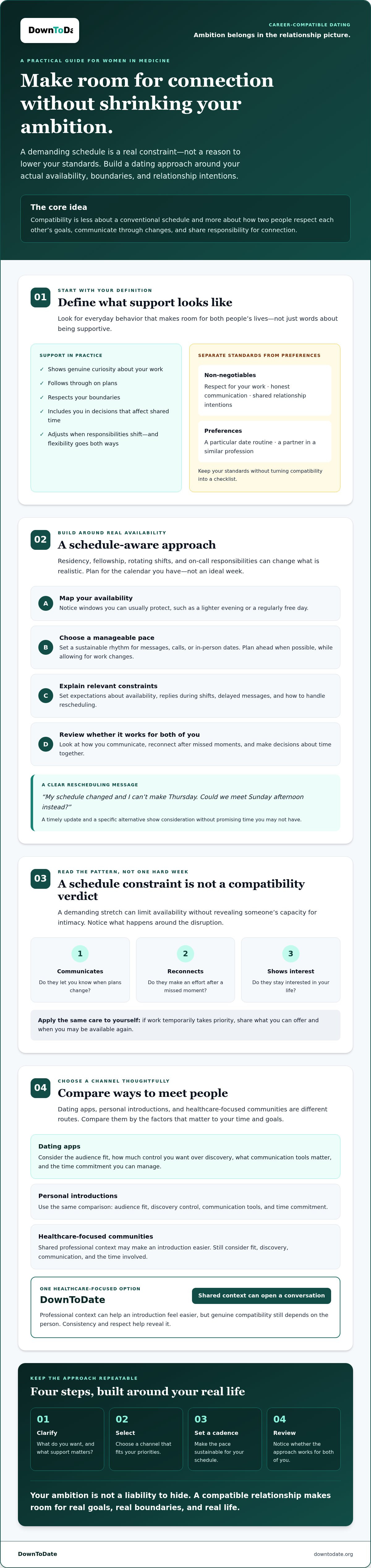
Build a dating approach that protects ambition and makes room for connection
A sustainable dating approach should support the life you have, not compete with it. Keep the process simple and repeatable: clarify what you’re looking for, choose a channel that suits your preferences, set a realistic pace, and check in regularly. The goal isn’t to turn dating into another performance metric. It’s to make room for connection without sidelining your priorities.
- Clarify your goals: Name the kind of relationship you want and what respect for your career looks like in practice.
- Choose a channel: Use an app, personal introductions, or a healthcare-focused community based on your comfort and the time you can give it.
- Set a cadence: Decide what feels manageable for conversations and dates during your current work period.
- Reflect regularly: Notice whether the process feels reciprocal, energizing, and sustainable.
As you get to know someone, look beyond status or occupational similarity. Does this person show consistency, ask thoughtful questions, and respect your boundaries? Consider whether both of you initiate contact, adjust when plans change, and show interest in each other’s lives. Shared ambition can matter, but it doesn’t replace care and follow-through.
Create a profile that reflects both your work and your personhood
Let your profile show more than your profession. Include interests you enjoy, the relationship you’re seeking, and the qualities you value in a connection. Describe demanding work matter-of-factly, without presenting it as an apology or making your career the whole story. Protect patient and workplace privacy by avoiding identifying details, confidential stories, or information that could reveal someone else’s identity.
Review whether the approach is working for you
Pause periodically to ask: Do I have the energy for this pace? Are conversations curious and respectful? Can I maintain my boundaries during a demanding stretch? If dating repeatedly feels draining or one-sided, adjust the channel, expectations, or cadence. For more schedule-specific ideas, look for the article Dating with an Unpredictable Schedule.
If shared healthcare context matters to you, consider exploring DownToDate’s healthcare-focused dating community as one possible channel. Choose the approach that fits your priorities, and keep assessing the person in front of you.
Explore DownToDate as one way to meet people who understand medical life
A healthcare-focused dating community may suit you if shared professional context is a priority. DownToDate is designed for doctors, nurses, and other medical staff seeking meaningful connections. For dating for ambitious women in medicine, that focus may make it easier to start conversations with people familiar with the demands of healthcare work. It provides context, not a shortcut to compatibility.
What DownToDate can offer healthcare professionals
DownToDate’s Premium Membership includes advanced search filters, unlimited messaging, and enhanced profile visibility. These features may be useful if you value more control over profile discovery or prefer flexible communication. Weigh them against your priorities: which tools would genuinely make dating more manageable, and which are less relevant to how you like to meet people?
Before joining or subscribing, review the current membership details, community criteria, and any verification information presented by the platform. Don’t assume a shared occupation establishes a person’s values, relationship intentions, or emotional availability. Ask the same questions you would in any dating setting, and assess each connection on its own merits.
Choose your next step with intention
Use the criteria from your comparison: audience fit, control over discovery, communication tools, and the time required to participate. Check which features are included with the membership option you’re considering, and decide whether they support your preferred pace. A platform should fit your dating approach, not pressure you to be constantly available.
For more context, explore Dating for Doctors and The Best Professional Dating App for Medical Professionals. These topics can help you consider how professional context may shape dating choices and what to assess when comparing platforms.
DownToDate may be worth exploring if you’re interested in meeting people who work in healthcare. Look at the community and decide whether its focus and features fit what you’re seeking. No platform can determine compatibility for you; your values, conversations, and shared intentions still matter.
Make space for a relationship that fits your life
Dating for ambitious women in medicine doesn’t require choosing between meaningful connection and professional purpose. It starts with knowing what compatibility means to you, setting a realistic pace, and noticing whether someone respects your time and boundaries. A demanding schedule may shape how you date, but it doesn’t define your capacity for closeness.
Choose the channel that suits your priorities, then evaluate people by their consistency, curiosity, and intentions. Shared healthcare experience can make some realities easier to understand, but genuine compatibility grows through individual conversations and mutual effort.
DownToDate is designed for healthcare professionals seeking meaningful connections and was founded and operated by medical professionals Dr. Shadi Rezai and Dr. Sasan Rezai. Its Premium Membership includes advanced search filters and unlimited messaging. If a healthcare-focused community aligns with what you’re looking for, explore DownToDate and see whether its medical community fits your priorities.
Your ambition belongs in the life you’re building, including the relationship you choose. Look for someone ready to make room for all of it.
Frequently Asked Questions
Is it harder for women in medicine to date?
Dating can be more challenging when demanding or unpredictable work limits the time and energy available to meet people and maintain plans. That doesn’t mean a medical career makes a relationship less possible. Clear communication and a realistic pace can help you distinguish a temporary scheduling challenge from a mismatch in effort or expectations. A compatible partner doesn’t need to share your profession, but should respect its demands and your boundaries.
Can ambitious women in medicine have successful relationships?
Yes. Ambition and a successful relationship can coexist when both partners respect each other’s goals and contribute to the relationship. Dating for ambitious women in medicine isn’t about reducing career priorities to seem more available. It’s about finding someone whose intentions, communication, and approach to shared decisions align with yours. Discuss what support looks like in practice, then notice whether actions match words, especially during demanding periods.
How do you date when you have a demanding medical schedule?
Build your dating routine around the availability you can reasonably offer. Identify likely openings, choose a manageable pace for messages and dates, and communicate if work changes a plan. For example, if a shift prevents you from meeting, send a timely update and suggest another day if you’d like to continue. Review your routine periodically. If it repeatedly leaves you depleted, adjust the pace or try a different way to meet people.
Should I only date someone who works in healthcare?
No. Dating within healthcare may offer shared context about shift changes, training, or work pressures, but it doesn’t establish personal compatibility. A partner in another field may still be curious, reliable, and respectful of your schedule. Consider professional similarity a preference, not a requirement, unless it genuinely matters to you. Focus on how someone handles communication, boundaries, and shared responsibilities rather than assuming their occupation predicts relationship fit.
How can I explain my medical schedule to someone I am dating?
Keep it direct and share only what’s appropriate: “My schedule can change, so I may need to adjust plans sometimes. I’ll let you know as soon as I can.” You can also discuss when you’re usually available and what response times are realistic during work or recovery time. You don’t need to disclose confidential patient or workplace information. Clear expectations help both people understand how to plan and communicate.
Is a dating app for medical professionals worth considering?
It may be worth considering if meeting people who understand healthcare work is a priority. Compare the community’s membership criteria, discovery controls, and communication features with what you want from dating. DownToDate is designed for healthcare professionals, and its Premium Membership includes advanced search filters, unlimited messaging, and enhanced profile visibility. Shared professional context can make some conversations easier, but assess each person’s values and relationship intentions individually.


