

What if the right partner doesn’t need the same schedule to understand your life in residency? Finding a partner who understands medical residency isn’t about finding someone with an identical job. It’s about finding someone who respects the demands of your training, communicates with care, and can adapt when plans change.
If you’ve felt guilty about limited availability or worried that a missed date will be mistaken for disinterest, those concerns make sense. Residency can limit your time and energy. You don’t have to apologize for your training, but you can help a new partner understand what it means for your relationship.
This article explains how to recognize empathy and flexibility beyond someone’s job title, when to discuss residency, and how to express your expectations and boundaries. You’ll also find practical ways to make room for both partners’ needs, so connection can grow through honest conversations, realistic plans, and mutual trust, even when your schedules don’t match.
Key Takeaways
- Define what understanding looks like day to day: respect, curiosity, reliability, and realistic expectations matter more than matching professions.
- Consider how rotations, fatigue, and changing plans affect your availability, then identify routines and ways to connect that feel realistic.
- When finding a partner who understands medical residency, look for supportive behavior rather than assuming only another healthcare professional can relate.
- Clarify your priorities, explain what residency may involve, and observe how a potential partner responds over time.
- Build trust through shared expectations and regular check-ins, while making room for both partners’ needs and flexibility.
Finding a Partner Who Understands Medical Residency Starts with Defining Understanding
You can want a meaningful relationship and take your training responsibilities seriously. Those needs aren’t in conflict, though residency can make it harder to protect time, keep plans, and show up with energy. Finding a partner who understands medical residency starts with defining what “understanding” means to you, rather than expecting a partner to know already.
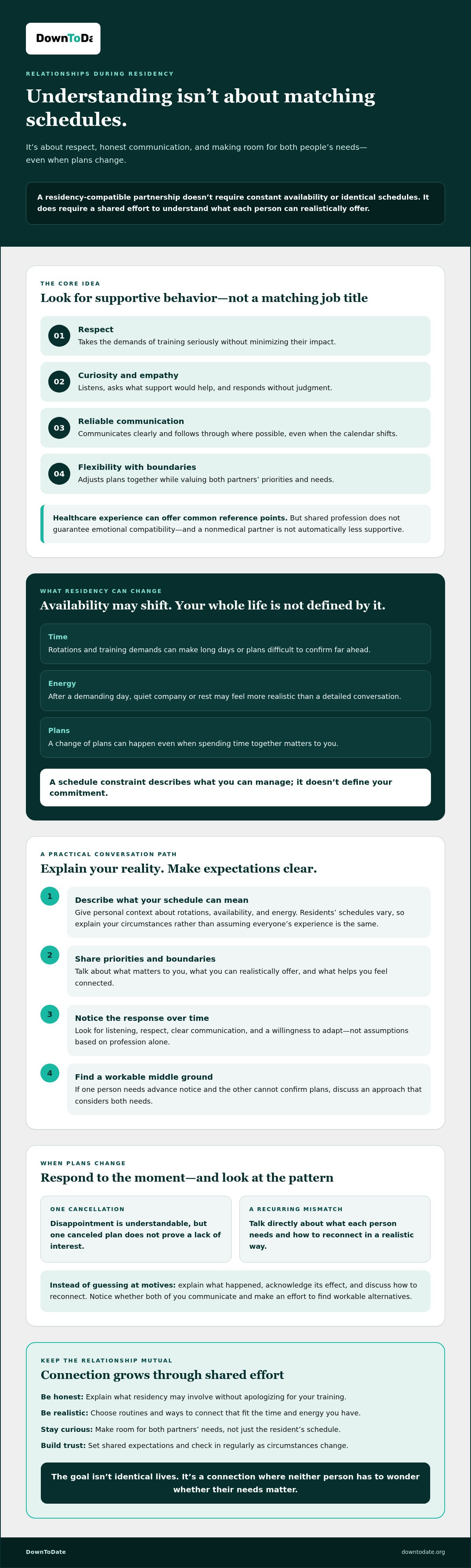
A residency-compatible partnership makes room for training demands through respect, honest communication, and flexibility, while still valuing both people’s needs. It doesn’t require constant availability, identical schedules, or one person putting their life on hold. It does require a shared effort to understand what each person can realistically offer.
What does it mean to understand medical residency?
Residency is a period of supervised medical training, and its demands can shape a resident’s schedule and energy. A partner can get basic context from Residency (medicine), but a general overview won’t explain exactly how your rotations affect your daily life. Understanding means accepting that demands may shift, without minimizing their impact or expecting you to make every disruption seem insignificant.
Empathy doesn’t mean solving every challenge. It can look like listening when you’re drained, asking what support would help, and adjusting plans together when your schedule changes. Reliability matters, too. A partner who communicates clearly and follows through where possible can create steadiness even when the calendar isn’t steady.
A canceled plan can be disappointing, but on its own, it doesn’t prove a lack of interest. Instead of guessing about each other’s motives, explain what happened, acknowledge the effect, and discuss how to reconnect. Look for patterns over time: do you both communicate and make an effort to find workable alternatives?
Why professional similarity is not the only measure
Dating someone in healthcare may offer common reference points. They may recognize the pace or pressures of clinical training without needing extensive explanation. But shared experience doesn’t guarantee emotional compatibility, just as a nonmedical partner isn’t automatically less capable of being supportive.
Focus on qualities that matter across professions: patience when plans change, curiosity instead of judgment, dependable communication, and respect for boundaries. A partner doesn’t need to know every detail of residency to take your experience seriously. You can provide context, then notice whether they listen and adapt.
For a broader perspective on the realities and choices involved in dating for doctors, consider how professional demands fit into your wider relationship priorities. The goal isn’t to find someone who lives your exact life. It’s to build a connection where neither person has to wonder whether their needs matter.
How Residency Shapes Relationship Needs Without Defining Your Whole Life
Residency can influence how much time and energy you have for a relationship, but it doesn’t define everything you bring to one. Depending on rotations and other training demands, you may face long days, fatigue, or plans that are difficult to confirm far ahead. One week might leave room for a relaxed evening together; another might call for a short check-in and more rest. Schedules vary, so describe your circumstances rather than assuming every resident’s experience is the same.
Limited availability can affect shared routines and emotional bandwidth. After a demanding day, you might want quiet company rather than a detailed conversation. You might also need to reschedule, even when spending time together matters to you. The importance of romantic partnerships doesn’t depend on pretending training is easy. You can value connection while being honest about what you can offer at a particular time.
A schedule constraint describes what you can manage; it doesn’t define your commitment. If a partner makes assumptions about your commitment, talk about them directly. If plans change, explain what you know and suggest a realistic way to reconnect. If there’s a recurring mismatch, such as one person needing advance notice while the other can’t confirm plans, discuss a workable middle ground. One difficult week and an ongoing pattern aren’t the same thing.
Explain your reality without turning every date into a work briefing
Keep your explanation clear and personal. You might say, “My rotation schedule can shift, so I may not be able to confirm every plan far ahead. I’ll share what I know and let you know if something changes.” That gives useful context without making your career the whole conversation. Keep patient information and confidential workplace details out of personal discussions. A partner needs to understand your availability, not private details about your work.
Name the support that would actually help
Before asking for understanding, consider what would make a practical difference. Would a brief check-in during a busy stretch help? Do you prefer tentative plans, advance notice when possible, or the option to choose a quieter date? Ask about your partner’s needs, too. They may value dependable updates or protected time together. For more ideas on handling changing plans, explore dating with an unpredictable schedule.
Finding a partner who understands medical residency doesn’t mean finding someone who never needs reassurance or flexibility. It means being able to discuss limits without treating them as a measure of affection. If meeting healthcare peers is one of your preferences, DownToDate’s dating platform for healthcare professionals is one option for making those connections.
How to Tell Whether a Partner Can Understand Medical Residency
A partner doesn’t need a medical background to respond with empathy. Professional similarity can provide useful context, but it can’t replace curiosity, respect, or dependable behavior. If you’re finding a partner who understands medical residency, look beyond reassuring promises and job titles. Notice how someone responds when your schedule or energy doesn’t match their expectations.
Green flags: curiosity, flexibility, and follow-through
A supportive partner asks what would help instead of deciding what you need. They respect a stated limit, such as needing rest after a demanding shift, and work with you to make plans that allow for adjustments. Flexibility doesn’t mean assuming every date will be canceled. It means making plans while staying open to change. No one responds perfectly every time. Consistency, accountability, and a willingness to repair a misunderstanding tell you more than one imperfect reaction.
Use this guide to distinguish a moment that may need clarification from behavior worth discussing if it continues:
| Supportive behavior | Ambiguous moment | Pattern worth discussing |
|---|---|---|
| Asks what kind of check-in feels manageable during a demanding stretch. | Seems disappointed when plans change, but listens when you explain. | Repeatedly treats schedule changes as proof you don’t care, even after you’ve discussed them. |
| Respects your stated limits and suggests another way to spend time together. | Offers a solution before asking whether you want advice or simply to be heard. | Continues pressing after you’ve clearly said a particular plan or conversation doesn’t work for you. |
| Follows through on plans where possible and communicates when circumstances shift. | Misreads your fatigue as distance once, then makes an effort to understand. | Agrees to expectations in conversation but repeatedly disregards them in practice. |
How to address a mismatch without jumping to conclusions
An expectation gap may be solvable. Perhaps one of you assumes plans should be firm early, while the other can only confirm closer to the date. Repeatedly disregarding a clearly stated boundary is different and deserves direct attention. Start with a question, not an accusation: “What were you hoping for when you suggested that?” or “Could we talk about how to make plans that feel reliable for both of us?” Then listen for whether the conversation leads to mutual clarity and changed behavior.
Assess patterns over time, not credentials, promises, or one tense exchange. For related communication challenges, read this guide to relationship advice for doctors. The aim isn’t to label a partner. It’s to learn whether you can discuss differences with honesty, respect, and follow-through.
How to Find and Build a Connection That Respects Residency
There’s no single route to a relationship that fits residency. A practical approach is to clarify what matters to you, meet people in settings that feel comfortable, communicate your circumstances, and notice how you relate. Reassess as you learn more. Finding a partner who understands medical residency is less about choosing a perfect setting and more about making thoughtful choices at each step.
Choose a meeting approach that fits your values
Introductions through friends or colleagues can offer a personal starting point. Shared-interest communities create space to connect around something beyond work. Dating platforms may widen your options, including platforms designed for healthcare professionals if meeting a peer is important to you. Consider whether a partner in healthcare is a preference or a requirement. There’s no universal answer, and a shared profession alone can’t establish compatibility.
DownToDate is one option for meeting healthcare professionals. If you explore any dating platform or meet someone in person, use your own judgment: protect personal information, choose a meeting arrangement you’re comfortable with, and keep your boundaries clear.
Use early conversations to test practical compatibility
You don’t need to give a full account of residency on a first date. Offer a brief explanation of what your availability may look like, then invite the other person to share what they’re looking for. These questions can open a genuine exchange:
- “How do you like to stay in touch when you’re busy?”
- “How do you feel about making plans that might need some flexibility?”
- “What helps you feel connected when time together is limited?”
- “What are you hoping to build in a relationship?”
These aren’t questions someone has to answer perfectly to earn a second date. They’re a way to understand each other’s expectations. Share your preferences, too. If advance notice matters to the other person, or they need plans to feel dependable, discuss what might work for both of you. Compatibility is a two-way conversation, not an exam.
Then give actions time to speak. Does the person follow through on what they say? Can you revisit an expectation as schedules or feelings change? One promising conversation is encouraging, but consistency across real interactions offers better insight. If you want to meet healthcare peers, you can explore DownToDate as one option while keeping your priorities and boundaries central.
Create a Residency-Aware Relationship and Choose Your Next Step
A supportive relationship grows through shared expectations, honest check-ins, and adjustments made by both people. It doesn’t require constant availability or matching careers. Finding a partner who understands medical residency can help create a stronger connection, but maintaining that connection also means making agreements that respect each person’s time, responsibilities, and boundaries.
Agree on communication and boundaries that can adapt
Talk about what feels realistic rather than setting an ideal routine neither of you can sustain. You might agree to send a brief update during a busy stretch or confirm plans when your schedule becomes clearer. Your partner may also need reliable communication or protected time together. Make the agreement mutual: each person’s needs count, and neither person should be expected to accommodate the other every time.
Revisit those expectations when circumstances change. A new rotation, a shift in either person’s workload, or a change in what feels manageable may call for a different approach. Regular check-ins can keep small frustrations from becoming unspoken assumptions. Ask what’s working, what feels difficult, and whether an adjustment would help both of you.
Protect personal time, too. Connection doesn’t have to mean being available whenever one person is free. Agree on ways to stay close while making space for rest, friends, interests, and independent responsibilities. A workable relationship isn’t a test of who can sacrifice more. It’s a continuing collaboration.
Consider a healthcare-focused way to meet peers
If shared professional context matters to you, a healthcare-focused dating platform can be one option alongside introductions and communities built around other interests. DownToDate is designed to connect healthcare professionals. Its subscription-based Premium Membership includes advanced search filters, unlimited messaging, enhanced profile visibility, and community features designed to foster romantic connections. A platform can create an opportunity to connect, but it can’t establish compatibility or replace clear communication.
Keep your next step simple. Decide whether meeting someone in healthcare is a preference or a requirement, then choose an approach that fits your values and comfort level. As you get to know someone, notice whether your conversations lead to mutual expectations and considerate actions. That’s the foundation of a relationship that can make room for residency without making residency the whole relationship.
If you’d like to explore a healthcare-focused option, Explore DownToDate at your own pace.
Build a Relationship That Makes Room for Residency
Finding a partner who understands medical residency starts with recognizing what genuine understanding looks like: respect for your responsibilities, curiosity about your experience, and flexibility when plans shift. A partner doesn’t need the same career or constant access to your time. What matters is whether you can communicate openly, honor each other’s limits, and adjust expectations together.
Notice patterns, not just promises. Discuss what helps you stay connected during demanding periods, ask what your partner needs in return, and check in as circumstances change. A supportive relationship makes room for both people’s priorities. It doesn’t ask one person to do all the adapting.
If meeting someone with healthcare experience is a preference, DownToDate offers an option for connecting with healthcare professionals. Founded by medical professionals Dr. Shadi Rezai and Dr. Sasan Rezai, the platform’s Premium Membership includes advanced search filters and unlimited messaging. A shared profession doesn’t guarantee compatibility, so keep your priorities and expectations in view. Explore DownToDate if you’re ready to connect with healthcare professionals.
Frequently Asked Questions
Can someone outside medicine understand medical residency?
Yes. A partner doesn’t need medical training to respond with empathy and respect. They can learn what your schedule may involve by listening, asking thoughtful questions, and accepting that demands can change. Shared professional experience may make some details familiar, but it doesn’t guarantee compatibility. Focus on whether someone takes your perspective seriously and works with you to understand what support and connection can realistically look like.
How do I explain my residency schedule to someone I’m dating?
Give a concise, honest explanation of what you know and where plans may be uncertain. For example: “My schedule can change with rotations, so I may not be able to confirm plans far ahead. I’ll keep you updated when I can.” Explain how that may affect time together without sharing confidential patient or workplace details. Then ask what helps the other person feel considered when plans shift.
What should I look for in a partner while I’m a medical resident?
Look for respect, curiosity, dependable communication, and flexibility from both sides. A supportive partner listens when you explain a limit, shares their own needs, and collaborates on realistic plans. Finding a partner who understands medical residency isn’t about expecting someone to accept every change without discussion. Notice whether their actions align with their words over time, including how they respond after a misunderstanding.
Is it better to date another medical professional during residency?
Not necessarily. Another healthcare professional may understand aspects of clinical work from experience, but a shared career doesn’t ensure emotional compatibility or aligned relationship goals. Someone outside medicine can still be attentive, patient, and willing to learn. Decide whether dating a healthcare peer is a preference or a requirement for you. A platform such as DownToDate is one option for meeting healthcare professionals.
How can I date when residency makes my availability unpredictable?
Be straightforward about uncertainty and suggest plans that allow room for adjustments. You might make a tentative plan, confirm when your schedule is clearer, or agree to reconnect if a shift disrupts the date. Communicate considerately, and ask what helps the other person feel included. Unpredictable availability can create challenges, but it doesn’t mean you can’t build connection or show genuine interest.
When should I tell someone I’m dating about residency demands?
Share the basics early enough to give context for your availability, especially before scheduling becomes an issue. You don’t need to give a complete account of your training on a first date. As trust develops, explain more about what a demanding period may mean for your time and energy. Early, proportionate honesty helps both people understand expectations and decide whether their needs can work together.
What are signs that a partner respects the demands of medical training?
They listen without minimizing your experience, respect the limits you communicate, and discuss changes to plans without assuming you’ve lost interest. They also express their own needs rather than expecting you to guess. Look at patterns, not one imperfect response. A partner who can clarify expectations, follow through where possible, and repair misunderstandings is showing consideration through actions.


