

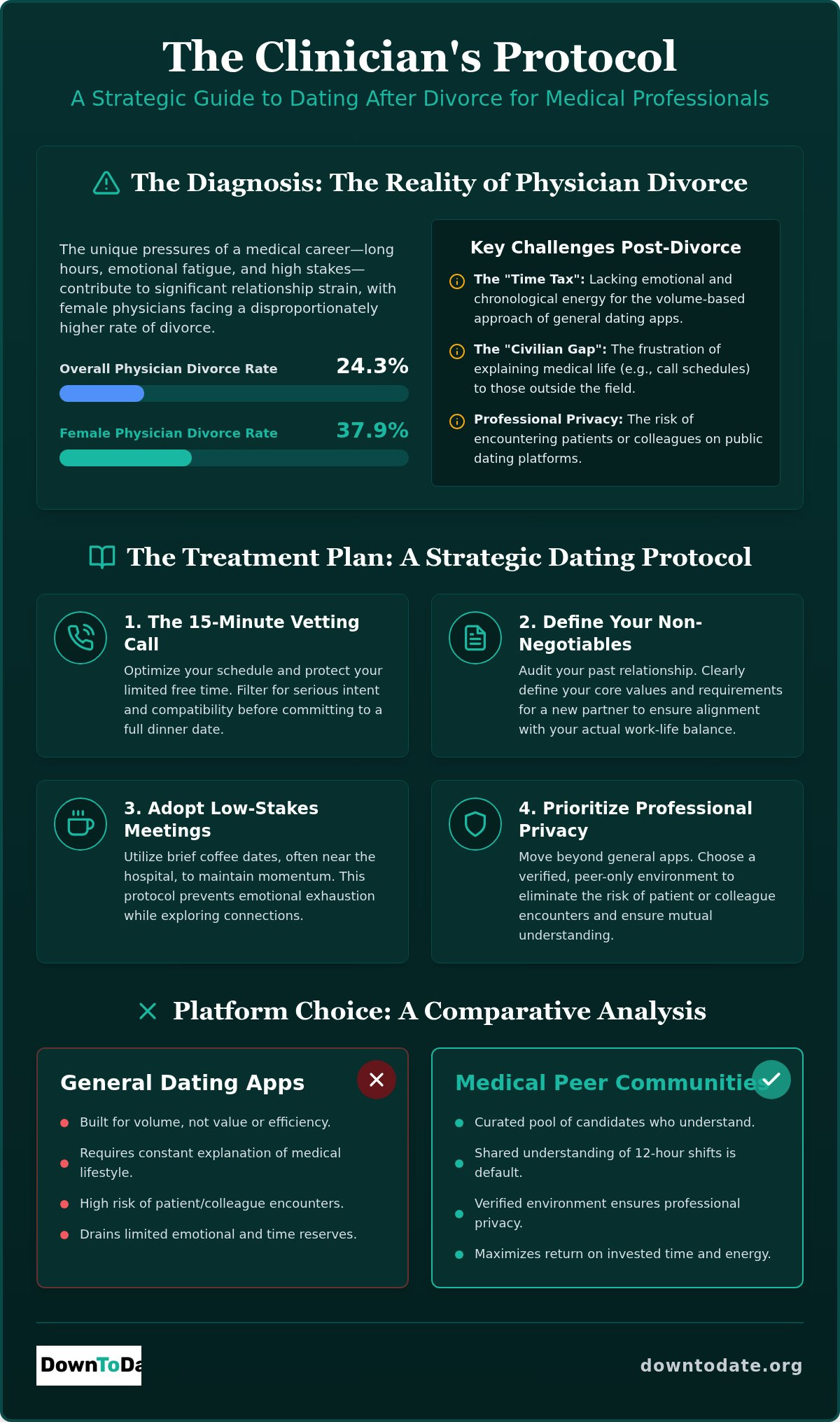
While the overall physician divorce rate sits at 24.3%, female physicians face a significantly higher rate of 37.9%. These aren't just numbers. They represent the unique pressure of balancing a high-stakes career with a personal life that often takes a backseat to the pager. You've conquered the rigors of residency and the demands of attending life. Now, you're facing a new challenge. Dating after divorce for medical professionals often feels like a logistical nightmare. You're tired of explaining your call schedule to civilians. You're wary of repeating past mistakes. You need a solution that values your time as much as you do.
This guide offers a practical, high-value approach to finding connection without compromising your career. You'll discover how to efficiently filter for serious intent and maintain your professional privacy in a digital world. We provide a streamlined path to finding a peer who understands the 12-hour shift lifestyle. It's time to apply the same clinical precision to your personal life that you bring to the patient bedside. Let's find a partnership built on shared values and mutual respect.
Key Takeaways
- Optimize your schedule by implementing a 15-minute vetting call. Protect your limited free time by filtering for serious intent before committing to a formal dinner.
- Prioritize professional privacy by moving beyond general apps. Eliminate the risk of patient encounters through a verified, peer-only environment.
- Navigate the complexities of dating after divorce for medical professionals with clinical efficiency. Connect with peers who instinctively understand the demands of a 12-hour shift.
- Define your non-negotiables with clarity and purpose. Ensure your next partnership aligns with your actual work-life balance rather than an idealized version of it.
- Adopt a low-stakes protocol for initial meetings. Utilize brief coffee dates near the hospital to maintain momentum without exhausting your emotional reserves.
The Reality of Dating Post-Divorce in the Medical Field
Medical divorce isn't just a legal proceeding. It's the byproduct of a high-pressure lifestyle that rarely leaves room for error. Long hours. Emotional fatigue. The relentless strain of residency. These factors often act as catalysts for relationship breakdown. When you emerge from a marriage, you aren't just looking for a partner. You're looking for someone who understands why you can't text back for eight hours. The Reality of Dating Post-Divorce is that the stakes are higher now. You've already invested years into a career and a previous life. You don't have time for a steep learning curve.
Dating after divorce for medical professionals requires a strategic approach. It's about efficiency, empathy, and exclusivity. In 2026, simply "showing up" on an app isn't enough. You need a protocol that respects your time and your status. This transition from a failed marriage back into a high-stakes clinical environment is an emotional hurdle. It requires you to be as intentional with your heart as you are with your diagnosis.
The Time-Tax of General Dating
Swiping is a second job. If you're working 80 hours a week, you don't have a surplus of emotional or chronological energy. General dating apps are built for volume, not value. You spend hours explaining your call schedule to people who think "on-call" means you're just busy. It's frustrating. It's draining. The "civilian gap" is the disconnect between your reality and their expectations. You need a curated pool of candidates. You need a system that filters for understanding before you even say hello. Efficiency is the only way to protect your limited free time.
Emotional Readiness vs. Professional Duty
Compartmentalization is a survival skill in the clinic. It's harder to maintain when your personal life is in flux. You have to treat patients while managing your own transition. This requires a level of emotional agility that few other professions demand. Self-reflection isn't a luxury; it's a prerequisite for a successful second act. You must identify where your work-life balance failed in the past. Setting boundaries is essential. Your practice needs your focus. Your personal life needs your presence. A successful second act starts with knowing where your professional duty ends and your personal life begins. You've spent years caring for others. Now, it's time to curate a life that cares for you.
Rebuilding Your Relationship Bedside Manner
Relationship Bedside Manner is the ability to bring professional empathy into a romantic partnership. It is the bridge between your clinical expertise and your personal connection. You've spent years mastering the art of the patient encounter. Now, you must master the art of the romantic encounter. Dating after divorce for medical professionals is not just about finding someone new. It is about becoming someone who is ready for a healthier second act. Success requires a shift in perspective. You are no longer just a clinician. You are a partner. Analyze the past. Define the future. Protect your peace.
The Post-Divorce Audit
Every successful recovery begins with an assessment. You need to audit your previous relationship with the same precision you use for a case review. Identify what was missing. Perhaps it was a lack of understanding regarding your 80-hour weeks. Maybe it was a mismatch in core values. Research regarding Dating Post-Divorce in the Medical Field indicates that while specific stressors vary, the need for a supportive peer remains constant. Define your non-negotiables now. Do not ignore red flags that clash with your medical life. If a potential partner resents your call schedule on week one, they won't tolerate it in year five. Determine if you seek a casual distraction or a long-term peer who shares your dedication.
Managing Professional Identity
Your white coat is a symbol of authority, but it shouldn't be your entire personality. Lead with your humanity, not just your credentials. It is tempting to stay in consultation mode during dinner. You diagnose problems. You offer solutions. You manage crises. In a relationship, this can feel like an interrogation rather than a conversation. Learn to be a partner, not a provider, when you are off the clock. Listen without the intent to fix. Share your day without presenting it as a case study. If you find it difficult to switch off the professional persona, consider a community like DownToDate where your identity is understood without being the only focus.
Finally, prepare for the inevitable "Why are you divorced?" question. Do not treat it like a deposition. Provide a brief, honest professional summary. You might say: "My previous marriage didn't survive the strain of my early surgical training, and we realized our long-term goals no longer aligned." This shows maturity. It shows accountability. It shows you've processed the past and are ready to focus on a future built on mutual respect and shared lifestyle realities.
Choosing the Right Platform: General Apps vs. Medical Communities
General dating apps operate on a high-volume, low-intent model. For the public, it is a game of numbers. For you, it is a drain on resources. Dating after divorce for medical professionals requires a higher signal-to-noise ratio than mainstream platforms can offer. You are a high-earning professional. You have a public-facing role. You have a reputation to protect. The risk of seeing a patient on a general app is not just awkward. It is a liability. It compromises your authority. It invades your privacy. You need a platform that acts as a gatekeeper, ensuring your profile is seen only by those who share your standards. Finding the best professional dating app for medical professionals is the first step in a clinical approach to connection.
The Security of Verified Peer Networks
Verification is a security protocol. Knowing your match is a verified healthcare professional eliminates the guesswork. It prevents professional impersonation. It filters for serious intent. It protects you from those seeking high-income partners without shared values. DownToDate uses a verified membership model to ensure every user is an actual peer. This level of security is essential for maintaining your professional reputation. Aligning your personal life with research on post-divorce well-being often means seeking out those who understand your specific stressors. A Premium Membership ensures you are part of an exclusive community that values integrity over volume. It ensures your first interaction is based on authenticity, not a curated persona.
Efficiency in Filtering
Your schedule is non-negotiable. Traditional apps filter by distance or age. They do not filter by residency year, specialty, or night-shift rotation. Finding someone who respects the "pager life" is the ultimate efficiency. In a niche medical community, you skip the "what do you do?" explanation phase entirely. They already know. They understand why a date might be canceled for an emergency surgery. They appreciate the weight of a 24-hour call. Dating after divorce for medical professionals requires a system that respects your time. You can filter by professional compatibility, ensuring that your limited free time is spent with someone who speaks your language. This is how you reclaim your personal life without sacrificing your clinical focus.
The Busy Professional’s Strategic Dating Protocol
Successful dating after divorce for medical professionals is a matter of clinical protocol. You triage your patients. You must triage your prospects. Start with a 15-minute Vetting Call. This screen saves you from a two-hour dinner with a mismatch. Move to a Low-Stakes First Date. Meet for coffee near the hospital. Keep it brief. Use Integrated Scheduling to find the rare overlap in your call cycles. Finally, practice Radical Transparency. Be honest about your divorce and your financial landscape early. This includes student loan debt or income expectations. It feels counterintuitive. It is actually a filter. It ensures you don't build a connection with someone who cannot handle your professional reality. Efficiency is the goal. Authenticity is the requirement.
Maximizing Limited Free Time
Batch your dates during your "off" weeks or between rotations. Friday at 7:00 PM is a civilian standard that often clashes with your reality. Connection can happen on a Tuesday morning or a post-call afternoon. Use your post-call days for meaningful interaction rather than just recovery. Strategy is essential when dating with an unpredictable schedule. You aren't just looking for a date. You're looking for a partner who respects the rhythm of your career. This approach protects your energy. It prevents burnout in your personal life.
The Divorce Conversation
The divorce conversation is a milestone. Disclose your marital history on the second or third date. This timing builds trust without wasting effort. When discussing co-parenting, treat it like a handover. Clear. Concise. Objective. Explain how you manage your 12-hour shifts with your childcare responsibilities. This level of clarity prevents future friction. Avoid the "bitter ex" trope. You are a professional. Your past is a chapter, not the whole book. Being honest about your history shows maturity. It shows you've processed the past and are ready for the future. Dating after divorce for medical professionals is about finding a peer who shares your values and your pace.
You deserve a partner who understands this level of strategic intent. You deserve a community that values your time as much as you do. Start your Premium Membership to connect with peers who live by the same high standards.
Re-entering the Scene with DownToDate
DownToDate is not just another dating platform. It is a specialized solution designed by doctors, for doctors. It recognizes that dating after divorce for medical professionals requires more than a casual swipe; it requires a mission-driven search for a partner who understands the weight of your day. For those over 30 or 40, the priorities have shifted. You aren't just looking for a date. You're looking for a peer who shares your lifestyle and your values. A DownToDate Premium Membership provides the elite tools necessary to find that connection. Unlimited messaging. Advanced filters. A verified community. This is the standard for medical dating in 2026. It is about moving forward with clinical precision and personal intent.
Why Peer Dating Works Post-Divorce
The shared language of medicine serves as a foundation for trust. When you speak about a difficult case or a taxing shift, your partner shouldn't need a glossary. They should offer empathy. Mutual respect for professional ambition is the baseline of a successful second act. You need someone who values your long-term goals as much as their own. They understand the emotional toll of the OR. They recognize the specific fatigue after an ER rotation. This shared reality eliminates the friction common in civilian relationships. It creates an environment where your career is supported, not just tolerated. Peer dating ensures that your partner "gets it" without a 30-minute explanation. It allows you to focus on the connection rather than the logistics of your career.
Taking the First Step
Creating a profile is your first clinical step toward a new partnership. Use this space to highlight your life outside the white coat. Show your interests. Share your passions. The process of connecting with other verified healthcare workers is designed for efficiency. The platform acts as a protective gatekeeper. It ensures quality. It ensures authenticity. It ensures serious intent. You have navigated the complexities of divorce. You have managed the demands of a high-stakes medical career. Now, it is time to prioritize your personal connection with the same level of commitment.
Don't settle for the noise of general apps. Choose a community that respects your time and understands your journey. Your next chapter deserves a partner who speaks your language and respects your pace. Join the community today. Reclaim your personal life. Find the peer who truly understands what it means to be DownToDate.
Reclaiming Your Personal Connection with Purpose
Success in dating after divorce for medical professionals requires the same intentionality you bring to the clinic. You have learned to triage your time, set non-negotiable boundaries, and move beyond the noise of general apps. Rebuilding your life doesn't mean settling for a civilian gap that fails to respect your call schedule. It means finding a peer who speaks your language and understands the weight of your professional duty. You've already done the hard work of self-reflection. Now, it's time to apply a strategic protocol to your search for partnership.
DownToDate was founded by medical professionals who understand your schedule. It is a verified community of healthcare peers designed for serious relationships, not just swiping. You deserve a partner who respects your ambition and matches your integrity. Don't waste your limited free time on platforms that don't value your privacy or your profession. Join DownToDate today and connect with peers who understand your life. Your next chapter is waiting. It's time to find a connection that is as high-value as your career.
Frequently Asked Questions
Is it better for divorced doctors to date other doctors?
Dating within the medical community often leads to higher success rates because of a shared lifestyle. Peers understand the emotional weight of clinical decisions and the exhaustion of a 24-hour call. You don't have to explain why you are late or why you are tired. A partner who shares your professional ambition is more likely to respect your long-term career goals. It builds a foundation of mutual empathy and shared reality.
How do I handle my medical schedule when I start dating again?
Use integrated scheduling and batch your dates during rotations or off weeks. Efficiency is the key to dating after divorce for medical professionals. Don't feel obligated to meet at standard times like Friday nights. Utilize post-call mornings for coffee or brief walks near the hospital. Being upfront about your 12-hour shifts prevents future friction. Protect your time by treating your personal life with the same logistical precision as your clinical rounds.
What are the best dating apps for divorced medical professionals?
Niche platforms like DownToDate are superior to general apps because they prioritize verification and peer-to-peer matching. General apps often lead to swiping fatigue and a low signal-to-noise ratio. A Premium Membership on a specialized site offers advanced filters that respect your residency year or specialty. These tools ensure you spend your limited energy on high-value connections. Choose a platform designed by medical professionals who understand your unique lifestyle and time constraints.
How do I explain my divorce to a new partner I met online?
Provide a brief, honest professional summary by the second or third date. You don't need to share every detail immediately. Frame the divorce as a learning experience that clarified your values and non-negotiables. Explain how your career played a role without sounding bitter. This transparency builds trust and accountability. It signals that you are ready for a serious relationship built on mutual respect and shared future goals. Clear communication is your most effective vetting tool.
Should I mention I have kids on my dating profile as a nurse?
Yes, mentioning your children early filters for partners who respect your family commitments. You don't need to post photos, but a clear statement about being a parent is essential. It ensures your matches understand that your time is divided between your 12-hour shifts and your home life. Transparency prevents awkward conversations later. It attracts individuals who value stability and are comfortable with the logistical realities of a medical professional's family life and schedule.
How do I avoid seeing patients or subordinates on dating apps?
Use verified, niche platforms that offer enhanced privacy settings and exclusive membership models. General apps present a significant risk of patient encounters, which can compromise your professional authority. Dating after divorce for medical professionals requires a secure environment. DownToDate uses a verified membership model to ensure you only connect with healthcare peers. This gatekeeping function protects your reputation. It allows you to date with confidence and maintain your professional boundaries while seeking a partner.
Is it possible to find a serious relationship in medicine after 40?
Absolutely, many medical professionals find their most compatible partners later in life when career paths are established. By 40, you have a clearer understanding of your non-negotiables and emotional needs. You are no longer navigating the chaos of early residency training. This maturity allows for more intentional matching. Utilizing a specialized community helps you find peers who are also seeking long-term stability. Your life experience is an asset in building a resilient and balanced partnership.
How can I vet a potential match before committing to a date?
Implement a 15-minute vetting call to screen for compatibility before committing to a formal dinner. This protocol saves hours of wasted time and emotional energy. Ask direct questions about their lifestyle, values, and understanding of the medical career path. Look for consistency in their responses. If they respect your time during the initial screen, they are more likely to respect your schedule in a relationship. Efficiency in the vetting process is a clinical necessity.


