

The secret to balancing a healthcare career isn't finding more time; it's finding a partner who understands why you have none. In 2026, the clinical environment is more demanding than ever. You face 80-hour weeks. You manage high-stakes rotations. You carry the emotional weight of patient care. Balancing career and relationships in healthcare often feels like a forced choice between your calling and your personal life. It's a trade-off that leaves even the most successful clinicians feeling isolated.
You know the exhaustion of a twelve-hour shift. You feel the guilt of every missed dinner or skipped holiday. It's draining to justify your absence to a partner who doesn't grasp the reality of a code or a late consult. We understand this pressure because we've lived it. This guide provides actionable, medical-focused relationship strategies designed specifically for your schedule. You can maintain professional excellence without sacrificing intimacy.
We'll show you how to find a partner who shares your pacing, reduce dating burnout, and implement systems to sustain connection during your most intense rotations. It's time to build a life that supports both your career and your heart.
Key Takeaways
- Identify the psychological and physical stressors that create an emotional load at home. Learn to mitigate the impact of irregular shift work on relationship synchronicity.
- Discover why balancing career and relationships in healthcare is more sustainable when your partner shares your professional vernacular and understands the demands of a late shift.
- Move beyond the filtering fatigue of general dating apps. Focus on verified communities that prioritize security and shared values for high-profile clinicians.
- Adopt the Micro-Date system to redefine quality time. Maintain deep connection through small, intentional windows of intimacy during your busiest rotations.
- Streamline your search for partnership. Use advanced filtering to find high-value connections without the need for endless explanations about your lifestyle.
The Clinical Strain: Why Healthcare Careers Challenge Traditional Relationship Models
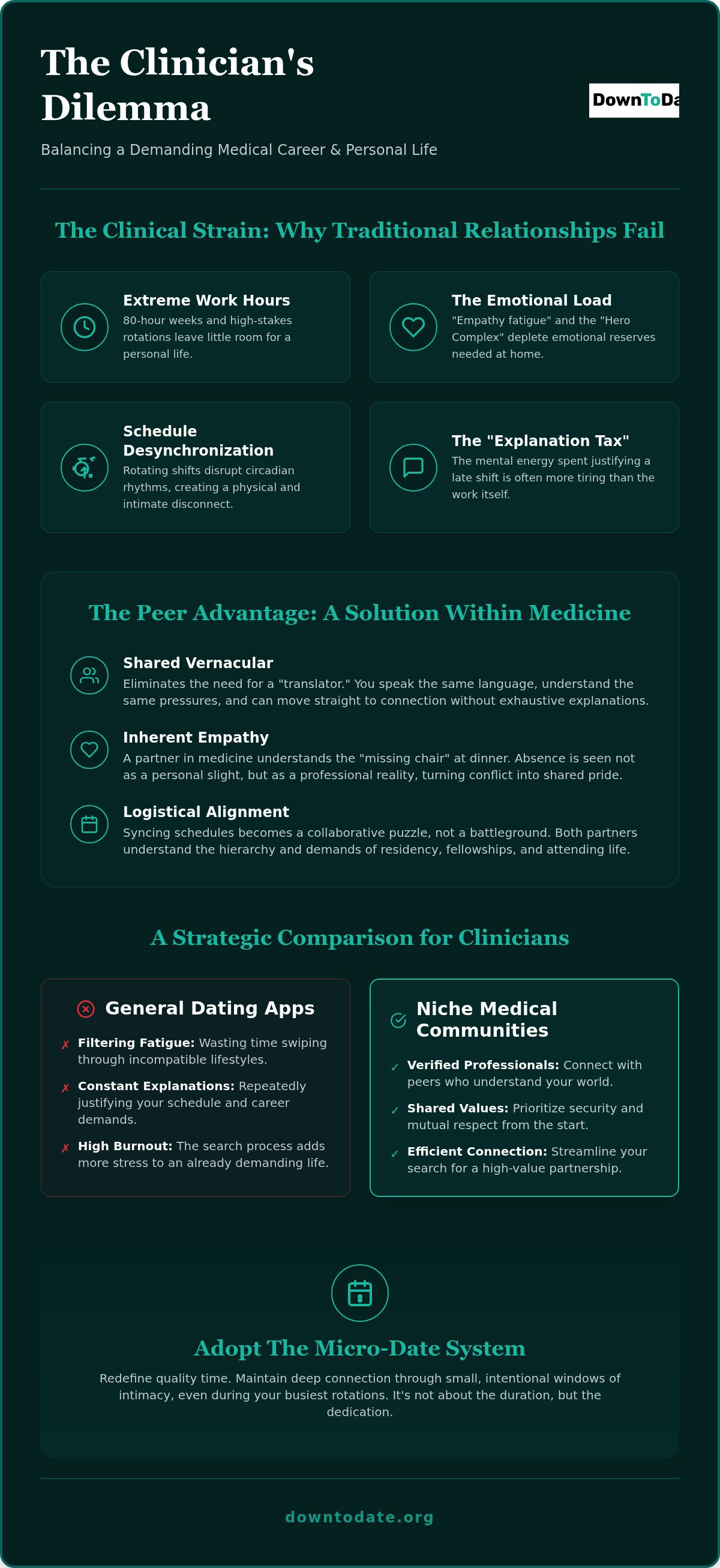
The "Hero Complex" is a double-edged sword. In the clinic, your dedication saves lives. At home, it creates a secondary emotional load that few understand. You're trained to prioritize the patient. You're taught that the mission comes first. When you finally return home, the mundane tasks of a relationship can feel insignificant compared to the high-stakes decisions you just made. This psychological disconnect is the primary hurdle in balancing career and relationships in healthcare.
The 24-hour cycle of modern medicine further complicates connection. Circadian rhythms don't just dictate sleep; they dictate intimacy. When you work a rotating shift, you're physically out of sync with a partner on a traditional schedule. You're awake when they sleep. You're exhausted when they want to connect. This constant desynchronization leads to a profound cognitive load. It's hard to switch off. The adrenaline of the ER or the focus of the OR doesn't dissipate at the hospital exit. It follows you home, making it difficult to be present for the person who matters most.
Then comes the "Explanation Tax." It's the mental energy spent translating your day for someone outside the field. Explaining why a routine consult turned into a four-hour ordeal is taxing. Defending your late arrival is draining. For many clinicians, the effort of explanation is often more tiring than the shift itself. You shouldn't have to justify your career to the person you love.
Burnout and Its Ripple Effect on Intimacy
Empathy fatigue is real. After a day of holding space for patient trauma, your emotional reserves are depleted. This leads to emotional withdrawal. You don't lack love; you lack bandwidth. High rates of Physician Burnout often manifest as silence at the dinner table. If your career is cannibalizing your personal life, you might notice a shift in your attachment style. You become avoidant to protect what little energy remains. Identifying these signs early is critical for relationship survival. Professional trauma shouldn't dictate your capacity for connection.
The Reality of the Unpredictable Schedule
Traditional date nights are a luxury most clinicians can't afford. A sudden trauma call or a patient complication can derail plans in minutes. This unpredictability creates a psychological toll for both partners. It's not just about the missed event; it's about the constant anticipation of disappointment. Learning how to manage dating with an unpredictable schedule requires a shift in mindset. You must move away from rigid planning and toward radical flexibility. Communicating this need clearly prevents resentment and builds a foundation of mutual respect.
The Peer Advantage: Why Dating Within Medicine Improves Relationship Longevity
Efficiency is the cornerstone of a successful medical career. It should also be the foundation of your personal life. When both partners are clinicians, you eliminate the need for a translator. You speak the same language. You understand the weight of a difficult prognosis. You don't have to explain why a ten-minute consult lasted three hours. This shared vernacular saves precious emotional energy. It allows you to skip the basics and move straight to connection. It's the most direct path to balancing career and relationships in healthcare.
A non-medical partner might see a late shift as a personal slight. A peer sees it as a professional reality. We call this empathy for the "missing chair." It's the quiet understanding that your absence isn't a lack of interest, but a commitment to care. This mutual respect for the system is vital for long-term stability. It transforms a common source of conflict into a point of shared pride. You aren't just partners; you're allies in a high-stakes environment.
The "Power Couple" dynamic in medicine isn't about competition. It's about logistical alignment. When both partners understand the hierarchy of residency or the demands of an attending, syncing schedules becomes a collaborative puzzle rather than a battleground. You share the same intellectual standards. You share the same social circles. Most importantly, you share the same mission. This alignment makes the impossible feel manageable.
Mutual Understanding of Professional Stakes
Recent research from the American Medical Association highlights medicine's toll on personal relationships, citing long hours and emotional exhaustion as primary stressors. A partner who already understands doctor dating challenges is naturally more resilient. They don't just tolerate your schedule; they validate it. This validation prevents the "competition" myth from taking root. You aren't competing for time; you're coordinating for it. Shared values in the clinic often translate to shared values in family life, creating a robust foundation for the future.
Efficiency in Connection
The "no-explanation" rule is a game changer for busy clinicians. Skipping the play-by-play of why you're tired allows you to focus on recovery and intimacy. You need a support system that understands the specific weight of clinical decisions without requiring a lecture on medical ethics. The Peer Advantage is the reduction of emotional friction through shared vocational identity. It's about finding someone who recognizes your world because they live in it too. If you're ready to stop explaining and start connecting, consider joining a community of verified medical professionals who already get it.
Strategic Comparison: Niche Communities vs. General Dating Apps
The tool you use determines the outcome you get. For most clinicians, general dating apps are a primary source of "Filtering Fatigue." You're swiped for the wrong reasons. You're seen as a status symbol or a financial safety net rather than a person with a demanding life. This makes balancing career and relationships in healthcare an uphill battle from the first match. You don't have hours to waste on users who view your career as a trophy rather than a commitment. Efficiency in your personal life requires a platform that filters for reality, not just aesthetics.
Security is paramount for high-profile professionals. General platforms lack the rigorous vetting required to protect your professional identity and privacy. Niche communities prioritize verification. They ensure you're interacting with peers who share your intellectual and social standards. This intentionality shifts the focus from casual browsing to serious partnership. When everyone in the room understands the medical system, the "Time-to-Match" drops significantly. You aren't teaching a civilian about your world; you're meeting someone who already lives there.
- Intentionality: Niche platforms attract users looking for serious commitment, not just a distraction.
- Verification: Vetted communities reduce the noise of professional misrepresentation.
- Efficiency: Specific filters for medical roles save hours of unproductive swiping.
Why General Apps Fail the Healthcare Professional
The "Doctor" stereotype is a persistent barrier to genuine connection. Civilian matches often romanticize the prestige while resenting the schedule. They don't understand why you can't text back during a 12-hour surgical block or why you're too exhausted for a Friday night out after a week on-call. Explaining the nuances of residency or the weight of clinical decisions becomes an exhausting part-time job. In 2026, your time is your most valuable asset. Quality must beat quantity. If you only have 30 minutes of free time, you can't spend 20 of them defending your vocational choices or explaining the basics of shift work.
The Value of a Verified Medical Community
Verification is the foundation of trust in a digital space. Choosing a specialized dating app for medical professionals reduces the risk of "catfishing" and professional misrepresentation. It provides a level of psychological safety that general apps cannot match. You can interact within a peer group that values integrity and shared experience. This allows you to focus on shared lifestyle goals rather than just surface-level interests. You're finding a partner who understands that balancing career and relationships in healthcare is a coordinated effort. It's about building a life with someone who respects the weight of your calling.
5 Strategic Steps to Balance Your Medical Career and Love Life
Success in medicine requires a protocol. Your personal life deserves the same level of intentionality. Moving from clinical exhaustion to relational fulfillment isn't about working less; it's about connecting smarter. Balancing career and relationships in healthcare is a skill that can be mastered through specific, high-yield actions. It requires shifting from a reactive mindset to a proactive strategy.
- Step 1: Radical Transparency. Set expectations from the first interaction. Don't minimize your commitment. If you're in a heavy surgical rotation, say it. Authenticity filters out those who cannot handle the medical lifestyle.
- Step 2: The 'Micro-Date'. Redefine connection. A fifteen-minute window is an opportunity, not a limitation. High-frequency, short-duration interactions sustain intimacy better than infrequent, long-duration ones.
- Step 3: Schedule Syncing. Use digital tools to share on-call calendars. Visibility reduces friction. When your partner knows your schedule, they don't have to wonder if you're available; they already know.
- Step 4: Emotional Decompression. Create a ten-minute ritual. Use your commute to transition. Scrub out of your clinical mindset before you walk through the front door. Your partner needs the person, not the practitioner.
- Step 5: Intentional Community. Stop fighting the algorithm. Choose platforms designed for your pacing. Finding a partner who understands the system is the ultimate time-saving strategy.
Redefining Quality Time
A twenty-minute coffee between shifts can be more intimate than a three-hour dinner. It's about the quality of presence, not the quantity of minutes. Micro-dating is the practice of utilizing small, consistent windows of time to maintain emotional proximity. Embrace "passive quality time." Sitting in the same room while you're charting and they're reading creates a sense of shared life. It's about being together in the quiet moments that define a medical career.
Communication Frameworks for Busy Couples
Implement a "State of the Union" check-in. This is a five-minute daily sync to discuss logistics and emotional needs. Use low-stakes communication to bridge the gap during twelve-hour rotations. Voice notes and photos provide a sense of continuity without the pressure of an immediate response. This approach manages the "on-call" anxiety that often plagues medical couples. If you're ready to find a partner who values this level of strategic connection, join our verified community today and start connecting with peers who understand your world.
DownToDate: Streamlining Connection for the Modern Medical Professional
The struggle is real. The solution is here. DownToDate was not built in a boardroom; it was built in the hospital. Founded by Dr. Shadi and Dr. Sasan Rezai, this platform was born from the lived experience of medical training. They understood the weight of the white coat. They knew the exhaustion of the post-call morning. They recognized that balancing career and relationships in healthcare requires more than just effort. It requires an environment that respects your time. It requires a community that understands your world without a lengthy explanation.
Our platform logic mirrors the efficiency of clinical practice. We don't believe in endless swiping. We believe in high-yield matching. By focusing on a verified community, we eliminate the noise and uncertainty of general dating. You are interacting with peers. You are connecting with individuals who share your intellectual and social standards. You are building a network that values integrity as much as you do. Trust is not a luxury in our community; it is a prerequisite for entry. This is how we solve the "time" problem for the busiest clinicians.
Built by Peers, for Peers
The story of the Rezai doctors is a commitment to the medical community. They saw colleagues choosing between their patients and their partners. They saw the "explanation tax" draining the energy of the best clinicians. DownToDate removes that burden. The platform is designed to handle the logistical heavy lifting. It respects your schedule. It understands your professional vocabulary. It builds a bridge between your professional excellence and your personal needs. This is not just a service; it is a community builder that understands the unique hurdles of a high-stakes lifestyle.
Your Next Step Toward Balance
2026 is the year to stop waiting for a lighter rotation. Time is a finite resource that will never simply "appear." You must claim it. Getting started is a matter of professional intentionality. Create a profile that highlights your professional and personal values. Define your pacing. For those seeking the elite standard of connection, our Premium Membership offers advanced filtering features that solve the time problem. It is the most efficient way to find a partner who understands the system.
You have dedicated your life to the care of others. It is time to apply that same dedication to your own happiness. Balancing career and relationships in healthcare is possible when you have the right tools. You don't have to choose between your white coat and a full heart. The next chapter of your personal life begins with a single, strategic move. Join a community that values your time as much as you do.
Secure Your Personal Connection in 2026
Connection shouldn't be a casualty of your calling. You've seen how the peer advantage reduces emotional friction. You've learned that micro-dating and radical transparency preserve intimacy during heavy rotations. Balancing career and relationships in healthcare is about intentional strategy, not just luck. It requires moving away from general platforms that drain your energy and toward communities that respect your reality. You deserve a partner who understands the weight of your day without a translation.
You need a system designed for your specific pace. Our verified peer-to-peer community is tailored for high-stakes schedules. It was founded by medical professionals who believe you can have both a successful practice and a full heart. Don't wait for a lighter rotation that may never come. Your time is too valuable to spend it on explanations. Your future is too important to leave to chance.
Start building your medical power couple today on DownToDate. Your career is thriving. It's time for your personal life to do the same.
Frequently Asked Questions
Is it better to date another doctor or someone outside the medical field?
Dating within the field eliminates the "explanation tax" often paid when justifying late shifts. You gain an ally who understands why a code blue takes precedence over a dinner reservation. However, dating outside medicine can provide a necessary mental break from clinical life. Successful balancing career and relationships in healthcare requires finding a partner who respects the rigidity of your schedule, regardless of their own vocation.
How do I find time for dating during a busy residency?
Efficiency is your best tool during residency. Stop spending hours on general apps that don't filter for your specific lifestyle. Focus on high-yield interactions instead. A fifteen-minute video call during a break is more valuable than a week of unanswered texts. Use platforms that verify users to ensure you're meeting people with similar drive. Prioritizing intentionality over volume prevents the exhaustion often associated with clinical dating.
What are the best date ideas for healthcare workers with limited time?
Forget the traditional three-hour dinner. Optimal date ideas for clinicians center on "Micro-Dating." Meet for a twenty-minute coffee near the hospital between rotations. Try a "post-call breakfast" when your schedules align. Even "passive quality time," such as completing charts in the same room while your partner reads, builds intimacy. These small windows of connection sustain the relationship without requiring you to sacrifice necessary sleep or clinical duties.
How can I explain my unpredictable on-call schedule to a new partner?
Lead with radical transparency from the first message. Don't apologize for your calling; explain the reality of the medical system. Use shared digital calendars to provide visibility into your on-call blocks. When a delay happens, communicate the "why" briefly. A partner who understands the high-stakes nature of your work won't take a late arrival personally. Clear, proactive communication prevents the resentment that often stems from unpredictable schedules.
Why do medical professionals struggle with dating burnout?
Burnout in dating often mirrors clinical burnout. It's caused by "filtering fatigue" on general apps where you're constantly justifying your lifestyle. You're already making high-stakes decisions all day. Coming home to swipe through hundreds of incompatible profiles creates a secondary cognitive load. Niche communities reduce this friction by ensuring every match already understands the medical lifestyle. This streamlined approach preserves your emotional energy for actual connection.
Are niche dating apps for doctors actually effective?
Niche apps are highly effective because they solve the "Time-to-Match" problem. By interacting within a verified community, you skip the basic explanations of residency or shift work. These platforms attract users with high intentionality who are looking for serious partnership. Features like those found in a Premium Membership allow you to use advanced search filters. This ensures you spend your limited free time engaging with people who share your lifestyle goals.
How can I maintain intimacy when working the night shift?
Intimacy during night shifts requires a shift to asynchronous connection. Use voice notes, photos, or short videos to stay present in your partner's day while you're awake and they're asleep. This creates a sense of continuity. On your days off, prioritize "State of the Union" check-ins to sync your emotional needs. Balancing career and relationships in healthcare while working nights is possible when you redefine connection as a consistent, ongoing dialogue.
What should I look for in a professional dating site?
Look for three core pillars: verification, peer focus, and efficiency. A reliable site should require credential verification to ensure a secure, authentic environment. It should offer tools tailored to high-stakes schedules, such as advanced filtering and enhanced visibility. Choose a platform founded by people who have lived the medical struggle. This ensures the site's logic mirrors the practical needs of a busy clinician rather than a casual browser.


