

Dating in medicine isn't a distraction from your career; it's a vital component of professional longevity when managed with clinical precision. You've spent years mastering complex protocols, yet the protocol for a thriving personal life often remains elusive. You understand the weight of a 12 hour shift. You know the emotional exhaustion that follows. For many, the challenge of stress management and dating in medicine feels like a zero-sum game where one must eventually fail. You're tired of explaining your lifestyle to those who don't understand the stakes.
It's time to change the narrative. You can maintain clinical excellence while building a partnership that actually serves as a sanctuary. This 2026 guide provides the peer-validated frameworks you need to reclaim your time and your emotional energy. We'll explore practical ways to decompress before a date, even after grueling rounds. We'll show you how to find a partner who respects the medical journey without the need for constant explanation. From efficient scheduling to high-value connection, here's how to master the balance of the medical lifestyle.
Key Takeaways
- Understand how the "Compassion Fatigue" cycle impacts your ability to engage in early dating conversations after a demanding clinical shift.
- Implement strategic frameworks for stress management and dating in medicine to protect your romantic life from the "Second Shift" of emotional labor.
- Compare the efficiency of dating healthcare peers versus the time-intensive process of explaining the medical lifestyle to non-medical partners.
- Apply practical batching techniques to manage your dating life like administrative tasks, ensuring consistency without the burnout.
- Leverage verified communities to bypass the explanation phase and build immediate trust with partners who understand your professional stakes.
Understanding the Interplay Between Medical Burnout and Dating Success
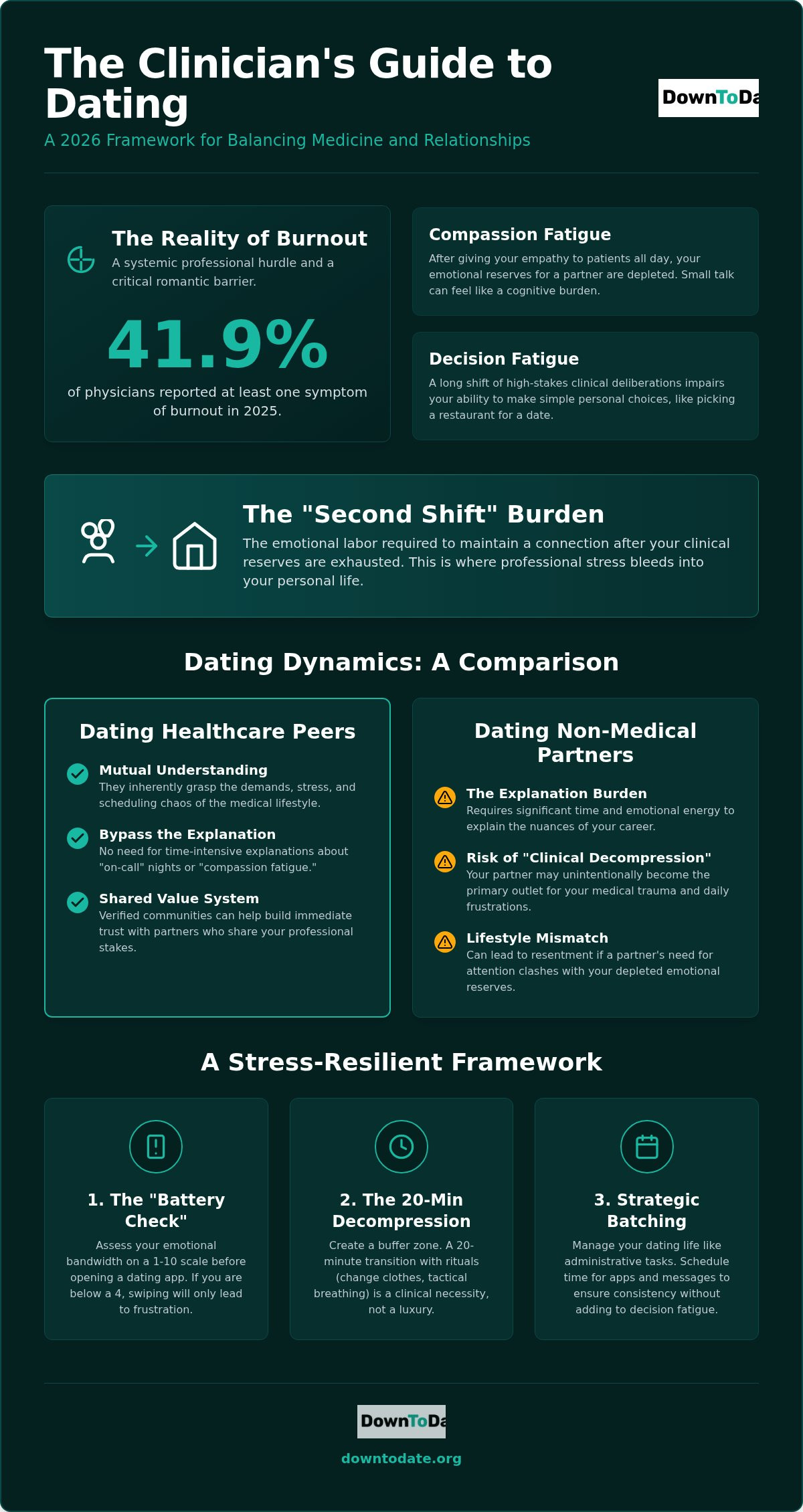
Physician burnout is a systemic reality. In 2025, 41.9% of physicians reported experiencing at least one symptom of burnout. This is not just a professional hurdle; it is a romantic barrier. Understanding Physician Burnout is the first step toward reclaiming your personal life. When you spend 12 hours in a state of high-alert empathy, you enter the Compassion Fatigue cycle. You have given everything to your patients. You have nothing left for a first date. Small talk feels physically painful because your brain, saturated with cortisol, views trivial questions as a cognitive burden. This is why stress management and dating in medicine is a physiological challenge before it is a social one.
You must distinguish between healthy dedication and relationship-sabotaging burnout. Dedication means you value your work. Burnout means your work has erased your capacity for connection. If you find yourself feeling resentful of a partner's need for attention, you aren't "bad at dating." You are likely experiencing a depleted emotional reserve. Emotional regulation is a prerequisite for dating in 2026. You cannot build a sanctuary with another person if your own internal environment is in a state of constant emergency. Mastering this balance requires a clinical approach to your own downtime.
The Physiology of Stress in the Dating World
Your sympathetic nervous system does not simply switch off when you clock out. The "fight or flight" response triggered by a coding patient or a chaotic ER shift follows you to the dinner table. This physiological carryover makes it difficult to transition into a romantic headspace. You may experience Decision Fatigue, which paralyzes your ability to make simple choices. Decision Fatigue in a medical context is the progressive decline in the quality of choices made by a clinician after a long sequence of high-stakes clinical deliberations. If you cannot choose a restaurant, it's because your brain has already hit its limit for the day.
Recognizing Your Own Dating Capacity
The "Battery Check" method is an essential tool for the modern clinician. Before you open a dating app, assess your emotional bandwidth on a scale of one to ten. If you are below a four, swiping will only lead to frustration. Signs of severe burnout include persistent irritability, a lack of curiosity about others, and a preference for total isolation. Sometimes you don't need a break from dating; you need a peer who understands the stakes without an explanation. If you find yourself consistently choosing isolation over connection, you may need specific relationship advice for doctors to bridge the gap between your professional demands and your personal needs.
Identifying and Mitigating the Second Shift Emotional Burden
The medical shift ends at the hospital. The second shift begins at home. This second shift is the emotional labor required to maintain a romantic connection after your clinical reserves are exhausted. If you fail to manage this transition, you risk "Clinical Decompression." This is the habit of using your partner as a primary outlet for medical trauma and daily frustrations. It's a heavy burden for a civilian to carry. Effective stress management and dating in medicine requires a conscious boundary between these two worlds. Insights from AHRQ on Physician Burnout highlight how professional exhaustion bleeds into every facet of a clinician's life, making these boundaries essential for relational survival.
You need a buffer zone. A 20 minute transition period is not a luxury; it's a clinical necessity. This is your time to shed the white coat persona before you step into a date or walk through your front door. Communicate your post-shift state clearly. Tell your partner you're at "low power" and need a moment to reset. This transparency prevents you from scaring off potential partners with the intensity of an unresolved shift. It sets a standard for mutual respect and emotional intelligence from day one.
The Decompression Routine for Busy Professionals
Shed the clinical persona through physical rituals. Change your clothes immediately. Wash your hands. Use tactical breathing to signal to your brain that the "Fixer" role is over. These doorstep rituals are vital. Venting isn't always healing. Sometimes, recounting a traumatic case increases your cortisol instead of lowering it. Limit medical talk during your first three dates. You're more than your NPI number. You're a person seeking connection. For those who want to skip the "explanation phase" entirely, finding a verified medical peer can simplify these transitions.
Emotional Labor vs. Clinical Duty
Don't treat your date like a patient. Don't treat them like a subordinate. It's easy to stay in "Diagnostic Mode" when you're tired. You listen for symptoms. You look for solutions. You try to "fix" their problems. This is clinical duty, not emotional labor. Shifting to "Partner Mode" requires active listening without a plan of care. It means holding space without offering a prescription. Practice hearing their day without mentally charting it. This shift in mindset is the difference between a clinical consultation and a thriving romance. It's about presence over performance.
Comparing Dating Dynamics: Healthcare Peers vs. Non-Medical Partners
Choosing a partner is a strategic decision that affects your professional longevity. The "civilian learning curve" often adds an extra layer of emotional labor to an already full plate. Explaining call schedules, HIPAA constraints, and the reality of 12 hour shifts is exhausting. It's a second shift of education. This is why stress management and dating in medicine often leans toward peer connection. You bypass the explanation phase. You start with a shared understanding of the stakes. You find someone who doesn't need a primer on why you're emotionally unavailable after a difficult outcome.
Shared values in healthcare often lead to higher long-term satisfaction. When both partners value service, resilience, and health, the foundation of the relationship is stronger. You aren't just dating; you're building a life with someone who respects the gravity of your work. This alignment reduces the friction often found in medical-civilian pairings. It turns your personal life into a sanctuary rather than another place where you have to defend your career choices.
The Case for Dating a Peer
Peers offer an efficiency advantage that civilians cannot match. There is no need to explain why you're late for dinner or why you're too tired to talk. You share a mission. You understand the unique pressures of the medical lifestyle. This shared vocabulary fosters a "Medical Power Couple" dynamic where both partners thrive. You support each other's growth without the friction of professional jealousy. For those ready to find a partner who understands the grind, dating for doctors provides a roadmap for modern connection in a high-stakes environment.
The Challenges of the Medical Household
Double-doctor households require strict boundaries. You must manage the risk of trauma dumping when both partners have had difficult shifts. Scheduling the unpredictable becomes a shared challenge. Two on-call calendars require a master level of coordination. You must fight to maintain a non-medical identity as a couple. Don't let your home become a satellite clinic. Discuss travel. Talk about art. Find hobbies that have nothing to do with anatomy or pharmacology. Maintaining this separation is a vital part of stress management and dating in medicine when both partners are clinicians.
A Practical Framework for Stress-Resilient Dating in Healthcare
Generic wellness advice fails the modern clinician. You don't need more meditation apps; you need a time-management strategy that respects your 80 hour week. Effective stress management and dating in medicine requires moving beyond hope and into clinical precision. You must treat your personal life with the same rigor you apply to your patient charts. This means automating what you can and being ruthlessly efficient with the rest. When you manage your dating life as a series of strategic windows, the pressure of finding connection begins to dissipate.
Efficiency is your primary tool. Treat swiping and messaging as "Admin Time." Block out 15 minutes twice a day to engage with your matches. Don't let dating apps bleed into your clinical hours or your precious sleep. For high-stress weeks, pivot to the "Low-Stakes First Date." A 30 minute coffee or a quick walk between shifts is superior to a three hour dinner you're too exhausted to enjoy. This reduces the barrier to entry. It lowers the stakes. It allows you to assess chemistry without sacrificing a night of recovery. To streamline this process, join a community of verified peers who already understand your constraints.
The 5-Step Strategic Dating Plan
Success in dating follows a protocol. Start by auditing your schedule to identify "Connection Windows." These are the small gaps in your calendar where you actually have the energy to respond. Select a niche platform to reduce Profile Fatigue. Mass-market apps often lead to a cycle of repetitive explanations that drain your battery. Set a "Shift-End Protocol" for messaging. Use the adrenaline from the end of your shift to send a few thoughtful replies before you decompress. Finally, schedule date nights as non-negotiable events. Give them the same priority as rounds or a scheduled surgery. Consistency builds trust.
Communication Hacks for the On-Call Professional
You don't need hours of free time to maintain a connection. High-impact, low-time gestures are your best assets during a 24 hour shift. The "Thinking of You" text takes ten seconds but provides significant emotional ROI. It signals presence without requiring a full conversation. Leverage video calls during "Golden Hour" breaks. A five minute face-to-face interaction is more grounding than an hour of texting. If you find the logistics of your career are still causing friction, consult our guide on dating with an unpredictable schedule. Honesty about your availability from day one is the ultimate stress-reducer. It filters out those who cannot handle the reality of medicine and protects your emotional energy for those who can.
DownToDate: Streamlining Your Path to Connection Without the Burnout
DownToDate is the clinical solution for a personal challenge. Most platforms operate on volume. They require you to filter through thousands of profiles to find one person who understands your schedule. This creates filtering stress. It's another task on an already overloaded list. DownToDate removes the explanation stress by curating a community that already speaks your language. You don't have to explain your call schedule. You don't have to justify a 24 hour shift. Stress management and dating in medicine becomes significantly easier when your partner understands the baseline of your life from day one.
A Premium Membership is an investment in your emotional well-being. It's a commitment to finding a partnership that supports your career rather than competing with it. This niche platform acts as the ultimate productivity hack for the single clinician. It respects your time. It protects your energy. It facilitates connection without the burnout associated with mass-market apps. You've optimized your clinical practice. Now, you can optimize your personal life with the same professional precision and mission-driven focus.
Efficiency Through Verification
Skip the anxiety of the unknown. DownToDate was founded by Dr. Shadi Rezai and Dr. Sasan Rezai. These are doctors who understand the residency grind and the pressures of modern practice. Every member is part of a verified community of medical peers. This verification process ensures you're interacting with individuals who share your professional standards and high-stakes lifestyle. You can filter by specialty and lifestyle to find a true peer match. A curated pool reduces dating burnout. It replaces the "is this person real" question with a "how do we sync our schedules" conversation. This is efficiency in its purest form.
A Community That Understands Your "Why"
Your dedication is a virtue. It isn't a relationship flaw. In a non-medical pairing, your long hours can be interpreted as a lack of interest or a failure of priority. In this community, those hours are understood as a commitment to service and clinical excellence. You can build a relationship founded on shared professional ethics and mutual respect. Find a partner who respects your dedication. Build a life with someone who supports your growth. This is about finding a safe space for those who have experienced the intensity of medical training. Join the community designed for your lifestyle and start your journey toward a stress-resilient connection. Become a member today and bypass the civilian learning curve for good.
Mastering Your Personal Longevity
Your career demands precision. Your personal life deserves the same level of intentionality. Mitigating the second shift of emotional labor requires a proactive strategy. Effective stress management and dating in medicine isn't about finding more time. It's about protecting the energy you have left. By leveraging peer-validated frameworks and strategic buffer zones, you can safeguard your emotional reserves. You don't have to sacrifice a thriving career for a meaningful partnership. You can have both.
You deserve a community that understands the weight of your clinical duties. DownToDate is a verified healthcare community designed specifically for high-stakes lifestyles. It was founded by medical professionals who have lived the same experience. We've removed the explanation phase so you can find immediate connection. Reclaim your time and build a relationship that serves as your sanctuary.
Join DownToDate and connect with peers who understand your schedule. Your journey in medicine is demanding. Your path to partnership shouldn't be. Start building a connection that respects your dedication and supports your future.
Frequently Asked Questions
How do I tell a date I’m too stressed to talk without sounding uninterested?
Use clear, vulnerable communication that emphasizes the situation, not the person. Frame your need for space as a way to be more present later. For example, say, "I've had a high-intensity clinical day and need an hour to reset so I can give you my full attention." This demonstrates emotional intelligence and high standards. It signals that you value the connection enough to wait until you can engage meaningfully.
Is it better to date another doctor or a civilian for stress management?
Dating a healthcare peer often simplifies stress management and dating in medicine because they understand the baseline pressures without explanation. You bypass the "civilian learning curve" regarding call schedules and clinical trauma. However, dating a non-medical partner can provide a necessary mental break from hospital talk. The best choice depends on whether you seek a shared mission or a complete separation between your professional and personal identities.
What are the best date ideas for someone with a 12-hour shift schedule?
Focus on low-stakes, high-connection activities that don't require complex logistics. Consider a 30-minute walk through a park or a quiet breakfast after a night shift. Avoid loud, crowded environments that contribute to sensory overload. These "micro-dates" respect your recovery time while maintaining momentum. The goal is to prioritize quality interaction over the duration or cost of the outing. Simple, grounding activities often provide the best emotional ROI.
How can I prevent medical burnout from affecting my new relationship?
Establish clear boundaries between your clinical persona and your private life. Use physical rituals, like changing your clothes or listening to non-medical podcasts, to transition out of "diagnostic mode." Be honest about your capacity on any given day. If you're experiencing symptoms like irritability or emotional numbness, communicate this early. A supportive partner can help you decompress, but they shouldn't be your only outlet for processing professional trauma.
Can a relationship actually help reduce my career stress in medicine?
A healthy partnership acts as a vital buffer against the pressures of residency and practice. It provides emotional stability and a sense of purpose beyond the hospital walls. Research suggests that clinicians with strong social support systems report lower levels of job-related distress. When your partner understands the medical journey, they become a sanctuary rather than another source of obligation. This connection can significantly improve your overall professional longevity and mental health.
What should I do if my partner doesn’t understand my on-call requirements?
Education is key, but compatibility also plays a major role. Explain the legal and ethical stakes of your on-call duties using concrete examples. If they continue to resent your schedule, it may indicate a fundamental mismatch in lifestyle expectations. Many clinicians choose verified communities like DownToDate to find partners who already respect these professional constraints. Finding someone who values your dedication is essential for a sustainable, long-term relationship in healthcare.
How do I find time to swipe on dating apps when I work 80 hours a week?
Shift your approach from constant browsing to "batching" your engagement. Dedicate 10 minutes during your morning commute or before bed to respond to messages. Use niche platforms that cater to healthcare professionals to reduce the time spent filtering through incompatible matches. Efficiency-seeking clinicians often find that a focused, high-value community requires less effort than mass-market apps. Managing your dating life like administrative time ensures you stay connected without sacrificing sleep.
Is dating during residency even possible without total burnout?
It's entirely possible when you prioritize efficiency and mutual understanding. Dating during residency requires a strategic framework that accounts for your limited bandwidth. Focus on partners who are flexible and empathetic to the high-stakes nature of your training. By using tools designed for the medical lifestyle, you can find connection without adding to your cognitive load. Remember that a thriving personal life is a protective factor against burnout, not just another chore.


