

Success in long distance relationships for medical professionals isn't a matter of luck. It's a clinical operation. In 2026, with 1,258 couples participating in the Match, the stakes are higher when your schedule is dictated by 24-hour shifts and unpredictable on-call rotations. You've felt the sting of a missed connection. You've navigated the exhaustion of a clinical rotation. You've balanced the weight of a patient's life with the weight of a partner's absence.
It's difficult to sustain intimacy when your time zones conflict and your clinical duties leave you emotionally drained. We understand this pressure. This article promises a tactical roadmap to master the logistical complexities of your partnership while thriving in your medical career. We'll explore a sustainable communication framework, strategies to reduce residency-induced guilt, and a concrete plan to eventually close the geographic gap. Your career requires precision. Your relationship deserves the same.
Key Takeaways
- Adopt a clinical mindset to navigate the geographic mandates and high-stakes demands of a medical partnership.
- Replace traditional communication metrics with a synchronization protocol designed to fit unpredictable on-call rotations.
- Avoid the common pitfall of logistical detachment by fostering intellectual intimacy through shared professional experiences.
- Manage the specific financial and logistical hurdles of long distance relationships for medical professionals by treating travel as a strategic rotation.
- Discover why partners within the medical field possess the built-in empathy required to sustain a resilient connection during residency.
The Unique Architecture of Medical Long Distance Relationships
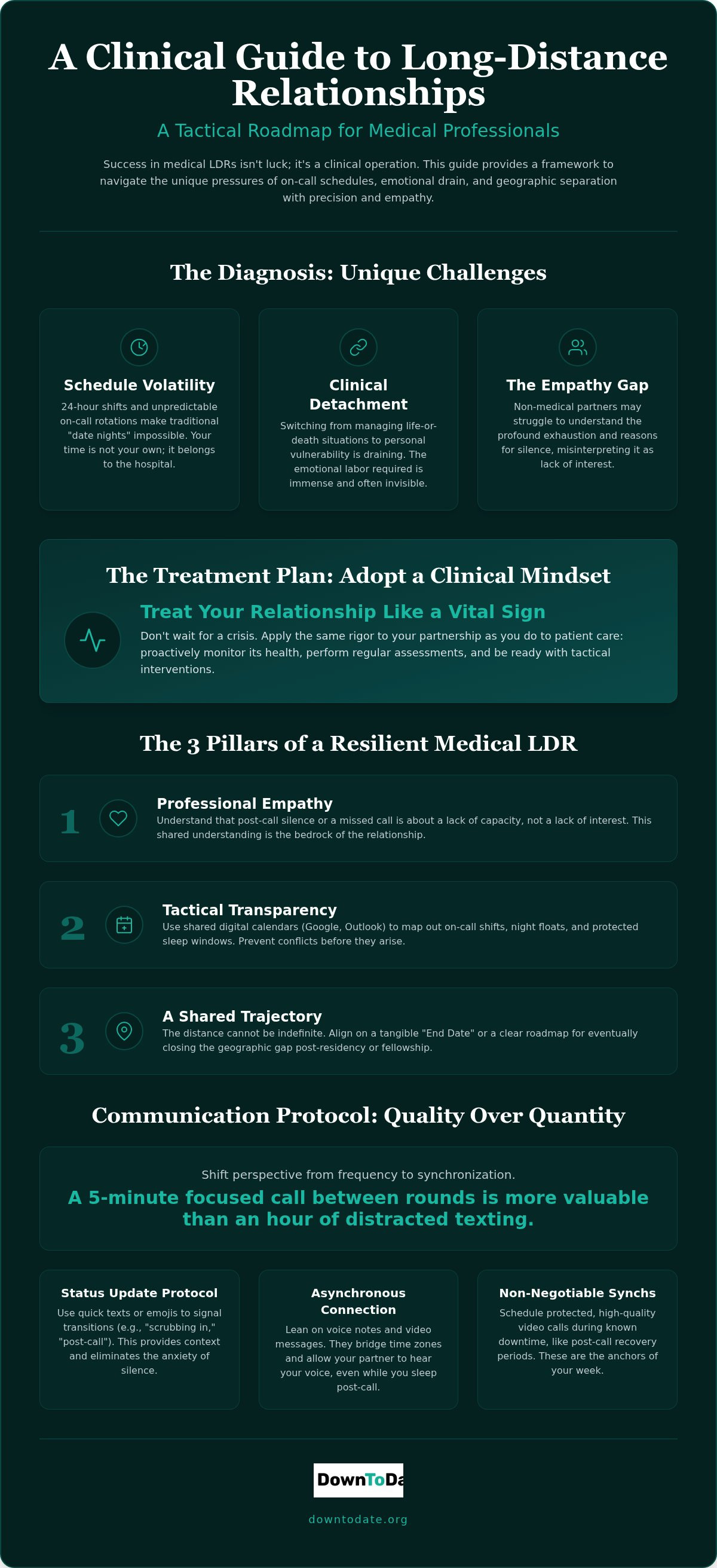
A medical long-distance relationship is more than a geographic challenge. It's a high-stakes partnership governed by clinical rotations and geographic mandates. It's built on a foundation of professional necessity. It's often dictated by the Match, fellowship placements, or attending contracts. For those managing long distance relationships for medical professionals, the distance isn't the only hurdle. The primary challenge is the very architecture of a medical career. You don't just live apart. You work in environments that demand your total cognitive and emotional presence, often leaving little for the person on the other side of the screen.
The emotional labor of this lifestyle is significant. You finish a 24-hour shift. You've managed codes. You've scrubbed into surgery. You've updated grieving families. Now you must "switch off" to engage with a distant partner. This transition is invisible but heavy. It requires moving from clinical detachment to personal vulnerability in a matter of minutes. When one partner is a civilian, an empathy gap often emerges. They don't understand the silence after a difficult day. They don't understand why a "quick call" feels like an insurmountable task when you're post-call and sleep-deprived.
View your relationship as a vital sign. It requires proactive monitoring. It requires regular assessment. Don't wait for a crisis to intervene. Treat the connection with the same clinical rigor you apply to your patients. If the "pulse" of the relationship is weak, you need a tactical intervention, not just a reactive fix.
Why Traditional Dating Advice Fails Physicians and Nurses
Standard dating advice tells you to "just make time." For a surgical resident or an ICU nurse, this is a frustrating and unrealistic directive. You don't own your time. Your schedule belongs to the hospital. General guides ignore the fatigue-related communication barriers that define your life. Civilians enjoy scheduled romance. You rely on stolen moments. You rely on five-minute FaceTime calls between rounds or texts sent from the scrub sink. You need a framework that respects your exhaustion. You don't need another task on your to-do list.
The Three Pillars of Medical LDR Success
Success in this environment rests on three specific pillars. First, professional empathy. You must understand the "why" behind the silence. It's not a lack of interest; it's a lack of capacity. Second, tactical transparency. Share your schedules before they become conflicts. Use shared digital calendars to map out call shifts, night floats, and protected sleep windows. Third, a shared trajectory. You must align on an eventual geographic "End Date." Distance isn't just a residency phase. It can persist through fellowships and first attending roles. Without a clear roadmap for eventually closing the gap, the distance becomes an indefinite burden. You need a plan that outlasts the training years.
Master Communication with an Unpredictable On-Call Schedule
Communication in medicine requires precision. For those navigating long distance relationships for medical professionals, frequency is a secondary metric. You cannot always guarantee three calls a day. You can guarantee the quality of your synchronization. Synchronization means aligning your limited availability with surgical precision. It means understanding that a five-minute conversation during a residency break is worth more than an hour of distracted texting during rounds. Managing long-distance relationships requires this shift in perspective. You aren't just talking; you're coordinating a shared life across clinical barriers.
Implement a "Status Update" protocol. This is a binary system for transition periods. Leaving the OR? Send a specific emoji or a short text. Starting a night shift? Provide a quick brief. These updates eliminate the anxiety of silence. They provide context without requiring a deep emotional dive. When live synchronization fails, lean into asynchronous communication. Voice notes and video messages bridge the gap between time zones and opposing shifts. They allow your partner to hear your voice and see your face when you are finally asleep after a 24-hour call. Schedule "Non-Negotiable Synchs" that specifically align with your post-call recovery periods. These are the anchors of your week.
The Tactical Tech Stack for Long-Distance Couples
Your calendar is your most valuable asset. Leverage shared digital platforms like Google or Outlook to visualize on-call rotations and protected sleep windows. If your partner can see your "Post-Call Sleep" block, they won't feel ignored when you don't answer. Use dedicated communication apps to separate partner chats from the constant noise of hospital pages. This distinction helps you mentally "clock out" when you see a notification from them. Managing long distance relationships for medical professionals demands a tech stack that works as hard as you do. Incorporate virtual co-living tools like shared digital reading lists to create shared experiences. Finding a partner who values this level of coordination is easier when you connect with peers who understand the medical lifestyle.
Navigating the Post-Shift Decompression Zone
The "Decompression Zone" is a necessary clinical recovery period for the relationship. It's the time between leaving the hospital and being ready for emotional engagement. Establish a "15-minute buffer" rule. This allows you to process the day's stressors before engaging in deep conversation. Communicate your need for silence clearly. Silence is not a withdrawal; it's a recharge. By defining this zone, you prevent your partner from feeling shut out. You protect the relationship from the emotional residue of a high-pressure shift. You ensure that when you do speak, you are fully present.
Sustaining Emotional and Physical Intimacy Without Proximity
Intimacy is not a byproduct of proximity. It's a result of intentionality. In long distance relationships for medical professionals, the greatest threat to a connection is "Roommate Syndrome." This occurs when your limited communication becomes purely logistical. You talk about flight times. You discuss bills. You coordinate the next visit. You forget to be partners. To combat this, prioritize intellectual intimacy. Share interesting, anonymized clinical cases. Discuss professional wins. Invite your partner into your world. This creates a shared mental space that transcends physical distance. For deeper insights into maintaining your emotional health during training, review our relationship advice for doctors.
Physical visits are not vacations. They are re-anchoring events. They are essential for recalibrating your connection after weeks or months apart. Don't feel pressured to fill every hour with high-energy activities. Focus on domestic normalcy. Cook a meal together. Sleep in. Simply existing in the same physical space restores the "vital signs" of the relationship. These moments provide the emotional capital required to survive the next stretch of distance.
The Science of Shared Experiences at a Distance
Co-regulation is a neurobiological necessity. It's how humans synchronize their nervous systems to reduce stress. You can simulate this effect via high-fidelity video and audio calls. Plan Virtual Date Nights that respect your post-call exhaustion. Watch a film simultaneously. Order the same meal from different locations. If energy is too low for active conversation, use "Parallel Play." Stay on a video call while you complete charts or handle housework. The silent presence alone facilitates connection. It reduces the isolation inherent in the medical lifestyle. It makes the distance feel manageable.
Managing Trust and the Night Shift Anxiety
Long hours do not lead to infidelity. This is a common misconception that plagues many long distance relationships for medical professionals. Trust in a medical LDR is built through radical transparency, not constant surveillance. Be open about your work-life social interactions. Mention the post-shift drinks with co-residents. Share the names of your colleagues. This clarity prevents "Night Shift Anxiety" from taking root in a distant partner. Use Micro-Check-ins throughout your 12-hour rotation. A thirty-second text during a quiet moment maintains a sense of presence. It signals that you are thinking of them, even when the clinical demands are at their peak.
The Logistics of Love: Travel, Budgeting, and the End Date
Travel in long distance relationships for medical professionals is a logistical feat. It requires a budget. It requires a schedule. It requires a goal. Treat each trip as a "Strategic Rotation." Define the objectives before you book the flight. In 2026, the average domestic round-trip airfare reached $623 for summer travel. On a resident or nurse practitioner salary, this is a significant line item. You aren't just paying for a ticket. You're paying for the preservation of your partnership. Every flight is an investment in your shared future.
Navigating long distance relationships for medical professionals requires a clear finish line. The most critical metric is the "End Date." This is the specific month and year when the geographic separation concludes. Without it, the distance feels terminal. With it, the distance is just a temporary phase of training. Coordinate your visits around call blocks to minimize missed time. For tactical help with this, see our guide on dating with an unpredictable schedule. Planning visits with precision ensures you maximize every hour of proximity.
Negotiating Geographic Compromise
Deciding whose career dictates the next move is a professional negotiation. It involves comparing fellowship match locations against attending contracts. Use "Away Rotations" or travel contracts to test-drive a new city together. This provides a low-risk clinical trial of your future home. Create a Joint Career Roadmap. Align your professional trajectories. Ensure that both partners have a viable path in the destination city. This prevents resentment from taking root in the relationship. It ensures that the "End Date" leads to a sustainable life for both.
Maximizing Limited Face-to-Face Time
Avoid the "Vacation Bubble." It's tempting to ignore real-life issues during short visits. This is a mistake. Use your time together to address domestic realities. Balance rest and recovery with adventure and connection. If you're post-call, prioritize sleep over sightseeing. Your partner should understand this. Finally, plan the "Post-Visit Decompression." This handles the emotional drop after saying goodbye. It's a necessary recovery period before you return to the clinical front lines. To find a partner who understands these logistical demands, apply for a Premium Membership today.
Why Medical Peers Are Better Equipped for Long-Distance Success
The most resilient partnerships in medicine aren't built on proximity alone. They're built on built-in empathy. When both partners understand the weight of a clinical day, the relationship gains a unique layer of protection. You don't have to explain why a "Q3 call" means you'll be unreachable. You don't have to apologize for the emotional residue of a difficult patient outcome. A peer already speaks this language. This shared vocabulary eliminates the friction that often plagues long distance relationships for medical professionals who date outside the field. You aren't just two individuals living apart. You're a "Medical Power Couple." You're a resilient unit capable of navigating geographic shifts and training cycles together. You understand that the current distance is a professional phase, not a permanent state.
Peer matches are more resilient to the stressors of residency and fellowships. Your partner understands that your schedule isn't a choice; it's a mandate. This mutual respect for professional duty creates a foundation of trust that is difficult to replicate with a civilian. You both value the same high standards. You both respect the same mission-driven lifestyle. This alignment makes the logistical hurdles of distance feel like a shared challenge rather than an individual burden. Finding this level of understanding is the core philosophy behind the DownToDate community. It's the premier space for professionals who prioritize quality and shared intent.
The DownToDate Advantage: Efficiency in Matching
Efficiency is the primary requirement for a busy physician or nurse. You don't have the time for endless swiping or explaining your career to people who don't understand it. Our verified community ensures that every connection is pre-screened for professional background and serious intent. This specialized environment allows you to use filters that identify partners open to geographic flexibility. You can connect with peers who are already prepared for the realities of a medical lifestyle. For more on how these peer connections thrive, review our guide on dating for doctors. It's about finding a match that fits your trajectory.
Finding Your Peer Match Outside the Hospital
Workplace dating often leads to unnecessary professional complications. It's safer and more effective to find a peer match outside your immediate clinical environment. This allows you to maintain professional boundaries while pursuing a serious personal connection. We provide a verified safe space for this purpose. A Premium Membership offers the elite standard for medical professionals seeking meaningful partnerships. You've invested years into your clinical expertise. It's time to invest the same precision into your personal life. Join a community that understands your schedule, respects your professional demands, and speaks the language of long distance relationships for medical professionals.
Securing Your Shared Future
Success in long distance relationships for medical professionals requires more than hope. It requires a clinical framework. Shift your focus from the frequency of contact to the quality of synchronization. Establish a firm "End Date" to transform an indefinite distance into a temporary phase. By prioritizing intellectual intimacy and tactical transparency, you ensure your partnership remains a resilient vital sign rather than a source of stress.
You've invested years in your medical expertise. Your personal life deserves the same precision. Don't waste your limited free time explaining your schedule to those who don't speak the language of medicine. Our community was founded by physicians who lived this experience. We provide a verified healthcare community designed specifically for high-stakes professional lifestyles.
It's time to build a connection that matches your ambition. Find a partner who understands the medical journey on DownToDate. Your career is demanding. Your relationship should be your strongest support system. Start your next rotation with a partner who truly understands the path you're on.
Frequently Asked Questions
Can a long-distance relationship survive medical residency?
Yes, residency is a finite training phase that requires tactical planning and professional empathy. Success rates remain high; statistics from 2026 show that 85% to 87% of partnered residents report high relationship satisfaction. You must treat the partnership as a vital sign. Monitor it proactively. Communicate your clinical stressors clearly. A connection that survives the Match and the demands of residency is often the most resilient partnership you'll ever build.
How often should medical couples in an LDR talk?
Prioritize the quality of synchronization over the frequency of contact. Every couple is different, but the average long-distance couple spends approximately 8 hours on video or phone calls per week. In medicine, this might happen in five-minute bursts between rounds or during a post-call buffer. Don't aim for a specific number of calls. Aim for presence during your available windows. Use asynchronous voice notes when shifts don't align.
What is the best way to handle time zone differences during night shifts?
Use binary "Status Updates" to bridge the gap between different schedules. Send a specific emoji when you start your shift and another when you leave the hospital. This provides context without requiring an immediate, deep conversation. Leverage asynchronous video messages so your partner can see you when they wake up. Shared digital calendars are essential. They allow your partner to visualize your sleep blocks and avoid calling during your recovery period.
How do you deal with the guilt of working too much in an LDR?
Reframe your work as a shared investment in your collective future trajectory. Guilt is often a byproduct of a lack of transparency regarding your daily demands. Share your schedule and the "why" behind your clinical duties. When both partners understand the high-stakes nature of the medical field, the guilt dissipates. Focus on being fully present during your "stolen moments." Quality engagement during a short call is more valuable than distracted presence during a long one.
Is it better to date another medical professional when doing long distance?
Peer matches often have a higher resilience to the unique pressures of a clinical lifestyle. A partner who understands "Q3 Call" won't interpret your silence as a lack of interest. They speak your language. They respect your geographic mandates. Long distance relationships for medical professionals thrive when there is built-in empathy for the training process. Finding a peer who understands these hurdles is the core mission of the DownToDate community.
How do we decide who moves when the long distance ends?
Create a Joint Career Roadmap that accounts for both professional trajectories. Compare fellowship match locations against attending contracts using data-driven logic. Use "Away Rotations" to test-drive a new city together before making a permanent commitment. This decision should be a professional negotiation rather than an emotional sacrifice. Consider the long-term viability of both careers in the target location. Align on an "End Date" that respects the professional goals of both partners.
What are some low-energy date ideas for post-call partners?
Focus on "Parallel Play" and shared digital experiences that require minimal cognitive effort. Stay on a video call while you both complete charts or handle domestic tasks. This silent presence facilitates connection without the pressure to perform. Watch a film simultaneously using streaming tools. Order the same meal from different delivery services. These activities respect your lower energy levels while maintaining a sense of shared normalcy. It's about being together without the exhaustion of active conversation.
How can I support my partner during their board exams from a distance?
Provide tactical support by managing the logistical noise of their daily life. Send pre-prepped meals or handle the research for their next travel rotation. Offer "Micro-Check-ins" that don't require an immediate response. A simple text provides emotional support without adding to their cognitive load. Respect their study blocks and the high-stakes nature of board preparation. Your role is to be a steady anchor while they navigate the intense demands of their medical career.


