

What if dating during medical school didn’t have to follow anyone else’s timeline? Dating for medical students can feel complicated when exams shift your plans, clinical schedules change without warning, and conversations with classmates make being single feel like falling behind. Those pressures are real, but they don’t mean you have to choose between your training and meaningful connection.
There’s no single correct time to start a relationship, and there’s no perfect schedule for building one. What matters is finding an approach that adapts to your workload, respects your priorities, and leaves room for genuine connection. This guide offers practical ways to plan around changing demands, communicate your availability, and set boundaries that work for you.
You’ll also consider the trade-offs of dating someone in medicine versus outside it, and how to look for a partner who respects the realities of your training. Whether you’re actively dating or simply open to meeting someone, connection can fit your life as it is, not as you think it should be.
Key Takeaways
- Dating for medical students can adapt to training demands. Check your capacity, communicate your availability, make realistic plans, and reassess as your schedule changes.
- Research on medical students’ relationships offers context, not a universal picture. The study discussed included 326 students from two schools and had a 21% response rate.
- Compare dating a classmate with dating someone outside medicine by considering shared context, privacy, schedule understanding, and separate social circles.
- Choose how to meet people based on what matters most to you, whether that’s healthcare experience, shared values, privacy, or schedule compatibility.
- Healthcare-focused dating communities are one way to meet people who understand the professional environment.
Dating for Medical Students: Why Your Relationship Timeline Is Your Own
Coursework, clinical responsibilities, rest, friendships, and personal priorities all draw from the same limited hours. Some weeks leave room for a date; others call for more focus on training or recovery. Dating for medical students isn’t another requirement to complete on schedule. It’s a personal choice shaped by your interest, capacity, and readiness.
Being partnered, being single, and not seeking a relationship are all valid. None is a measure of academic ability, maturity, or personal fulfillment. The medical school experience can involve different academic and clinical demands, so no universal timetable fits every student. Your relationship decisions can reflect your circumstances without becoming a verdict on your future.
What does dating during medical school mean in practice?
It means deciding whether you want to meet people or build a relationship while you study, then choosing an approach that fits your current time, energy, and priorities. You might date regularly, meet people occasionally, or not date at all. The right approach is one you choose freely and can sustain.
Is there a “normal” time to date during medical school?
There’s no single normal. You may notice classmates dating, getting engaged, or sharing relationship milestones, while others keep their personal lives private. What’s visible in your social circle is only a partial picture, not a standard you need to meet. A classmate’s relationship status can’t tell you whether you’re ready, interested, or making the right choices for yourself.
Separate outside expectations from your own reasons. Are you interested in meeting someone, or feeling pressure because friends are dating? Do you have the capacity to make space for another person, or would you rather wait? Either answer is legitimate. You don’t need to pursue a relationship to prove you’re thriving, and being in one doesn’t establish that you’re more settled or successful.
How medical school changes the dating context
Your available time and energy may shift as training moves between coursework, exams, and clinical responsibilities. A study-heavy period might make spontaneous plans difficult; a later stretch may offer a different routine. Demands vary from one student to another, even at the same stage, so no schedule applies to everyone.
Flexibility is more useful than setting a fixed dating quota. During a busy stretch, you might prefer a brief coffee between commitments; at another point, you may have more room for a longer plan. Be honest with yourself and anyone you’re dating about what you can offer now. Expectations can change as training changes, and your plans can change with them. The goal isn’t to fit your personal life into a perfect calendar. It’s to make choices that respect both your education and your life beyond it.
What Research Says About Medical Students’ Relationships, and What It Cannot Say
Research can offer perspective when it feels as if everyone around you has their personal life figured out. But a survey captures a particular group of respondents at a particular time. It can describe their responses; it can’t determine what you should want or predict what your relationships will look like.
Citation-ready summary: A study cited in a University of Miami article surveyed 326 medical students at the University of Miami Miller School of Medicine and Tulane University School of Medicine, received a 21% response rate, and reported that 67% of respondents were in a relationship, 33% were single, and 9% had never been in a relationship.
What the reported survey found
The categories need a little care. The article reports 67% in a relationship and 33% single; it also notes that 9% had never been in a relationship. That last figure describes relationship history, not a separate relationship-status category to add to the 67% and 33%. Keeping those distinctions clear prevents the numbers from implying more than they do.
The University of Miami article also says respondents sought connection through dating apps, friends, and social outings. Those routes show that there isn’t one required way to meet people during training. You might welcome introductions through friends, prefer social events, or choose an app that matches your preferences. The survey describes what respondents reported, not which approach works best for everyone.
How to interpret the findings without adding pressure
A percentage is context, not a target. The 67% figure doesn’t mean being partnered is expected, and the 33% figure doesn’t make single students unusual or behind. Nor can these results measure anyone’s academic ability, readiness to date, or personal satisfaction. Those are individual questions, not conclusions a relationship-status survey can answer.
The sample also matters. It included students from two schools, and a 21% response rate means the findings reflect the people who responded, not necessarily every student who was invited. The results shouldn’t be extended to every medical school, class year, or future cohort. A survey of one group can’t establish what all medical students experience.
Use the findings as a prompt for reflection, not comparison. Ask what kind of connection you want, if any, and what your current circumstances allow. If meeting people who understand healthcare feels important, a healthcare-focused dating community such as DownToDate, created by physicians for healthcare professionals, is one option. Let your priorities, not a survey’s percentages, guide your choice.
Dating a Classmate or Someone Outside Medicine: Weighing the Trade-Offs
A partner’s professional background can shape everyday conversations, but it can’t tell you whether you’ll communicate well, share priorities, or feel respected. Dating a classmate may bring familiarity with training; dating someone outside medicine may offer a different perspective. Neither option is inherently better. Consider the practical differences, then pay attention to the individual in front of you.
| Consideration | Dating a classmate or someone in healthcare | Dating someone outside medicine |
|---|---|---|
| Shared context | They may recognize medical terminology and understand common training pressures. | You may need to explain parts of your routine, creating opportunities to learn about each other’s worlds. |
| Privacy | Overlapping academic or professional circles can make personal boundaries especially relevant. | Separate circles may create more distinction between school and personal life, though privacy still depends on your choices. |
| Schedule understanding | They may have firsthand experience with demanding or changing schedules, but their availability may also be limited. | They may need context about your commitments; clear communication can help set realistic expectations. |
| Social circles | You may share classmates, colleagues, or social settings, which can make connection easier and boundaries more complex. | Separate networks can introduce different interests and routines, while requiring more intentional time together. |
What can feel easier when a partner understands medical training?
Shared vocabulary can make it easier to explain a long day or a change in plans. Someone familiar with training demands may understand why an exam period affects your availability without needing every detail. Still, shared context doesn’t guarantee compatible priorities, good communication, or mutual care. Dating a classmate can also mean seeing each other in academic and social settings, so consider what privacy and boundaries would feel comfortable.
What to consider when dating outside the medical community
A partner doesn’t need to know medical training in advance. Offer the relevant context plainly: “My schedule can shift during rotations, but I’d like to plan time together when I can.” Then make room for their experiences, too. Medical school can be part of the relationship without becoming its only subject. If schedule changes are difficult to explain, this guide to dating with an unpredictable schedule offers additional ideas.
Whatever their profession, a partner should be able to discuss plans, limits, and needs with you. You can agree on how much school talk feels welcome, what you prefer to keep private, and how to handle a last-minute change. Dating for medical students works best when those conversations make space for both people. Look beyond the job category: notice whether you feel heard, whether expectations are discussed openly, and whether each person respects the other’s priorities.
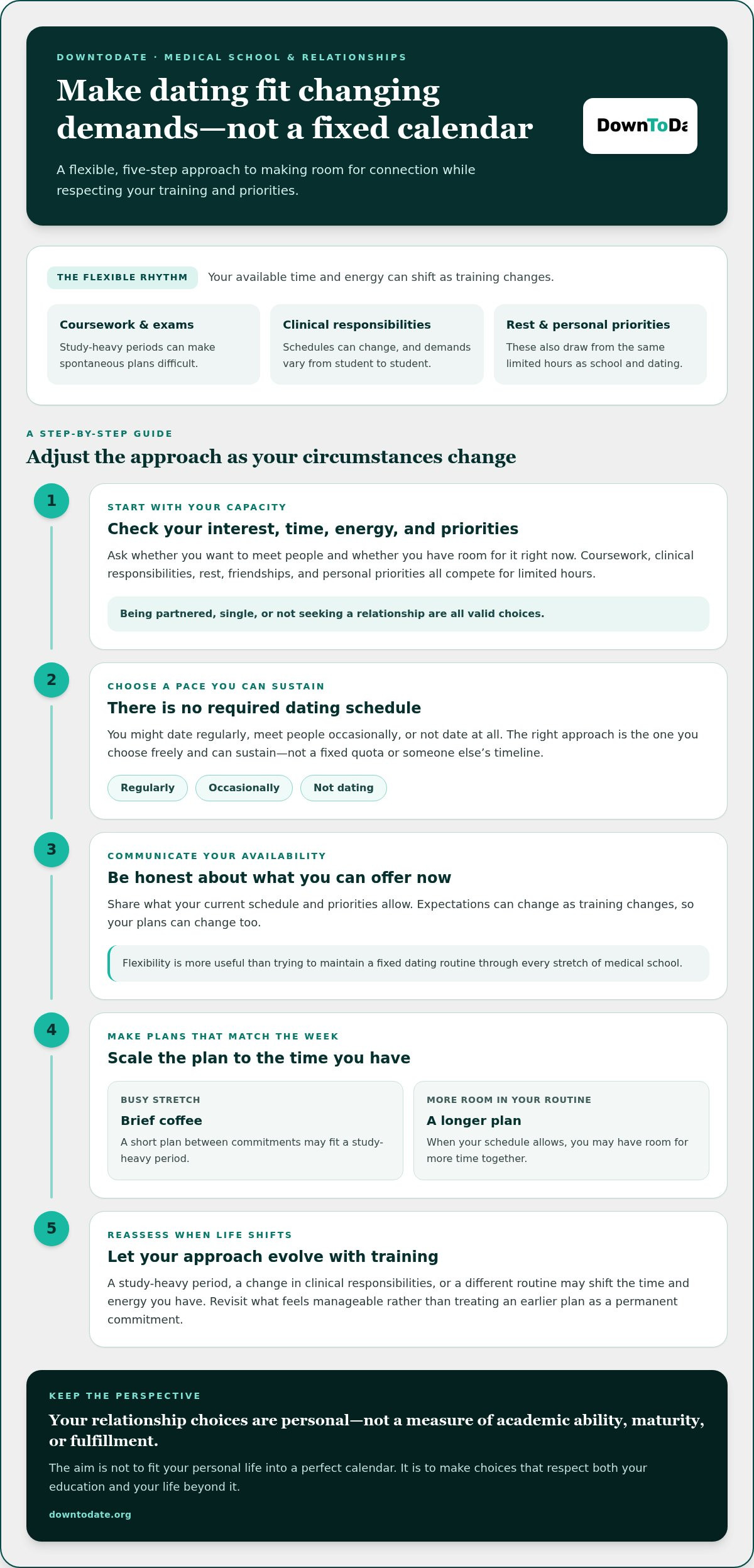
How to Make Dating Fit Around Exams, Rotations, and Changing Priorities
Dating for medical students works better as a flexible part of life than as another fixed obligation. Before making plans, look honestly at what your schedule and energy can support. Then communicate clearly, choose low-pressure plans, and adjust when training changes. You can respect academic responsibilities without apologizing for having them.
- Check your current capacity. Consider upcoming deadlines, rotation demands, rest, and personal commitments. Decide what feels realistic now, whether that’s meeting someone occasionally, keeping plans simple, or taking a break from dating.
- State your availability early. Share what you know about the weeks ahead and where your schedule may shift. For example: “I have exams coming up, so I’m less flexible this week. I’d still like to find a time to meet.” Clear information is more helpful than an apology.
- Plan simply and flexibly. Choose plans that don’t require extensive preparation or a long time commitment. Leave room to adjust if a clinical day runs late, and avoid promising constant availability. A plan should suit both people, not add pressure to an already full week.
- Reassess as training changes. Check whether your current pace still feels manageable when coursework, rotations, or priorities shift. Update the person you’re dating rather than relying on an arrangement that no longer fits.
Set expectations before scheduling becomes a source of stress
Talk about your typical availability and any changes you can already anticipate. You might agree to send a brief update when plans need to shift, or choose a communication rhythm that feels considerate to both of you. A busy stretch can reflect limited capacity, not a lack of interest, but don’t assume either explanation. Ask, share what’s true for you, and listen to the other person’s needs.
Reassess your approach as the semester or rotation changes
At the start of a new rotation or after exams, take a moment to reconsider your energy and priorities. If you need to reschedule, say so promptly and offer a realistic alternative when you can: “I can’t make tonight, but I’m free after my assessment next week.” If even that feels like too much, it’s reasonable to slow down or pause rather than overextend yourself.
Schedule changes are part of dating across demanding career stages, not a reason to leave someone guessing. If you’d like to meet people who understand healthcare work, explore DownToDate+, a dating app for healthcare professionals created by physicians.
Finding Healthcare-Aware Connections as a Medical Student
There’s no single best place to meet someone. Friends, social activities, and dating apps each offer a different starting point. Choose based on what feels comfortable and useful to you, rather than assuming one route guarantees a better connection. Dating for medical students can include people in healthcare, people outside it, or both.
- Friends: Introductions can come with shared context and a familiar social bridge. You may also want to keep your dating life separate from your existing circle.
- Social activities: Clubs, gatherings, and interest-based events create opportunities to meet through shared activities. They may take time and energy you’d rather reserve for other priorities during a demanding stretch.
- Dating apps: Apps offer another way to meet people beyond your immediate networks. A healthcare-focused community may appeal if understanding the professional environment matters to you; a broader app may suit other preferences.
Before choosing a route, consider what matters most right now: a partner who understands healthcare training, shared values, privacy from school or work, or practical compatibility around schedules. Your priorities may change. You don’t need to optimize for every factor at once; start with the one that would make connection feel more comfortable and sustainable.
How to decide whether a healthcare-focused dating app suits you
Ask yourself whether meeting people familiar with healthcare life is a priority or one preference among several. A specialized community can connect you with people who understand the professional setting, but shared work context doesn’t guarantee compatible values, communication, or attraction. When comparing apps, consider whether the community fits your preferences and whether its features support the way you want to connect.
If a healthcare-focused option fits what you’re looking for, DownToDate+ is a dating app for doctors, nurses, and other healthcare professionals. Created by physicians, it’s tailored to the healthcare community. Its Premium Membership is subscription-based and includes advanced search filters, unlimited messaging, enhanced profile visibility, and exclusive community features designed for romantic connections. Shared professional context can be a useful starting point, but compatibility still depends on the people involved. Explore DownToDate+ to learn more about dating designed for healthcare professionals.
A low-pressure way to start making room for connection
Choose one manageable next step: accept an introduction, attend an activity you already enjoy, or explore a dating app. Keep the step proportionate to your current capacity. You can approach dating gradually, pause during a demanding period, or give it more attention when your circumstances allow. A change of pace isn’t a failure; it’s a decision about what fits now.
Let your priorities guide the pace and your capacity inform the next step. Personal connection doesn’t need to follow a fixed medical-school timeline.
Make Space for Connection on Your Terms
Your next step doesn’t need to be a major commitment. Choose an approach that fits the season you’re in, and give yourself permission to adjust as your priorities change. Dating for medical students can move at a pace that respects both your personal life and the work you’re pursuing.
If meeting people who understand healthcare matters to you, DownToDate+ offers a focused place to start. Created by physicians and designed for doctors, nurses, and other healthcare professionals, it’s tailored to the healthcare community. Treat any app as a way to meet people, not a guarantee of connection.
Explore DownToDate+ and take a next step that feels right for you. Connection can make room for your ambitions, your boundaries, and your own timing.
Frequently Asked Questions
Is it normal to be single during medical school?
Yes, being single during medical school is normal, and it doesn’t mean you’re missing a required experience. Dating for medical students can look different from one person to another because interest, timing, and priorities differ. If someone asks about your relationship status, you can simply say you’re focused elsewhere or open to meeting someone. You don’t owe anyone a timeline or an explanation for your choice.
Can medical students date during clinical rotations?
Yes, medical students can date during clinical rotations if it fits their capacity and responsibilities. Start with plans that are easy to adjust, such as a short coffee or a phone call, rather than an evening with several fixed commitments. If a shift or rotation schedule changes, communicate promptly. A date should be something you can enjoy, not another obligation that leaves you more depleted.
How do medical students meet people outside their class?
Try widening your routine in manageable ways. Ask a trusted friend to introduce you to someone, join an interest-based group, or attend a social event where the focus isn’t medical school. You can also use dating apps to connect beyond your existing circle. Pick one avenue that feels comfortable, then give it enough time to see whether it suits your interests and available energy.
Should medical students tell a date about their schedule right away?
Share the broad picture early, especially before making plans that depend on a predictable schedule. You might say, “My rotation hours can change, so I sometimes need flexibility.” There’s no need to provide a full calendar or disclose private details before you’re comfortable. Clear expectations help the other person plan, while leaving room for the two of you to learn what communication works best.
Can dating a classmate make medical school more complicated?
It can, particularly if you share study groups, close friends, or regular academic settings. Before dating, consider what you’d want to keep private and how you’d handle shared commitments if the relationship changed. You might agree not to discuss personal disagreements during group study or ask friends not to take sides. These conversations can’t prevent every awkward moment, but they can clarify expectations.
Is a dating app useful for medical students with limited free time?
It can be useful if you prefer meeting people beyond your usual circles or want to explore connections at your own pace. An app won’t create more free time, so use it in a way that doesn’t compete with rest or study. For example, set aside a brief window to review messages rather than checking throughout the day. If that feels like another task, take a break.
What should I do if I do not have the time or energy to date?
Pause or step back without treating it as a failure. If you’re already seeing someone, tell them directly: “I don’t have the capacity to date consistently right now, and I want to be honest about that.” You can decide later whether your circumstances have changed. In the meantime, protect time for rest and the relationships that already support you. Your personal life doesn’t need to follow a deadline.


