

What if a partner doesn’t need to work in healthcare to understand what your career asks of you? Connecting with understanding partners in healthcare starts with recognizing that shared job titles are only one route to empathy. Irregular hours, changed plans, and demanding work can affect a relationship, but they don’t define who you are beyond your role.
It’s reasonable to want someone who respects your responsibilities without expecting your life to revolve around them. Understanding can come from another healthcare professional, or from someone who listens, communicates openly, and values your perspective. The foundation is mutual respect, not matching credentials.
This article looks at how to build trust around the realities of medical work, talk about schedules and emotional needs, and recognize the qualities that support a meaningful partnership. It also explores how a healthcare-focused dating community can help you meet people familiar with the profession. Created by physicians Dr. Shadi Rezai and Dr. Sasan Rezai, DownToDate is a dating app for doctors, nurses, and other healthcare professionals. The aim is to make room for both your career and the person you are.
Key Takeaways
- An understanding partner listens with care, respects the demands of healthcare work, and communicates openly.
- Build mutual understanding by asking thoughtful questions and listening closely, rather than assuming that a shared profession means you automatically relate.
- Connecting with understanding partners in healthcare can mean meeting someone in the field or someone with a different background. Shared context may help, but compatibility takes more.
- Discuss expectations, boundaries, and support needs to build trust without making early dates feel like interviews.
- DownToDate+ is designed for healthcare professionals, offering a community where shared work context can support meaningful connections.
Why understanding matters when connecting with a healthcare partner
This section is about romantic relationships, not patient-provider partnerships. An understanding partner listens to your experience, respects your professional commitments, and communicates with care. They don’t need to know every clinical detail or share your job to treat your work as meaningful.
Mutual understanding in a healthcare relationship means listening to each other’s needs, respecting boundaries, and adapting together as work and life change. Healthcare can affect when you’re available, how much energy you have, and what’s on your mind. It’s part of your circumstances, not a complete definition of who you are. Connecting with understanding partners in healthcare means making room for both: the responsibilities you carry and the person you are outside them.
What does an understanding partner look like?
An understanding partner shows curiosity without treating your work as an invitation to discuss private patient details. A caring question might be, “How did your shift feel today?” If you choose to share a difficult moment, they listen without asking for identifying information or pressing you to say more than you want.
Empathy doesn’t require identical experience. A partner in another profession may not know what a clinical decision feels like, but they can take your account seriously and ask what support would help. Shared healthcare experience can offer useful context, too, but it doesn’t automatically make someone attentive or emotionally available.
Respect works both ways. Your commitments matter, and so do your boundaries. Explain what you’re comfortable discussing, while making space for your partner’s feelings when plans shift or work occupies your attention. Understanding isn’t unlimited accommodation or keeping score. It’s an honest conversation about what each person needs.
Why the healthcare context can matter in dating
Healthcare responsibilities may shape a date night in practical ways. A shift could run late, a schedule may change, or you might arrive home with little energy for conversation. At other times, work may not affect your plans. There’s no single schedule or emotional response that applies to every clinician, role, or day.
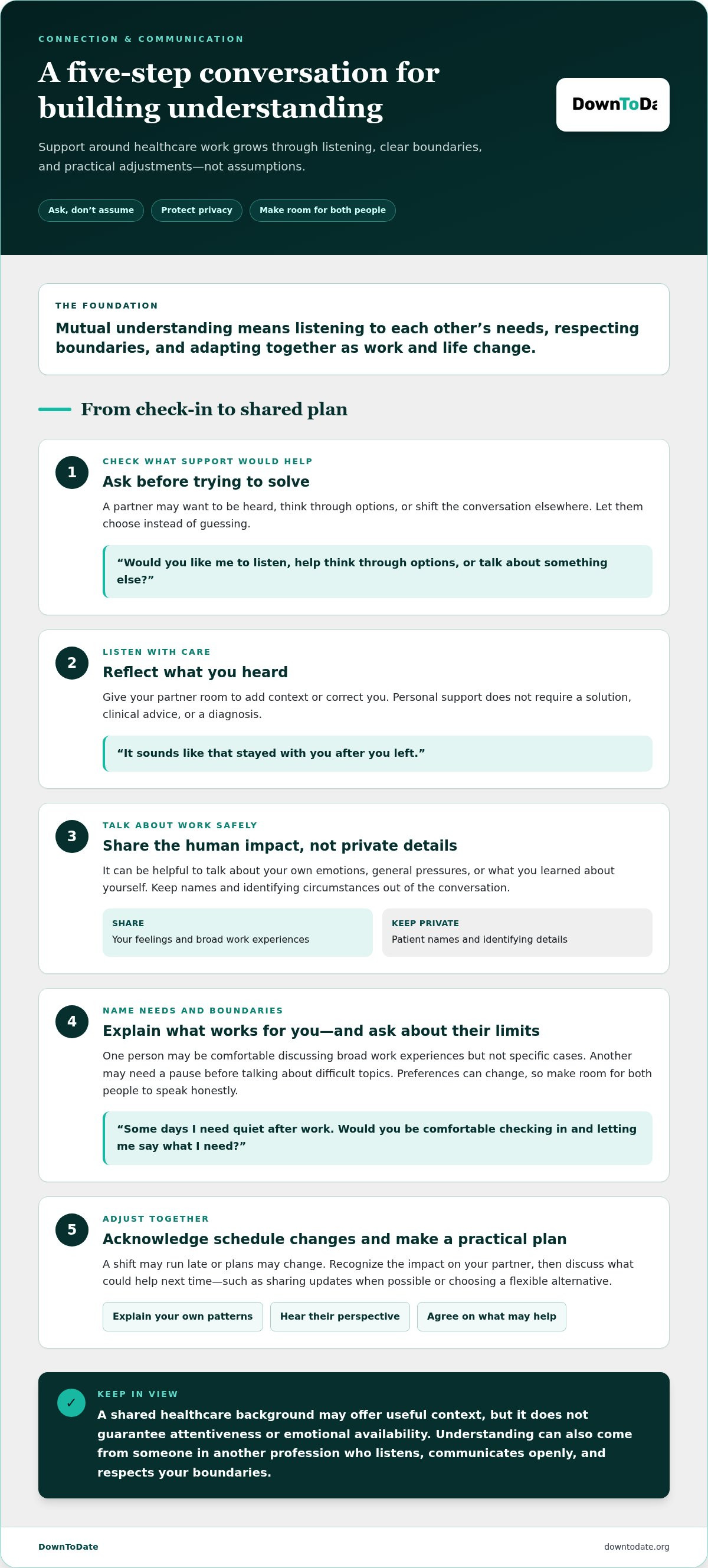
Start by explaining your own patterns instead of assuming a partner already understands them. For example: “Some days I need quiet after work. Would you be comfortable checking in and letting me say what I need?” This gives the other person something concrete to respond to, without asking them to guess or treating work as an excuse for every disappointment.
Invite their perspective, too. A partner might say that a last-minute change feels difficult, even when they understand why it happened. Acknowledge the impact and discuss what might help next time, such as sharing schedule updates when possible or planning a flexible alternative. Conversation builds understanding; assumptions, even well-intended ones, can create distance.
The goal isn’t to find someone who never feels inconvenienced or asks questions. It’s to build a relationship where both people can speak honestly, protect personal boundaries, and respond with consideration.
How mutual understanding grows between healthcare professionals and partners
Mutual understanding isn’t automatic, even when both people work in healthcare. Roles differ, and a shared workplace can’t tell you what a partner needs after a demanding day or how they prefer to handle a difficult conversation. Understanding develops through repeated acts of attention: asking instead of assuming, listening before responding, and being willing to adjust.
Empathy helps partners hear the feelings behind the words, while clear communication gives them a practical way to respond. Together, they make support more personal and less dependent on guesswork. That matters in relationships where one person may want to talk about work while the other isn’t sure whether to listen, offer suggestions, or give space.
Listening without turning every conversation into a case review
Start by asking what kind of support would feel useful: “Would you like me to listen, help think through options, or talk about something else?” This check-in respects the speaker’s preference and keeps the conversation from turning into unsolicited problem-solving.
Then reflect what you heard without cross-examining. If your partner says a work interaction left them unsettled, you might respond, “It sounds like that stayed with you after you left.” Give them room to correct or add context. You’re offering personal support, not clinical advice or a diagnosis. Care doesn’t require a solution.
Talking about healthcare work with care and boundaries
Partners can share the human impact of work without sharing private patient details. Talk about your own emotions, general pressures, or what you learned about yourself. Leave names and identifying circumstances out of the conversation; a partner’s curiosity doesn’t mean you need to disclose them.
Agree on boundaries together. One person may be comfortable discussing broad work experiences but not specific cases. Another may need a pause before talking about emotionally difficult topics. Name your preferences calmly and ask about your partner’s limits, too. Boundaries protect trust; they aren’t a rejection of closeness.
These agreements can change. A new role, a stressful period, or greater trust may shift what feels comfortable to discuss. Revisit the conversation instead of treating an earlier agreement as permanent. You could ask, “Is this still okay to talk about, or would you rather keep work out of tonight?” That gives both people a clear, respectful choice.
Connecting with understanding partners in healthcare is less about finding someone who already knows exactly what to say and more about building a reliable way to learn from each other. If shared professional context feels valuable as you meet potential partners, explore DownToDate+, a dating app created by physicians for healthcare professionals. Familiarity can open a conversation; attentive listening and honest boundaries help it grow.
Same profession or different background: what helps partners understand each other?
A partner who works in healthcare may recognize familiar pressures without needing every detail explained. Someone in another field may bring a fresh perspective and a different kind of support. Neither background guarantees compatibility. The more useful question is whether both people are willing to understand each other as individuals.
Shared terminology and work context can make some conversations easier, but they can also encourage assumptions. Two clinicians may have different roles, workplaces, schedules, and ways of processing a difficult day. Someone outside healthcare can still listen closely, respect professional boundaries, and take the realities of the work seriously.
| Relationship context | What may help | What still takes effort |
|---|---|---|
| Both partners work in healthcare | Familiarity with clinical environments or professional demands may make certain experiences easier to recognize. | Different roles and workplaces can mean different pressures. Explain personal needs rather than relying on shorthand or assuming the other person knows. |
| One partner works outside healthcare | A different perspective may bring attentive support, fresh questions, and connection beyond the medical world. | Work context may need explaining. Don’t expect instant understanding, and don’t mistake unfamiliarity for a lack of care. |
When shared healthcare experience can help
There can be relief in speaking with someone who recognizes some of the language or rhythms of healthcare work. You may need less background to explain why a shift change matters or why a demanding day is still on your mind. But similar credentials don’t make two people’s experiences identical. A nurse and a physician, or clinicians in different settings, may face distinct expectations and pressures. Say what you need plainly, even when your partner seems likely to understand.
When different careers bring a useful perspective
A partner outside healthcare may offer attentive support without bringing work into every conversation. Their questions can help you reflect, and their world can create shared interests beyond your profession. Friction can arise if either person expects mind-reading: one assumes a partner should already understand, while the other avoids asking questions for fear of saying the wrong thing. Curiosity and respect bridge that gap. Explain what matters, invite questions, and allow room for different perspectives.
Compatibility rests on more than a job title. Consider how each person handles changed plans, listens during stressful periods, respects privacy, and makes time for the relationship. Connecting with understanding partners in healthcare can include meeting someone with shared professional context, but the meaningful test is how you treat one another. No role makes someone automatically more empathetic, and a career outside medicine doesn’t rule it out. Look for shared values, honest communication, and consistent respect.
Practical ways to build connection and trust around healthcare work
Trust grows through small, consistent conversations, not one perfect discussion about your career. Rather than explaining every demand at once, talk about what each of you needs, what you can realistically offer, and how you’ll handle changes. Keep it mutual: your work matters, and so do your partner’s need for connection and reliability.
Use this sequence to open the conversation without turning a date into a formal review:
- Share what matters to you. Explain how work can affect your availability or energy, and mention what helps you feel connected during demanding periods.
- Ask about their expectations. Find out what regular communication, quality time, and advance notice mean to each of you.
- Agree on boundaries. Decide what you’re comfortable discussing about work and how you’ll protect time that belongs to your relationship.
- Check in and adjust. Notice what’s working, raise concerns early, and revisit agreements as your circumstances change.
Questions that invite genuine understanding
Thoughtful questions make room for a real exchange. Try, “What helps you feel supported after a demanding day?” or “What do you enjoy making time for outside work?” You could also ask, “If my plans change, what’s the best way for me to let you know?” Ask one question, listen to the answer, then share your own perspective. Clear requests are kinder than expecting a partner to infer what you need.
These conversations don’t need to happen all at once. Bring them up naturally as you learn about each other. A question about free time can lead to what you both value beyond professional identity; a conversation about a changed plan can clarify how you prefer to communicate. Keep the tone curious, not evaluative.
Building trust while respecting professional boundaries
Be open about your feelings and broad experiences while keeping patient information private. You can say that a day felt emotionally demanding without sharing identifying details or a confidential case. Agree on what stays off-limits, and respect those limits consistently. Trust depends not only on what you share, but also on how carefully you protect what isn’t yours to share.
Reliability matters in ordinary moments. If you say you’ll call, follow through. If work disrupts a plan, communicate as soon as you reasonably can and acknowledge the effect. Neither person can control every change, but both can be honest about what happened and make a thoughtful effort to reconnect.
For more ideas about communicating around changing availability, explore this guide to dating with an unpredictable schedule. Connecting with understanding partners in healthcare means putting respect into practice, one conversation and one kept commitment at a time. To meet people within a community designed for healthcare professionals, explore DownToDate+.
Find healthcare-minded connections with DownToDate+
Shared context can make it easier to begin a conversation about the realities of healthcare work. It can’t guarantee that two people will communicate well, share the same values, or be compatible. Those qualities grow through curiosity, respect, and consistent effort.
DownToDate+ is a dating app created by physicians Dr. Shadi Rezai and Dr. Sasan Rezai for doctors, nurses, and other healthcare professionals. Its healthcare-focused community gives members a place to meet people who may recognize some of the demands of medical careers. That familiarity can provide useful context, while each person still gets to know the individual beyond their role.
A dating community shaped around healthcare professionals
A shared professional setting may make it easier to explain why work can affect availability or energy. But no app or common occupation can establish understanding on its own. Notice how someone listens, responds to what matters to you, and shows interest in your life beyond work. For a closer look at dating within the profession, explore this guide to dating for doctors.
DownToDate+ was created by physicians, a perspective that informs its focus on healthcare professionals’ lives. That origin doesn’t promise a particular relationship outcome. Whether two members share a role or have different professional experiences, compatibility depends on the connection they build together.
Use membership tools to explore and communicate
Premium Membership includes advanced search filters, unlimited messaging, enhanced profile visibility, and community features. These tools can support different parts of the dating process: filters help members narrow their discovery preferences, messaging gives them a way to communicate, and enhanced visibility can help bring a profile forward. They’re practical features for exploring potential connections, not substitutes for thoughtful conversation or mutual respect.
As you use a dating platform, be clear about what you’re looking for. A profile can introduce your professional world, but include interests and values that show the person behind the role. In conversation, ask questions that invite genuine answers and share your own expectations at a natural pace. Familiar work context can be a starting point; trust comes from how you treat each other over time.
If you’re comparing options designed for healthcare professionals, this professional dating app evaluation guide offers another perspective. Connecting with understanding partners in healthcare begins with making space for shared context and individual connection. Explore DownToDate+ at your own pace and see whether its healthcare-focused community fits what you’re looking for.
Make space for the connection you want
Your next step doesn’t need to be a grand gesture. It can be approaching dating with openness, sharing what matters to you at a comfortable pace, and noticing whether someone meets that honesty with care. Let professional understanding be part of the conversation, not the whole story. You deserve a relationship where your work is respected and your identity extends well beyond it.
Connecting with understanding partners in healthcare means finding someone willing to learn, communicate, and build trust alongside you. Keep your standards grounded in the qualities that matter: mutual respect, genuine curiosity, and room for both people’s lives.
If you’re ready to meet people who understand the context of healthcare work, take a first step that feels right for you. Explore DownToDate+ and connect with healthcare professionals. Meaningful connection starts with a conversation, and you can begin yours with confidence.
Frequently Asked Questions
What does it mean to have an understanding partner in healthcare?
It means being with someone who makes room for the realities of your work without treating your profession as your whole identity. For example, if you need to decompress after a demanding day, they can ask what would help rather than assume. Connecting with understanding partners in healthcare is less about finding someone with perfect answers and more about building a relationship where both people can express needs and respond with consideration.
Do you need to work in healthcare to understand a healthcare professional?
No. A partner outside healthcare can learn what your work means to you without sharing your training or workplace. They might ask what an ordinary week looks like, remember that a certain period is especially busy, or take an interest in your plans beyond work. Their willingness to listen matters more than clinical knowledge. You can help by explaining unfamiliar terms or context, while keeping private work details to yourself.
How can I explain my healthcare job to someone I am dating?
Describe how the job affects your life, not confidential details about the people you care for. You could say, “My schedule can change, so I appreciate plans that leave room for updates,” or explain which parts of your day you prefer not to discuss. Then invite your date to share what they want to understand. This keeps the conversation personal and useful, rather than turning it into a job description or a test.
Can two healthcare professionals have a successful relationship?
Yes. Two people in healthcare can build a strong relationship, but a shared field doesn’t remove the need to learn each other’s preferences. One may want to talk after work while the other needs time to reset. Make room for those differences instead of expecting a partner to react as you would. Shared professional context can be a point of connection, while trust and compatibility depend on how both people handle everyday choices together.
How do you support a partner after a difficult day in healthcare?
Ask what would help in that moment, then respect the answer. Your partner may want company, a meal, a quiet evening, or conversation about something unrelated to work. If they choose not to talk, don’t press for an explanation or patient details. Following through on a shared task you agreed to handle can also show support. Check in later, since what feels helpful can vary from day to day.
Where can healthcare professionals meet partners who understand their work?
Potential partners may come through friends, community activities, or dating platforms built around a professional community. DownToDate+ is designed for doctors, nurses, and other healthcare professionals, so members may share some context around medical careers. Use that as a starting point, not a shortcut to assuming compatibility. As you get to know someone, notice whether your conversations feel reciprocal and whether they show interest in the parts of your life beyond work.
Is dating someone in the same healthcare profession better?
Not necessarily. A person in the same profession may recognize some workplace references, while someone in another field may bring different interests and perspectives into the relationship. Neither option is automatically a better fit. Consider how someone handles a rescheduled plan, responds when you set a boundary, and shows interest in your priorities. Those interactions reveal more about potential compatibility than whether your job titles match.


