

A healthy relationship during residency isn’t built on equal time. It depends on finding dependable ways to stay connected when shifts change, plans fall through, and fatigue follows you home. Learning how to balance residency and a relationship can feel difficult, especially if one partner feels deprioritized or the time you have together doesn’t feel restorative.
Residency may not become predictable, but expectations can become clearer. Talk about what each of you needs, agree on how to handle changes, and create ways to reconnect that can flex with the schedule. Small, consistent efforts can help both partners feel considered, even when time and energy are limited.
This article offers practical ways to plan around changing shifts, share the work of maintaining closeness, and make available time count without turning every moment together into an obligation. You’ll also learn how to recognize when recurring tension calls for a deeper conversation or additional support. Balance doesn’t mean dividing time equally. It means building a relationship that feels reliable within the realities of residency.
Key Takeaways
- Learn how to balance residency and a relationship by distinguishing core emotional needs from preferences that can flex with a demanding schedule.
- Use a calm check-in to agree on what availability means, rather than letting missed plans define expectations.
- Compare what you agreed to with what each partner is experiencing to see whether a disruption is temporary or part of a recurring pattern.
- Build a simple connection routine with a realistic fallback, then review whether it works for both of you.
- Shared understanding of medical training may help when meeting a potential partner, but compatibility depends on the individuals.
Why balancing residency and a relationship can feel harder than finding free time
Both partners can be doing their best and still feel the strain. Residency demands sustained attention, while a relationship needs care, communication, and a sense of being considered. The challenge in how to balance residency and a relationship isn’t simply finding an empty space in the calendar. It’s making connection feel dependable when plans and energy are less predictable.
Balance doesn’t mean equal hours together or perfect availability. It means communicating honestly, following through where possible, and being clear when circumstances change. Medical residency is supervised clinical training, and its structure and demands can vary. Medical Residency Explained offers background on the training pathway. Understanding the context can help, but it doesn’t erase either partner’s experience.
What residency changes about everyday relationship time
A free evening on the schedule isn’t automatically an evening with energy to spare. After a demanding shift, a resident may need quiet or rest, while their partner may have been looking forward to focused time together. Both realities matter. Scheduled time creates an opportunity to connect, but it doesn’t guarantee the attention or energy either person hopes to bring.
Call, changing rotations, and schedule updates can disrupt plans and routines. One week may allow a regular dinner; another may require rescheduling at short notice. Training experiences differ, so don’t assume every resident has the same timetable or flexibility. Focus instead on what the schedule means for this couple right now. If a plan changes, share the update as soon as you can and suggest a realistic alternative.
Why different expectations can create avoidable tension
A missed plan can mean different things to each partner. The resident may see a practical disruption caused by work, not a choice against the relationship. Their partner may experience repeated changes as a sign that shared time is a low priority. Neither interpretation should be dismissed, and neither tells the whole story before the couple talks.
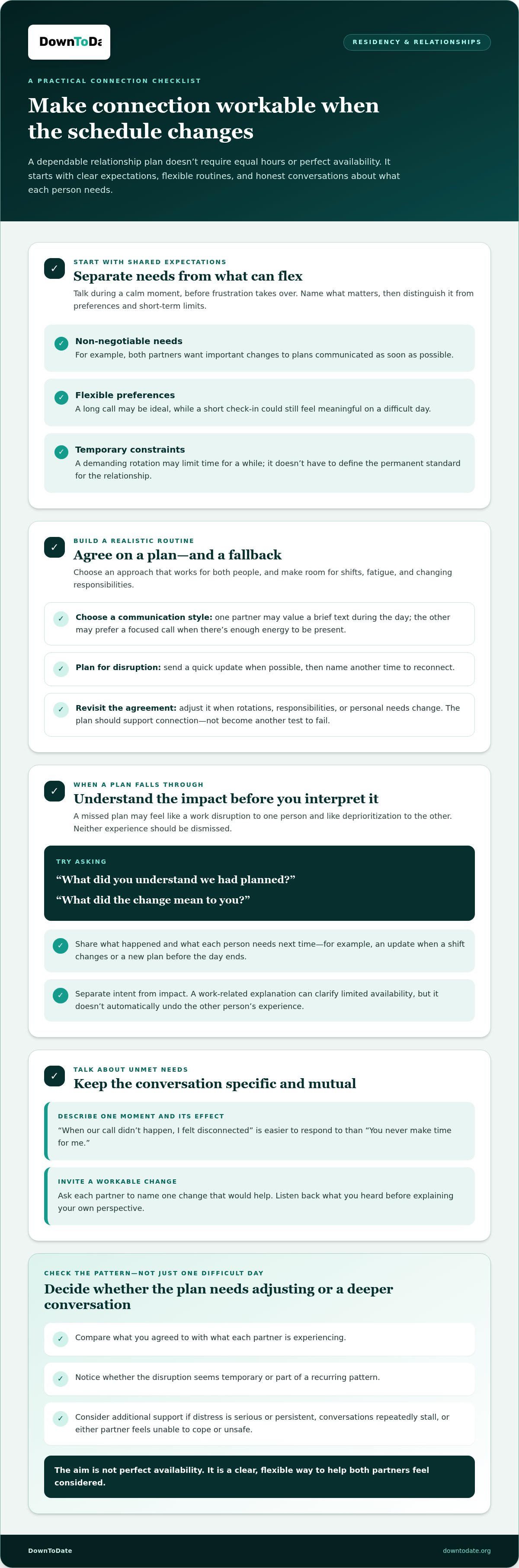
Start with curiosity rather than accusation. Ask, “What did you understand we had planned?” and “What did the change mean to you?” Then clarify what happened and what each person needs next time, such as an update when a shift changes or a new plan before the day ends. This separates intent from impact and gives both partners something specific to address.
This guide can help couples name patterns and consider practical adjustments. It isn’t a substitute for professional support when distress is serious, persistent, or feels unsafe. Seeking help can be appropriate when conversations repeatedly stall or either partner feels unable to cope. That isn’t a verdict on the relationship; it’s a way to take both people’s well-being seriously.
How to talk about connection, availability, and expectations during residency
Talk before frustration takes over. A calm check-in gives both partners room to describe what connection means to them, instead of trying to solve everything after a missed plan. A demanding shift can explain limited availability, while the effect of that absence on a partner still deserves attention. Research on residency’s influence on relationships and resident well-being offers useful context in Impact of Residency on Personal Relationships.
To make how to balance residency and a relationship more practical, separate three things that can otherwise blur together:
- Non-negotiable needs: For example, both partners want important changes to plans communicated as soon as possible.
- Flexible preferences: A long call may be ideal, but a short check-in could still feel meaningful on a difficult day.
- Temporary constraints: A demanding rotation may limit time for a while without setting the permanent standard for the relationship.
How to agree on realistic communication expectations
Choose a communication approach that works for both people. One partner may value a brief text during the day; the other may prefer a focused call when there’s enough energy to be present. Agree on a fallback for disrupted plans, such as sending a quick update when possible and naming another time to reconnect. Revisit the agreement when rotations, responsibilities, or personal needs change. A plan should support connection, not become another test to fail.
How to discuss unmet needs without keeping score
Describe one specific moment and its impact instead of making a global judgment. “When our call didn’t happen, I felt disconnected” is easier to respond to than “You never make time for me.” Then invite each partner to name one change that would help. Listen back what you heard before explaining your own perspective. An explanation can clarify why availability was limited, but it doesn’t automatically undo the other person’s experience.
A concise check-in might sound like this: “I know your schedule may change. I’d like us to choose one way to stay connected that feels manageable for both of us. If a shift disrupts it, what’s a realistic fallback? I’ll share what helps me feel considered, and I want to hear what feels supportive to you.” Adapt the words to your circumstances. The goal isn’t perfect availability; it’s clear, workable expectations.
If you’re single and hoping to meet someone familiar with medical training, DownToDate is a physician-created dating app for doctors, nurses, and other healthcare professionals. It offers a way to meet people who may understand healthcare work, while compatibility still depends on the individuals.
How to tell whether your relationship needs a schedule adjustment or a bigger conversation
A difficult stretch in residency can put pressure on a relationship without defining its overall quality. Ask whether the strain changes when circumstances shift or continues despite clear agreements and reasonable efforts. Look at observable patterns, not assumptions about what a missed call or cancelled plan proves. Consider what you agreed to, what actually happened, and how each of you says the pattern feels.
This comparison can help you decide what to discuss next. It isn’t a diagnosis or a test one partner has to pass.
| Temporary schedule disruption | Recurring pattern that needs discussion |
|---|---|
| Plans change around a demanding rotation, call, or an unexpected schedule update. | The same concern keeps returning across different schedules or after circumstances ease. |
| Both partners can describe the impact without dismissing the other’s experience. | One partner struggles to raise needs without being dismissed, blamed, or met with resentment. |
| A practical change, such as a different time or a brief update, improves the sense of connection. | Agreed changes aren’t followed, or repeated attempts don’t address the underlying concern. |
| Both people are willing to adjust within their actual time and energy. | One person feels solely responsible for keeping the relationship connected. |
Signs a practical adjustment may be enough
Look for flexibility and follow-through. If disruption is occasional, both partners can talk about how it felt, and a small change helps, a schedule adjustment may be a reasonable next step. For example, moving a planned call to a more realistic time can reduce repeated disappointment. The key is that both people remain willing to adapt, rather than expecting one partner to absorb every change.
When unmet needs deserve a deeper conversation
If the same need remains unmet despite clear agreements and practical attempts to adapt, pause before making another calendar fix. A recurring concern may call for a fuller conversation about what each person needs and can offer. Take it seriously if one partner feels unable to speak without dismissal or resentment. Neither person should have to treat ongoing distress as the unavoidable price of residency.
To keep the discussion grounded, review a specific period together. What did you agree would happen? What changed? Did either of you communicate about the change? What was the effect, in each person’s own words? These questions help separate a one-off disruption from a pattern without guessing at intent. A busy training period alone doesn’t establish whether a relationship is healthy or unhealthy.
If you see a recurring pattern, agree on a time to discuss it when neither of you is in the middle of a shift change or conflict. Name one concern, listen to each account, and decide whether a new agreement is realistic. If conversations keep stalling or distress feels difficult to manage, consider qualified support together. The aim isn’t to diagnose burnout or assign blame. It’s to understand what’s happening and identify a next step that respects both partners’ well-being.
Practical routines that help couples stay connected through residency
A dependable routine doesn’t need to be elaborate. It needs to fit the week you have, not an ideal week without late shifts or fatigue. For couples thinking about how to balance residency and a relationship, a small ritual both people can sustain often works better than ambitious plans that repeatedly fall through.
Try this sequence together:
- Compare schedules. Identify likely openings and known pressure points, while leaving room for changes.
- Choose one realistic ritual. Pick a brief check-in, a shared meal, or another moment that feels meaningful to both partners.
- Plan a fallback. Decide what to do if a shift runs late or one of you has no energy for the original plan.
- Review its usefulness. Ask whether the routine helped you feel connected or became another obligation.
Create a low-pressure routine for predictable connection
Agree on a frequency and format that feel manageable during a demanding week. That might mean a short call on a mutually workable evening or breakfast together after a shift. Treat the plan as an invitation to connect, not a performance test. If work or fatigue disrupts it, use the fallback you chose together, such as sending a brief update and finding another moment.
Keep the ritual simple enough to repeat. A protected meal doesn’t have to become a special occasion; it can be a shared meal without multitasking. A quick check-in can be a chance to ask how the other person is doing, not a full relationship review. The routine should create an opening for closeness, not add pressure to make limited time feel perfect.
Make limited time feel more intentional
Presence looks different for different people. One partner may appreciate putting phones aside, while another may feel cared for through a quiet meal and a chance to decompress. Agree on what helps each of you feel attended to. If it suits both partners, allow a brief transition after work before moving into household logistics or difficult topics.
Then review the routine without assigning blame. Is the timing realistic? Does the format leave both people feeling more connected? Would a shorter check-in be easier to sustain than a long call? Adjust when schedules or needs change. Mutual flexibility matters: a routine shouldn’t depend on one person doing all the planning or pretending to have energy they don’t have.
If the ritual starts to feel like another item on a checklist, simplify it or choose a different one. The purpose is reliable care, not perfect execution. Residents who are single and interested in meeting people familiar with healthcare work can also explore DownToDate+, a physician-created dating app for doctors, nurses, and other healthcare professionals. Explore DownToDate+ as one way to meet people who may understand the demands of medical training.
Finding understanding and support while building a relationship in residency
A partner who understands medical training may need less context about why a shift changed or why recovery time matters. That familiarity can make some conversations easier, but it can’t guarantee compatibility or replace the effort of learning about one another as individuals. A shared profession is context, not a shortcut to trust, consideration, or aligned expectations.
For couples, the practical work remains personal: ask what helps your partner feel supported, explain what you can realistically offer, and listen without relying on assumptions about what a resident or a partner “should” be like. Mutual respect matters whether you work in healthcare or a different field. Understanding the pressures can help, but both people’s needs still deserve attention.
What shared understanding can and cannot do
Clinical experience may help a partner recognize that a schedule change isn’t always within a resident’s control. It won’t tell them whether you prefer a quiet evening, a direct update, or help protecting time together. Those details require conversation. Avoid turning professional familiarity into a stereotype: two people in healthcare can have different boundaries, priorities, and ways of communicating.
People outside medicine can also be thoughtful, supportive partners. What matters is whether each person shows curiosity and respect, follows through where possible, and speaks honestly about what they need. Understanding isn’t measured by occupation. It’s demonstrated through consistent care.
Where DownToDate+ fits for healthcare professionals seeking a partner
DownToDate+ is a physician-created dating app designed for doctors, nurses, and other healthcare professionals. Its healthcare focus gives residents a way to meet peers who may already have some context for medical training. That context can make it easier to explain parts of work life, but it doesn’t promise shared values, compatibility, or a particular relationship outcome.
Meeting someone and building a relationship are separate parts of the process. An app can be a place to connect with potential partners; it isn’t relationship counseling and won’t resolve communication challenges for couples already together. If you’re single and interested in meeting people who work in healthcare, consider exploring DownToDate+ at your own pace. Keep the same standards you’d bring to any connection: respect, genuine interest, and clear communication.
For more practical ideas, see this guide to dating with an unpredictable schedule. For a broader perspective on the pressures doctors can face in relationships, explore relationship advice for doctors. Different schedules may shape how a connection develops, but a strong foundation still comes from how two people treat and understand each other.
Choose one next step that supports the connection you want
You don’t need a perfect plan for every demanding week. Start with one manageable step: name what you need, invite an honest conversation, or choose a small way to make connection part of your routine. Learning how to balance residency and a relationship is an ongoing process, shaped by changing schedules and what works for both people. Adjust as you learn. Progress can be steady without being perfect.
If you’re single and would like to meet people who understand the demands of healthcare work, DownToDate+ is a physician-created dating app for doctors, nurses, and other healthcare professionals. Its healthcare focus offers a way to make connections, not a promise of compatibility or a substitute for the work of building a relationship.
Explore DownToDate+ and see whether its healthcare-focused community fits what you’re looking for. Whether you’re strengthening a current relationship or open to meeting someone new, move forward with clarity, mutual respect, and realistic expectations. The schedule may change. Your intention to build meaningful connection can remain.
Frequently Asked Questions
Can a relationship survive medical residency?
Yes, a relationship can continue through residency, though the experience depends on both partners and their circumstances. A useful starting point is to ask whether you can still make decisions as a team, even when time is limited. For example, you might agree on how to handle an important event that conflicts with a shift. Learning how to balance residency and a relationship means adapting together, not expecting one person to carry every compromise.
How often should couples in residency communicate?
There’s no universal frequency that suits every couple. Agree on a baseline that feels reassuring to one partner and manageable to the other, then see how it works in real life. That might mean a short message on workdays and a longer conversation when both have capacity. If one person feels they must always initiate, discuss how to share that effort. The goal is mutual connection, not a fixed message count.
What should I do if my resident partner keeps canceling plans?
Address the repeated pattern directly and make a plan for the next cancellation, rather than debating each incident separately. You could say, “I understand shifts can change, but repeated cancellations are affecting me. Can we decide how we’ll reschedule?” Notice whether your partner engages and follows through on a workable agreement. If plans keep falling through without acknowledgment or repair, consider what you need to continue feeling respected.
Is it normal to feel lonely while dating someone in residency?
Feeling lonely can happen even when you care about each other and understand the demands of training. Loneliness is a real experience, not proof that you’re unsupportive or that the relationship must end. Consider what feels absent: everyday conversation, shared activities, affection, or being included in decisions. Naming the specific gap can help you decide whether to seek connection in the relationship, with friends, or through activities of your own.
How can a partner support a resident without neglecting their own needs?
Support doesn’t require putting your life on hold. Keep plans, friendships, rest, and personal goals that matter to you, and be clear about what you can offer without building resentment. For instance, you can understand a demanding week while still expecting honest updates about plans that affect you. Ask for support in return, too. A sustainable partnership makes room for both people’s well-being, not only the resident’s work.
Should I break up with my partner during residency?
Residency alone doesn’t determine whether you should stay or leave. Consider whether the concerns are temporary, whether both of you are willing to address them, and whether the relationship continues to meet your essential needs. You don’t have to decide during an especially stressful shift or argument. If you feel unsafe, prioritize your safety and seek trusted support. Otherwise, a thoughtful conversation can help clarify whether change feels possible for both of you.
Can dating another medical professional make residency relationships easier?
A partner who understands healthcare work may need less context about some of its demands, but a shared profession doesn’t ensure compatible values or communication. People in the same field can have very different schedules, boundaries, and expectations. DownToDate+ is a physician-created dating app designed for doctors, nurses, and other healthcare professionals. It offers a healthcare-focused way to meet peers, but the quality of a relationship depends on the individuals.
When should couples consider professional support during residency?
Consider qualified support when the same conflict keeps returning, conversations regularly break down, or either partner feels persistently distressed and unsure how to move forward. You don’t need to wait for a crisis to ask for help. A counselor or other qualified professional can provide a structured setting to explore concerns and discuss options. If either person feels unsafe, seek immediate help from trusted people or appropriate local emergency resources.


