

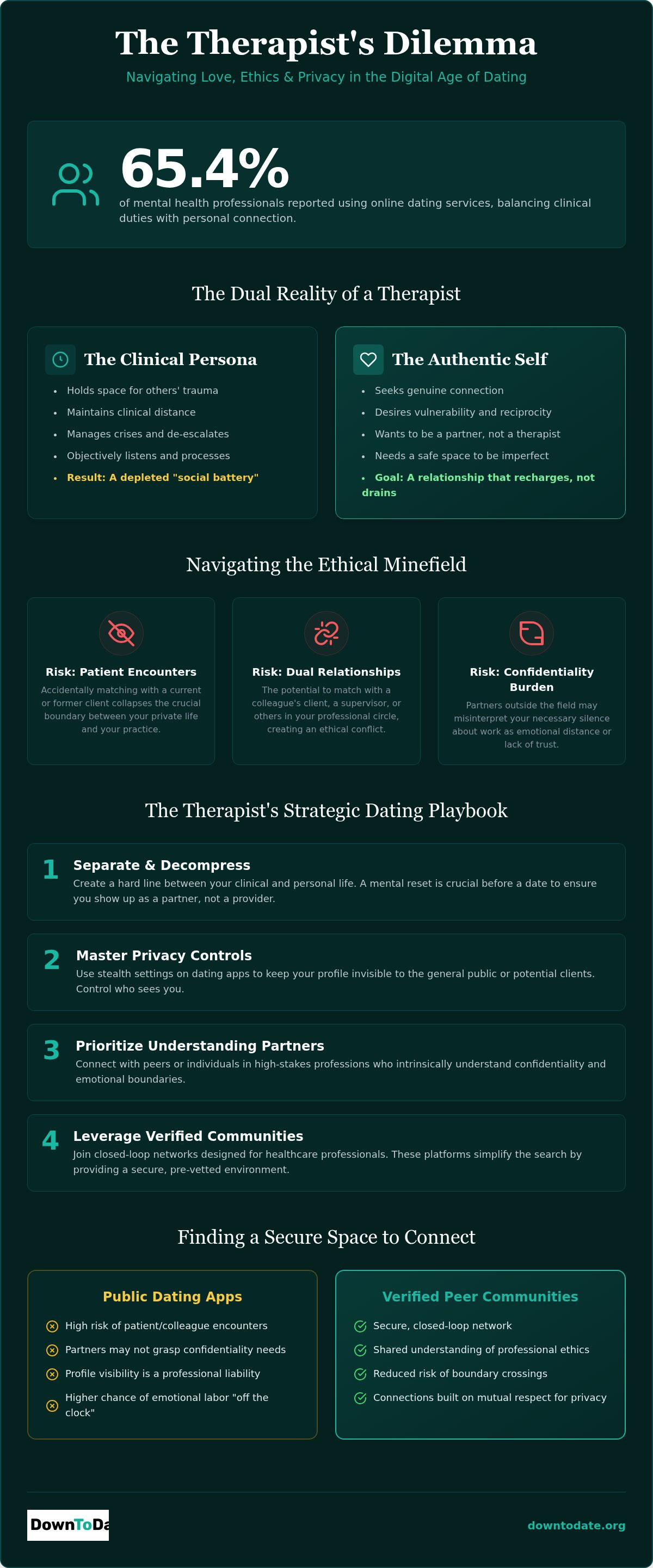
A 2018 study found that 65.4% of mental health professionals reported using online dating services. While dating for therapists is now common, it remains a delicate balance of ethics and exposure. You spend your hours holding space for others. You manage crises. You maintain a clinical distance that protects the therapeutic alliance. When the workday ends, the desire for connection shouldn't come with the fear of a patient appearing on your screen. You deserve a personal life that feels safe. You want a relationship that doesn't require you to be "always on."
Mastering this balance in 2026 requires a strategic approach to privacy and vulnerability. It's about protecting your license while opening your heart. This article provides a roadmap for navigating the digital landscape with confidence. You'll learn how to secure your professional boundaries, avoid the exhaustion of emotional labor at home, and identify partners who understand the gravity of your profession. We will examine the ethics of disclosure, the benefits of verified peer communities, and the practical steps to finding a high-quality match who respects your silence.
Key Takeaways
- Separate the clinical persona from the authentic self. Protect your social battery from the weight of daily emotional labor.
- Master dating for therapists with strategic privacy controls. Use stealth settings to ensure your profile remains invisible to patients.
- Prioritize partners who understand high-stakes environments. Connect with peers who respect the silence and confidentiality of your profession.
- Navigate the ethics of dual relationships with confidence. Protect your license while pursuing meaningful personal connection.
- Leverage verified communities to simplify your search. Join a closed-loop network designed for the unique needs of healthcare professionals.
The Unique Challenges of Dating as a Mental Health Professional
You hold the space. You carry the weight. You manage the silence. By 5 PM, your social battery isn't just low; it's depleted. You've spent eight hours processing trauma, de-escalating crises, and maintaining a clinical distance that is as exhausting as it is necessary. This is the "emotional labor tax" of your profession. For most people, a dinner date is a way to unwind. For you, it can feel like a ninth hour of active listening. This reality makes dating for therapists a unique challenge that requires more than just a good profile. It requires a strategy for self-preservation.
The "Therapist Persona" is a professional tool. It is measured, objective, and endlessly patient. But a romantic relationship requires you to be messy, vulnerable, and occasionally irrational. Traditional dating apps often feel like a second job. You swipe through profiles while worrying about professional visibility. You encounter "civilians" who expect you to fix them or who struggle to understand why you can't share the details of your day. They want the therapist; you want to be the partner.
Decompressing Before the Date
Effective dating for therapists requires a hard line between the office and the evening. You must take off the clinical hat before you meet a match. This transition isn't just a change of clothes. It's a mental reset. You need a partner who understands that you aren't there to provide a consultation. You need emotional reciprocity. You deserve a space where your needs are prioritized, not just managed. Setting these boundaries early prevents you from becoming a 24/7 counselor to your partner.
The Burden of Confidentiality
Confidentiality is the bedrock of your practice. It is also a barrier to intimacy. You cannot vent about a difficult session without navigating a legal and ethical minefield. HIPAA regulations and professional codes of conduct create a wall of silence that non-clinicians rarely understand. A partner who doesn't work in a high-stakes field might interpret this silence as emotional distance or a lack of trust.
Dating another professional often bridges this communication gap. They understand the weight of what you cannot say. They recognize the Ethical definition of dual relationships and the importance of maintaining professional distance. When you date someone who speaks the same language of boundaries, the silence becomes a shared respect rather than a source of tension. Dating for therapists becomes significantly more sustainable when your partner respects the gravity of your silence.
Navigating Ethics, Privacy, and Patient Boundaries
Visibility is a liability. For most, a dating profile is a digital billboard for connection. For you, it is a potential breach of the clinical frame. The primary fear in dating for therapists is the accidental encounter with a patient. You curate your professional image. You protect your space. You guard your license. When you enter the digital dating market, you risk collapsing the distance between your private life and your practice. This risk requires a proactive defense rather than a reactive apology.
Dual relationships are a constant threat in smaller professional circles. You might match with a colleague’s client or a former supervisor. Managing professional boundaries means vetting matches before the first message is sent. It means checking names against your current and former caseload. It means recognizing that your digital footprint is never truly private. You must approach every interaction with the understanding that your professional reputation is always on the line.
The Ethics of Online Self-Disclosure
Self-disclosure is a spectrum. Your dating bio should be authentic but professional. Avoid sharing specific locations, workplace names, or overly personal anecdotes that could be used to identify your clinical practice. In 2026, social media vetting is a standard part of the dating process. Your potential partners will look for you. Ensure your public presence reflects the high standards of your field. High-quality peers will respect this level of discretion. They understand that a verified community is the most secure way to meet without compromising your professional integrity.
Handling Accidental Client Encounters
The encounter is inevitable if you use public apps long enough. You swipe and see a familiar face. You realize a current client has viewed your profile. Do not panic. Follow a clear protocol to protect your practice. Do not engage with the profile. Do not "match" to explain the situation. Block the user immediately to remove your visibility. Documentation is your best defense. Record the date and the platform where the encounter occurred. Bring the situation to clinical supervision immediately. If the client raises the issue in a session, keep the focus on their clinical needs while maintaining your professional stance. Your license is your livelihood; protect it with rigorous boundaries and intentional platform choices.
Beyond the Couch: Finding a Partner Who Understands Emotional Labor
Finding a partner isn't just about chemistry. It's about finding someone who can sit in the silence of your workday. High-achieving clinicians often seek high-empathy partners who don't feel threatened by the emotional intimacy you share with your clients. In the context of dating for therapists, this alignment is a prerequisite for long-term stability. You need a partner who recognizes that your silence isn't a lack of interest; it's a byproduct of a high-stakes career.
Dating generalists can lead to friction. They might ask for details you can't provide. They might resent the time spent on crisis calls. Dating a peer creates an immediate "Power Couple" dynamic where the rules of the profession are already understood. Shared values regarding mental health become the foundation of the relationship. You don't have to explain why you're drained. You don't have to justify your boundaries. Your partner already lives them.
The Benefits of Dating Professional Peers
Peers offer a unique form of support. They understand that a 6 PM crisis call isn't an interruption; it's the job. Adhering to the APA Ethics Code means your partner must accept that your work life is a vault. A fellow professional respects the "off-limits" nature of your caseload without taking it personally. This mutual respect fosters a deep, intellectual connection rooted in high emotional intelligence and a shared commitment to personal growth.
Managing the 'Two Therapists' Household
When two clinicians build a life together, they must guard against the "over-analysis" trap. It's easy to turn a simple argument into a clinical case study. Successful dating for therapists involves creating a "therapy-free zone" at home. You must consciously decide to be partners first and practitioners second. This is especially vital when balancing demanding roles. If you're struggling to find time for connection between sessions, consider our guide on Dating with an Unpredictable Schedule. Establishing these home-life boundaries ensures your relationship remains a sanctuary rather than an extension of the office.
Strategic Dating: How to Protect Your Profile and Sanity
Effective dating for therapists is a tactical operation. It is not a passive activity. You must protect your image. You must protect your time. You must protect your peace. Traditional apps often leave you exposed to the public. They offer little control over who sees your face or your story. To date safely, you must prioritize platforms with robust privacy controls and verified user bases. You are not just looking for a match; you are looking for a secure connection.
Use "Ghost Mode" or "Incognito" settings whenever possible. These features ensure you remain invisible until you decide to be seen. You control the exposure. You manage the risk. Filtering for specific educational and professional backgrounds is another vital layer of defense. It narrows the field to peers who understand the high-stakes lifestyle. This strategic approach saves your social battery for individuals who truly align with your professional and personal values.
Set firm date nights that respect your clinical load. Never schedule a first meeting after your heaviest clinical days. If your Tuesday is filled with trauma work, your Tuesday night should be for restoration, not evaluation. Protect your schedule to ensure you show up as your authentic self rather than a drained practitioner. Consistency in your personal boundaries creates the foundation for a sustainable relationship.
Optimizing Your Professional Dating Profile
Your bio should signal intelligence and depth without using clinical jargon. You are a person, not a practitioner, in this context. Highlight interests that show a well-rounded life beyond the couch. Talk about your passions, your travels, or your favorite restorative hobbies. Showing a life outside of psychology makes you more approachable and relatable. For more guidance on finding the right digital space, see our review of The Best Professional Dating App for Medical Professionals.
Vetting Your Dates Safely
A pre-date video call is non-negotiable. It serves as a vital compatibility check before you invest physical time or energy. Trust your clinical intuition during these interactions. You have spent years honing your ability to read people; use that skill to protect your heart. Maintain your personal privacy until trust is earned. Do not share your office location or full name until you are certain of the connection. Secure your personal life by joining a community of verified peers who value discretion and shared professional integrity.
DownToDate: The Secure Community for Mental Health Peers
General dating apps are open systems. They are designed for mass consumption. For you, this openness is a liability. Every swipe carries the risk of a professional breach. DownToDate operates differently. It is a closed-loop community. It is built by people who have lived your schedule and protected your boundaries. Founded by Dr. Shadi and Dr. Sasan Rezai, the platform addresses the specific hurdles of a high-stakes healthcare lifestyle. It is a space where your professional dedication is a shared value, not a point of contention. This is the new standard for dating for therapists.
You shouldn't have to choose between your career and your personal life. You deserve a platform that acts as a protective gatekeeper. DownToDate provides a streamlined path forward for clinicians who are tired of the exposure and exhaustion of traditional dating. It is not just a service; it is a community of verified peers who respect the weight of your work. By prioritizing privacy and professional integrity, we ensure that your search for connection remains safe and focused.
The Power of Professional Verification
Verification is our core philosophy. It is the gatekeeper of our community. Every member must verify their professional status before they can connect. This process effectively eliminates the risk of "catfishing" or accidental client-matching. When you match on DownToDate, you know the person on the other side understands the medical and clinical lifestyle. They understand the silence of a heavy day. They understand the importance of confidentiality. For those seeking the most exclusive experience, DownToDate Premium Membership offers the elite tools necessary to manage your search with precision and ease. It is the safest choice for dating for therapists in 2026.
Taking the Next Step Toward Connection
Your time is a finite resource. Your emotional energy is a precious asset. Do not waste them on platforms that do not respect your dedication. Moving from clinical burnout to a meaningful romantic partnership requires an environment of mutual respect and shared experience. You can sign up and verify your professional status today. The process is direct. The community is authentic. The goal is a partnership that understands the gravity of your world. Start your journey with a community that understands you. Join a network where you can finally be a partner first and a practitioner second.
Protect Your Peace and Pursue Partnership
Your dedication to your patients shouldn't come at the expense of your personal fulfillment. Successful dating for therapists requires a shift from passive swiping to intentional, secure connection. You've learned that privacy isn't just a preference; it's a professional necessity. You've seen that finding a partner who understands the weight of your silence is the key to emotional sustainability. It's time to stop managing your dating life like a liability and start treating it as a priority.
DownToDate provides the streamlined solution you need. As a verified community of medical and mental health professionals, we ensure you meet high-quality peers who respect your boundaries and your time. Founded by doctors for healthcare peers, our platform offers enhanced privacy features designed specifically for high-profile clinicians. You don't have to navigate the digital landscape alone. Join DownToDate today and connect with peers who understand your professional world. Reclaim your evening. Protect your practice. Find the partnership you deserve.
Frequently Asked Questions
Is it ethical for a therapist to use online dating apps?
It is entirely ethical for mental health professionals to use dating platforms to seek personal connection. Your right to a private life is supported by professional organizations, provided you maintain clear boundaries. The key is ensuring your profile doesn't compromise your professional objectivity or violate confidentiality. Dating for therapists requires a higher level of discretion, but it doesn't require you to remain isolated from the digital dating world.
What should I do if a current client finds my dating profile?
Block the client immediately once you become aware of the encounter. This action removes your visibility and prevents further interaction on the platform. Do not message the client to explain the situation through the app. Document the occurrence for your professional records and bring the matter to clinical supervision. If the client raises the issue in session, address the clinical implications while maintaining your professional frame.
Can a therapist date a former client after a certain period?
Ethics codes provide strict timelines for these relationships. The APA Ethics Code prohibits sexual intimacies with former clients for at least two years after therapy ends. Even after this interval, such relationships are only permissible in the most unusual circumstances. Many clinicians avoid these connections entirely to prevent exploitation or harm. Always verify the specific regulations of your state licensing board before proceeding with any such relationship.
How do I explain my need for privacy to someone I just started dating?
Frame your need for privacy as a non-negotiable professional requirement. Explain that your role involves high-stakes confidentiality and strict safety protocols to protect your patients. A partner who understands the weight of your work will respect these boundaries without feeling excluded. You aren't hiding your life; you're protecting your license. Clear communication about these professional standards helps filter for partners who value your dedication and integrity.
Are there specific dating apps designed for therapists and doctors?
Specialized platforms like DownToDate are designed specifically for the healthcare community. These apps utilize professional verification to ensure every member is a verified peer, such as a doctor, nurse, or therapist. This closed-loop approach significantly reduces the risk of accidental client encounters. It connects you with individuals who already speak the language of emotional labor and unpredictable schedules. These niche communities prioritize your security and professional standing.
How can I avoid 'therapizing' my partner in a new relationship?
Consciously transition out of your clinical role before you meet your partner. Focus on emotional reciprocity rather than providing a service or intervention. If you notice yourself analyzing their behavior, redirect the focus to your own feelings or a shared activity. A healthy partnership requires you to be vulnerable and imperfect. Set a boundary to keep clinical jargon out of your romantic life to ensure your home remains a sanctuary.
What are the best privacy settings for therapists on dating apps?
Utilize "Incognito" or "Ghost Mode" features to ensure your profile is only visible to people you have already liked. This setting prevents your profile from appearing in a general stack where clients might see you. Avoid linking your dating profile to other social media accounts or including your full name. For many clinicians, dating for therapists is safest on verified platforms that offer built-in privacy protections for high-profile professionals.
How do I manage dating burnout while maintaining a heavy caseload?
Schedule your dating activities with the same intentionality you use for your clinical sessions. Limit swiping to specific times of the week to prevent decision fatigue. If your caseload is particularly draining, pause your dating apps to preserve your social battery. Focus on meeting a few high-quality peers rather than managing a high volume of matches. Protecting your energy ensures you can show up authentically in both your practice and your personal life.


