

Residency schedules don't kill relationships. Rigid, civilian-standard expectations do. You already know the toll of the 80-hour work week. You understand the weight of post-call fatigue and the sting of a cancelled dinner because of an emergency shift. It's exhausting. It's unpredictable. It feels like your career is at odds with your connection. Successfully dating with a resident's schedule requires more than just patience. It requires a tactical shift in how you view time and intimacy.
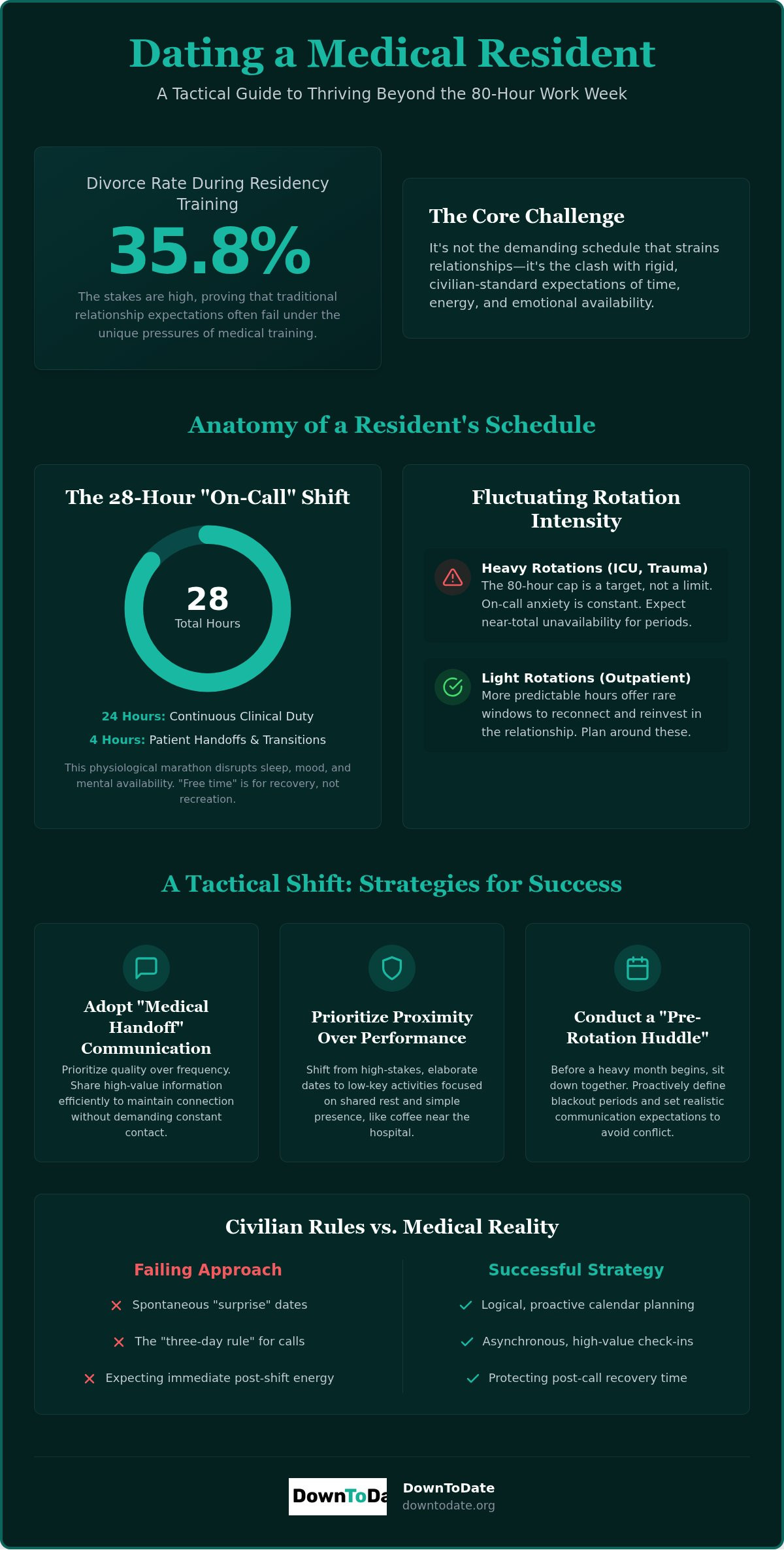
The 35.8% divorce rate during residency training proves the stakes are high. However, you can maintain a thriving partnership while navigating the grueling rotations of 2026. This is about working with the system, not against it. It's about efficiency, empathy, and intentionality. We understand these specific hurdles because we've lived them. We are here to facilitate a connection that respects your time and your ambition.
This guide provides a sustainable communication plan designed for the on-call lifestyle. We offer realistic date ideas that fit into tight windows of rest. We outline how to build a mutual understanding of professional demands so your relationship becomes a sanctuary rather than another source of stress. Let's move past survival and toward a partnership built on shared values and serious intent.
Key Takeaways
- Navigate the structural realities of the 80-hour cap. Understand the specific intensity of intern year versus senior resident responsibilities.
- Adopt a "medical handoff" communication style. Ensure high-value connection while dating with a resident's schedule.
- Prioritize proximity over performance. Transition to low-stakes dates that focus on shared rest and clinical proximity.
- Bridge the civilian gap. Harness the inherent empathy and shared vocabulary found within a verified medical community.
- Utilize asynchronous tools for intimacy. Maintain a consistent presence during unpredictable on-call shifts and exam cycles.
Understanding the Medical Residency Schedule Reality
Residency is a high-stakes training period. It's not a standard job. It's an immersion. The ACGME mandates an 80-hour weekly cap, but these hours are often compressed into unpredictable, high-pressure blocks. Understanding the Medical Residency Schedule Reality means recognizing that time is a finite, heavily guarded resource. Intern year represents the peak of this intensity. It's a period of survival. Senior residents may gain some autonomy, but their clinical responsibilities only expand. Dating with a resident's schedule requires an early acknowledgment that this career demands a level of sacrifice most civilians cannot comprehend.
Physical presence does not guarantee mental availability. A resident may be sitting across from you while mentally processing a difficult patient outcome. This is the reality of Second Victim Syndrome. It creates an emotional distance that can strain a partnership if not identified early. The post-call state is equally taxing. It's a period of deep cognitive fog. Expecting a partner to switch instantly from a 24-hour trauma shift to a romantic dinner is unrealistic. Validation of this exhaustion is the first step toward a sustainable connection.
The Anatomy of the 28-Hour Shift
The 28-hour shift is a physiological marathon. It consists of 24 hours of continuous clinical duty followed by up to four hours for patient handoffs and transitions. This structure effectively obliterates the circadian rhythm. "Free time" isn't spent on social outings. It's spent on recovery sleep or catching up on complex charting. This exhaustion isn't just physical. It's hormonal. Disrupted sleep cycles lead to significant shifts in mood and a temporary decline in libido. Partners must view rest as a biological necessity, not a personal rejection of intimacy.
Why Traditional Dating Rules Fail Residents
Civilian dating advice is largely useless in the medical world. The "three-day rule" for communication is impossible when a resident is working 12-hour blocks in a surgical rotation. Spontaneity is a luxury residency rarely affords. If a date isn't on the calendar weeks in advance, it simply won't happen. Dating with a resident's schedule demands a strategic approach over an emotional one. Success relies on viewing the calendar as a shared challenge to be managed. You must replace casual expectations with a commitment to logical, proactive planning.
Navigating Rotations, On-Call, and Exam Stress
Residency is not a monolith. It is a fluctuating cycle of clinical intensity. Dating with a resident's schedule requires you to differentiate between "light" rotations, such as outpatient clinics with predictable hours, and "heavy" rotations like ICU or Trauma Surgery. During heavy months, the 80-hour cap is a target, not a limit. The pager is a constant presence. It is a silent third wheel in your relationship. This "on-call" anxiety creates a baseline level of stress that never truly dissipates. It demands a partner who understands that a sudden page isn't a choice, but a professional mandate.
Academic milestones add another layer of complexity. Step 3 and Board exams demand hundreds of hours of dedicated study. These are periods of total unavailability. Conversely, the "Golden Weekend," having both Saturday and Sunday off, is the holy grail of medical training. These rare 48-hour windows must be protected. They require strategic planning rather than casual spontaneity. Finding a Partner Who Understands the Medical Path is essential during these high-pressure phases, as shared experience reduces the need for constant explanation and emotional labor.
Managing Rotation-Based Relationship Flux
Success depends on the "pre-rotation huddle." Sit down before a heavy month begins. Define the blackout periods. Agree that communication will be brief and often asynchronous. When you transition back to a lighter month, reinvest in the partnership. Use that extra time to rebuild the intimacy that was sacrificed during the 80-hour weeks. Matching with someone who respects these cycles is simpler through a Premium Membership designed specifically for the medical community.
The Stress of the Match and Fellowship Applications
The Match process introduces a unique brand of geographic uncertainty. You may be in one city today and across the country in July. This makes long-term planning difficult. Communicate early about the possibility of long-distance phases. If you are dating a non-medical partner, explain the lack of control you have over your destination. Be transparent about your rank list. Honesty prevents resentment when the Match results are finally revealed. It allows you to build a foundation that can survive a potential relocation.
Strategic Communication: Quality Over Frequency
Frequency is a civilian metric. In medicine, efficiency is the currency of connection. Dating with a resident's schedule requires a transition from constant texting to the "Medical Handoff" style. This means delivering brief, high-value status updates that respect the constraints of the clinical environment. Don't aim for a high volume of messages. Aim for high-impact communication. Asynchronous tools like voice notes and video snippets allow for intimacy without the pressure of a real-time response. They bridge the gap between 12-hour shifts and the "no-phone" zones of the operating room or ICU.
Emotional regulation is a shared responsibility. Establish a "No-Vent" zone to prevent hospital talk from consuming your limited time together. While sharing the day's events is natural, a relationship needs space for personal connection beyond the wards. Implement a "Safe Word" for moments of extreme fatigue. When exhaustion overrides the ability to engage, the safe word signals a need for quiet rest without causing personal offense. It's a logistical solution to a biological problem. It protects the partnership from the irritability that often follows a 24-hour call.
Mastering the 5-Minute Check-In
The high-efficiency check-in for busy doctors is a focused exchange that prioritizes emotional presence over logistical planning. Don't ask about the schedule or the chores during these windows. Prioritize emotional validation. Use micro-affirmations. A simple "I'm proud of the work you're doing today" carries more weight than a dozen generic texts. These small deposits of support maintain the bond during the most grueling rotations. They ensure your partner feels seen, even when they are physically absent.
Navigating the 'Post-Call' Conversation
The post-call state is a period of cognitive transition. Residents often need "buffer time" to decompress before engaging with a partner at home. This isn't a lack of interest; it's a physiological requirement for mental reset. Set clear boundaries around hospital trauma and patient stories to prevent secondary burnout for the non-medical partner. For more tactical strategies, see our guide on Relationship Advice for Doctors: Navigating Dating Challenges in 2026. Managing the transition from clinician to partner is essential for long-term sustainability while dating with a resident's schedule.
Date Ideas for Residents with Zero Free Time
Traditional dating advice suggests elaborate dinners and planned outings. For a resident on a surgical rotation, these suggestions are not just impractical; they are a source of stress. Dating with a resident's schedule requires a radical redefinition of what constitutes a "date." You must prioritize low-stakes interactions that focus on physical proximity and mutual rest. The goal is connection, not performance. If you only have 15 minutes, find a way to make those minutes count. This is about reclaiming the small pockets of time that the hospital hasn't yet claimed.
Consider the hospital cafeteria date. It is not glamorous. It is, however, functional. It allows for a brief, intentional connection during a hectic shift. Similarly, co-working dates offer a way to be together without sacrificing productivity. One partner studies for Step 3 or Board exams while the other reads or catches up on work. You are sharing space. You are supporting each other's professional growth. You are maintaining the bond. The "sleep-in" date is perhaps the most valuable of all. Valuing rest as a shared romantic activity acknowledges the reality of post-call fatigue. It is an act of deep empathy and practical love.
The Power of the Micro-Date
A micro-date is a 20-minute window of intentional connection. It is the grocery store run. It is the shared morning commute. It is the 10-minute coffee before a shift starts. These "boring" errands are the secret to residency relationship success. They integrate your partner into your actual life rather than a curated version of it. Efficiency is the key to longevity. To find a partner who values this level of intentionality, consider a Premium Membership to connect with peers who understand your time constraints.
Planning Around the Unpredictable
Residency is inherently unstable. Shifts run late. Emergencies happen. Pagers go off. You must have a "Backup Plan" strategy. If a dinner date is cancelled, have a low-energy alternative ready at home. Focus on the goal of the date, which is connection, rather than the specific activity. Flexibility is a requirement, not an option. For a deeper look at managing these logistics, read our guide on Dating with an Unpredictable Schedule: The Medical Professional’s Strategic Guide (2026). Success in dating with a resident's schedule comes down to one core philosophy: adapt or drift apart. Choose to adapt.
Finding a Partner Who Understands the Medical Path
The "Civilian Gap" is a documented reality in medical relationships. Non-medical partners often struggle to reconcile the 80-hour weekly cap with their own expectations of partnership. They see a cancelled date as a lack of interest rather than a clinical necessity. They see post-call silence as emotional distance rather than cognitive survival. Dating with a resident's schedule is significantly more sustainable when your partner speaks the language of the wards. Shared vocabulary and inherent empathy eliminate the need for constant justification. You don't have to explain why you're late. You don't have to apologize for the pager. It is about finding a partner who recognizes that your career is a calling, not just a job.
Specialized platforms solve the problem of "explanation fatigue." When you match with a peer, the baseline of understanding is already established. You start from a place of mutual respect for the high-stakes nature of the profession. DownToDate was built by doctors who lived the residency struggle. It is a community-builder that values integrity and serious intent. It acts as a protective gatekeeper; it ensures that your limited time is spent connecting with those who already understand the demands of your career. We understand the specific hurdles of a high-stakes lifestyle because we have lived them.
DownToDate Premium: Efficiency for the Time-Poor
Efficiency is a requirement for the modern resident. Our Premium Membership provides advanced filters to find partners with compatible career trajectories. You can search for those who understand the specific pressures of your specialty or rotation cycle. In a high-stakes profession, a verified community is essential. Verification ensures authenticity and shared values. It protects you from the noise of generic dating apps. For a detailed comparison of options, see The Best Professional Dating App for Medical Professionals: A 2026 Evaluation Guide.
Joining a Community of Like-Minded Professionals
Shared values are the foundation of residency-proof relationships. Long-term success in dating with a resident's schedule depends on finding someone who views your ambition as an asset, not a hurdle. Dr. Shadi Rezai and Dr. Sasan Rezai founded this platform to leverage their own expertise in medical training and partnership. We aren't just a service provider. We are a facilitator for the medical community. We believe that professional success and personal connection are not mutually exclusive. Explore more strategies in our article on Dating for Doctors: Navigating Love in the Modern Medical World.
Mastering the Medical Connection
Residency is a period of professional immersion. It is not a barrier to intimacy. Successfully dating with a resident's schedule requires a shift from civilian standards to tactical efficiency. You must prioritize quality over frequency. You must value shared rest over elaborate performance. By adopting the medical handoff communication style and embracing low-stakes micro-dates, you build a partnership that survives the 80-hour week. You move from surviving your rotations to thriving in your connection.
Finding a partner who understands the weight of the pager is the ultimate efficiency. DownToDate is a verified healthcare community founded by medical professionals who have lived the residency struggle. It is designed for high-efficiency matching. It eliminates the explanation fatigue that often stalls medical relationships. Don't leave your personal life to chance while you manage the lives of others.
Join DownToDate and connect with peers who understand your schedule today. You deserve a partnership that respects your ambition and your time. Your career is demanding. Your relationship should be your sanctuary.
Common Questions About Medical Relationships
Is it possible to maintain a long-distance relationship during residency?
Yes, but it requires radical transparency and scheduled intentionality. Success depends on setting a clear end-date for the distance. Use asynchronous tools like voice notes to bridge the gap during 80-hour weeks. Protected video time should be treated with the same priority as a clinical appointment. It's about maintaining a shared vision for the future while navigating the present constraints of medical training and geographic uncertainty.
How do I handle my partner's post-call mood swings and fatigue?
Treat post-call fatigue as a biological reality, not a lack of interest. The 28-hour shift structure causes significant cognitive fog and irritability. Provide a two-hour buffer zone for sleep before expecting any social engagement. Handle the logistical life admin like meals or chores to reduce their mental load. Validation and quiet presence are more valuable than a forced conversation during this recovery window. Practical empathy is the foundation of stability.
Should I wait until after residency to start dating seriously?
Waiting isn't a requirement for success. Many physicians find that a supportive relationship is an effective hedge against the 28.6% burnout rate. Dating with a resident's schedule is possible if you use efficient tools to find compatible partners. Starting now allows you to build a foundation of mutual understanding. Don't put your personal life on a permanent hold while you pursue your professional calling. Connection is an essential part of well-being.
How do I explain my residency schedule to someone who isn't in medicine?
Use specific data to define the civilian gap. Explain the 80-hour weekly cap and the mandatory nature of the pager. Compare residency to a high-stakes deployment that lasts for years. Be clear that free time is often spent on recovery or charting. If a partner cannot accept the unpredictability of emergency shifts, they may not be able to sustain a long-term connection with a resident. Honesty prevents future resentment.
What are the best ways to support a partner during their intern year?
Intern year is a survival phase that demands logistical support. Take over the daily chores and administrative tasks to free up their limited mental bandwidth. Offer micro-affirmations instead of demanding long, emotional debriefs after a 12-hour shift. Your goal is to be a low-pressure sanctuary. Understand that their primary focus is learning to manage patient care safely. Your patience is a form of professional investment in their long-term success.
How can I find time for dating when I work 80 hours a week?
You must prioritize efficiency over traditional dating standards. Reclaim found time like shared commutes or hospital cafeteria breaks. A 20-minute intentional check-in is more valuable than a distracted dinner. Dating with a resident's schedule requires you to cut through the noise of generic apps. Utilizing a Premium Membership on a specialized platform allows you to match with peers who already respect your time and understand your professional demands without explanation.
Can two residents successfully date each other?
Two residents can build a highly successful partnership based on inherent empathy. You share a vocabulary and a mutual understanding of clinical pressure. The primary hurdle is the logistical coordination of Golden Weekends. While you may see each other less than civilian couples, the quality of your connection is often deeper. You never have to explain why you're late or why the pager interrupted your dinner. Shared sacrifice builds a unique bond.


