

What if a meaningful dating life doesn’t require more free time, just clearer expectations? Learning how to date with a demanding job starts with accepting that unpredictable hours and limited energy are real constraints, not signs that you’re doing dating wrong.
After a long shift or an intense workday, arranging another commitment can feel like too much. When plans change, someone you’re getting to know may mistake limited availability for limited interest. The answer isn’t to apologize for your career or push past the need to recover. It’s to make dating fit your life more deliberately.
This guide will help you build a sustainable routine for meeting people, plan dates that work with your schedule, and communicate your availability with confidence. You’ll also learn how to look for a relationship that respects both your professional demands and your need to recharge. Reliable dating doesn’t depend on abundant free time. It depends on honest expectations, thoughtful choices, and consistent effort that works for you.
Key Takeaways
- Learn how to date with a demanding job by setting a realistic rhythm that fits your schedule and energy.
- Choose date plans that leave room for recovery instead of treating connection as another work obligation.
- Recognize whether a match can communicate flexibly and respect changing availability.
- Use a brief weekly check-in to decide whether to make space for a date, scale back, or pause.
- Explore how shared understanding of medical work can make dating conversations easier with DownToDate.
How a Demanding Job Changes the Dating Equation
You can care deeply about your career and still want a close, committed relationship. The tension is real: work may claim your evenings, change plans at short notice, or leave you with little energy for conversation. That doesn’t mean you’re failing at dating. It means your approach has to reflect the life you actually live, rather than an idealized calendar.
Sustainable dating is not constant availability. It’s consistent, honest effort: making room for connection when you can, communicating when plans shift, and following through on commitments you can realistically keep. The broader idea of Work-life balance recognizes that professional and personal demands compete for finite time and attention. Dating needs to fit that reality, not depend on pretending work pressure isn’t there.
It also helps to separate three different limits. A calendar constraint means you’re booked. Fatigue means you may technically be free but need rest. Emotional bandwidth is your capacity to be present, listen, and respond with care. These limits aren’t interchangeable. Knowing which one is affecting you helps you make a better plan than automatically saying yes or disappearing.
What a demanding job changes beyond your calendar
Long hours, on-call duties, and rotating shifts can make plans difficult to predict. In healthcare, a shift may run late or a call schedule may change; other demanding roles bring their own disruptions. Even when work ends on time, decision fatigue or exhaustion can make a lively evening feel out of reach. Notice which days leave you socially energized and which call for quiet recovery. That distinction helps you plan with intention.
Why limited availability is not the same as low interest
Specific communication makes your interest easier to understand. Instead of a vague “I’m busy,” try: “This week is full, but I’d like to see you. I’m free Thursday evening, and I’ll confirm after my schedule is set.” A busy stretch paired with a clear next step signals engagement. Repeated vagueness, unanswered messages, or no attempt to reschedule can signal something different, regardless of workload.
Reliability isn’t being constantly reachable. It’s making realistic plans, keeping them when you can, and communicating promptly if circumstances change. If you need to reschedule, offer another time when possible. If you don’t yet know your availability, say when you expect to know. These small, concrete actions help someone distinguish a demanding week from a lack of interest.
That’s the core of how to date with a demanding job: let your actions communicate care without asking your energy to exceed its limits. Your work may change the logistics, but it doesn’t define your capacity to care. You don’t have to prove your interest by giving up every moment of recovery.
How to Make Dating Fit Your Time and Energy
A workable dating routine starts with your actual schedule, not a picture of what a “normal” week should look like. Some weeks may offer a predictable evening; others may leave only a small opening between shifts or commitments. The goal is to create a rhythm you can maintain without turning every free hour into a plan.
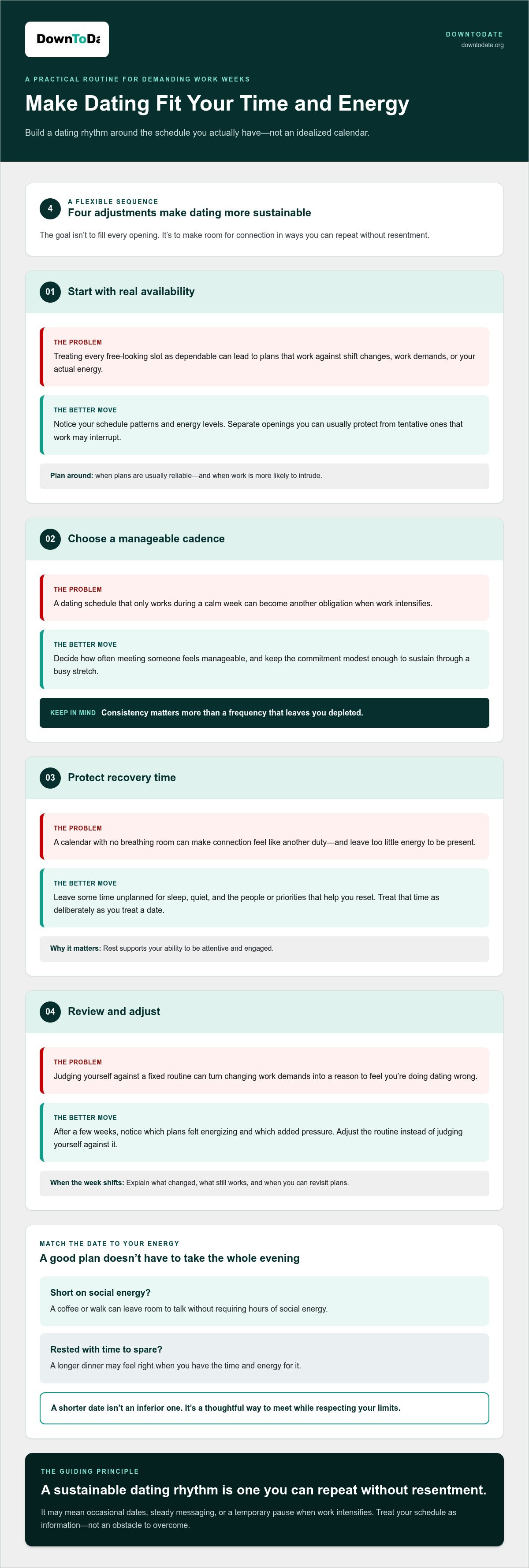
Use this sequence to build a routine that can flex when work changes:
- Identify realistic windows. Look at your schedule patterns and energy levels. Note when plans are usually reliable and when work is more likely to intrude.
- Choose a cadence. Decide how often it feels manageable to meet someone or go on a date. Keep the commitment modest enough to sustain through a busy stretch.
- Protect recovery. Leave some time unplanned for sleep, quiet, and the people or priorities that help you reset.
- Review what works. After a few weeks, notice which plans felt energizing and which added pressure. Adjust the routine instead of judging yourself against it.
A sustainable dating rhythm is one you can repeat without resentment. It may mean occasional dates, steady messaging, or a temporary pause when work intensifies. Consistency matters more than a frequency that leaves you depleted.
Build a dating rhythm around real availability
Separate dependable openings from tentative ones. For example, a free morning after a night shift may be less useful than an evening you can usually protect. Keep a manageable number of plans in motion so one work change doesn’t lead to a chain of cancellations. When your week shifts, check in with yourself and the person you’re seeing: explain what changed, what still works, and when you can revisit plans.
Choose dates that respect energy and attention
Match the format to how you feel, rather than assuming every first date needs a full evening. A coffee or walk can offer room to talk without requiring hours of social energy. If you’re rested and have time, a longer dinner may feel right. A shorter date isn’t an inferior one; it’s a thoughtful way to meet while respecting your limits.
Protect unscheduled time as deliberately as you protect a date. Rest supports your ability to be attentive and engaged, while a calendar with no breathing room can make connection feel like another duty. The same principle applies to dating apps: set aside specific times to browse or reply instead of checking continuously during work. Focused attention is more useful than constant interruptions.
To decide how to date with a demanding job, treat your schedule as information, not an obstacle to overcome. Try a manageable cadence, then refine it based on your energy and work patterns. For healthcare professionals who value meeting peers with a shared understanding of medical work, DownToDate’s dating community offers a way to connect within that professional context.
How to Tell Whether a Dating Match Fits Your Work Life
Compatibility isn’t a contest to see who has the more flexible calendar. It’s the ability to understand each other’s needs and negotiate plans that feel fair. A partner doesn’t need the same occupation or schedule you do. They do need to be able to discuss how work affects time together, and you need to take their needs seriously in return.
Look for the difference between flexibility and constant access. Flexibility leaves room for real life while maintaining mutual effort. Constant access treats immediate replies and unlimited availability as proof of interest.
| Flexible expectations | Pressure for constant access |
|---|---|
| Accepts that a work pattern may affect when you can confirm plans. | Expects immediate replies, even during work or recovery time. |
| Discusses a change and helps find another time. | Treats every schedule change as a personal rejection. |
| Shares their own preferences and makes room for yours. | Expects you to accommodate their availability without negotiation. |
| Values follow-through on plans you both agreed to. | Assumes flexibility means you should always accept last-minute plans. |
Flexibility doesn’t mean a match must accept every last-minute cancellation without disappointment. Their time matters too. A demanding role can explain why plans change, but it doesn’t remove the need to acknowledge the impact, communicate promptly, and make a genuine effort to reschedule. Compatibility is mutual adjustment, not a standing exemption from consideration.
Discuss availability without making promises you cannot keep
Be clear early about what your work pattern means in practice. You might say, “My schedule can change at short notice, so I can’t always confirm plans far ahead. I can usually tell you which days are more reliable, and I’ll let you know if something shifts.” Then share what contact feels manageable and when you can make plans. A considerate boundary is still a boundary; honesty is kinder than promising certainty you don’t have.
Look for flexibility, reciprocity, and follow-through
Notice what happens after a scheduling conflict. Do you both suggest alternatives, or does one person carry all the planning? Reasonable flexibility makes room for each person’s commitments. One-sided accommodation asks the same person to keep adjusting. Before reading a mismatch as disinterest, talk about what each of you needs. Perhaps one person values advance notice, while the other can only confirm closer to the date.
Then assess actions over time. A match who understands your work may still need dependable communication and plans that don’t repeatedly fall through. You may need patience with uncertainty, but you’re not required to accept a dynamic that consistently leaves your needs unmet. The question of how to date with a demanding job is partly a question of fit: can you make agreements that respect both your work realities and each other’s time?
A Practical Plan for Dating During a High-Pressure Work Period
A demanding stretch doesn’t have to force an all-or-nothing choice between dating at full intensity and disappearing. Use a short weekly check-in to decide what’s realistic now. The goal isn’t to guarantee a date; it’s to choose one action that supports connection without adding pressure to an already full week.
Use a simple weekly dating check-in
Set aside a few minutes to review your schedule and energy before making plans. Ask yourself:
- Which openings are genuinely available, not just technically free?
- How much energy do I expect to have after work?
- What is one manageable dating action I can take?
- What recovery time do I need to protect first?
Your action might be replying thoughtfully to a message, suggesting a date, or confirming a plan. At the end of the week, consider whether the routine felt sustainable, not only whether it led to a meeting. If it felt draining, scale it back. If it fit comfortably, keep the pattern.
Reset expectations when work becomes especially demanding
During a high-pressure period, you can pause new conversations, date less often, or keep a connection going with a clear update. You don’t need to share private work details or give a lengthy explanation. State what’s changing, reaffirm your interest if it’s genuine, and offer a next step you can keep.
For example: “Work has become more intense this week, so I need to slow down on plans. I’m still interested in seeing you. Could we look at next week when I know my schedule?” If you need to cancel, acknowledge the change and suggest a specific alternative when possible: “I’m sorry, I can’t make tonight. Would Thursday work instead?” Care is clear. So is the plan.
If you can’t name a date yet, say when you’ll have a better sense of your availability. If you need a pause, communicate that rather than leaving someone to guess. When work eases, resume with a small, realistic step instead of trying to make up for lost time by overbooking yourself. This flexible reset is a practical part of how to date with a demanding job.
For healthcare professionals, shared context can make it easier to connect with people who understand the demands of medical work. Explore DownToDate’s dating community, built for healthcare professionals seeking connection with peers.
How DownToDate Supports Dating Around Medical Work
The habits in this guide help you make room for connection. The people you meet matter, too. For healthcare professionals, dating someone who already understands the pressures of medical work can reduce the need to explain why a shift ran late, a schedule changed, or recovery time matters. Shared context doesn’t remove the need for good communication, but it can make an initial conversation easier.
Why shared medical context can make conversations easier
DownToDate is a dating platform for healthcare professionals, built around connecting with peers. Its community offers a common starting point: members may already recognize some of the realities that shape medical work. That familiarity can ease the work-life translation burden, but it doesn’t guarantee compatibility. You’ll still need to learn how a match communicates, handles changing plans, and approaches a relationship.
Shared profession isn’t a substitute for shared values. Two people in healthcare may have very different schedules, boundaries, and relationship priorities. Trust grows through individual conversations and consistent actions, not a job title. Be direct about what you’re looking for, ask about the other person’s expectations, and use the same thoughtful planning you would with any potential partner.
Explore a medical dating community at your own pace
DownToDate was founded in 2021 by medical professionals Dr. Shadi Rezai and Dr. Sasan Rezai. It serves a verified medical community, giving healthcare professionals a place to connect with people who share a professional context. Bring the priorities that matter to you, whether that’s intentional conversation, respect for a demanding schedule, or the possibility of a serious relationship.
Premium Membership includes advanced search filters and unlimited messaging. Members also receive enhanced profile visibility and access to community features designed to foster romantic connections. These tools can help you focus your search and continue conversations at a pace that suits your availability. Feature access doesn’t replace the work of getting to know someone, but it can help you use your time more deliberately.
Consider whether Premium Membership’s search and messaging features fit your approach to dating. A dating platform can make introductions easier to pursue, but the right rhythm still comes from honest expectations, mutual effort, and plans that respect both people’s lives.
For healthcare professionals ready to meet peers who understand the demands of medical work, explore DownToDate and connect with medical professionals. Shared context can be a helpful beginning, while the connection itself develops one conversation at a time.
Make Your Next Step Work for You
A demanding career may shape your availability, but it doesn’t have to decide whether connection is possible. The next step doesn’t need to be a dramatic change or a perfectly open calendar. Choose one small action that feels manageable now, and let your dating life develop at a pace you can sustain.
That might mean being more intentional about who you meet, setting clearer expectations early, or making space for a conversation when your energy is there. Progress isn’t measured by how often you date. It’s measured by whether your choices make room for genuine interest without asking you to neglect your own needs. That’s a grounded way to think about how to date with a demanding job.
For healthcare professionals, DownToDate offers a dating community built around the realities of medical life. Explore DownToDate and connect with medical professionals when you’re ready to take that next step. You can build a meaningful connection without putting your career or well-being second.
Frequently Asked Questions
Can a relationship work if one partner travels frequently for work?
Yes, a relationship can work when travel is treated as a shared planning issue rather than a test of commitment. Before a busy stretch, discuss how you’ll stay in touch, what each person expects during travel, and how you’ll reconnect afterward. For example, agree on a call when schedules allow and reserve a relaxed evening after the trip. If time zones or travel demands make that difficult, adapt together and revisit the plan as circumstances change.
Is it selfish to protect recovery time when you are dating?
No. Protecting recovery time helps you maintain a life beyond work and approach dating with more presence. Explain what rest means in practical terms, such as keeping the evening after a demanding shift free or avoiding back-to-back plans. If you decline an invitation, suggest another option you can genuinely manage. Then ask what helps your partner feel connected, too. Rest and consideration can coexist when both people’s needs are part of the conversation.
How do you avoid cancelling dates during a demanding work period?
Choose plans around the parts of your schedule that are most dependable, and avoid committing to windows that regularly get disrupted. That’s a practical part of how to date with a demanding job. If a cancellation is unavoidable, contact your date as soon as you know, acknowledge the inconvenience, and offer a replacement plan you can keep. If cancellations are becoming routine, reduce your planned dating pace until your workload eases instead of repeatedly making promises you can’t meet.
How much time should busy couples spend together?
There’s no universal number that defines enough time together. A useful starting point is to compare what makes each of you feel connected, then agree on a rhythm that fits both lives. Some couples may value an unhurried shared meal; others may prefer a brief call on a travel day. Revisit the arrangement if one person feels like an afterthought or the other feels overextended. The goal is a shared agreement, not a quota.
What should you do when work interrupts a date?
Explain the interruption directly and give your date your attention while you can. If you need to handle something urgent, say so rather than leaving without context. For example: “I’m sorry, I need to step away for a work issue. Can I call you tomorrow to make a new plan?” Once the interruption passes, follow through. If work can wait, agree on when you’ll address it rather than letting it take over the evening.
Can dating someone in the same profession make scheduling easier?
It can offer useful understanding, but a shared profession doesn’t guarantee compatible schedules or expectations. Two people in the same field may work different shifts or have different limits around contact and time together. Treat the shared experience as a helpful opening, then discuss the details that affect your relationship. Ask what each person considers dependable communication and how you’ll handle competing work demands. Mutual flexibility matters more than matching job titles.


