

What if the most efficient dating app isn’t the one showing you more profiles, but the one helping you focus on more relevant connections? If work, caregiving, or an unpredictable schedule already limits your free time, dating apps that don't require a lot of time should reduce friction, not demand constant attention.
Endless swiping and conversations that go nowhere can make dating feel like another commitment on your calendar. When your availability changes from week to week, keeping up with messages or setting up a date can be difficult, too. The answer isn’t necessarily to spend more time online. It’s to choose an app and routine that fit your priorities.
This 2026 guide compares dating app approaches by the effort they ask of you, explains which features can help you narrow your search, and offers a practical way to keep app use sustainable. For healthcare professionals, DownToDate offers a focused community, with Premium Membership features that include advanced search filters and unlimited messaging. The goal is simple: spend less time on mismatched conversations and leave more room for connections that suit your life.
Key Takeaways
- Dating apps that don't require a lot of time reduce browsing friction, not the need for thoughtful conversation.
- Choose filters and messaging features based on whether they support your compatibility priorities, not simply how many options they provide.
- Compare swipe-based, curated, and professional-focused app approaches to find a discovery style that fits your schedule.
- Use separate, manageable sessions for reviewing profiles, messaging, and planning dates to make app use easier to sustain.
- Healthcare professionals can consider whether a medical-focused dating community better reflects the demands of their work and lifestyle.
Why dating apps that don’t require a lot of time appeal to busy singles
Limited free time doesn’t mean you have to put meaningful dating on hold or turn it into another job. If you’re balancing work, caregiving, and other responsibilities, the goal is not to rush a connection. It’s to spend less time on repetitive app tasks and more time deciding whether a conversation feels worth continuing. Dating apps that don't require a lot of time are best understood as tools that reduce browsing friction, not shortcuts to guaranteed results.
Time spent dating online includes several different tasks: scrolling through profiles, sending and answering messages, coordinating a date, and keeping a conversation active between plans. An app may simplify one task while leaving the others unchanged. A smaller stream of relevant profiles, for example, can make browsing more focused, but it won’t make scheduling easy if your calendar changes without warning.
What does a low-time dating app actually mean?
Both app design and personal habits shape the time commitment. Filters or a focused pool of profiles can cut down on profile review, while set limits on app sessions can prevent unplanned scrolling. Less administration doesn’t mean skipping thoughtful communication. A clear profile and a considered reply still matter. The right amount of time depends on your schedule and what you’re seeking, so efficiency means a manageable process, not a universal timer.
A time-efficient dating app helps you focus on relevant people while keeping browsing, communication, and planning within the time you can realistically give. That leaves room for different preferences. Someone who enjoys frequent conversation may choose a different rhythm from someone who prefers a brief exchange before arranging a date. For a general explanation of how dating apps work and the features they commonly use, see this Dating app overview on Wikipedia.
Why busy schedules change the dating-app equation
Shift work, on-call demands, and unpredictable free periods can make a conventional dating rhythm hard to maintain. You might have time to read a message between responsibilities but not enough attention to send a thoughtful reply. Open-ended chats can start to feel like unfinished tasks, especially when neither person knows when a free evening will appear.
That doesn’t make dating incompatible with a demanding schedule. It makes clarity and flexibility more valuable. A brief, honest note about your availability can set expectations without promising instant replies. It can also help you learn whether the other person is comfortable with a less predictable pace. For more ways to approach those constraints, explore dating with an unpredictable schedule.
Focus on reducing avoidable effort: fewer aimless profile checks, conversations with clearer intent, and date planning that reflects your real availability. A practical match is not only someone you find appealing. It’s also someone whose communication style and expectations can fit alongside the life you already lead.
Which dating app features can reduce effort without weakening compatibility?
A feature is useful when it helps you make a better decision with less unnecessary browsing. A long filter menu or a steady stream of prompts may look productive, but neither matters if it doesn’t help you identify people who share your priorities. When comparing dating apps that don't require a lot of time, judge each feature by the work it removes and the useful context it preserves.
Filters, matching, and focused discovery
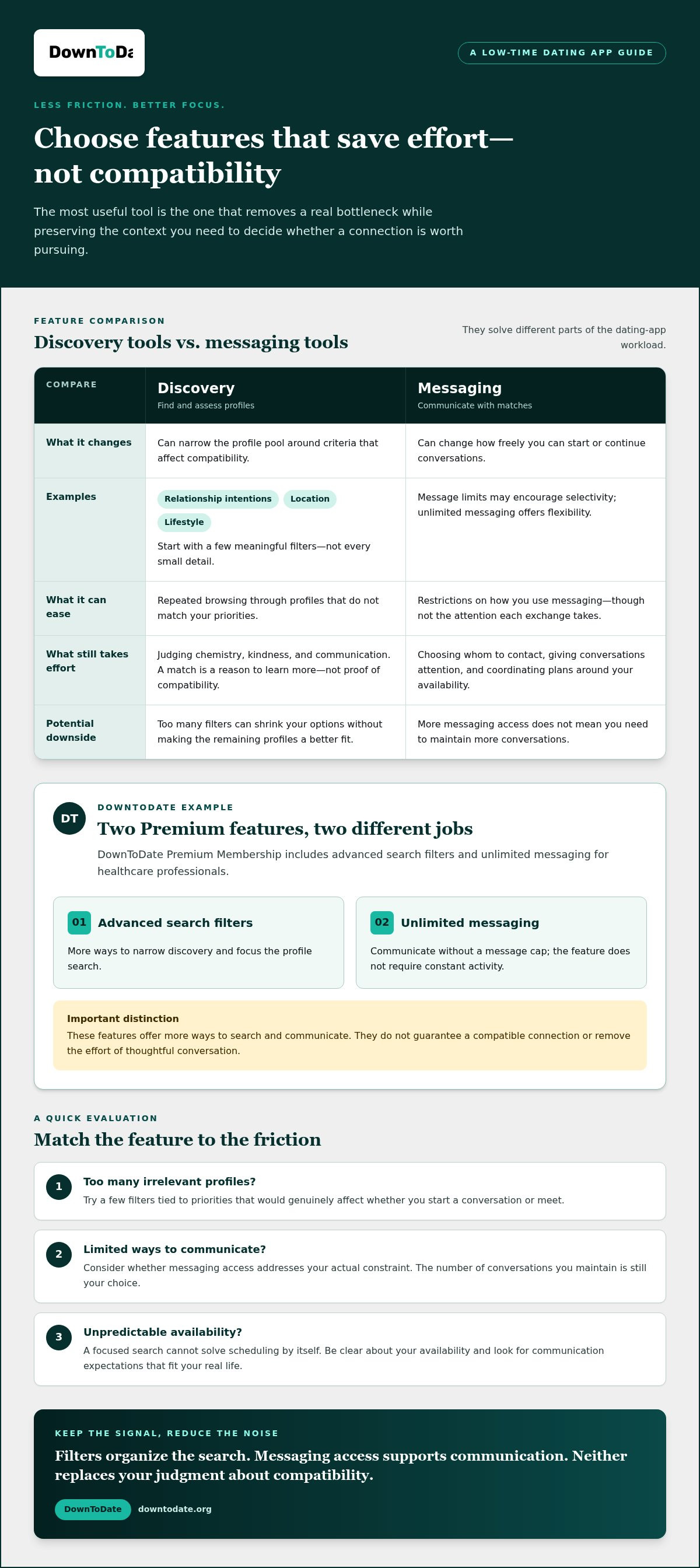
Filters can make discovery more focused by narrowing profiles around criteria that genuinely affect compatibility. Depending on your priorities, those might include relationship intentions, location, or lifestyle. Start with a few meaningful preferences. Filtering for every small detail can shrink your options without making the remaining profiles a better fit.
Ask yourself: would this preference change whether you’d want to start a conversation or meet? If yes, it may deserve a place in your search. If not, leave room for curiosity. Filters organize the search, but they can’t assess chemistry, kindness, or how two people communicate. Treat a match as a reason to learn more, not proof that you’re compatible or a promise that you’ll spend less time dating.
Messaging tools and membership features
Messaging access and messaging effort are different things. A limit on messages may encourage selectivity, while unlimited messaging offers flexibility. Neither determines how many conversations you should maintain. The time involved still depends on whom you contact, how much attention you give each exchange, and whether you’re both clear about what you’re looking for.
DownToDate’s Premium Membership includes advanced search filters and unlimited messaging. These features give healthcare professionals more ways to narrow discovery and communicate without a message cap. They don’t require constant activity or guarantee a compatible connection. For a closer look at what’s included, see DownToDate Premium membership features.
Discovery features streamline how you find and assess profiles; activity features give you more ways to use the app. That distinction can help you decide whether a paid feature addresses a real bottleneck or simply adds more to do. Before paying for any upgrade, identify the friction you want to reduce: too many irrelevant profiles, limited ways to communicate, or difficulty finding people with a shared context.
Profile visibility and community focus can also shape who you encounter. Greater visibility may put your profile in front of more people, but more exposure doesn’t automatically mean more compatibility. A focused community can make shared professional context easier to find, though it can’t replace individual judgment. If meeting healthcare professionals who understand demanding work matters to you, you can explore DownToDate as a dating platform for healthcare professionals and decide whether that community fits your priorities.
Dating app approaches compared: which one fits your available time?
The best fit depends on where you want to spend your effort: screening a wider pool, considering a smaller set of recommendations, or meeting people who share a professional context. These categories are decision aids, not rankings. None guarantees faster dates or compatibility. Use the comparison to identify the discovery process that fits your priorities and the time you can give it.
| App approach | Typical discovery style | Where effort tends to go | Potential fit |
|---|---|---|---|
| Broad swipe-based apps | Browse a wide pool and decide profile by profile | More individual screening and choices about whom to contact | People who value variety and can manage more discovery |
| Curated platforms | Review a more guided or selected set of potential matches | Assessing recommendations and deciding which introductions merit attention | People who prefer a more structured discovery experience |
| Professional-focused communities | Discover people within a shared career context | Considering personal compatibility alongside professional understanding | People who value connection with peers familiar with their work |
Broad dating apps versus focused dating communities
Broad platforms offer variety, but you’re responsible for deciding which filters and profile details matter. Focused communities organize discovery around a shared context, such as a profession. That context can be a useful starting point, not a substitute for getting to know someone. Community size and personal compatibility still matter, so a narrower focus isn’t automatically a better fit for every user.
DownToDate is a focused dating platform for healthcare professionals. Its emphasis on the medical community is relevant if understanding demanding work is a priority, while broad apps may suit someone who wants to meet people across different backgrounds. Neither approach removes the need to assess values, communication, and relationship goals.
Match an app model to your schedule and priorities
Choose broad discovery if variety matters to you and you’re comfortable screening profiles against your own criteria. Consider focused discovery if shared work context is a meaningful priority and you’d rather begin with that common ground. The professional dating app evaluation guide can help healthcare professionals consider what matters in a career-focused dating community.
To decide, identify what currently takes the most effort: finding people who meet basic preferences, identifying shared priorities, or managing conversations around your schedule. Then choose the app model that addresses that specific friction. Dating apps that don't require a lot of time aren’t one universal category. They’re platforms whose discovery style fits your priorities and leaves you in control of how actively you use them.
A practical low-time routine for using dating apps consistently
A sustainable routine gives dating a place in your life without requiring you to be constantly available. The structure can stay steady even when your workweek doesn’t. Choose check-in moments that fit your schedule, then give each one a specific purpose instead of opening the app every time a notification appears.
Set a realistic cadence for browsing and replying
Pick a repeatable rhythm you can maintain, adjusting it around shifts, call schedules, and personal commitments. There’s no universal daily limit. What matters is that your app use feels intentional rather than like another obligation. Separate profile review from messaging so each session has a clear endpoint.
- Review profiles with a purpose. Look for alignment with priorities that matter to you, such as relationship intentions or lifestyle. Save or like profiles that prompt genuine interest, then stop browsing and give your attention to a promising conversation.
- Reply when you can give the exchange attention. A thoughtful response is more useful than a rushed one sent to satisfy an imagined deadline. If you’re interested but occupied, a brief note explaining that you’ll reply when you have a moment can set a considerate expectation.
- Keep conversations manageable. Focus on the exchanges you’re curious about rather than trying to maintain every match at once. If a conversation feels one-sided or no longer fits your goals, it’s reasonable to let it end respectfully.
- Set aside a separate moment for planning. Once interest is mutual, discuss a practical next step instead of letting the chat drift without direction. Consider both your schedules and the energy you’ll have available.
A delayed reply isn’t automatic evidence of disinterest. People have responsibilities, changing shifts, and periods when they can’t focus on a conversation. Look at the overall pattern and communicate directly rather than drawing conclusions from one gap. If you know your availability will be uneven, say so early to find out whether your communication expectations fit.
Move from app conversation to a compatible plan
Once you’ve established mutual interest, be clear and respectful about availability. You might explain that your schedule changes and suggest discussing plans when you can see a realistic opening. A flexible proposal, such as choosing a day after checking work commitments, can be more considerate than promising a time you may need to change. For additional perspective on finding time for dating as a medical professional, consider how your work patterns affect both communication and plans.
Dating apps that don't require a lot of time work best alongside habits you can sustain. The aim isn’t to maximize activity; it’s to make room for genuine interest without letting app use take over. If a shared medical-professional context matters to you, explore DownToDate’s community for healthcare professionals as one way to meet people who understand the demands of your work.
When DownToDate may suit healthcare professionals short on time
A focused dating community is worth considering if shared professional context matters to you. Healthcare work can shape schedules, energy, and availability. Meeting someone who understands that environment can make it easier to discuss those realities, though a common occupation is only a starting point. Compatibility still depends on individual values, communication, and what each person wants from a relationship.
What a healthcare-focused dating community offers
DownToDate is a dating platform designed for healthcare professionals seeking romantic connections with peers. Medical professionals Dr. Shadi Rezai and Dr. Sasan Rezai founded and operate the platform. Shared context can help people recognize the pressures of demanding work, but it doesn’t guarantee understanding, attraction, or relationship success.
That distinction matters. A professional community can shape whom you’re likely to meet, but it can’t determine whether you share priorities beyond work. Consider how someone communicates, what they value, and whether your schedules and relationship goals feel compatible. Treat professional common ground as useful context, not a substitute for getting to know the person behind the profile.
How to decide whether this approach fits
DownToDate suits healthcare professionals who value a focused community and want tools to make discovery more directed. Its Premium Membership includes advanced search filters, unlimited messaging, enhanced profile visibility, and community features. Filters can help members narrow their search around relevant preferences, while unlimited messaging provides access without a message cap. Neither feature requires constant use or guarantees faster matches.
Consider whether these features address your actual priorities:
- Advanced search filters: Useful if you want to narrow discovery around preferences that matter to you.
- Unlimited messaging: Relevant if you value being able to communicate without a set message limit while choosing your own pace.
- A focused community: A potential fit if meeting healthcare professionals who may understand demanding work is important to you.
- Enhanced profile visibility: A feature to weigh if profile exposure matters in how you approach discovery, without assuming it will produce a particular outcome.
Your best choice depends on how you prefer to meet people. A broad app may offer more variety; a professional-focused platform may better reflect the context you want to share. Decide based on your priorities, schedule, and comfort with each discovery style, rather than assuming one model is automatically more efficient.
If a healthcare-focused community feels aligned with what you’re looking for, Explore DownToDate and find your community.
Make space for connection on your terms
Your next step doesn’t need to be a complete dating overhaul. Choose one small adjustment that makes the process more manageable, whether that’s being clearer about your availability or focusing on people whose priorities align with yours. Then give yourself room to see how it feels. A sustainable approach should support your life, not compete with it.
The right dating apps that don't require a lot of time are the ones that make intentional connection possible within your real schedule. You don’t need to be constantly online to show genuine interest. You need a discovery experience and a communication rhythm that work for you.
If you’re a healthcare professional looking to meet people who understand the demands of your work, take a closer look at DownToDate. Explore DownToDate and meet healthcare professionals who understand your world. A more practical path to connection can start with one considered choice.
Frequently Asked Questions
Are there dating apps that do not require a lot of time?
Yes. Some apps make it easier to focus your search, but no platform removes the time involved in getting to know someone. Dating apps that don't require a lot of time may suit people who want to limit repetitive browsing and focus on conversations with genuine potential. Before choosing one, decide what you want to spend less time doing, then look for features and a community that address that specific need.
How much time should I spend on a dating app each day?
There’s no set daily amount that works for everyone, and you don’t need to open an app every day to date with intention. Choose a rhythm that feels manageable across a typical week, then adjust it if it begins to compete with rest or responsibilities. A useful check is whether your app use leaves you feeling engaged and clear-headed or pressured to keep checking for new activity.
Can dating apps work if I have an unpredictable work schedule?
Yes, if you communicate your availability honestly and look for people who can work with some uncertainty. You don’t need to provide a detailed account of your job; a simple explanation that your schedule can shift helps set expectations. For example, you might suggest confirming a plan once your next work commitments are clear. If someone needs a different level of predictability, that’s useful information about fit.
Do paid dating app features actually save time?
They can reduce a specific source of friction, but paying doesn’t guarantee fewer steps or better matches. Before subscribing, identify the problem: perhaps you need more control over search criteria, or you want messaging access without a cap. Then assess whether the feature addresses it. DownToDate Premium includes advanced search filters and unlimited messaging, but the time spent choosing whom to contact and communicating remains personal.
Is a niche dating app better than a mainstream app for busy professionals?
Not automatically. A niche app may make a shared interest or professional background more central to discovery, while a mainstream platform can expose you to a wider mix of people. Consider which starting point matters more to you and whether you’re comfortable with the size and focus of the community you’re joining. A shared profession can offer context, but compatibility still depends on the individuals.
Can I take a break from dating apps without losing momentum?
Yes. Taking a break can help you return with clearer priorities rather than using an app out of habit. If you’re already having a conversation you value, send a brief note that you’re stepping back and say whether you’d like to stay in touch. You can also decide in advance what would make you ready to return, such as having more emotional energy or a less demanding stretch at work.
What should healthcare professionals look for in a low-time dating app?
Look for an audience and discovery tools that match your priorities. Healthcare professionals may value a community designed for peers who understand the demands of medical work, along with search options that help them focus on relevant preferences. Consider whether the app’s communication features suit your own pace, rather than assuming you must always be available. DownToDate is a dating platform for healthcare professionals seeking romantic connections.


