

What if dating someone as driven as me could create more connection, not more competition? When two demanding careers shape the week, it’s natural to wonder whether there’ll be enough time for intimacy, whether a partner will welcome your success, and whether shared ambition will become a contest. Those concerns deserve more than a quick reassurance.
Ambition can be a source of mutual respect, but it doesn’t guarantee compatibility. The difference lies in how each person handles priorities, celebrates progress, and makes room for the relationship without asking either partner to shrink. You can take each other’s goals seriously and still protect time, trust, and a sense of “us.”
This guide will help you recognize healthy alignment, spot signs of competition, and talk about goals and time without diminishing either person’s priorities. We’ll explore how to support each other through demanding seasons while preserving individual identity and shared connection. The aim isn’t to find someone with an identical career or schedule. It’s to build a partnership where drive works for both of you.
Key Takeaways
- Define drive broadly, from professional growth to creativity, service, curiosity, and discipline.
- Learn practical ways to support a partner’s goals without turning encouragement into pressure.
- When dating someone as driven as me, look for behaviors that show partnership rather than status competition.
- Use four adaptable conversations to explore ambition, time, support preferences, and relationship intentions.
- Reflect on respect, reciprocity, time, and shared intentions; a partner’s profession alone can’t establish compatibility.
Dating Someone Driven: Defining What Drive Means
Wanting a partner who understands your goals and the sustained effort behind them is reasonable. You may not want to translate why a demanding week matters, why a project keeps your attention after hours, or why meaningful progress can take patience. Shared understanding can make it easier to feel seen. But it starts with knowing what “driven” means to you, rather than treating a particular career path as the definition.
Drive can look like professional growth, but it can also come from purpose, curiosity, discipline, service, or creativity. One person may be committed to advancing in healthcare; another may be focused on community work, further study, or a personal project. The visible outcomes differ. What connects them may be the willingness to keep showing up for something that matters.
The idea of achievement motivation offers one useful lens: people can be motivated to pursue goals and improve their performance. In a relationship, though, a job title or impressive milestone doesn’t tell the whole story. Notice how someone follows through, responds to setbacks, and treats the people around them while pursuing what matters.
Shared ambition means respecting each other’s meaningful goals and effort, even when your careers, schedules, and milestones take different paths. Equal drive isn’t identical achievement. It’s mutual regard for what each person is building.
What does it mean to date someone equally driven?
It means you can take each other’s goals seriously without needing to want the same things. One partner might pursue a leadership role while the other invests in study or a community initiative. Look for motivation paired with follow-through, not status, income, or job title alone. Ask what gives someone’s goal meaning, and notice whether their actions reflect that answer.
Drive may be evident in a healthcare professional’s commitment to improving their skills, a volunteer’s steady service, or an artist’s discipline in developing a project. These efforts aren’t interchangeable, and they don’t need to be. What matters is whether both people make room for the other’s priorities and show genuine respect, rather than ranking whose work counts more.
Why shared ambition can feel both exciting and uncertain
There’s real appeal in being with someone who understands professional pressure without requiring a full explanation. At the same time, two goal-focused people may wonder whether time together will get squeezed, whether support will turn into comparison, or whether achievement will take priority over attention. Those questions are worth noticing, not treating as proof that the relationship is doomed.
Compatibility comes from behavior and values, not ambition alone. Pay attention to whether you can be pleased for each other’s progress, talk openly about competing demands, and stay curious about life beyond work. If one person’s goal consistently takes precedence, that pattern deserves conversation. If each can pursue purpose while making space for the relationship, different goals can still fit together.
How Shared Ambition Can Strengthen a Relationship Without Taking It Over
Mutual ambition can bring energy and respect to a relationship. You understand why a goal matters, and you can encourage each other without treating every busy week as evidence that work matters more than love. The difference is whether support feels like an invitation or an expectation. Encouragement leaves room for each person’s pace, priorities, and definition of progress.
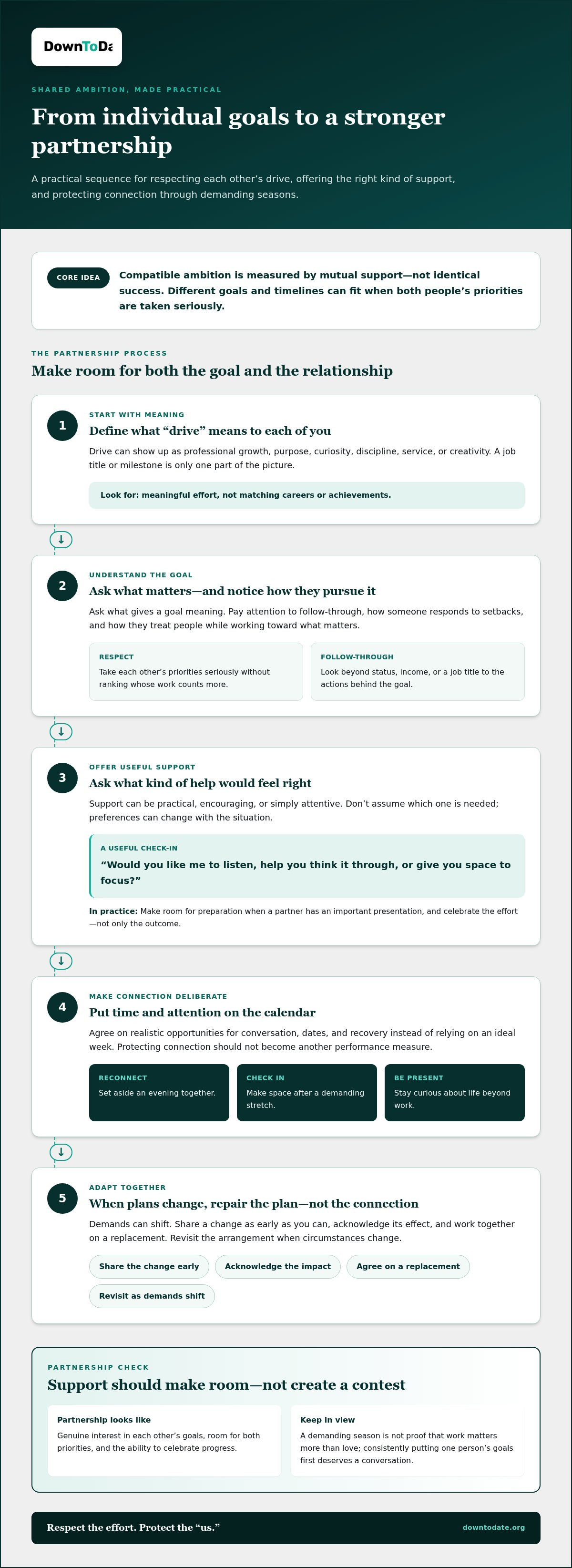
Compatible ambition is measured by mutual support, not identical success. One partner might be working toward a professional milestone while the other focuses on a personal project or a change in direction. Neither needs to match the other’s timetable. Both should feel that their priorities can be discussed and taken seriously.
That support also depends on emotional availability. Asking thoughtful questions, listening without immediately offering solutions, and staying curious about each other’s lives make it clear that a partner is more than a career or a list of goals. For anyone dating someone as driven as me, that balance matters: share the effort, but keep seeing the person behind it.
What supportive ambition looks like in everyday life
Support is often practical and specific. You might protect an evening so your partner can prepare for an important presentation, then celebrate the work they put in, not just the outcome. They might listen as you talk through a decision without turning it into an opportunity to compare achievements. A sincere “I know this matters to you” can carry more weight than unsolicited advice.
Don’t assume you know what help looks like. Ask, “Would you like me to listen, help you think it through, or give you space to focus?” Preferences can change with the situation. Some days, a partner wants encouragement; on others, they may need a quiet meal together and a conversation that has nothing to do with work.
How to protect connection when both people have demanding goals
Connection needs space in the calendar and attention in the moment. Agree on realistic opportunities for conversation, dates, and recovery, rather than relying on an ideal week that rarely arrives. A simple plan, such as setting aside an evening to reconnect or checking in after a demanding stretch, helps make closeness deliberate without making it another performance measure.
Plans will sometimes change. Share the change as early as you can, acknowledge its effect, and work together on a replacement instead of leaving one person to absorb the disappointment. Then revisit the arrangement if demands shift. Flexibility works best when both people participate, rather than one partner repeatedly adapting in silence.
For practical ideas on making plans around changing work demands, explore dating with an unpredictable schedule. Healthcare professionals seeking peers who understand the demands of medical careers can also explore DownToDate’s dating community. Shared context can make understanding easier to begin; everyday care is what helps a relationship grow.
Dating Someone Driven: Partnership or Competition?
Two ambitious partners can still want different things. The useful question isn’t who is more successful, or whether your goals move at the same speed. It’s what happens between you when one person gets an opportunity, faces a setback, or needs to make a difficult choice. In dating someone as driven as me, watch for patterns of behavior rather than relying on labels like “supportive” or “competitive.”
Support often shows up as interest without interrogation: your partner asks what a goal means to you, listens when progress is slow, and can celebrate your good news without redirecting the conversation to their own accomplishments. Competition may appear through repeated scorekeeping, minimizing a partner’s progress, or treating time and sacrifices as proof that one career matters more.
Signs ambition is mutual rather than competitive
Notice whether both people can talk about setbacks without ridicule, offer compromises that protect each person’s priorities, and make room for each other’s opportunities. A disagreement about a demanding season doesn’t automatically signal incompatibility. It may reveal an unmet need, such as reassurance, shared planning, or more influence over decisions. Pay attention to whether you can name that need and work on it together.
| Behavior | Likely meaning | Useful conversation prompt |
|---|---|---|
| They ask follow-up questions about your goal and remember what matters to you. | They’re showing genuine interest, not just assessing its status. | “What would help you feel involved in this part of my life?” |
| Your achievement is met with a comparison or quickly redirected to theirs. | The interaction may be becoming a contest for recognition. | “Can we celebrate this moment before comparing our experiences?” |
| One person repeatedly changes plans for the other’s work. | The compromise may be falling unevenly on one partner. | “How can we make this plan work for both of our priorities?” |
| You can discuss a setback without blame or mockery. | There’s room for honesty and emotional safety. | “Would listening, advice, or space feel most useful right now?” |
Use these as openings for conversation, not a scorecard. One awkward response doesn’t define a relationship; a repeated pattern, especially after you’ve explained its effect, deserves closer attention.
When different definitions of success need an honest conversation
Success might mean leadership to one partner and meaningful work with protected personal time to the other. You may value visibility, while your partner prefers steady progress; financial priorities, appetite for responsibility, or the pace of change can differ too. Different goals can coexist when respect is mutual and expectations are practical.
Ask, “What does success mean to you right now?” Then explore what could change. A goal that feels essential today may shift with new responsibilities or interests. Talk about what those changes could mean for decisions you make together, including time, location, and whose plans take priority in a given season.
Look for a conversation that makes room for both answers. You don’t need matching milestones. You do need a way to discuss trade-offs without treating one person’s ambition as the default and the other’s as an obstacle.
Dating Someone Driven: Four Early Conversations
These conversations aren’t an interview or a test of whether someone deserves a place in your life. They’re openings for both people to share what matters, listen without defensiveness, and see how priorities might fit together. You don’t need to cover every subject on one date. Let curiosity guide the timing, and offer your own answers too.
- What are you working toward right now? Ask what currently feels meaningful, whether that’s a career goal, a personal project, further study, or something else. You might follow up with, “What makes that important to you?” Share your own priorities in return. The aim is to understand the meaning behind each goal, not compare ambition or measure whose plan sounds more impressive.
- What kind of time and connection feels realistic? Talk about what your weeks tend to look like and how you like to stay in touch during busy periods. Ask, “What does making time for someone look like for you?” Be honest about your availability without presenting it as an apology or a promise you can’t keep. This gives both people a clearer basis for planning.
- What support feels useful when work gets demanding? One person may want space to focus; another may appreciate a check-in or a chance to talk through a decision. Ask, “Would listening, flexibility, or celebrating a milestone help most?” Explain what you prefer as well. Specific requests make support easier to offer and reduce the pressure to guess correctly.
- What are you hoping to build with someone? Invite a conversation about relationship intentions without demanding certainty or rushing commitment. You could ask, “What would you like a relationship to make room for?” Discuss how partnership might sit alongside independent interests, friendships, and personal goals. Intentions can be clear even while the details of a new connection are still unfolding.
Keep the exchange reciprocal. After asking a question, answer it yourself; if one person shares something personal, respond with interest rather than immediately turning the conversation back to your own experience. It’s fine to say, “I’m still figuring that out.” Honest uncertainty can open a better conversation than a polished answer designed to impress.
These discussions aren’t a one-time agreement. As responsibilities, careers, or feelings change, return to what each of you needs and adjust expectations together. Healthcare professionals may find profession-specific context useful, and dating for doctors explores that setting. If you’re ready to meet healthcare professionals who understand demanding medical careers, explore DownToDate’s dating community.
Find a Partner Who Respects Your Drive and Makes Room for Connection
A strong match isn’t simply someone with an impressive career or a full calendar. It’s someone whose actions show respect for your priorities and whose expectations leave room for connection. If you’re dating someone as driven as me, shared motivation may feel promising, but compatibility becomes clearer through everyday choices: how you handle plans, respond to each other’s needs, and make decisions together.
Turn what you’ve learned into a grounded next step. Before your next date, write down two values you won’t compromise on and two areas where you’re open to flexibility. Your non-negotiables might include mutual respect or serious relationship intentions. Flexible areas might include how often you see each other during a busy period or how you divide time between independent goals and shared plans. The point is clarity, not a rigid set of rules.
Then choose one question to bring into conversation. Ask what a fulfilling life looks like to the other person right now, or what kind of support feels meaningful when work is demanding. Share your own answer. You’re opening a discussion, not conducting an evaluation. Notice whether curiosity and honesty move in both directions.
Use a simple reflection after spending time together:
- Respect: Do you both take each other’s goals and personal priorities seriously?
- Reciprocity: Are listening, flexibility, and effort shared rather than carried by one person?
- Time: Do your plans make realistic space for connection as well as individual responsibilities?
- Shared intentions: Are you moving toward relationship expectations that can coexist?
Look for consistency over time. Someone may speak confidently about ambition, but how they respond to your success, respect an agreement, or revisit a plan will tell you more than a polished description of their goals. You don’t need perfect alignment at every moment. You do need a willingness to consider each other as circumstances change.
For healthcare professionals, shared experience can make some pressures easier to understand. A partner who knows the demands of medical work may recognize why plans shift or why a particular goal matters. Still, a profession can’t establish emotional availability, respect, or relationship compatibility on its own. Those qualities show up in how two people treat each other.
DownToDate is designed for healthcare professionals seeking meaningful connections with peers who understand the realities of medical careers. That shared context can be a useful starting point, while compatibility develops through the same conversations and behaviors that matter in any relationship. If you’d like to meet people in that community, explore DownToDate at your own pace.
Make Your Next Step a More Intentional One
You don’t need to have every detail of a future relationship figured out before you begin. You can move forward with clarity about the kind of connection you want, while staying open to learning who someone is through conversation and consistent actions. Dating someone as driven as me can work when ambition is part of a shared life, not a measure of whose priorities matter more.
For healthcare professionals, meeting someone who understands the realities of medical work can offer a familiar starting point. DownToDate was founded and is operated by medical professionals Dr. Shadi Rezai and Dr. Sasan Rezai, and is designed for healthcare professionals seeking meaningful connections with peers. Shared professional context can support understanding, while genuine compatibility grows through the relationship itself.
If you’re ready to meet people who understand your career’s demands, meet healthcare professionals on DownToDate. Take the next step at your own pace, with room for both meaningful connection and the ambitions that make your life your own.
Frequently Asked Questions
Is it a good idea to date someone as ambitious as you?
Yes, it can be a good idea to date someone whose ambition you respect, provided you also enjoy each other’s company outside achievement. If you’re dating someone as driven as me, treat shared motivation as a point of connection, not proof you’ll want the same life. Notice how you feel after conversations about work: understood and encouraged, or evaluated and pressured? That response offers useful information.
Can two highly driven people have a healthy relationship?
Yes, two highly driven people can have a healthy relationship if both protect space for the partnership, not only their individual goals. For example, agree on how you’ll handle a demanding stretch before it begins, then check whether the plan still feels fair afterward. A healthy dynamic doesn’t require identical schedules or constant availability. It requires both people to stay engaged and address disconnection rather than letting it become the default.
How do you stop ambition from becoming competition in a relationship?
Make recognition and comparison different conversations. If one person shares good news, give that moment attention before discussing your own related experience. If a competitive tone appears, describe the behavior calmly: “I wanted to share this with you, not compare our progress.” You can also agree to talk openly about envy or disappointment without blame. Naming a reaction gives you both a chance to understand it before resentment builds.
What should I look for in a partner who supports my goals?
Look for follow-through in small moments. A supportive partner may remember an important date, ask how a challenging meeting went, or respect a boundary you set while focusing on a project. They don’t need to solve every problem or share your expertise. Notice whether they take your needs seriously without making you feel guilty for having them, and whether you offer the same consideration in return.
Can partners have different career goals and still be compatible?
Yes, different career goals can fit together if both people respect the choices and can discuss practical effects. One partner might want a demanding leadership role while the other prefers a steadier path with more personal time. Talk about what each choice could mean for shared decisions, such as where to live or how to handle expenses. Compatibility depends less on matching titles than on whether expectations can be negotiated fairly.
How do you make time for dating when both people are busy?
Build a simple routine around the time you can genuinely offer. You might agree to a short call on a predictable day and plan your next in-person date before the current one ends. Keep a backup idea for weeks when plans change, such as a brief walk or a meal at home. Regular, attentive time can help you stay connected without treating dating like another demanding performance target.
Should couples in demanding careers set shared goals?
Shared goals can help couples make joint decisions, but they don’t need to turn the relationship into a project plan. Choose something both people value, such as protecting time for a regular activity or preparing for a future move. Be clear about each person’s role and revisit the goal if circumstances change. Keep individual ambitions in view too, so shared progress doesn’t depend on one partner giving up what matters.


