

What if being understanding of a surgeon’s schedule didn’t mean putting your own needs on hold? Plans can change when clinical demands shift, and a delayed message may have a practical explanation. Still, managing relationship expectations with a surgeon shouldn’t require one partner to disappear. Your need for clarity, consideration, and time together matters too.
It’s reasonable to expect flexibility in a relationship shaped by surgical work. It’s also reasonable to expect honest communication and effort from both people. The key is distinguishing a demanding schedule from a pattern where your needs are repeatedly overlooked.
This guide will help you set realistic expectations, communicate what you need, and protect boundaries without dismissing the realities of a surgical career. You’ll find practical ways to plan and stay connected, respond when plans change, and assess whether flexibility is reciprocal. A surgeon’s schedule and lifestyle can vary, but mutual respect remains essential.
Key Takeaways
- Start by identifying what a surgeon’s schedule can realistically accommodate, then agree on practical alternatives when plans change.
- Managing relationship expectations with a surgeon means making room for clinical demands without treating every disappointment as inevitable.
- Look at patterns over time: occasional unavoidable changes differ from repeatedly disregarding plans or agreed needs.
- Use a calm, focused conversation to describe what’s happening, state a concrete need, and agree on one change to try.
- Define your essential needs, flexible preferences, and boundaries so you can assess compatibility through care and follow-through.
Managing relationship expectations with a surgeon starts with understanding the pressures
Setting expectations isn’t a request for constant access. It’s a mutual agreement about how two people will stay connected while working within real constraints. A surgical career may involve demanding responsibilities, changing schedules, or periods of fatigue. Those pressures can explain why a plan shifts, but they don’t make the disappointment irrelevant or remove the need to talk about its impact.
Flexible expectations adapt to real constraints; having no expectations leaves one partner’s needs undefined. The aim isn’t to prevent every disruption. It’s to make room for dependable communication, consideration, and repair when time together has to change. The trust, respect, and communication emphasized in the doctor-patient relationship offer a useful reminder that clear communication matters, though a romantic partnership has its own needs and responsibilities.
Which assumptions can create avoidable conflict?
Don’t let a job title fill in the blanks. Prestige doesn’t prove someone is emotionally distant, income doesn’t guarantee availability, and assumptions about work hours can obscure what this person’s schedule is actually like. Ask about their responsibilities, how much notice they usually have, and what tends to disrupt plans. Treat the answer as individual context, not a rule about every surgeon or specialty.
Then compare expectations with observed behavior. A surgeon may be unable to predict a particular workday, yet still communicate when possible and show care in other ways. The useful question isn’t whether the schedule matches a stereotype. It’s whether both partners can discuss its effects and make decisions together.
What can a surgical career affect in everyday dating?
Depending on the person and workplace, clinical responsibilities may make some plans harder to confirm far in advance. A demanding stretch may also leave less energy for conversation or social time. These are possibilities, not universal features of dating a surgeon. Work patterns can differ by role, training stage, specialty, workplace, and personal boundaries around work.
That distinction helps keep a real constraint from becoming a blanket excuse. Ask what is predictable, what can change unexpectedly, and how you’ll reconnect after a disruption. Focus on what each person can reasonably do instead of expecting certainty from a schedule that may not offer it.
Start with specifics, not assumptions. Together, clarify:
- Which plans can usually be made ahead of time?
- How will you communicate when a commitment changes?
- What alternative would help preserve connection?
- When will you revisit the arrangement if it isn’t working?
These questions don’t demand that professional responsibilities disappear. They make space for both lives in the relationship. Managing relationship expectations with a surgeon means acknowledging the pressures while staying honest about what helps you feel considered. Context matters. So do your needs.
How to build shared expectations around a surgeon’s schedule and availability
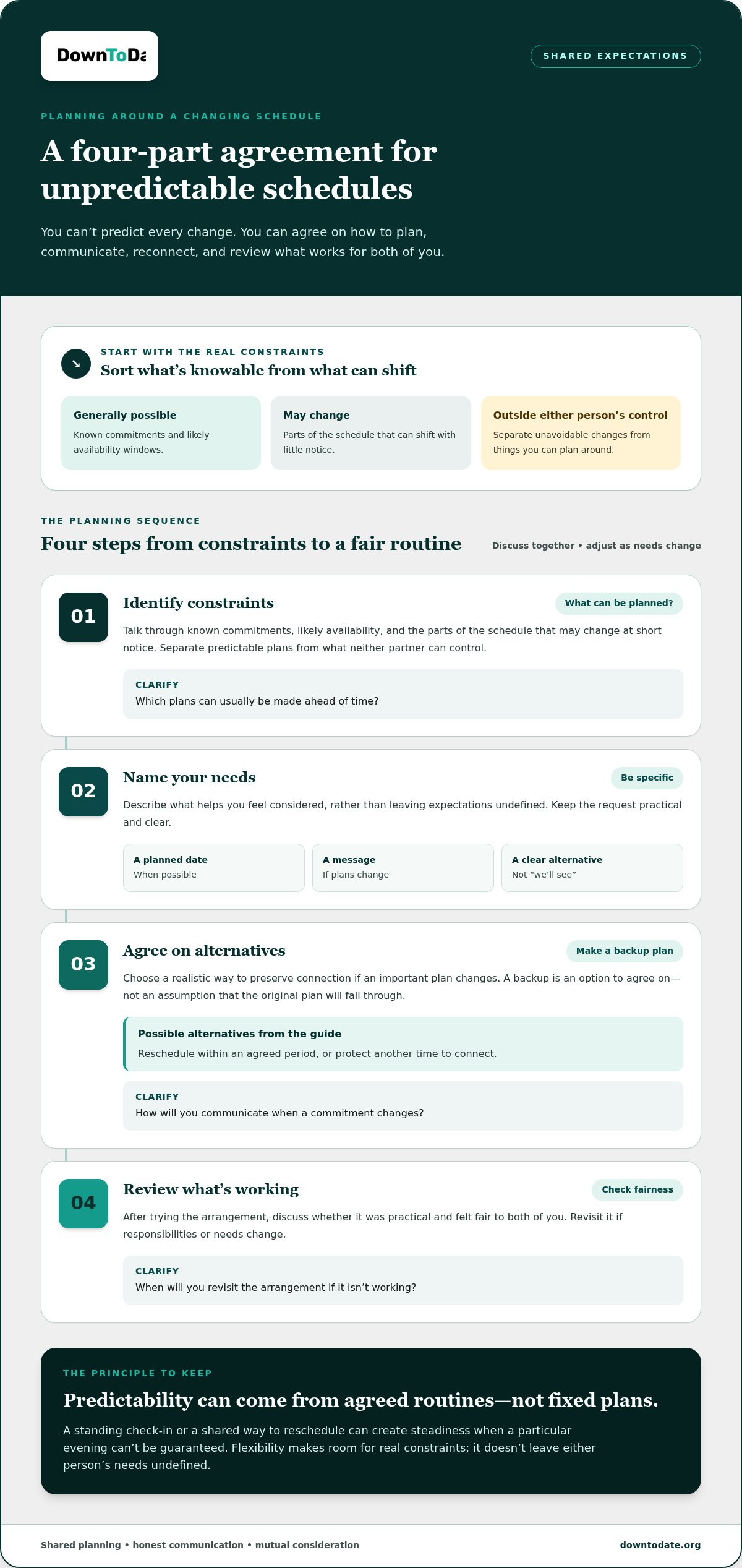
A workable plan doesn’t depend on predicting every change. It depends on understanding what’s generally possible, how you’ll respond when circumstances shift, and how both partners can stay connected. For managing relationship expectations with a surgeon, use a simple sequence: identify constraints, name needs, agree on alternatives, then review what’s working.
- Identify constraints. Discuss known commitments, likely availability windows, and parts of the schedule that can change with little notice. Separate what’s predictable from what neither partner can control.
- Name needs. Be specific about what helps you feel considered. You might want a planned date when possible, a message if plans change, or a clear alternative rather than an open-ended “we’ll see.”
- Agree on alternatives. Choose a realistic backup for plans that matter, such as rescheduling within an agreed period or protecting another time to connect. A backup is an option, not an assumption that the original plan will fall through.
- Review. After trying the arrangement, discuss whether it was practical and felt fair to both of you. Adjust the agreement as responsibilities or needs change.
Predictability can come from agreed routines, not fixed plans. A standing check-in or a shared understanding of how to reschedule can create steadiness even when a particular evening can’t be guaranteed. For more perspective on making plans amid changing demands, see this guide to dating with an unpredictable schedule.
How can couples plan when schedules may change?
Before committing, compare calendars and talk through likely availability, known work obligations, and personal plans. For a meaningful event, agree on a backup that still feels worthwhile, such as choosing a flexible reservation or identifying another date. Avoid treating cancellation as inevitable. Planning for a possibility can reduce stress without making disappointment the default.
Not every change has the same cause. An urgent, unexpected responsibility may leave little room to plan. A recurring commitment or routinely busy period may be easier to anticipate. Discuss the difference without turning one disruption into a verdict on the relationship. Look for useful patterns over time, then plan around what’s reasonably knowable.
What communication agreements are realistic?
Agree on a practical way to share changes when feasible. For example, decide whether a text is enough to flag a disruption and when you’ll reconnect to discuss a new plan. This isn’t a demand for constant updates. It’s a clear, mutual approach that respects work demands and the other partner’s need to know what’s happening.
Ask directly for reassurance or connection rather than using hints or tests. “If tonight changes, could you let me know when you’re able and suggest another time?” is clearer than withdrawing and hoping your partner guesses why you’re hurt. The agreement should work both ways, including how each person communicates availability, disappointment, and follow-through. DownToDate is a dating platform for healthcare professionals, with Premium Membership offering advanced search filters and unlimited messaging. Explore connections with healthcare professionals as one possible starting point. Shared career context can help open a conversation, but it can’t replace honest communication.
Reasonable flexibility or one-sided compromise? How to assess the relationship
Supporting a surgeon doesn’t mean accepting any level of unavailability. A last-minute change may be unavoidable; repeated disregard for shared plans is a different pattern. The distinction isn’t whether work ever interrupts the relationship. It’s whether both people acknowledge the impact and make a genuine effort to stay connected.
Reciprocity doesn’t require matching schedules or equal amounts of free time. It means both partners’ circumstances and needs count. One person may have fewer chances to adjust a work commitment, while the other has more flexibility. What matters is whether that flexibility is treated as a shared resource, not an expectation placed permanently on one partner.
What does healthy flexibility look like?
In a flexible relationship, a disrupted plan is acknowledged rather than brushed aside. The person whose schedule changed communicates when able, and both partners consider a realistic way to reconnect. Perhaps one partner reschedules a dinner, while the other chooses a different activity that fits the available time. On another occasion, the surgeon may take the lead in proposing a new plan. Flexibility moves in both directions.
When should unmet needs prompt a direct conversation?
Notice recurring patterns, not just one difficult week. If agreed plans often change without acknowledgment, or you’re consistently the one proposing alternatives, describe the specific behavior and how it affects you. Then make a reasonable request, such as asking to hear about changes when possible and to help choose a new time. Keep the conversation focused on what happened between you and what would help next time.
Stay grounded in events rather than assigning a motive or label. For example: “When our plans changed twice and we didn’t set another time, I felt unsure whether we’d make space to see each other. Could we choose a new time together when a plan falls through?” This gives your partner a clear opportunity to understand the impact and respond.
After you raise a concern, pay attention to what follows. A constructive response doesn’t have to solve every scheduling challenge immediately. It should show willingness to understand, consider a workable adjustment, and follow through where possible. If the same concern keeps returning, that information matters too. Managing relationship expectations with a surgeon means making room for genuine professional constraints without treating your needs as optional.
- Flexible: A change is acknowledged, and both partners help find a way to reconnect.
- Potentially one-sided: One partner repeatedly absorbs the disruption while the other makes little effort to address its effect.
These are observations, not diagnoses. Look at the pattern and its effect on your connection. The goal isn’t to keep score; it’s to determine whether consideration and effort are mutual over time.
A practical conversation plan for setting relationship expectations with a surgeon
A sensitive conversation works best when it has a clear purpose: understand a recurring friction point and agree on one manageable adjustment. Managing relationship expectations with a surgeon doesn’t require a perfect script. It does benefit from preparation, a specific request, and room for both perspectives.
Try this four-step structure:
- Choose a calm time. Raise the topic when neither of you is rushing between responsibilities or already upset about a changed plan. Ask for a focused conversation rather than starting with an accusation in the moment.
- Describe the pattern. Use a specific observation, not a judgment about character. “Our last few plans changed, and we didn’t decide when to reconnect” is more useful than “You never make time for me.”
- State what you need. Make one concrete request. For example: “If you can’t make our plan, could you let me know when you’re able and suggest another time?”
- Agree on one experiment. Choose a realistic action to try, such as protecting a planned evening when possible or setting a brief check-in after a demanding stretch. Decide when you’ll discuss whether it helped.
Keep the request practical, not absolute. A partner may not be able to promise that work will never disrupt time together. They may be able to agree on how to acknowledge a change and make a sincere effort to reconnect.
How can you raise a sensitive need without sounding accusatory?
Pair an observable event with its impact and a request: “When our plans changed and I didn’t know whether we’d reschedule, I felt disconnected. Could we choose another time together when you’re able?” Then listen to the constraints your partner describes. Understanding them can shape the solution, but it shouldn’t erase the need you raised. Be open to adjusting the request while keeping its purpose clear.
How should couples revisit expectations as circumstances change?
Return to an agreement after a meaningful change, such as a new schedule, training stage, or shift in the relationship. Ask each other what’s working, what feels difficult, and what one adjustment might help. Keep the review brief and collaborative. It’s a way to adapt together, not a performance scorecard or demand for flawless follow-through.
A recurring check-in is a tool for adjustment, not surveillance. Its purpose is to make sure an agreement still supports both partners, not to monitor every message or evaluate every difficult day. After trying the experiment, acknowledge what improved and identify any obstacle without assigning blame. If the plan didn’t work, revise it together rather than treating one imperfect attempt as proof that change is impossible.
Clear conversations can help you recognize what matters in a partner beyond shared work experiences. DownToDate is designed for healthcare professionals, and Premium Membership includes advanced search filters and unlimited messaging to support more tailored connections. Connect with healthcare professionals on DownToDate. Shared context can be a starting point; thoughtful communication is what helps two people build expectations that fit their lives.
Decide what a sustainable relationship with a surgeon looks like for you
A sustainable relationship isn’t defined by how often plans change. It’s defined by whether the way you handle those changes leaves room for both people to feel respected and connected. Before deciding what works for you, separate what you need from what you’d simply prefer. That distinction can help you make a clear choice without expecting a surgeon’s job title to predict your compatibility.
Write down three categories:
- Minimum needs: the conditions that help you feel secure in a relationship, such as honest communication or making time to reconnect after a disruption.
- Flexible preferences: things you value but can adapt, such as which day you spend time together or how far ahead you plan.
- Personal boundaries: what you’re not willing to keep accepting, such as repeatedly setting aside your own plans without discussion.
These aren’t demands for a particular schedule. They’re a way to understand your own priorities and discuss them honestly. Shared understanding of medical life may make some conversations easier to begin, but it can’t guarantee compatibility or replace communication. Assess how the relationship feels in practice: whether care is expressed, agreements are taken seriously, and both partners can speak openly about what they need.
What signs suggest expectations are becoming workable?
Look for honest communication, meaningful repair after disruptions, and consideration of both people’s priorities. An agreement doesn’t need to work perfectly every time; notice whether it makes your day-to-day experience better and whether both partners are willing to adjust it. No checklist can predict whether a relationship will succeed. Patterns can, however, help you judge whether the effort feels mutual and sustainable for you.
Where can healthcare professionals meet people who understand medical life?
Shared professional context can offer an easier starting point for discussing demanding schedules, though it doesn’t remove the need to learn each other’s needs. DownToDate is designed for a verified healthcare community and offers tailored matching tools. Premium Membership adds advanced search filters, unlimited messaging, enhanced profile visibility, and exclusive community features designed to foster romantic connections. This context may be valuable if you’d like to meet people familiar with medical careers, while keeping compatibility and communication at the center.
Ultimately, managing relationship expectations with a surgeon means balancing understanding with self-respect. You can acknowledge the demands of clinical work and still decide what kind of connection you want. If meeting healthcare peers feels like a helpful next step, Explore DownToDate.
Choose the kind of partnership that fits your life
You don’t have to decide everything at once. Let your next step be an honest conversation, a clear boundary, or simply noticing whether care and effort are becoming more mutual. Managing relationship expectations with a surgeon isn’t about asking someone to choose between a career and a relationship. It’s about finding out whether the two of you can make a relationship meaningful without either person’s needs disappearing.
If you’re still looking for a partner who may understand the demands of healthcare, shared professional context can be one useful place to begin. DownToDate was founded and is operated by medical professionals, with Premium Membership features designed to support more tailored connections. That shared context can open a conversation, but the connection you build will still depend on how you communicate and treat each other.
Explore a community shaped around healthcare professionals when you’re ready to take that step: Explore DownToDate. Whether you meet someone through shared medical experience or a different path, you deserve a partnership grounded in respect, clear intent, and room for both lives.
Frequently Asked Questions
Is it normal to feel lonely when dating a surgeon?
Yes, feeling lonely can happen, and it doesn’t mean you’re unsupportive or asking for too much. Notice when the feeling is strongest: during long stretches without meaningful conversation, after plans change, or when you’re handling important moments alone. That detail can help you explain what kind of connection would help. Keep investing in friendships and interests outside the relationship too, so your emotional world doesn’t depend on one person’s availability.
Can a relationship with a surgeon work if I am not in medicine?
Yes. You don’t need medical training to build a close relationship with a surgeon. Curiosity and mutual respect matter more than knowing clinical terminology. You can ask what aspects of their work they’re comfortable discussing, while sharing your own experiences and priorities too. A partner’s role isn’t to become an expert in medicine or serve as a career counselor. The relationship needs room for both people’s lives beyond work.
How do I respond when a surgeon cancels a date because of work?
Respond honestly without assuming the cancellation says everything about the relationship. You might say you understand that work intervened and that you’re disappointed, then ask whether they’d like to find another time. If you need to decide what to do with your evening, say so directly rather than waiting indefinitely. Later, consider whether this was an isolated disruption or part of a pattern that needs a broader conversation.
Should I expect a surgeon to talk about difficult cases after work?
No. A surgeon may want to talk about how a demanding day affected them, but they may not want to discuss the details of a case. Let them decide what they’re comfortable sharing, and offer support without pressing for specifics. You can ask, “Would you rather talk, decompress quietly, or shift to something unrelated?” That gives your partner options and helps you show care without treating access to work details as a measure of intimacy.
How often should couples discuss relationship expectations?
There’s no single schedule that suits every couple. Discuss expectations when a recurring issue appears, after a meaningful change in work or personal circumstances, or when an existing arrangement no longer feels workable. A conversation can be brief: identify what has shifted and decide whether anything needs to change. Managing relationship expectations with a surgeon is an ongoing process, but it shouldn’t require constant monitoring or turning every interaction into a review.
What if my expectations and a surgeon’s schedule are incompatible?
Take the mismatch seriously without blaming either person. Clarify which needs are essential for you and which preferences could adapt, then consider what the surgeon can realistically offer. If the relationship repeatedly leaves important needs unmet despite honest discussion, compatibility may be the issue, not a failure to be patient enough. You’re allowed to decide that a particular arrangement doesn’t fit your life, even when both people care about each other.


