

What if a committed relationship didn’t depend on having a predictable schedule? Committed relationships for healthcare workers can grow through honest communication and mutual trust, even when shifts change, on-call duties interrupt plans, or work leaves little energy at the end of the day. You don’t need to promise constant availability. You do need a partner who understands that reliability comes from clear expectations, not perfect timing.
It’s understandable to worry that limited free time or emotional exhaustion will make consistent connection difficult. Healthcare work can shape when you’re available and what you have capacity for, but it doesn’t have to define the quality of your partnership. Shared professional context may help a partner understand your work, though compatibility still depends on your values, communication, and goals.
This guide covers practical ways to discuss schedule changes, set boundaries around work-related stress, and protect meaningful time together. You’ll also learn how to build trust without overpromising and recognize whether a partner’s expectations support a sustainable relationship. The aim isn’t to make your schedule effortless. It’s to make your connection more intentional.
Key Takeaways
- Committed relationships for healthcare workers can accommodate demanding schedules when both people set clear expectations and communicate steadily.
- Use a brief check-in to explain what changed, what you can manage, and when you can reconnect.
- Combine fixed plans with flexible planning windows to create a relationship rhythm that suits changing shifts.
- Discuss values, family plans, availability, and boundaries to assess compatibility beyond shared professional experience.
- Meeting healthcare peers can offer shared context, but assess each connection on its own merits.
Committed Relationships for Healthcare Workers Start with Realistic Expectations
A committed relationship is a partnership both people choose and sustain through trust, shared expectations, and ongoing communication. It isn’t measured by constant access or a perfectly predictable calendar. For healthcare workers, commitment can mean being clear about what work may interrupt, making plans thoughtfully, and following through when circumstances allow.
A general definition of a committed relationship offers a starting point, but each couple needs to decide what commitment looks like in daily life. Rotating shifts, call responsibilities, overtime, and schedule changes can affect when you’re free. Clinical work may also leave someone tired or emotionally spent, though demands differ across roles and workplaces. Those limits can be real without indicating a lack of care.
An unpredictable schedule is a logistical challenge, not proof of emotional unavailability. The distinction matters. A shift change may make a planned dinner impossible. Avoiding a conversation about the change, repeatedly cancelling without trying to reconnect, or dismissing a partner’s disappointment are different patterns that deserve discussion.
Why healthcare work can complicate dating and commitment
Plans made around a posted schedule may need to change when a shift runs long, overtime comes up, or call responsibilities interrupt personal time. After a demanding clinical day, someone may need quiet or rest rather than a full evening out. Not every healthcare role brings the same pressures, and a partner shouldn’t have to ignore their impact. Talk about the actual pattern instead of assuming every disruption is a choice.
Separate what neither person can control from what you can address together. A sudden work obligation may be unavoidable; how you communicate it and make room for the other person’s plans is something you can discuss. If a change becomes likely, share it as soon as practical. Acknowledge the inconvenience and suggest a realistic next step, rather than leaving your partner to guess whether the plan still stands.
What commitment can look like with limited availability
Committed relationships for healthcare workers can be dependable without requiring the same amount of free time as another couple has. Agree on what helps each of you feel considered. You might confirm plans before a shift pattern changes, send an update when timing is uncertain, or protect a short stretch of focused time together. These are options to discuss, not rules every couple must follow.
Meaningful presence isn’t simply a count of hours. A shorter visit with attention and shared conversation may feel more connected than a longer stretch spent distracted or exhausted. At the same time, one partner shouldn’t carry all the work of adapting. Both people need to say what they need, listen without treating every constraint as rejection, and revisit the arrangement when it stops working.
- Be specific about availability, including what remains uncertain.
- Agree on how to communicate a change of plans.
- Choose a workable way to reconnect, and follow through.
Realistic expectations don’t lower the standard for commitment. They make it possible to build trust around the schedule and energy you actually have.
How Healthcare Couples Build Trust Through Clear Communication
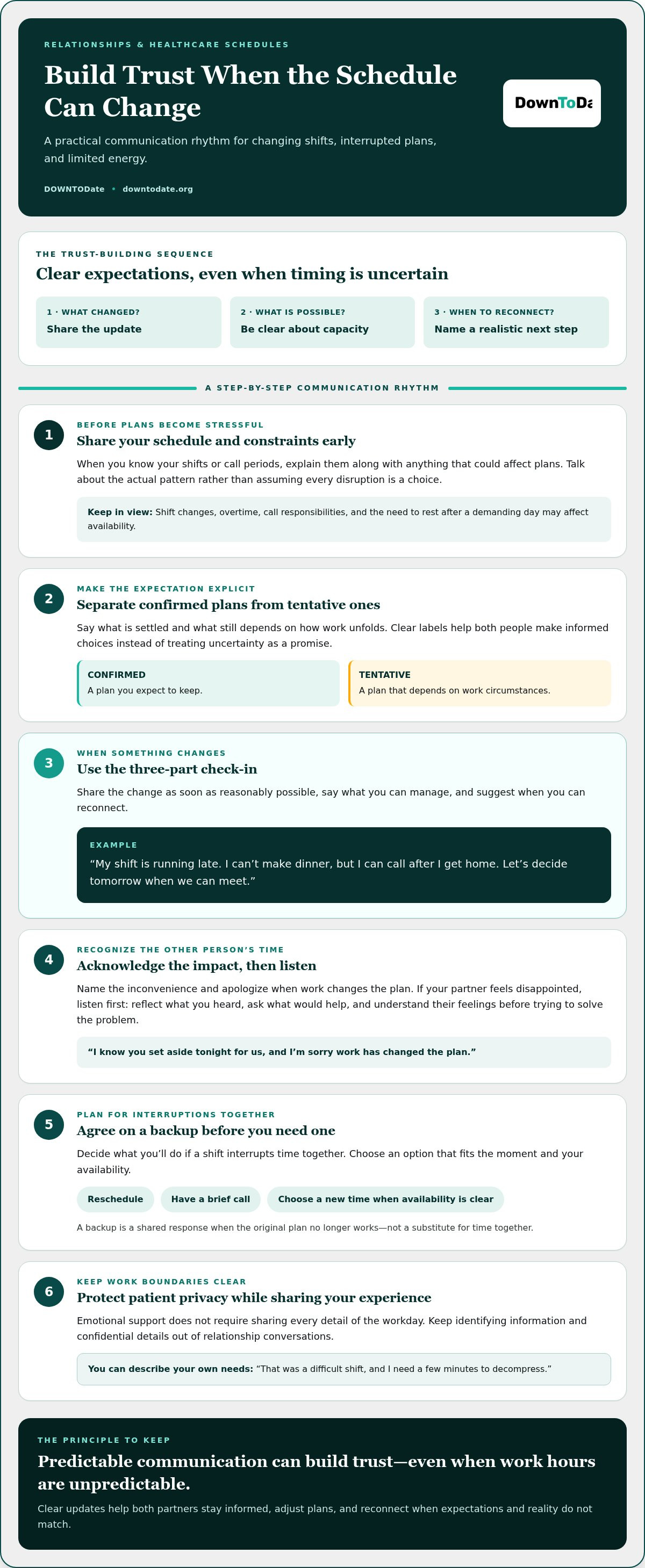
Trust grows when both people know what to expect, especially when work plans can change. A useful check-in covers three things: what changed, what is possible, and when to reconnect. For example: “My shift is running late. I can’t make dinner, but I can call after I get home. Let’s decide tomorrow when we can meet.” The details may differ. The clarity matters.
Share schedule changes as soon as you reasonably can, and acknowledge their effect. “I know you set aside tonight for us, and I’m sorry work has changed the plan” recognizes the other person’s time without turning a work disruption into a debate about your commitment. If your partner shares disappointment, listen first. Reflect what you heard, ask what would help, and wait to solve the problem until you understand how they feel.
Predictable communication can create trust even when work hours are unpredictable. It gives both partners a reliable way to stay informed, adjust plans, and repair the moment when expectations don’t match reality.
Talk about schedules before they become a source of conflict
When you know your shifts or call periods, share them early, along with any constraints that could affect plans. Label commitments clearly: a confirmed date is different from a tentative plan that depends on how work unfolds. This lets each person make informed choices instead of treating uncertainty as a promise.
Agree on a backup plan before you need one. If a shift interrupts an evening together, decide whether you’ll reschedule, have a brief call, or choose a new time once you know your availability. A backup isn’t a substitute for time together. It’s a shared way to respond when the original plan no longer works.
Set boundaries around work stress and personal privacy
Emotional support doesn’t require sharing every detail of the workday. Protect patient privacy by keeping identifying information and confidential details out of relationship conversations. You can still describe your own experience: “That was a difficult shift, and I need a few minutes to decompress,” without recounting private patient information.
A decompression routine might mean changing clothes, taking quiet time, eating, or having a short walk before talking. Discuss what works for you rather than expecting your partner to absorb every emotion as soon as you get home. Partners can ask, “Would you like me to listen, help you think it through, or give you space?” A clear answer helps each person support the other without guessing.
Committed relationships for healthcare workers benefit when communication is a shared practice, not one person’s responsibility. If meeting someone familiar with medical work matters to you, DownToDate’s healthcare professional community offers a way to connect with peers. Shared context can support understanding, while trust still grows through how two people communicate with each other.
Choosing a Relationship Rhythm That Fits Healthcare Schedules
A workable relationship rhythm should fit real schedules, not an ideal week that rarely arrives. Some couples prefer a fixed weekly plan because it creates a dependable point of connection. Others use flexible planning windows, choosing a day once shifts and energy are clearer. Many combine both: one regular anchor, with room to adjust around changing responsibilities.
There’s no single best routine. Consider both partners’ needs, work patterns, family responsibilities, travel time, and energy. A plan that reassures one person may feel rigid to another. Talk about what helps you feel connected, then try a routine and adjust it together.
- Rotating shifts: Choose a flexible window after schedules are known, and protect one shared activity when possible.
- Regular daytime hours: Set a recurring evening or weekend plan, with room to move it when responsibilities come up.
- Frequent call periods: Keep plans during call tentative and identify a lower-pressure alternative, such as a meal together when availability allows.
- Different work patterns: Look for overlapping time, even if it falls outside a conventional evening or weekend routine.
Plan connection around energy, not only calendar openings
A free hour isn’t always an energized hour. After a demanding shift, connection might mean eating together, taking a quiet walk, or sitting side by side without planning a major outing. Save occasional higher-energy time for an activity that needs more attention. Rest matters too. A healthy routine doesn’t turn every open block into a date or make either partner feel guilty for needing recovery.
Agree on flexibility without making one partner carry the plan
Both partners can initiate plans, suggest alternatives, and help maintain the rhythm. If training, shifts, or other responsibilities change, revisit the arrangement instead of assuming the old routine still fits. Rescheduling can acknowledge both people: “I’m sorry our plan needs to move. I know you made time for it. Could we choose another evening together?” Then work together on a replacement that suits both of you.
Flexibility shouldn’t mean one person always waits, reminds, or rearranges. Take turns proposing plans. Be open about what’s realistic, and treat suggesting an alternative as part of following through, not an afterthought. If a routine repeatedly leaves one partner feeling disconnected or the other feeling overcommitted, renegotiate it.
For more strategies tailored to changing work hours, explore dating with an unpredictable schedule. The goal isn’t to create a perfect calendar. It’s to build a shared rhythm that can adapt while still making room for meaningful time together.
How to Recognize Compatibility and Address Relationship Strain
Shared experience can help a partner understand the pressures of healthcare work. It can make conversations about shifts, fatigue, or professional demands easier to begin. But familiarity with medical life doesn’t guarantee compatible values, communication styles, or long-term goals. Committed relationships for healthcare workers still depend on whether both people respect each other’s needs and make room for a shared life.
Compatibility also doesn’t mean one partner must always accommodate the clinician’s schedule. Work constraints may be real, but both people’s time, rest, and responsibilities matter. Use these questions to turn assumptions into a direct conversation:
- Clarify values: What do respect, support, and partnership look like to each of you?
- Compare commitment goals: Are you seeking the same kind of relationship and direction?
- Discuss availability: How much time together feels meaningful, and what can each person realistically offer?
- Talk about family plans: If relevant, explore whether your hopes and timelines are aligned.
- Name personal boundaries: Consider work, rest, privacy, and social obligations. Where can you compromise, and where do you need a clear limit?
Discuss the expectations that shape long-term compatibility
Ask how each of you prefers to communicate, what commitment means in practice, and what helps you feel connected. Be specific about boundaries: one person may need quiet after work, while the other may value a brief check-in. Differences aren’t automatic deal-breakers. Ask what each preference protects, then look for an arrangement that respects both people.
Look at actions as well as stated intentions. Does each person try to understand the other’s priorities? Can you discuss a disagreement without dismissing or punishing one another? Shared professional context may offer a starting point for empathy, but day-to-day consideration shows whether that understanding translates into compatibility.
Address recurring tension before resentment takes hold
Choose a calm moment and describe a specific pattern, its impact, and what you’d like to change. For example: “When our plans change and we don’t choose another time, I feel like our time together is uncertain. Could we agree to revisit the plan the next day?” Invite your partner’s view, then identify one practical step each person can take. Keep the discussion focused on the pattern, not a judgment about character.
If the same conflict keeps returning despite honest efforts, or either person feels unsafe, consider support from a qualified relationship professional. Safety comes first; no one should feel pressured to remain in a harmful situation.
For more on challenges shaped by medical careers, read this relationship advice for doctors. If shared professional context matters in your search, explore DownToDate’s healthcare community and meet peers who understand medical careers.
Meet Healthcare Peers Who Understand the Demands of Medical Life
Finding a partner who understands medical work can make it easier to explain why a shift changed, why you need time to decompress, or why certain plans remain uncertain. Meeting healthcare peers is one way to begin with that shared context. It can open a conversation, but it can’t tell you whether two people want the same kind of relationship or are compatible over time.
Committed relationships for healthcare workers still grow through individual choices: how each person communicates, respects boundaries, handles conflict, and makes space for shared goals. A similar professional background may support understanding. It isn’t a substitute for asking what matters to the person in front of you.
How a healthcare-focused dating community can support connection
In a medical-focused community, members may already recognize some of the realities of healthcare careers. That common ground can offer a natural starting point for conversations about work and daily life. From there, get to know each other beyond the profession. Discuss values, expectations, and personal boundaries instead of assuming similar careers mean similar priorities.
DownToDate is a dating platform for healthcare professionals seeking meaningful relationships. Its tailored matching tools are designed to connect healthcare peers, and its community is for verified medical professionals. Shared context can help a conversation begin, but no platform or professional background can guarantee compatibility or relationship success. A connection still depends on how two people treat one another and whether their intentions align.
Start with intentional conversations and clear expectations
Be honest about what you’re looking for and what your schedule can realistically support. Early conversations can explore questions such as:
- What kind of relationship are you hoping to build?
- How do you prefer to stay connected during demanding work periods?
- What boundaries around work, rest, and personal time matter to you?
- What shared goals would you like a partner to understand?
Clear answers help both people decide whether to keep building the connection. They also make it easier to notice differences in expectations before either person relies on assumptions. Be open to learning about the other person’s work and life, even when their experience doesn’t mirror yours.
Premium Membership includes advanced search filters, which can help you focus discovery around personal priorities, along with unlimited messaging and enhanced profile visibility. These features make it easier to explore connections and communicate; they don’t replace thoughtful conversations or the work of assessing mutual fit.
If you’re ready to meet healthcare peers in a community built around medical professionals, explore DownToDate and begin with an honest conversation about the relationship you hope to build.
Take the Next Step Toward a Relationship That Fits
You don’t have to wait for work to become predictable before making space for connection. Start with one intentional step: get clear on what you’re seeking, then meet people whose lives may offer some understanding of your own. Committed relationships for healthcare workers begin with two people choosing to learn about each other, not with perfect timing.
DownToDate was founded and is operated by medical professionals Dr. Shadi Rezai and Dr. Sasan Rezai. Its focus on healthcare professionals offers a shared starting point for meeting potential partners, while each connection develops through honest conversation and individual compatibility.
Explore DownToDate and meet healthcare professionals seeking meaningful connection. Take your time, be clear about what matters to you, and stay open to a partnership built around mutual understanding. Your schedule may shift. Your next step can still be intentional.
Frequently Asked Questions
Can healthcare workers have a committed relationship with an unpredictable schedule?
Yes. Committed relationships for healthcare workers can thrive without a fixed weekly routine when both partners agree on what dependable effort looks like. Try setting a regular time to review the coming week, then identify one firm plan and another that can move if work intervenes. This gives each person a clearer basis for making other plans while leaving room for genuine schedule changes and time to recover.
How do healthcare workers make time for a serious relationship?
Make time by treating connection as a shared priority, not as whatever remains after every other obligation. Alongside dates, consider small rituals that fit naturally into your routines, such as sharing breakfast before one partner leaves or setting aside a few minutes to catch up on a day off. Discuss which moments feel meaningful to both of you. Protect personal downtime too, so maintaining the relationship doesn’t become another source of exhaustion.
Should healthcare workers date someone in the medical field?
They can, but it’s a personal preference, not a requirement for a strong partnership. Someone in healthcare may relate quickly to professional demands, while someone outside it may bring a different perspective and be willing to understand your experience. Consider how each potential partner responds to your needs instead of using a job title as a shortcut for compatibility. Shared work can be common ground, but it doesn’t settle questions about values or relationship goals.
What should healthcare workers discuss before committing to a relationship?
Talk about the shape of daily life, not just the label of the relationship. Discuss how each of you approaches exclusivity, long-term plans, finances, family responsibilities, and major career decisions such as further training or relocation. Clarify what information about work is private and how you’ll handle periods of reduced availability. You don’t need identical preferences, but you should understand the differences and decide whether you can make choices that respect both people.
How can couples handle canceled plans because of a healthcare shift?
Respond to the immediate change with care, then address any recurring pattern separately. If a shift cancels a plan, let your partner know as soon as you can, recognize any effort they made, and avoid offering a replacement time you can’t reasonably keep. Once the pressure has passed, discuss whether the plan depended on uncertain work hours and how to make future arrangements fairer. A cancellation may be unavoidable; its impact still deserves attention.
Can a partner outside healthcare understand the demands of medical work?
Yes, if both partners approach the difference with curiosity and respect. Explain what a work constraint means for your energy or availability without sharing confidential patient details. A partner can ask what support would be useful and learn which parts of your experience you’re comfortable discussing. Understanding doesn’t require firsthand experience. It does require taking your account seriously while making room for your partner’s needs and perspective as well.
Is dating within the healthcare community a guarantee of better compatibility?
No. A shared profession may make it easier to recognize certain pressures, but it can’t ensure aligned priorities, emotional readiness, or compatible plans for the future. Two healthcare professionals may have very different boundaries and expectations; a partner outside the field may be an excellent fit. Judge compatibility through honest conversations and consistent actions. Treat professional similarity as one possible point of connection, not proof that a relationship will work.


