

What if the best way to support your partner through medical school isn’t doing more, but getting clearer about what actually helps? When exams, coursework, and clinical responsibilities take over the calendar, it’s easy to feel sidelined or unsure whether to offer practical help, give space, or ask for more time together. Learning how to support a partner through medical school starts with recognizing that both of you have needs, and neither should have to disappear for the relationship to work.
The pressure is real, but support doesn’t have to mean guessing, keeping score, or setting your own feelings aside. It can mean agreeing on what’s manageable during an exam week, finding small ways to stay connected, and speaking honestly before frustration builds. Clear expectations can reduce guilt and make room for both a demanding education and a meaningful partnership.
This guide offers practical ways to ask what your partner needs, stay connected through busy periods, and set fair boundaries for both of you. You’ll find ways to handle uneven schedules and difficult conversations without turning support into self-sacrifice. The goal is a stronger team, with space for each partner to thrive.
Key Takeaways
- Learn how to support a partner through medical school by asking what kind of help feels useful instead of relying on assumptions.
- Adapt practical support to coursework, exam periods, and clinical training rather than relying on a one-size-fits-all checklist.
- Use a clear conversation framework to discuss changing schedules, shared time, and expectations with care and respect.
- Set boundaries that make room for your needs, then revisit your support plan as medical school demands shift.
How to support a partner through medical school without guessing what they need
Care is a strong starting point, but it doesn’t tell you exactly what to do. One student may want to talk through a difficult day; another may prefer quiet, practical help, or protected study time. Medical school varies by program and stage of training, so don’t assume your partner’s pressures match someone else’s experience. For an overview of what to expect in medical school, consider how coursework, clinical experiences, and other demands can shape a student’s routine.
Support can mean emotional presence, help with a practical task, honest communication, and respect for each person’s limits. The aim isn’t to anticipate every need. It’s to learn what helps, agree on what’s realistic, and adjust together. Sustainable support is help both partners can agree to give and receive over time.
Start with the student’s actual experience
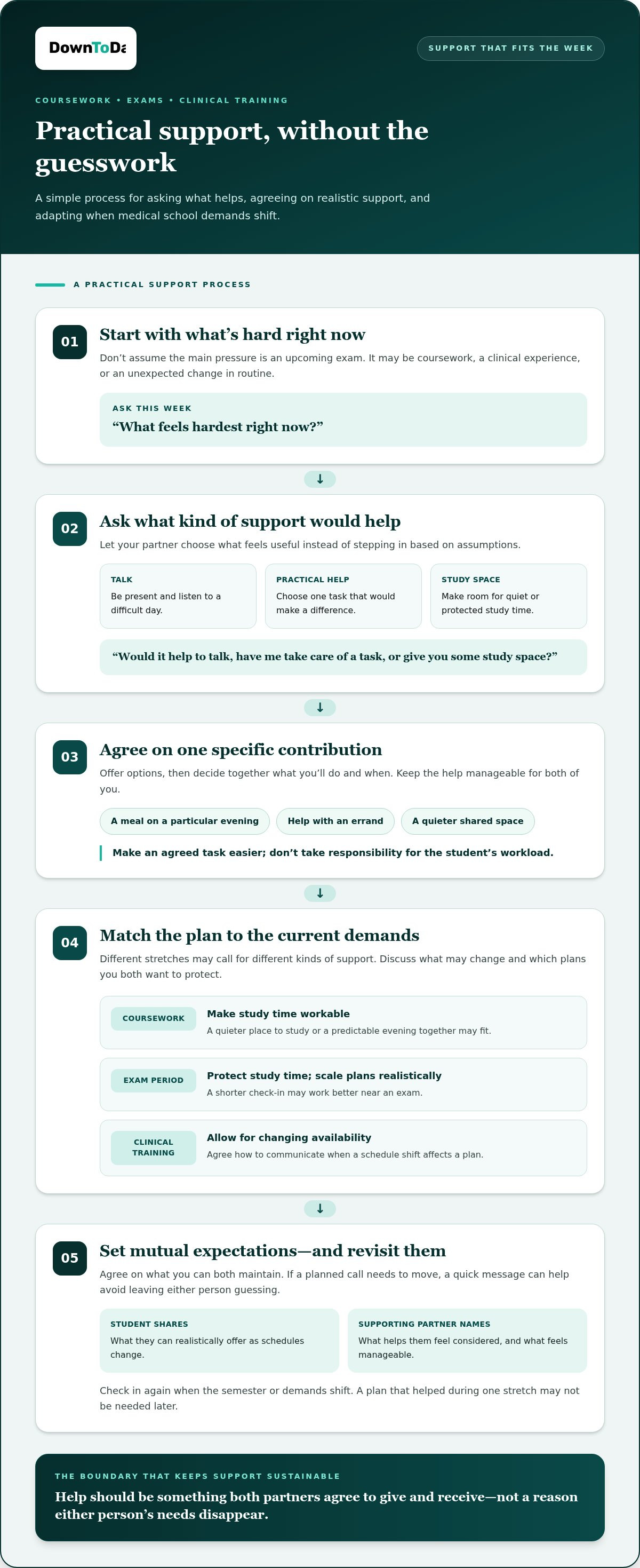
Ask what feels hardest right now instead of assuming the main challenge is an upcoming exam. It might be keeping up with coursework, adjusting to a clinical experience, or managing an unexpected change in routine. A specific, open question can make the answer easier: “Would it help to talk, have me take care of a task, or give you some study space?”
Keep the check-in low-pressure. Ask what would be useful this week, then revisit the conversation when the semester shifts. A request that helps during a demanding stretch may not be needed later. Let your partner answer honestly, and share what feels manageable for you, too.
Separate support from fixing every problem
Sometimes listening is the most useful response. Before offering advice, ask, “Do you want me to listen, or would you like help thinking through options?” That small pause can prevent a caring conversation from becoming a list of solutions your partner didn’t ask for.
You can help with what’s within your shared control, such as making time to connect or agreeing on a household task. You can’t make academic decisions for your partner or control every outcome. Being supportive doesn’t mean being constantly available or setting aside your own needs. Offer care honestly, without sacrificing your well-being.
To understand how to support a partner through medical school, focus less on guessing and more on asking, listening, and agreeing. Clear requests make care more useful, while respect for limits helps make it last.
Practical ways to support a partner through coursework, exams, and clinical training
Practical support works best when it responds to the demands your partner is facing now. Coursework may call for a quieter place to study; an exam period might mean agreeing on protected study time; clinical training can bring schedule changes that make plans harder to keep. These are possibilities, not obligations. Ask first, then choose support that fits both your partner’s needs and your capacity.
Offer practical help that is specific and agreed upon
Try asking, “Which one task would make the biggest difference this week?” Your partner might appreciate a meal, help with an errand, or a quieter shared environment for studying. Offer options rather than taking over chores or caregiving by default. Then agree on what you’ll do and when. Practical support should reduce a shared point of friction, not quietly make you the manager of your partner’s workload.
Helpful practical support makes agreed tasks easier; it doesn’t make you responsible for the student’s workload. Your partner remains responsible for their academic commitments. Your contribution is something you’ve chosen together, such as handling dinner on a particular evening or keeping the living room quiet during an agreed study block.
Adjust support around exams and clinical demands
If your partner knows a demanding period is coming, discuss it in advance. Talk through what may change, which plans you both want to protect, and how you’ll handle a schedule shift. During coursework, a predictable evening together may be realistic; near an exam, a shorter check-in may work better. Clinical responsibilities can also make availability less certain, so agree on a communication approach that allows for changes without leaving either person guessing.
Set expectations you can both maintain. For example, you might agree to send a quick message if a planned call needs to move, rather than promising a fixed daily conversation that may not fit the week. Make the agreement mutual: the student shares what they can, and the supporting partner names what helps them feel considered. For broader guidance, explore dating with an unpredictable schedule.
There’s no single system for how to support a partner through medical school. Review what’s working as coursework, exams, and clinical demands change. For healthcare professionals looking to connect with people who understand demanding medical schedules, DownToDate is a dating platform for healthcare professionals.
How to communicate when medical school changes your time together
A changed schedule can affect both partners, even when neither person caused the disruption. Clear communication helps you address the impact without treating a demanding training period as a test of commitment. Keep the conversation focused: describe what happened, name how it affects you, ask for what you need, then listen to your partner’s perspective.
Ask clearly for reassurance, time, or practical help
Be specific, but leave room for your partner to respond. For example: “Our plans have shifted a few times, and I miss having time together. Could we choose another evening when you know more about your schedule?” Or: “I’m feeling a little disconnected. Would a brief call help us catch up this week?” These prompts express a need without demanding an immediate solution.
Ask what helps your partner feel connected, too. You may both value a regular check-in but disagree about its timing or format. Agree on something realistic, then revisit it if the arrangement stops working. A check-in is an invitation to connect, not a requirement to report every movement or justify every hour. Consent and mutual expectations matter.
Discuss changed plans without turning them into a test of commitment
Separate the effect of a cancellation from the story you might attach to it. “I was disappointed when dinner was cancelled” describes your experience. “You clearly don’t care about our time” assigns an intention and can make a useful conversation harder. Medical training may explain a change, but your feelings still deserve a respectful discussion.
Once you’ve both had a chance to speak, explore an alternative without expecting an instant fix. You might ask whether rescheduling makes sense, or agree to revisit plans when your partner has a clearer view of the week. Related guidance on relationship advice for doctors can offer additional perspective on communicating through professional demands.
A quick comparison can help you choose words that invite connection rather than guilt:
| Supportive phrase | Likely to sound dismissive or guilt-inducing |
|---|---|
| “I miss our time together. Can we talk about a plan that works?” | “If you cared, you’d make time.” |
| “Would reassurance or a short check-in help?” | “You never tell me anything.” |
| “I understand plans can change, and I felt disappointed.” | “Your training always comes first.” |
Learning how to support a partner through medical school includes making room for both realities: training can change the plan, and connection still matters. Speak plainly, listen carefully, and adjust agreements together.
How to protect your own needs while supporting a medical student
Supporting a partner doesn’t mean accepting every disruption in silence. Medical training can place real demands on a relationship, but your time, energy, and commitments matter, too. A boundary isn’t punishment or withdrawal. It’s a clear agreement about what you can offer and what you need to stay well in the relationship.
Name the limits of what you can sustainably give
Consider what you can reasonably contribute across your time, emotional energy, finances, household responsibilities, and personal commitments. You might be glad to take on an extra errand during a particularly busy week, but not able to become responsible for every household task. Keeping time for friends, rest, and your own routines can coexist with being supportive.
Make requests specific and open to discussion. For example: “I can handle dinner on the nights we agree on, but I need us to share the other chores,” or “I want to support you, and I also need us to protect some time together.” These statements explain your limit without turning it into an ultimatum. The aim is a workable agreement, not a contest over whose demands matter more.
Recognize when the relationship needs a reset
Repeated resentment, avoiding important conversations, or uncertainty about who is responsible for what can signal that your current arrangement needs attention. These signs don’t diagnose either partner or prove the relationship is failing. They do suggest it may be time to pause and talk honestly about what feels unfair, unclear, or difficult to sustain.
Choose one manageable change to try, such as clarifying how you’ll divide a recurring task or setting aside time to reconnect. Agree on when you’ll check in about how it feels for both of you. A new routine can help with a practical mismatch, but no single script or agreement can guarantee that deeper relationship concerns will resolve. Stay attentive to whether both partners feel heard and respected.
Learning how to support a partner through medical school includes knowing when to offer help and when to name a limit. For broader context on relationships shaped by medical life, read dating for doctors. If you’re single or seeking a partner who understands healthcare training, DownToDate connects healthcare professionals with peers.
Build a support plan that can change as medical school progresses
A useful support plan isn’t a fixed set of rules. It’s a small agreement you can revisit as coursework, exams, and clinical responsibilities change. Start with three decisions: choose a check-in, agree on one practical form of support, and set a time to review how the plan feels. Keep what works and adjust what doesn’t.
Create a simple weekly check-in
Choose a brief time that works for both of you, then take turns sharing three things: one current pressure, one need, and one positive moment. For example, one partner might mention a difficult stretch of coursework, ask for a quiet evening, and share something they enjoyed that week. The check-in isn’t a performance review or a demand to solve every concern. It’s a chance to stay informed and connected.
Before you finish, confirm one practical form of support for the coming week and choose when you’ll check in again. If a concern needs more time, name it and return to it together rather than forcing a resolution in the moment.
Flexibility matters. A plan that fits during coursework may need to change when exams approach or clinical commitments affect availability. At your review, ask whether the arrangement still feels fair, whether either person needs something different, and what one adjustment might help. The goal isn’t a perfect routine. It’s an agreement both partners can maintain and revise without treating change as failure.
Find connection through shared understanding
Dating someone in healthcare may bring a shared context for the pressures of medical training. That familiarity can make some experiences easier to understand, but it doesn’t guarantee compatibility or remove the need for communication. Each person still brings distinct needs, expectations, and limits to a relationship.
If you’re single or seeking a partner who understands healthcare careers, DownToDate connects healthcare professionals with peers. The platform’s Premium Membership includes advanced search filters, unlimited messaging, enhanced profile visibility, and access to community features designed to foster romantic connections. Explore DownToDate.
There’s no single formula for how to support a partner through medical school. Keep talking, make agreements you can sustain, and revisit them as life shifts. Small, mutual adjustments can help you face demanding periods as a team while making space for both partners’ needs.
Keep building a relationship that works for both of you
Learning how to support a partner through medical school isn’t about getting every moment right. It’s about asking what would help, agreeing on practical support that feels fair, and speaking honestly when schedules or needs change. Just as importantly, it means protecting your own time and energy so care remains sustainable for both of you.
Start small: choose a regular check-in, name one thing each of you needs, and decide when to revisit your plan. Medical school brings different demands at different times, so let your approach adapt. There’s no single relationship formula, only the ongoing work of listening, adjusting, and staying connected.
If you’re single or seeking a partner who understands healthcare training, DownToDate is a dating platform designed to connect healthcare professionals with peers. Its Premium Membership offers advanced search filters, unlimited messaging, enhanced profile visibility, and community features designed to foster romantic connections.
Support each other with clarity, respect, and room to grow. A resilient partnership is built one thoughtful agreement at a time.
Frequently Asked Questions
How can I support my partner through medical school?
Ask your partner what kind of support would help, then agree on specific actions together. They might want you to listen after a difficult day, share a task, or protect study time you’ve planned together. Avoid assuming one routine will work throughout training, since demands can change. Check in again as schedules shift, and include your own needs and limits in the conversation. Support is most useful when it works for both of you.
What should I say to a partner who is stressed about medical school?
Start with a calm question: “Would you like me to listen, help problem-solve, or give you some space?” Then reflect what you heard before offering advice. For example, “It sounds like the workload feels difficult to manage right now.” Avoid minimizing the pressure or insisting they stay positive. If your partner doesn’t want to talk at that moment, respect that and agree on a time to check in again.
How do I handle cancelled plans because of medical school?
Share your disappointment without assuming a cancellation means the relationship matters less. You could say, “I understand your schedule changed, and I’m disappointed we won’t have that time together. Can we talk about another option?” If changes happen often, agree on a flexible check-in plan around known demands. Both partners should be able to describe the impact and suggest workable alternatives, without blaming the student for responsibilities they can’t easily control.
Should I take on extra responsibilities while my partner is in medical school?
Take on extra responsibilities only when you freely agree and can sustain them. Ask which task would help most, then be clear about what you can manage. You don’t have to automatically take over household work because your partner is studying. Revisit the arrangement if it begins to feel unfair or exhausting. A shared plan should account for both partners’ time, commitments, and well-being, not quietly transfer responsibility to one person.
How can we stay connected when my partner has little free time?
Choose connection that fits the time and energy you both have. A brief check-in, a meal you protect in your calendars, or a rescheduled activity may help if you both want it. Before a demanding period, talk about what feels realistic and how you’ll handle changes. Don’t treat the frequency of contact alone as proof of care or commitment. Focus on clear expectations and moments of connection that feel meaningful to both partners.
Is it normal to feel neglected when your partner is in medical school?
Feeling lonely or overlooked can happen when training changes your shared routines. The feeling deserves a respectful conversation, but it doesn’t automatically mean either partner is at fault. Explain what you miss and ask what kind of connection is realistic right now. If the concern remains unresolved, agree on a time to revisit expectations together. Naming the impact clearly can help you discuss what needs attention without turning it into an accusation.
How can I support my partner without neglecting myself?
Decide what you can offer without giving up essential rest, friendships, work, or personal commitments. State your limits plainly, and suggest alternatives when you can. For example, you might be able to share a specific task but not take full responsibility for all household work. Keep routines that support your own well-being. Mutual support is more sustainable when both partners can name their needs and adjust agreements instead of one person silently absorbing every change.


