

What if sharing a medical career creates understanding, but doesn’t automatically create time or energy for each other? For two doctors, nurses, or other healthcare professionals, overlapping shifts, call duties, and residency demands can make even simple plans difficult. This relationship advice for two medical professionals starts with a practical truth: connection needs deliberate agreements, not just good intentions.
You may understand each other’s work in a way few people can. You may also come home depleted, carry work stress into the evening, or face career decisions that affect you both. Those pressures don’t mean your relationship is failing. They mean your routines need to reflect the reality of two demanding careers.
This article will help you set workable expectations for communication, quality time, and last-minute schedule changes. You’ll find ways to support each other without letting every conversation become a work debrief, make career decisions together, and build fair routines that can adapt as your roles change. Shared understanding is a strength. Clear agreements and consistent connection help you put it to work.
Key Takeaways
- Use a simple schedule-review routine to spot conflicts, agree on check-ins, and revisit plans when shifts change.
- Relationship advice for two medical professionals starts with recognizing that a shared career can build understanding, but compatibility still depends on individual needs and values.
- Protect the relationship with adaptable habits, and raise concerns using specific observations and clear requests rather than assumptions about work.
- Review time, communication, priorities, and support regularly so your relationship can adjust as both careers evolve.
Why a relationship between two medical professionals needs its own approach
Working in healthcare can give partners a useful point of connection, but it doesn’t guarantee shared time, identical pressures, or the same response to stress. A relationship between two medical professionals involves two people balancing distinct roles, schedules, and personal lives, then making room for a partnership within those realities.
Two demanding careers call for intentional relationship habits. Shared understanding can ease conversation, but clear expectations and ongoing choices are what protect connection. That’s the heart of relationship advice for two medical professionals. The goal isn’t to make each partner’s work life identical. It’s to understand how each person’s needs fit into the life they’re building together, including the broader challenge of work-life balance.
What shared medical experience can, and cannot, offer
A partner who knows clinical environments may understand why a difficult shift lingers, why a plan can change, or why some work details are hard to leave at the hospital. That familiarity can reduce the need to explain the context. It can also help each person offer support without treating every challenge as unfamiliar.
But medical work isn’t one shared experience. A resident and an experienced clinician may face different responsibilities. Specialties, workplaces, and coping styles also shape daily life. One partner may want to talk after a demanding day, while the other needs quiet first. Don’t assume professional similarity settles what compatibility, communication, or care should look like.
The pressures couples should name early
Talk about practical constraints before they become recurring disappointments. Changing shifts, call responsibilities, fatigue, and limited overlap may affect plans differently for each partner. Be specific about what support feels useful after a difficult workday. A simple question such as “Would you like to talk, decompress, or have help with something?” can replace guesswork.
Also distinguish a temporary surge from the relationship’s ongoing baseline. A demanding rotation, a new responsibility, or a stretch of call may require short-term flexibility. It shouldn’t silently become the permanent expectation that one partner’s needs always wait. Discuss what is changing, how long you expect it to shape your routines, and when you’ll revisit the arrangement.
These early conversations help partners make room for both professional commitments and personal priorities. Shared context is an advantage, not a complete plan. Naming differences with respect makes it easier to build routines around the people you are, rather than assumptions about what medical professionals should need.
How two medical professionals can communicate around demanding schedules
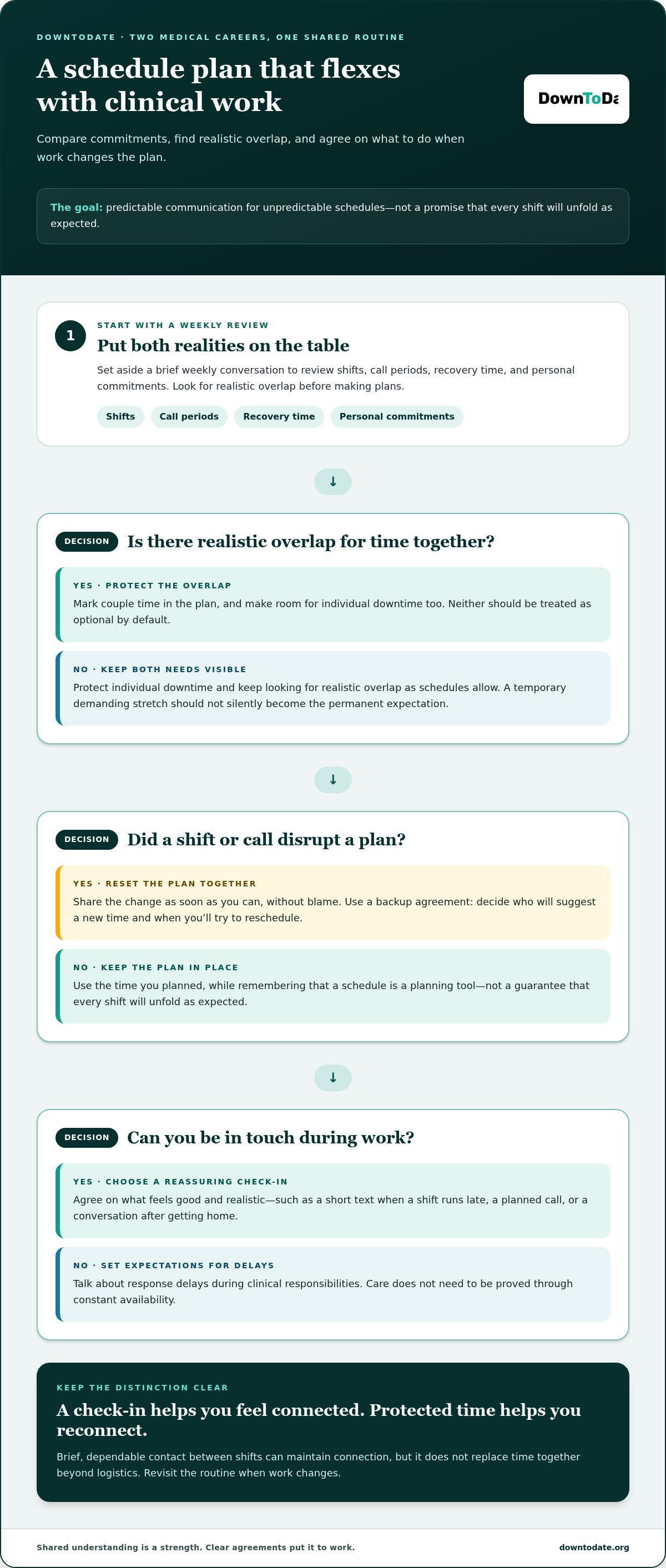
Good schedule communication isn’t a single calendar update. It’s a repeatable process: compare commitments, identify likely conflicts, agree on ways to stay in touch, then revisit the plan when work changes. Predictable communication can help couples manage unpredictable schedules.
Build a shared planning routine that can flex
Set aside a brief weekly conversation to review shifts, call periods, recovery time, and personal commitments. Look for realistic overlap, then mark protected couple time and individual downtime. Neither should be treated as optional by default. If a shift or call disrupts a plan, agree on a simple backup: who will suggest a new time, and when will you try to reschedule?
Share changes as soon as you can, while recognizing that clinical responsibilities may make some plans uncertain. A schedule is a planning tool, not a promise that every shift will unfold as expected. The aim is to update each other without blame and make the next decision together. The American Medical Association also offers strategies to handle the challenges of a dual-physician household.
Choose communication that fits the workday
Discuss what kind of contact feels reassuring and what’s realistic during work. One partner might prefer a short text when a shift runs late; the other may value a planned call or a conversation after getting home. Agree on expectations for response delays during clinical responsibilities. No one should have to prove care through constant availability.
Brief, dependable check-ins can maintain a sense of connection between shifts, but they don’t replace protected time together. A warm message or quick call can say, “I’m thinking of you,” while a shared meal or planned outing gives you space to reconnect beyond logistics. If work changes derail your plans, clarify the next step rather than leaving rescheduling to chance.
For more schedule-specific strategies, read this guide to dating with an unpredictable medical schedule. Clear, considerate communication also matters while you’re meeting someone new. DownToDate is a dating community designed for healthcare professionals who want to connect with peers who understand the demands of medical work.
Does sharing a medical career make you more compatible?
No. Working in medicine together doesn’t automatically make partners compatible. A shared profession may create common ground, but a strong relationship still depends on how each person communicates, makes decisions, handles stress, and imagines a shared future. Relationship advice for two medical professionals should recognize both sides: familiarity can help, while individual differences still matter.
Consider the distinction between shared context and personal fit:
| Shared medical context may mean... | Individual differences still shape... |
|---|---|
| Recognizing that shifts or clinical demands can affect plans | How each partner prefers to communicate about changes |
| Respecting the responsibility involved in clinical work | Which career and family priorities take precedence in a decision |
| Understanding why a partner may need time to recover after work | Whether recovery means quiet, conversation, exercise, or something else |
Where a shared profession can create understanding
A partner familiar with healthcare may need less background to understand why a shift changed or why a demanding day is still on your mind. That can make practical planning easier and help each person respect professional responsibilities. Still, familiarity isn’t a substitute for listening. Ask what the other person is experiencing instead of assuming your specialty, workplace, or career stage gives you the same perspective.
Where assumptions can create friction
Support can break down when couples compare workloads or debate whose work is harder. Different roles carry different pressures, and ranking them rarely answers what a partner needs. Agree on boundaries around work talk, patient privacy, and time away from clinical roles. For broader considerations, see this relationship advice for doctors navigating dating challenges.
Compatibility also depends on values and life priorities beyond work. One partner may be ready for a major career move while the other values stability. One may want to discuss work at home while the other needs a clear transition out of the clinical day. Neither preference is automatically right. The work is to understand the difference and decide together how to handle it.
Medical couples are neither inherently stronger nor weaker than other couples. Shared experience is a resource, not a verdict. The American Medical Association offers practical strategies for dual-physician households, but each partnership still needs agreements that fit its own people, boundaries, and priorities.
Practical habits that help two healthcare professionals protect their relationship
Strong routines don’t need to be elaborate. A short check-in, dependable time together, and a fair way to repair missed plans can help keep the relationship visible alongside work. Individual recovery time belongs in that routine too. Needing quiet after a demanding day isn’t evidence of disengagement; it’s information partners can use to care for each other more effectively.
Make quality time realistic and intentional
Match connection to the energy you both have. It could be sharing a meal without phones, taking a short walk, or sitting together quietly after a long shift. Separate restorative time from errands and work debriefs, so every moment together doesn’t become another task. Agree on one small, dependable ritual you can protect, while leaving other plans open to spontaneity.
Relationship advice for two medical professionals works best when it respects real capacity, not an idealized schedule. If one person needs solo downtime, name it kindly and decide when you’ll reconnect. A predictable ritual can offer reassurance without requiring either partner to be available at every moment.
Handle conflict without turning it into a workload contest
Talk about the effect of a missed plan without minimizing clinical responsibilities. For example: “I understand you had to stay. I felt disappointed when I didn’t know the plan had changed. Could you send an update when you’re able?” This names the impact and makes a practical request without accusing your partner or ranking whose work is harder.
If neither person can talk right away, agree on a simple way to return to the conversation, such as naming a time to check in. When the same disagreement recurs, look for a pattern you can adjust: unclear expectations, uneven rescheduling, or too little time to recover. Focus on the routine, not blame.
Try one habit this week:
- Set a brief check-in that fits both of your energy levels.
- Protect one modest, dependable ritual together.
- Agree on who will suggest a new plan after a cancellation.
- Ask directly what kind of support would help after a difficult day.
Choose one, then review whether it helped. Small agreements are easier to sustain when both partners shape them.
DownToDate brings healthcare professionals together in a community built around connecting with peers who understand medical work.
How to keep building a relationship as both medical careers evolve
A routine that works during one career stage may need to change during the next. Residency, a new role, added responsibilities, or a different work setting can shift schedules, energy, and priorities. Treat those transitions as prompts to revisit your agreements, not as proof that the relationship is off track. The strongest relationship advice for two medical professionals makes room for change without losing sight of what each partner needs.
Revisit agreements when work or life changes
Before a transition reshapes daily life, talk about what may look different. Each partner can name what they hope will stay consistent, what can flex for a while, and what support would help. Then set a date to check in again. A specific follow-up turns good intentions into a chance to adjust if the new arrangement isn’t working.
Once a quarter, set aside time to review four areas:
- Time: Is the balance of time together and individual recovery still workable?
- Communication: Are your check-ins and updates meeting both partners’ needs?
- Priorities: Are upcoming career and personal decisions being discussed together?
- Support: Does each person feel understood, and what would help them feel more supported?
Keep the conversation specific. Instead of asking whether everything is fine, name a pattern you’ve noticed, listen to how your partner sees it, and agree on one adjustment to try. Choose a date to revisit that change, especially during residency, a new responsibility, or a move into a different work setting.
Find connection with people who understand medical life
Shared professional context can give a conversation a familiar starting point. Someone who understands healthcare work may recognize why schedules shift or why a demanding day takes time to process. Still, common ground is only a starting point. It doesn’t replace curiosity, communication, or the habits that help a relationship grow. For related dating guidance, read dating for doctors in the modern medical world.
DownToDate is a dating community designed for healthcare professionals, including doctors, nurses, and other medical staff. Its tailored search and matching tools help members connect within a medical community. Common ground can make it easier to understand the context of medical work, while compatibility and connection develop through getting to know each other.
Building a relationship across two medical careers takes repeated attention, not a perfect schedule. Keep revisiting what works, make adjustments together, and leave room for each person to evolve. DownToDate’s community offers healthcare professionals a way to meet peers who understand the demands of medical work.
Build a Partnership That Can Grow With Your Careers
Two medical careers don’t need identical schedules to support a strong relationship. They do need honest conversations, adaptable plans, and respect for each partner’s needs. Compare schedules before conflicts build, protect realistic time together, and revisit your agreements as responsibilities change. Shared professional understanding can help, but compatibility grows through listening, shared priorities, and consistent effort.
That’s the foundation of relationship advice for two medical professionals: make space for both demanding work and genuine connection. Small habits, such as a reliable check-in or a fair plan for rescheduling, can keep you moving forward without expecting either career to stand still.
Ready to meet healthcare professionals who understand the realities of medical work? Explore DownToDate. Its Premium Membership includes advanced search filters, unlimited messaging, enhanced profile visibility, and access to community features designed to foster romantic connections.
Frequently Asked Questions
Can a relationship work when both partners are medical professionals?
Yes, a relationship between two medical professionals can work when both partners treat connection as something to plan and protect, not something a clear calendar automatically provides. Shared understanding can make work pressures easier to explain, but partners still need to discuss values, communication preferences, and how they make decisions. The most useful relationship advice for two medical professionals is to build flexible routines and review them as careers and needs change.
How do two doctors make time for each other?
Two doctors can make time by comparing schedules regularly and choosing realistic, protected moments together. A shared meal, a short walk, or a planned call may fit better than waiting for a full free day. Keep personal recovery time on the calendar too. If work disrupts a plan, agree on who will suggest another time, then reschedule rather than letting the missed date disappear without discussion.
What should medical professionals do when their shifts conflict?
Share the conflict as soon as you know about it, then talk through the options together. Decide whether to move the plan, choose a shorter alternative, or postpone it until both partners have more capacity. If a shift may change at short notice, say so clearly and agree on a backup plan. Acknowledge the disappointment without framing an unavoidable clinical responsibility as a lack of care.
Is dating someone in the same medical field easier?
It can make some conversations easier because both people may recognize common pressures, such as demanding shifts or changing plans. But a shared field doesn’t guarantee compatibility or identical experiences. Specialty, workplace, career stage, communication style, and recovery needs all differ. Stay curious instead of assuming you already know how your partner feels. Ask what support they want, and discuss values and priorities beyond work.
How can a couple keep work stress from taking over their relationship?
Agree on boundaries that help both partners transition out of work mode. For example, decide whether to ask before discussing a difficult day, set aside some conversations for a specific time, or keep patient details private. Make room for non-work topics and shared activities, even if they’re simple. If work stress repeatedly affects connection, name the pattern and discuss one practical adjustment together.
What happens if both partners are too tired to spend time together?
Take fatigue seriously rather than treating it as rejection. Ask what each person has capacity for: quiet company, a brief check-in, or time alone to recover. A low-energy moment together can help maintain connection, but rest matters too. If you postpone a plan, suggest a new time when possible. If exhaustion regularly leaves no room for the relationship, revisit schedules and expectations together.


